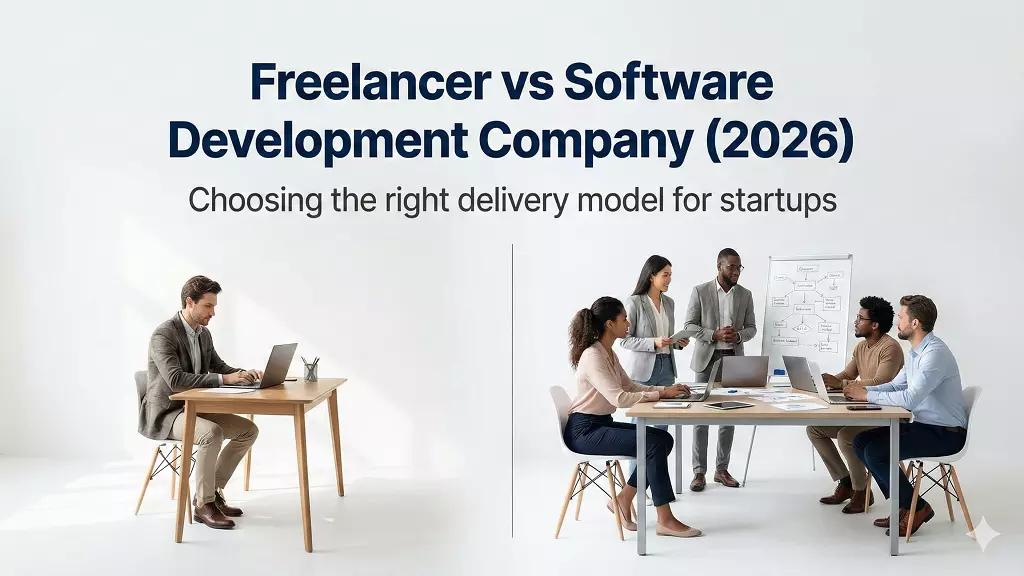
If your software touches revenue, customer data, compliance, or daily operations, a software development company is usually the safer choice in 2026—because you’re not only buying code, you’re buying a delivery system: planning, QA, security habits, release discipline, and continuity.
If your requirement is small, isolated, time-bound, and you can handle product ownership yourself, a freelancer can be a smart and cost-effective move.
Freelancer vs Software Development Company: Which Is Better for Startups in 2026?
In 2026, startups should hire a freelancer for small, well-defined, short-term tasks where risk is low and ownership is clear. A software development company is a better choice when the product affects revenue, handles customer data, requires ongoing updates, or must scale reliably over time.
In 2026, “building software” isn’t the hard part.
The hard part is keeping it:
-
stable when real users show up,
-
secure when attackers automate at scale,
-
maintainable when features pile up,
-
and predictable when your team changes.
Even Google Cloud’s DORA research has been emphasizing that software success isn’t just technical output—it’s the combination of delivery performance, culture, and sustainable ways of working.
So the real question isn’t: “Who can write code?”
It’s: “Who can ship reliably, reduce risk, and help this product survive change?”
First, let’s define what you’re really choosing
Most people compare “freelancer vs company” like it’s a simple price decision. In reality, you’re choosing between two delivery models:
Option A: Freelancer (Individual Delivery)

A freelancer is usually:
-
one person (sometimes with a small informal network),
-
focused on building features quickly,
-
with process depending entirely on that individual’s maturity.
A great freelancer can be a lifesaver. But if they disappear, get sick, or change priorities, your product can stall—especially if documentation, QA, and handover weren’t part of the deal.
Option B: Software Development Company (System Delivery)

A good software development company is typically:
-
a team, not a person,
-
built around a repeatable workflow: discovery → architecture → development → QA → release → monitoring,
-
accountable for continuity, planning, and quality gates.
When you hire a company, you’re not only paying for builders—you’re paying for a system that helps reduce “single point of failure” risk.
The Comparison That Actually Matters in 2026: Freelancers vs Software Development Company
| Factor | Freelancers | Software Development Company |
|---|---|---|
| Best for | Small, well-defined tasks | Core products, scale, long-term roadmaps |
| Risk profile | Higher (continuity depends on 1 person) | Lower (team + documented process) |
| Speed | Fast for isolated work | Fast and repeatable for ongoing releases |
| QA & reliability | Varies widely | Typically structured QA + checks |
| Security posture | Depends on individual discipline | Usually stronger governance + accountability |
| Ownership & handover | Often weak unless requested | More consistent if process is mature |
| Long-term maintenance | Hard if the freelancer leaves | Easier due to team continuity |
Freelancers work best for isolated tasks with limited long-term impact. Software development companies are designed for ongoing delivery, risk management, and product continuity. The decision depends less on cost and more on how critical the software is to the business.

Explore how iterative workflows improve quality and reduce risk in our guide to Adaptive Software Development.
When hiring a freelancer is the best decision in 2026
Freelancers are not “inferior.” They’re simply a better fit in specific situations—especially when the scope is narrow and you can keep ownership strong.
1) You have a small, isolated task with clear boundaries
Examples:
-
landing page build
-
fixing UI bugs in a stable product
-
building a small internal script or automation
-
integrating one API with clear documentation
-
creating a single dashboard view
In these cases, your risk is naturally capped. Even if things go wrong, the blast radius is small.

2) You already have technical leadership in-house
If you have a CTO, engineering manager, or senior dev who can:
-
define scope,
-
review code,
-
enforce standards,
-
ensure testing and documentation,
then freelancers become much safer—because you’re not relying on them for product governance.
3) Your product is still a “proof” (not a platform)
If your goal is to test an idea quickly—something like:
-
clickable prototype → basic MVP → feedback loop,
a freelancer can be the fastest path to learning without overbuilding.
4) You want specialized skill for a short burst
Need a very specific skill for 2–4 weeks?
-
performance audit
-
security review
-
mobile UI polish
-
DevOps pipeline tweak
A specialist freelancer can plug the gap efficiently.
The key rule: freelancers work best when you can keep the work contained, and ownership doesn’t depend on them.
When a software development company is the safer choice in 2026
This is because companies operate with shared knowledge, documented processes, and quality controls that reduce dependency on any single individual.
If your software is becoming part of how your business runs, you want a delivery partner—not a lone contributor.

1) Your software handles revenue or payments
If downtime costs money, you need:
-
stable releases,
-
rollback plans,
-
QA safety nets,
-
and visibility in production.
This is exactly where “cheap” development becomes expensive later.
Learn why custom software development frameworks matter in practice in our detailed guide on Custom Software Development Services.
2) You’re dealing with customer data or compliance
Security isn’t a checkbox—it’s a habit.
Data breaches are not theoretical. IBM’s breach research has repeatedly shown multi-million-dollar average impacts globally.
That doesn’t mean every product will be breached—but it does mean the cost of weak controls can be brutal.
A mature company is more likely to bring:
-
secure access control patterns,
-
code review discipline,
-
audit-friendly logging,
-
and structured environments.
3) You need a scalable product that won’t collapse later
Scaling isn’t just “use AWS.”
It’s:
-
database design that won’t choke,
-
caching where it actually helps,
-
clean service boundaries,
-
and a system that can evolve without becoming fragile.
Bad code and unmanaged technical debt don’t just slow teams down—they compound cost and risk over time.
4) You need predictable delivery, not “best effort”
A company can put structure around:
-
milestones,
-
sprint planning,
-
QA cycles,
-
acceptance criteria,
-
and release governance.
DORA’s work popularized the idea that delivery performance is measurable (lead time, deployment frequency, change failure rate, time to restore). Mature teams actually build around these outcomes.
5) You want continuity and long-term ownership
This is the quiet killer in freelancer-led builds:
-
no documentation,
-
messy repo,
-
missing environment setup,
-
unclear deployment steps,
-
no runbooks.
A good development company will treat handover like a deliverable, not an afterthought.
The hidden cost most people miss: “maintenance tax”
In several long-running projects, teams discovered that undocumented freelancer-built systems became harder to change than rebuilding from scratch.
Many teams compare:
-
Freelancer hourly rate vs Company hourly rate
But the real comparison is:

Total Cost of Ownership (TCO)
The “maintenance tax” shows up as:
-
bugs that reappear because tests are missing,
-
releases that break production,
-
features that take 3× longer because the codebase is tangled,
-
time wasted re-learning decisions that were never documented.
That’s why the best teams obsess over stability metrics and delivery discipline.
See a real example of structured delivery and scalable architecture in our Doukani.com multi-vendor eCommerce platform case study.
Cost in 2026: What you’re actually paying for
Pricing varies wildly by region and scope, but here’s the practical way to think about cost:
Freelancer cost usually includes:
-
development time (feature output)
-
sometimes basic fixes
Company cost usually includes:
-
discovery + planning
-
architecture
-
development
-
QA/testing cycles
-
project management
-
release process support
So the cost question becomes: Do you want cheaper output today—or lower risk over 6–18 months?
If your product will live beyond launch, the “cheapest build” often becomes the most expensive to maintain.
Freelancer vs Software Development Company Cost Comparison (2026)
| Cost Factor | Freelancer | Software Development Company |
|---|---|---|
| Upfront cost | Usually lower; pay per hour or fixed task | Higher due to team, planning, and process |
| Pricing transparency | Varies by individual; often scope-dependent | More predictable with defined milestones |
| What the cost includes | Feature development only | Discovery, architecture, development, QA, and release |
| QA & testing cost | Often limited or optional | Typically included as part of delivery |
| Documentation & handover | Often minimal unless explicitly requested | Usually structured and part of the process |
| Maintenance cost | Can rise sharply if issues appear later | Lower and more predictable over time |
| Rework & bug-fix cost | Higher risk due to missing tests or context | Reduced due to reviews and quality gates |
| Scalability cost | Increases as complexity grows | Planned upfront, reducing future changes |
| Continuity risk cost | High if the freelancer becomes unavailable | Low due to team-based ownership |
| Total Cost of Ownership (TCO) | Lower initially, higher long-term risk | Higher upfront, lower long-term risk |

GEO guide: what changes by region (US, UK/EU, UAE, Saudi)
If you sell globally—or even plan to—you should match your build approach to your compliance reality.
US (typical expectation)
US buyers often expect:
-
strong contractual clarity (IP ownership, NDAs),
-
stable uptime and incident response,
-
and predictable delivery governance.
UK & EU (privacy and accountability are non-negotiable)
The GDPR legal framework applies across the EU, and the UK runs UK GDPR alongside the Data Protection Act framework.
That doesn’t mean you need enterprise compliance for a tiny MVP—but it does mean sloppy data handling becomes a business risk fast.
If your business is undergoing large-scale change, read about Digital Transformation Services that teams should plan for.
UAE (federal PDPL is real—and enforced expectations are rising)
The UAE has a federal personal data protection framework under Federal Decree-Law No. 45 of 2021, with official guidance available through the UAE government platform.
Saudi Arabia (PDPL enforcement timeline matters)
Saudi PDPL reached full enforceability from September 2024 (widely referenced by privacy and professional bodies).
Practical takeaway: the more regulated your buyer environment, the more you benefit from a team that can build with documentation, access controls, audit trails, and predictable change management.
Learn why Gulf startups prefer hiring remote teams from India in our article on India-based development teams.

| Region | Typical Upfront Cost Expectation | Notes / Buyer Expectations |
|---|---|---|
| USA | Moderate to high | Transparent contracts, IP clarity, structured delivery governance. Companies preferred for revenue-critical projects. |
| UK / EU | Moderate | GDPR compliance critical. Freelancers ok for non-sensitive MVPs. |
| UAE | Moderate | PDPL enforced; companies preferred for secure, documented workflows. |
| Saudi Arabia | Moderate to high | PDPL compliance required; freelancers only for isolated, low-risk tasks. |
| India (Remote for Global Projects) | Low to moderate | Cost advantage high; freelancers ok for short-term, small tasks. Companies better for structured global delivery. |
Summary:
Freelancers = cheaper upfront, best for small tasks. Companies = higher upfront, lower risk, compliance-friendly, and scalable — especially in regulated regions.
The 60-Second Decision Framework: Freelancer vs Software Development Company
Choose a freelancer if:
-
Scope is small + clearly defined
-
You can review code and manage quality
-
No sensitive compliance exposure
-
Short timeline + low change risk
Choose a software development company if:
-
This product affects revenue/operations
-
Multiple features will ship over months
-
Security and stability matter
-
You need continuity + documentation
-
You want predictable releases, not heroics
Teams that want to pressure-test scope, delivery risk, and ownership before committing often start with a short discovery conversation to align expectations early.
The “Hybrid” Model (often the best in 2026)

Many smart teams do this:
-
Company owns architecture + QA + releases + product continuity
-
Freelancers support isolated tasks:
-
UI enhancements
-
content pages
-
small feature modules
-
short-term specialist work
-
This gives you speed without turning your product into a patchwork.
Due diligence checklist (what to ask before you hire anyone)
If you’re hiring a freelancer, ask:
-
“How will you document setup and deployment?”
-
“What tests will you add for critical flows?”
-
“What happens if you’re unavailable for 2–3 weeks?”
-
“Can you share a sample repo structure or past code?”
If you’re hiring a company, ask:
-
“What does your QA process look like in practice?”
-
“How do you handle security reviews and access control?”
-
“What does handover include (docs, runbooks, environments)?”
-
“How do you measure delivery reliability over time?”
-
“Who owns the code, IP, accounts, and infrastructure?”
A practical example (what this looks like in real projects)
When we build product-grade systems at Decipher Zone, the work isn’t “just development.” It’s typically:
-
clarifying scope so it doesn’t explode mid-build,
-
designing flows to reduce rework later,
-
building with testable components,
-
shipping through controlled release cycles,
-
and documenting so your product doesn’t become hostage to one person.
This is why companies outperform freelancers on long-lived products: not because freelancers aren’t talented—but because a system beats improvisation over time.
Final takeaway
If your software is small, low-risk, and time-bound, a freelancer can be perfect.
If your software is tied to revenue, data, or long-term operations, working with a structured delivery partner instead of a single contributor can significantly reduce execution risk.

Freelancer vs Software Development Company: FAQs
1) Is it better to hire freelancers or a software development company for startups in 2026?
For early validation and short experiments, freelancers are often sufficient. For products expected to scale or handle sensitive data, software development companies reduce long-term risk.
2) Are software development companies more secure than freelancers?
Often, yes—because security practices are easier to institutionalize in a team (reviews, environments, access control, documentation). Breach impacts can be massive, which is why governance matters.
3) How much does it cost to hire a software development company in the USA?
It varies by scope and complexity. Instead of comparing hourly rates alone, compare total ownership cost: quality, speed of iteration, stability, and the ability to keep shipping without chaos.
4) Can a software development company handle enterprise-level projects?
Yes—this is one of the key reasons companies exist: delivery governance, scalability, structured QA, and documentation that supports long-term maintenance.
5) What’s the safest approach if I’m unsure?
Start hybrid: let a company define architecture, delivery process, and releases—then use freelancers for isolated tasks where risk is contained.
Author Profile: Mahipal Nehra is working at Decipher Zone Technologies, specializing in content strategy, and tech-driven marketing for software development and digital transformation.
Follow us on LinkedIn or explore more insights at Decipher Zone.
Planning a product build for 2026?
A short discovery conversation can help clarify scope, risk, and the right delivery model before you commit.