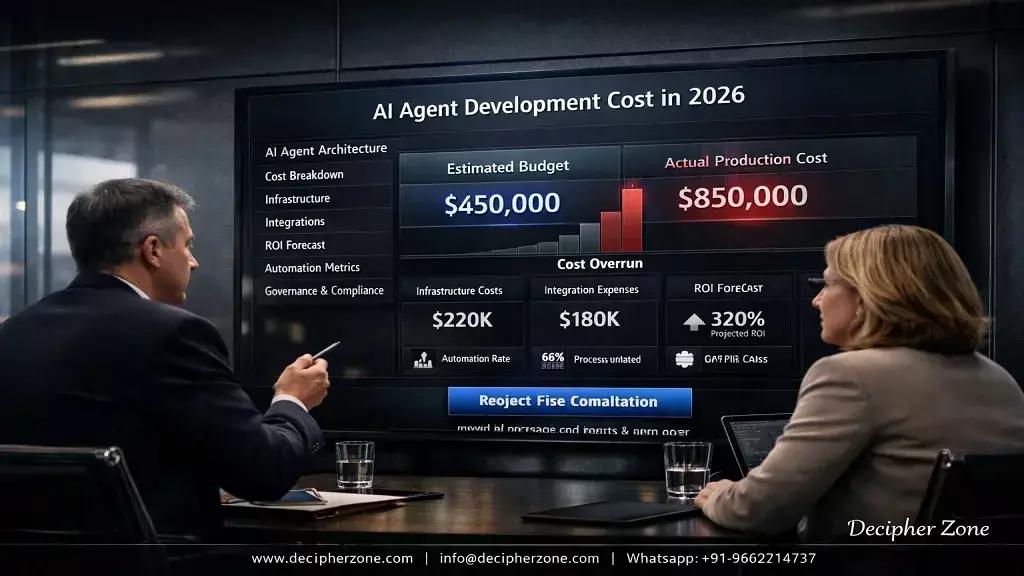
Most enterprises that budget for AI agent development get the number wrong. Not by 10 or 20 percent. By 40 to 60 percent. That gap, between what vendors quote and what projects actually cost, is where AI initiatives go quiet. Not with a dramatic cancellation announcement, but with a gradual loss of momentum as the real expenses surface and the business case unravels.
AI agent development cost in 2026 ranges from $15,000 for a focused single-task agent to $400,000 or more for an enterprise-grade multi-agent system with compliance, custom integrations, and orchestration layers. Most mid-market implementations fall between $40,000 and $150,000. But the build cost is only part of the story. Infrastructure, ongoing LLM usage, integration complexity, maintenance, and governance add 40 to 80 percent to the first-year total cost of ownership.
This guide gives you the real numbers. Not the headline ranges that make AI agents look either trivially cheap or intimidatingly expensive, but the specific breakdown by agent type, industry, infrastructure choice, and team model.
You will also find the hidden costs that most budgets miss, the ROI math that determines whether an AI agent project pays for itself, and a cost reduction framework built from real project experience at Decipher Zone’s AI development services team.
Read: AI-Enabled Software Development | Latest AI Trends 2026 | AI Use Cases Across Industries
The AI Agent Market in 2026: Why Costs Are Shifting
Understanding what drives AI agent development cost requires understanding the market moment. This is not a stable, commoditized technology category where prices follow a predictable curve. It is a rapidly evolving set of tools and practices where the right choice in Q1 2026 may look different from the right choice in Q4.
Gartner predicts that 40% of enterprise applications will include task-specific AI agents by end of 2026, up from less than 5% in 2025. The global AI agents market reached $7.6 billion in 2025 and is projected to exceed $10.9 billion in 2026, with a CAGR above 45% through 2030.
Three forces are directly affecting AI agent development cost in 2026. First, LLM API pricing has dropped by 60 to 80% over the past 18 months as competition between OpenAI, Anthropic, Google, and open-source alternatives intensifies.
This makes the model layer cheaper, but the engineering layer is now the dominant cost driver. Second, the tooling ecosystem has matured. LangChain, LangGraph, CrewAI, and AutoGen reduce framework development time but require engineers who understand their constraints and failure modes.
Third, enterprise integration complexity has not changed. Legacy systems, poorly documented internal APIs, compliance requirements, and security constraints still consume the majority of project time on complex deployments. See our cloud native architecture trends guide for the infrastructure shifts behind this.
The practical result: simpler agents are cheaper than ever to build. Complex, enterprise-integrated, governance-ready agents are not meaningfully cheaper than they were 18 months ago because the hard parts are still hard.

Agentic AI vs AI Agents: The Cost Difference Most Buyers Miss
This distinction looks like a technicality until you compare the price tags. Then it becomes the most consequential definition in your entire AI budget.
An AI agent is a software system that accepts an input, makes a decision, and produces an output. It may use a single LLM call or simple rule-based logic. A customer support chatbot that answers from a knowledge base is an AI agent. So is a classification system that routes incoming emails. These can be built in 4 to 12 weeks for $15,000 to $80,000.
Agentic AI is a specific subset. It refers to autonomous systems that plan multi-step actions, use external tools, evaluate their own results, and decide what to do next without human direction at each step. An agentic system that reads an incoming sales inquiry, looks up the prospect in your CRM, drafts a personalized response, schedules a follow up in Calendly, and updates HubSpot — that is agentic AI. These systems start at $60,000 and routinely exceed $200,000 because of orchestration, tool use, evaluation, and safety overhead.
The cost rule: All agentic AI systems are AI agents. Not all AI agents are agentic. The autonomy and tool-use requirements determine 60 to 70 percent of your total cost before you even pick a framework.
Side-by-Side Comparison
| Dimension | AI Agent (basic) | Agentic AI (autonomous) |
|---|---|---|
| Decision Steps | Single decision per task | Multi-step plan with self-evaluation |
| Tool Use | None or minimal (1 API) | Multiple tools, dynamic selection |
| Memory | Stateless or short context | Persistent memory across sessions |
| Error Handling | Fail and escalate | Retry, replan, fallback logic |
| Build Cost | $15,000 to $80,000 | $60,000 to $400,000+ |
| Monthly Run Cost | $200 to $2,500 | $1,500 to $20,000+ |
| Build Timeline | 4 to 12 weeks | 10 to 36 weeks |
| Governance Overhead | Light | Substantial (audit logs, human-in-loop) |
The most common and expensive scoping mistake we see is teams budgeting for an AI agent and then asking for agentic capabilities mid-project. The architecture is fundamentally different. Retrofitting orchestration, tool use, and evaluation into a system designed as a single-decision agent typically costs more than building agentic from the start. Define which one you actually need before requesting quotes.
AI Agent Types and Baseline Cost Ranges
Not all AI agents are the same product at different price points. They are structurally different systems with different engineering requirements, failure modes, and operational costs. The type decision, made before any code is written, determines 60 to 70 percent of total project cost.
| Agent Type | What It Does | Build Cost Range | Timeline | Monthly Run Cost |
|---|---|---|---|---|
| Rule-Based / Simple Agent | Follows fixed logic, answers from a knowledge base, routes queries | $15,000 to $40,000 | 4 to 8 weeks | $200 to $800 |
| RAG-Powered Agent | Retrieves context from documents and data, generates grounded responses | $30,000 to $80,000 | 6 to 12 weeks | $500 to $2,500 |
| Tool-Using Autonomous Agent | Reads inputs, calls external tools, executes multi-step tasks independently | $60,000 to $150,000 | 10 to 20 weeks | $1,500 to $6,000 |
| Multi-Agent System | Orchestrates specialized agents in coordinated workflows with shared memory | $120,000 to $400,000+ | 16 to 36 weeks | $4,000 to $20,000+ |
| Domain-Specific Enterprise Agent | Custom model, compliance architecture, regulated data handling, audit trails | $150,000 to $500,000+ | 20 to 52 weeks | $5,000 to $25,000+ |
In my experience scoping AI projects, the most common and expensive mistake is choosing the wrong tier for the actual use case. A team with a rule-based use case chooses a multi-agent architecture because it sounds more sophisticated.
A team with a genuinely complex multi-step workflow tries to ship it as a simple RAG agent to hit a budget target. Both paths produce waste. The first inflates cost by 3 to 5x. The second produces a product that fails in production and requires a rebuild. The discipline of starting with a focused MVP scope avoids both traps.
Year 1 All-In Cost Summary: What You Actually Spend
The build cost is only the first invoice. Real Year 1 spend includes infrastructure, LLM tokens, maintenance, governance, and the integration drift that surfaces in months 2 through 6. Here is what each tier actually costs across the first 12 months when you factor in everything.
| Tier | Build Cost | Year 1 Infra + LLM | Year 1 Maintenance | Year 1 All-In Total |
|---|---|---|---|---|
| Lean MVP (Simple Agent) | $15,000 to $40,000 | $3,500 to $10,000 | $3,000 to $6,000 | $21,500 to $56,000 |
| Mid-Tier RAG Agent | $30,000 to $80,000 | $10,000 to $30,000 | $6,000 to $16,000 | $46,000 to $126,000 |
| Autonomous Tool-Using Agent | $60,000 to $150,000 | $22,000 to $72,000 | $12,000 to $30,000 | $94,000 to $252,000 |
| Multi-Agent System | $120,000 to $400,000+ | $60,000 to $240,000+ | $24,000 to $80,000+ | $204,000 to $720,000+ |
| Enterprise Regulated Agent | $150,000 to $500,000+ | $75,000 to $300,000+ | $30,000 to $100,000+ | $255,000 to $900,000+ |
What This Table Reveals That Most Quotes Hide
Notice that Year 1 all-in cost is typically 1.4x to 1.8x the headline build cost. Vendor quotes that lead with "$80,000 to build your AI agent" rarely model the $30,000 to $50,000 in infrastructure, token usage, and maintenance you will spend in the same 12 months. That is the gap that surprises CFOs three months after launch.
The math also explains why focused MVPs are the smartest first move. A lean MVP delivered at $30,000 with $10,000 in Year 1 ops costs $40,000 total. Compare that to a multi-agent system at $300,000 with $150,000 Year 1 ops totaling $450,000. The MVP gets to production data 10x cheaper. Once production data proves the use case, the scale-up budget is far easier to justify.
Where Your Money Actually Goes: Cost by Development Phase
Most vendors give you one number. What you actually need to know is which part of the project that number covers and which parts it does not. Here is where the budget goes on a typical mid-market AI agent build.
| Phase | What Happens | Typical Cost | Share of Budget | Where Teams Go Wrong |
|---|---|---|---|---|
| Discovery and Scoping | Defining what the agent does, what it does not do, how it fails, and how failure gets handled | $5,000 to $20,000 | 8 to 15% | Skipping this phase to save money. Every dollar saved here costs three in development. |
| Data Preparation | Cleaning documents, stripping PII, building embedding pipelines, setting up retrieval for RAG | $5,000 to $40,000 | 10 to 25% | Assuming data is ready. It almost never is. Messy data alone can double a project timeline. |
| Core Agent Development | LLM integration, orchestration, prompt engineering, tool calling, memory | $15,000 to $100,000 | 25 to 40% | Building custom orchestration from scratch when LangChain or LangGraph would do the same job in half the time. |
| Integration Work | Connecting the agent to your CRM, ERP, internal APIs, databases, and third-party tools | $8,000 to $80,000 | 15 to 35% | Treating integration as a small task. On complex projects it regularly exceeds the core development cost. |
| QA and Safety Testing | Edge cases, adversarial inputs, hallucination measurement, output quality benchmarking | $5,000 to $25,000 | 8 to 15% | Running standard software QA on an AI system. Different discipline entirely. |
| Compliance and Security | Audit trails, access controls, PII masking, data residency, regulatory requirements | $0 to $50,000 | 0 to 20% | Adding compliance after launch. It costs three to five times more to retrofit than to build in from day one. |
| Deployment and Monitoring | Production launch, alerting setup, observability tools, evaluation pipelines | $3,000 to $15,000 | 5 to 10% | Going live without monitoring. An agent can silently degrade for weeks before anyone notices. |
Read: Agile Development Lifecycle | Software Development Lifecycle
The 7 Cost Drivers That Actually Determine Your Budget
1. Scope and Autonomy Level
The single most important question before any AI agent project is: what does the agent do on its worst day? That question determines how much error handling, fallback logic, audit logging, and human escalation the system needs. A single-task agent that reads a form and routes it to the correct Slack channel can be built and tested in 80 to 120 engineering hours.
A multi-step agent that reads the form, looks up the customer in a CRM, checks account history, drafts a response, routes for approval, and then sends, that is a fundamentally different project with 500 to 800 hours of engineering work.
Autonomy level also affects ongoing governance cost. The more independently an agent acts, the more audit infrastructure, monitoring, and human-in-the-loop controls are required. Gartner warns that more than 40% of agentic AI projects are at risk of cancellation by 2027 due to governance failures, escalating costs, and unclear business value. The governance layer is not optional, and it is not free.
2. LLM Selection and Token Economics
Model selection affects both build cost and long-term run cost. The counterintuitive reality: for most production agents, model spend is under 8 to 12% of total project cost. The rest is engineering. But the model choice determines the monthly bill that arrives after launch.
| Model Tier | Examples | Cost per 1M Tokens | Best For | Est. Monthly Cost at 10B Tokens |
|---|---|---|---|---|
| Open-Source (self-hosted) | LLaMA 3, Mistral, Falcon | Infrastructure only (~$0.50 to $2) | Prototyping, cost-sensitive high volume | $5,000 to $20,000 (self-hosted infra) |
| Frontier Efficient | GPT-4o-mini, Claude Haiku | $0.15 to $0.60 | High-volume routine tasks, classification | $1,500 to $6,000 |
| Frontier Standard | GPT-4o, Claude Sonnet 4.6 | $2.50 to $15 | Complex reasoning, multi-step tasks | $25,000 to $150,000 |
| Frontier Premium | o3, Claude Opus 4.6 | $15 to $75 | High-stakes decisions, long-context reasoning | $150,000 to $750,000 |
Smart model routing is one of the highest-ROI cost decisions available. Using a lightweight model for classification and routing, and a frontier model only for complex reasoning steps, can cut per-conversation LLM cost by 60 to 80% without degrading output quality. Most mid-size enterprises running production agents at scale implement model routing within the first three months.
AI Agent Frameworks Compared: Cost Impact of Your Tooling Choice
The framework you build on affects three things: how fast your engineers ship, what kind of agents you can build, and what you pay long-term for maintenance. Picking the wrong framework can add $20,000 to $50,000 to your project as engineers fight tooling constraints.
| Framework | Best For | Build Speed Impact | Maintenance Cost |
|---|---|---|---|
| LangChain | Most general purpose agents, RAG pipelines, fast prototyping | Fast (largest ecosystem) | Medium (frequent breaking changes) |
| LangGraph | Complex state machines, multi-step workflows with explicit control flow | Medium (steeper learning curve) | Low (cleaner architecture) |
| CrewAI | Multi-agent systems, role-based agent coordination | Fast for multi-agent scope | Medium (newer ecosystem) |
| AutoGen | Microsoft-stack enterprise, agent-to-agent conversation patterns | Medium | Low (Microsoft maintained) |
| Haystack | Production RAG pipelines, search-heavy applications | Fast for RAG-specific | Low (stable releases) |
| AgentOps / Langfuse | Observability layer for any agent (not a framework, an add-on) | N/A (complementary) | $200 to $1,500/month |
How Framework Choice Affects Cost
- LangChain for a simple RAG agent: Cuts development time by 30 to 40 percent versus building from scratch. Net savings: $8,000 to $20,000 on a typical mid-tier project.
- LangGraph for complex orchestration: Saves 4 to 8 weeks of custom state machine engineering on multi-step agentic workflows. Net savings: $25,000 to $50,000 on enterprise projects.
- CrewAI for multi-agent systems: Built-in role assignment and task delegation patterns reduce coordination engineering by 35 to 50 percent.
- Observability tooling (AgentOps, Langfuse) from day one: Adds $200 to $1,500 per month but prevents the much larger cost of silent production degradation. Most production agents that fail catastrophically failed for weeks before anyone noticed because no observability was in place.
Practical guidance: Use LangChain for prototyping and simple agents. Move to LangGraph when state and control flow become the limiting factor. Use CrewAI specifically when you need multiple agents coordinating. Add AgentOps or Langfuse before going to production, not after.
3. Integration Complexity
This is the factor most enterprise budgets underestimate by the widest margin. Integration work, connecting an AI agent to existing CRMs, ERPs, proprietary internal APIs, and legacy databases, routinely exceeds the LLM and core development work combined on complex projects.
A "simple" CRM integration can balloon into weeks of custom development when internal systems are poorly documented, authentication methods are non-standard, or data schemas are inconsistent. Enterprise software integration typically accounts for 35 to 55% of total project cost on mid-to-large AI agent builds.
Every additional system the agent must connect to adds risk, time, and ongoing maintenance cost. Read more on integration patterns in our web application architecture guide.
| Integration Type | Additional Cost Range | Timeline Add | Risk Level |
|---|---|---|---|
| REST API (well-documented) | $3,000 to $8,000 each | 1 to 2 weeks | Low |
| CRM (Salesforce, HubSpot) | $8,000 to $20,000 | 2 to 5 weeks | Medium |
| ERP (SAP, Oracle, Microsoft Dynamics) | $15,000 to $50,000 | 4 to 12 weeks | High |
| Legacy / Custom Internal Systems | $20,000 to $80,000 | 6 to 20 weeks | Very High |
| Real-time data stream (Kafka, etc.) | $12,000 to $35,000 | 3 to 8 weeks | Medium-High |
4. Development Team Location and Hourly Rates
Team structure is the cost lever with the largest absolute dollar impact on total project cost. The difference between a US-based senior AI engineer at $150 to $250 per hour and a qualified offshore engineer at $25 to $65 per hour produces enormous budget variation on equivalent project scope.
On a mid-complexity AI agent project requiring 1,500 engineering hours, the gap between a US-based team at $180/hr and an offshore team at $40/hr is $210,000 in labor cost alone. That is not a minor optimization. It is the difference between building one agent and building three.
| Team Location | AI/ML Engineer Rate | Backend Developer Rate | Project Cost Multiplier vs Offshore India |
|---|---|---|---|
| USA / Canada | $150 to $250/hr | $120 to $200/hr | 4x to 6x |
| Western Europe (UK, Germany) | $100 to $170/hr | $80 to $140/hr | 3x to 4x |
| Eastern Europe (Ukraine, Poland) | $50 to $90/hr | $40 to $75/hr | 1.5x to 2.5x |
| India (Tier 1 agencies) | $30 to $60/hr | $25 to $50/hr | Baseline |
| Southeast Asia | $25 to $55/hr | $20 to $45/hr | 0.8x to 1.2x |
Decipher Zone's senior AI engineers work at $25 to $49 per hour. That rate applies to full-stack AI development including LLM integration, RAG pipelines, agent orchestration, and production deployment. Hire dedicated AI developers for your specific project needs and timeline.
For team structure tradeoffs, see our analysis on in-house vs outsourcing and offshore software development.
Read: India vs Eastern Europe for AI Development | Dedicated Development Teams Guide
5. Infrastructure and Cloud Architecture
Cloud infrastructure is the post-launch cost that surprises most teams. The monthly bill grows with usage, and at enterprise scale it becomes a significant ongoing expense.
- Compute (LLM API calls): The largest variable cost at scale. At 100,000 monthly conversations using GPT-4o, budget $5,000 to $15,000/month in API costs depending on conversation length and complexity.
- Vector database: Pinecone, Weaviate, or pgvector on AWS RDS. $200 to $2,000/month depending on data volume and query frequency.
- Storage and retrieval: Document storage for RAG, conversation logs, agent memory. $100 to $1,500/month for typical enterprise deployments.
- Orchestration infrastructure: Kubernetes, serverless functions, message queues. $300 to $3,000/month for production multi-agent systems.
- Monitoring and observability: AgentOps, Langfuse, Datadog, or custom dashboards. $200 to $1,500/month for production systems.
For most mid-market implementations, total monthly infrastructure costs run $1,500 to $8,000 after launch. Enterprise deployments with high volume and complex orchestration commonly reach $15,000 to $30,000 monthly. Budget 25 to 40% of your initial build cost as annual run cost for the first 18 months.
6. Compliance, Security, and Governance
Regulated industries face a compliance layer that materially inflates both build and operational cost. Healthcare agents must comply with HIPAA. Financial services agents must meet SOC 2, PCI DSS, and often financial regulatory authority requirements. Legal AI systems face attorney-client privilege and data jurisdiction constraints.
Compliance architecture typically adds 20 to 35% to build cost for regulated industries. This covers audit trails, role-based access controls, data masking for PII, encrypted storage, human-in-the-loop controls, and documentation for regulatory review. As an ISO 9001 and ISO 27001 certified company, we build these controls into the architecture from day one. Cutting these corners does not save money. It creates liability that compounds until an incident forces a more expensive remediation. Read our practical GDPR and HIPAA compliance guide for regulated industry requirements.
7. Data Readiness and Preparation
AI agents are only as reliable as the data they act on. If your organization's data is fragmented across silos, inconsistently labeled, or contaminated with PII that must be stripped before the agent can access it, data preparation becomes a significant project phase on its own.
Data readiness costs that are commonly underbudgeted include: data cleaning and normalization ($5,000 to $25,000), document preparation for RAG ($3,000 to $15,000), API documentation for integration ($2,000 to $10,000), and ongoing data pipeline maintenance ($1,000 to $5,000/month). Organizations with well-maintained data infrastructure start from a 30 to 50% lower baseline than those without.

AI Agent Cost by Industry and Use Case
Healthcare and financial services agents cost the most because compliance, auditability, and accuracy requirements add layers that simpler deployments do not need. Customer support and HR agents sit at the lower end because their failure modes are less catastrophic and their data requirements are more contained.
| Industry / Use Case | Build Cost Range | Why Costs Are Higher or Lower | Typical ROI Timeline |
|---|---|---|---|
| Customer Support Agent | $30,000 to $90,000 | Well-defined intents, clear escalation paths, mature tooling | 3 to 6 months |
| HR / Recruitment Agent | $40,000 to $120,000 | Sensitive data handling, multi-system integration (HRMS, ATS) | 6 to 10 months |
| Sales Intelligence Agent | $50,000 to $150,000 | CRM integration depth, personalization requirements, real-time data | 3 to 8 months |
| Finance and Operations Agent | $80,000 to $250,000 | ERP integration, audit requirements, accuracy thresholds | 8 to 18 months |
| Healthcare Agent (Clinical) | $120,000 to $400,000+ | HIPAA compliance, EHR integration, clinical accuracy standards | 12 to 24 months |
| Financial Services Agent | $150,000 to $500,000+ | Regulatory compliance, fraud risk, auditability, real-time processing | 12 to 24 months |
| Supply Chain Agent | $80,000 to $250,000 | Multi-source data, real-time inventory and logistics APIs | 8 to 16 months |
| Legal Research Agent | $60,000 to $200,000 | Long-context reasoning, citation accuracy, data jurisdiction | 10 to 18 months |
Explore industry-specific guides: FinTech Software Development | Healthcare App Development | ERP Application Development | SaaS Application Development | Types of Healthcare Software
The Hidden Costs: What Most Budgets Miss
Enterprise budgets for AI agents consistently miss the same categories. Research shows that most enterprise AI agent budgets underestimate the true total cost of ownership by 40 to 60%. The following five areas account for the majority of that gap.
1. Post-Launch LLM Token Costs
The model cost feels small during development because you are running tests, not production traffic. After launch, real users generate real token consumption that grows with adoption. Many teams budget the API cost at prototype scale and do not re-model it at production volume. The math rarely works out in their favor. Budget 25 to 40% of your build cost as the first year's LLM infrastructure spend, then measure and optimize from there.
2. Prompt Engineering and Maintenance
AI agents require ongoing prompt maintenance. As underlying models update, as edge cases surface in production, and as business requirements evolve, the agent's prompt architecture needs revision. This is not a one-time cost. Experienced teams allocate 10 to 15% of build cost annually for prompt engineering and model update management.
3. Integration Drift
External systems change. A Salesforce update, a HubSpot API version change, or a modification to an internal microservice can break an agent's integration silently. Monitoring integrations and maintaining compatibility is an ongoing operational cost. Budget at least $1,000 to $3,000 per integration per year for maintenance on actively changing external systems.
4. Evaluation and Quality Infrastructure
Production AI agents need ongoing evaluation frameworks to detect when output quality degrades. This is the observability problem specific to AI systems: unlike traditional software where a bug is usually obvious, an AI agent can silently degrade from 95% accuracy to 80% accuracy over weeks before anyone notices.
Building evaluation pipelines, feedback loops, and quality dashboards adds 10 to 20% to infrastructure costs but prevents the much more expensive alternative of a production agent that erodes customer trust for months before being flagged.
5. Organizational Change and Training
Deploying an AI agent that automates a workflow does not automatically mean the people who ran that workflow stop being needed. Change management, retraining, and process redesign take time and internal resources. Organizations that budget only for the technical build and underinvest in organizational adoption see lower ROI because the agent gets used less, challenged more, and bypassed by employees who were not prepared for the transition.

Build vs Buy vs API Wrapper: The Right Approach for Your Budget
| Approach | Typical Cost Range | Best For | Key Trade-Off |
|---|---|---|---|
| API Wrapper / Off-the-Shelf | $5,000 to $25,000 setup | Standard use cases, limited customization needs | Fast and cheap, but limited by vendor's roadmap and data control |
| Low-Code / No-Code Agent Platform | $10,000 to $40,000 + subscription | Internal tools, simple workflows, fast prototyping | Lower upfront cost but scales poorly for complex enterprise needs |
| Custom Build (Agency) | $40,000 to $400,000+ | Unique workflows, deep integrations, IP ownership | Higher upfront cost, maximum control and long-term value |
| In-House Build | $200,000 to $800,000+/year | Large enterprises with dedicated AI teams | Full control but requires sustained talent investment |
The 3-year TCO comparison almost always shifts in favor of custom builds for organizations with unique workflows or large-scale volume. Vendor subscriptions that seem cheap at pilot scale become expensive at enterprise scale, especially when the vendor's pricing model is usage-based.
Read: Custom Software Development Guide | Custom Software Development Services
Unsure whether to build, buy, or use a platform?
Decipher Zone's AI team provides a free decision framework analysis within 24 hours.
Case Study: AI Customer Support Agent for a Fintech Platform
The challenge
A fintech platform serving business clients in the UAE and UK was handling 8,000 monthly support tickets with a team of 14 agents. Average resolution time was 6.2 hours. Customer satisfaction scores were declining as ticket volume grew 35% year over year.
Hiring additional support staff would cost $180,000 annually in salaries, benefits, and management overhead. The company needed a scalable solution that could maintain compliance with both DIFC and FCA customer communications standards.
The solution
Decipher Zone designed and deployed a three-tier AI agent system. The first layer is a classification and routing agent that reads every incoming ticket and assigns it to one of 47 intent categories with confidence scoring. The second layer is a resolution agent that handles the 62% of tickets classified as routine: account inquiries, transaction status, feature questions, and standard compliance disclosures.
All resolution responses include source citations from the company's verified knowledge base. The third layer is an escalation management agent that prepares human agents with full context, suggested responses, and relevant policy citations before they read a single ticket.
Technologies used
The system runs on LangChain for orchestration, Claude Sonnet 4.6 for complex reasoning tasks, and Claude Haiku for classification and routing (model routing reduced per-ticket LLM cost by 71%). A pgvector database on AWS RDS stores the knowledge base with semantic search.
The compliance layer implements DIFC and FCA disclosure requirements automatically based on customer jurisdiction detection. The entire system runs on AWS with Langfuse for observability and a custom evaluation framework that samples 5% of all responses for quality review.
Cost structure
- Discovery and architecture: $12,000 (4 weeks)
- Core agent development: $38,000 (8 weeks)
- Integration (CRM, ticketing system, compliance layer): $29,000 (6 weeks)
- Testing, QA, and evaluation framework: $11,000 (3 weeks)
- Deployment and monitoring setup: $7,000 (2 weeks)
- Total build cost: $97,000 over 23 weeks
- Monthly infrastructure: $4,200 (LLM API: $2,800, AWS: $900, monitoring: $500)
Results at 9 months post-launch
- Ticket deflection rate: 61% resolved autonomously without human intervention
- Average resolution time: reduced from 6.2 hours to 38 minutes for automated responses
- Human agent team reduced from 14 to 7 through natural attrition (no layoffs)
- Annual savings on support staffing: $94,000 in year one (salaries, management overhead)
- Customer satisfaction score: increased 18% as resolution speed improved
- Compliance audit: zero findings on a post-deployment DIFC regulatory review
- ROI payback: reached at month 9, with projected 3-year return of $380,000 on a $97,000 investment
Read: Fintech Software Development | AI in Healthcare | Building a Successful eCommerce Platform

ROI Framework: How to Know If an AI Agent Will Pay for Itself
The ROI question deserves a structured answer, not a vague claim that AI agents "pay for themselves." Here is the math that separates good AI agent investments from expensive experiments.
Step 1: Identify the baseline cost of the workflow being automated
Calculate the fully-loaded annual cost of the process the agent will handle: labor time, error rates, rework cost, and opportunity cost of delays. A sales team that manually qualifies 200 leads per week at 20 minutes each, with a blended cost of $45 per hour, spends $3,000 per week in labor on qualification alone, $156,000 annually. That is the numerator of the ROI calculation.
Step 2: Calculate the total cost of ownership over 36 months
Add build cost, year 1 through year 3 infrastructure, and maintenance (15 to 25% of build cost annually). A $80,000 build with $4,000/month infrastructure and $15,000/year maintenance costs $182,000 over 36 months. That is the denominator.
Step 3: Apply a realistic automation rate
Do not use 100% automation rates. Production AI agents typically automate 50 to 75% of targeted workload. The remaining 25 to 50% requires human handling for edge cases, low-confidence situations, and novel inputs. A 60% automation rate on the $156,000 baseline yields $93,600 in annual labor savings.
Step 4: Calculate payback period and 3-year return
$93,600 annual savings against $182,000 total 36-month cost produces a payback period of approximately 23 months and a 3-year return of $98,800 on an $80,000 investment. That is a 1.24x ROI over 36 months. A well-scoped agent with a higher automation rate and lower infrastructure cost reaches 3x to 5x in the same period.
McKinsey's State of AI research underscores why scoping discipline matters: AI adoption is now near-universal, yet most organizations have not translated it into meaningful bottom-line impact, and the strongest returns concentrate among teams that scope tightly and redesign the workflow around the agent. In our project experience, well-scoped mid-market implementations land in the 2x to 4x range over 36 months, with the higher multiples coming from high-volume, repetitive workflows.
Cost Reduction Strategies That Actually Work
Start with a Focused MVP
A focused scope reduces engineering time, testing surface area, and integration complexity. Narrowing the initial agent to one well-defined workflow often cuts the first phase cost by 30 to 50% while still generating enough production data to justify the full build. Ship a working agent that handles 30% of the use case in month three rather than a comprehensive agent that takes 14 months and exceeds budget. Our MVP development guide covers the scoping framework we use with AI agent clients.
Use Open-Source Models for Prototyping
LLaMA 3, Mistral, and similar open-source models are adequate for early-stage development and evaluation. Shift to OpenAI or Anthropic only when the performance requirements justify the cost. Many teams waste money on frontier models during development phases where a cheaper model would serve the testing purpose just as well.
Implement Model Routing from Day One
Use the smallest model that reliably handles each task. A classification step that routes tickets by intent does not require GPT-4o. It works well with a fine-tuned smaller model or Claude Haiku at 10% of the cost. Implementing model routing before launch rather than retrofitting it six months later consistently saves 50 to 70% of ongoing LLM costs.
Invest in Observability and AgentOps Early
Spending $5,000 to $10,000 on observability infrastructure before launch saves $30,000 or more in debugging, rework, and extended incidents that would otherwise run undetected. Langfuse, AgentOps, and similar tools provide the visibility needed to catch degradation early and fix it cheaply.
Use Proven Frameworks Rather Than Custom Orchestration
LangChain, LangGraph, CrewAI, and AutoGen save weeks of engineering time on framework development. Choosing the right AI agent framework at the start reduces backend engineering costs by 20 to 40%. Custom orchestration is justified only when production requirements expose specific limitations in existing frameworks. Most projects do not reach that threshold.
Read: MVP Development Guide | Agile Best Practices for AI Projects | JavaScript Frameworks Guide
AI Agent Development: Budget Planning by Company Size
| Company Size | Recommended Starting Budget | Approach | First Agent Target |
|---|---|---|---|
| Startup / Early Stage | $15,000 to $40,000 | Focused MVP with open-source models, single workflow | Customer FAQ agent or internal ops automation |
| Scale-Up (50 to 200 employees) | $40,000 to $100,000 | RAG-powered agent with 2 to 3 system integrations | Support deflection or sales qualification |
| Mid-Market (200 to 1,000 employees) | $80,000 to $200,000 | Multi-tool autonomous agent with governance layer | Finance ops, HR, or customer service at scale |
| Enterprise (1,000+ employees) | $150,000 to $500,000+ | Multi-agent system with compliance, custom model consideration | Cross-functional orchestration or regulated industry workflow |

How Decipher Zone Builds AI Agents
At Decipher Zone, we have delivered AI-powered products across fintech, healthcare, ecommerce, and SaaS for over a decade. 350+ delivered projects. ISO 9001 and ISO 27001 certified. Senior AI engineers at $25 to $49 per hour. Learn more about what software development means at our agency.
Our approach to AI agent development follows a production-first methodology. Every architecture decision starts with the question: how does this reach production reliably? Pilot environments are staging grounds, not destinations. We scope, govern, and monitor with production in mind from the first sprint.
- Discovery and scoping: We define the agent's exact scope, failure modes, escalation paths, and success criteria before any code. This prevents the most common and expensive mistake in AI agent projects: building the wrong thing. See our agile development lifecycle for what proper discovery delivers.
- Agent architecture: LangChain, LangGraph, or custom orchestration based on the specific production requirements. We do not recommend frameworks for their marketing value. We recommend them when they demonstrably reduce engineering time on your specific use case.
- LLM selection and routing: Model routing is designed into every production agent we build. We use the smallest model that reliably handles each decision step.
- Integration development: Our team has direct experience integrating AI agents with Salesforce, HubSpot, SAP, Microsoft Dynamics, custom internal APIs, and healthcare-specific systems including EHR platforms.
- Governance and compliance: Audit trails, RBAC, PII handling, and regulatory disclosure logic are built into the architecture for regulated industry deployments. See our GDPR and HIPAA compliance guide.
- Observability from day one: Every production agent ships with monitoring, quality sampling, and alerting before the first real user interaction.
Read: AI-Enabled Software Development | SaaS Application Development | Hire AI Developers | AI Development Services
Ready to build an AI agent that reaches production?
Get a scoped cost estimate from Decipher Zone's senior AI engineers. We respond within 24 hours.
Frequently Asked Questions About AI Agent Development Cost
How much does it cost to build an AI agent in 2026?
AI agent development cost in 2026 ranges from $15,000 for a simple single-task agent to over $400,000 for an enterprise-grade multi-agent system with compliance architecture, deep integrations, and orchestration layers. Most mid-market implementations fall between $40,000 and $150,000. The total first-year cost of ownership, including infrastructure, maintenance, and integration upkeep, typically runs 40 to 80% higher than the initial build cost. Get a scoped estimate based on your specific use case.
What is the difference between agentic AI and AI agents?
All agentic AI systems are AI agents, but not all AI agents are agentic. An AI agent makes a single decision per task and can be built for $15,000 to $80,000. Agentic AI refers to autonomous systems that plan multi-step actions, use external tools, evaluate results, and decide independently, typically costing $60,000 to $400,000 or more because of orchestration, tool use, and evaluation overhead.
What is the difference between an AI chatbot and an AI agent in terms of cost?
A chatbot responds to queries based on predefined rules or a knowledge base. An AI agent decides, acts, checks results, and decides again. That decision loop adds significant engineering surface. A basic chatbot might cost $10,000 to $30,000. An equivalent AI agent that takes autonomous action, calls external tools, and loops through multi-step reasoning typically costs $60,000 to $200,000 or more.
How much does it cost to build an AI agent with LangChain?
A LangChain-based AI agent typically costs $20,000 to $100,000 depending on complexity. LangChain reduces development time by 30 to 40 percent compared to building from scratch, saving $8,000 to $20,000 on a typical mid-tier project. LangGraph saves another $25,000 to $50,000 on complex agentic workflows requiring explicit state machines.
How much do LLM API tokens cost for a production AI agent?
LLM token costs vary 100x across models. At 10 billion monthly tokens, frontier-efficient models like GPT-4o-mini or Claude Haiku cost $1,500 to $6,000 per month. Frontier standard models like GPT-4o or Claude Sonnet 4.6 cost $25,000 to $150,000 monthly at the same volume. Smart model routing typically cuts per-conversation cost by 60 to 80 percent.
What is the cost of building a multi-agent system?
Multi-agent systems cost $120,000 to $400,000 or more to build, with monthly run costs of $4,000 to $20,000+. Main components: orchestration layer ($25,000 to $60,000), shared memory architecture ($15,000 to $40,000), agent-to-agent communication ($10,000 to $30,000), governance dashboard ($15,000 to $35,000). CrewAI and LangGraph reduce coordination engineering by 35 to 50 percent.
What are the hidden costs of AI agent development?
The five most commonly underbudgeted cost categories are: LLM token costs at production scale (often 3 to 5x development-phase estimates), integration drift as external systems update, ongoing prompt engineering and maintenance (10 to 15% of build cost annually), evaluation infrastructure and quality monitoring, and organizational change management. Together these add 40 to 60% to the budgeted cost in the first year of production.
How long does it take to build an AI agent?
A simple focused agent takes 4 to 8 weeks from kickoff to production. A RAG-powered agent with 2 to 3 integrations takes 8 to 16 weeks. A multi-step autonomous agent with enterprise integrations takes 16 to 30 weeks. Multi-agent systems with compliance architecture take 24 to 52 weeks. Read more about our agile delivery cycle.
What is the ROI of building an AI agent?
ROI depends on scoping discipline more than on the technology. McKinsey's State of AI research shows AI adoption is now near-universal, yet most organizations have not captured meaningful bottom-line value; returns concentrate among teams that scope tightly and target the right workflow. Well-scoped AI agent implementations aimed at high-volume, repetitive workflows typically reach payback within 12 to 24 months and 2x to 4x over 36 months. ROI is calculated by dividing annual labor savings by 3-year total cost of ownership.
Should I build, buy, or use a no-code AI agent platform?
Use an off-the-shelf platform or no-code tool when your use case fits the vendor's capabilities and you do not need deep integration with proprietary internal systems. Build a custom agent when your workflow is unique, when you need to integrate with legacy enterprise systems, or when data control and IP ownership matter. The 3-year TCO comparison almost always favors custom builds for organizations with high transaction volume or unique data requirements. See our in-house vs outsourcing breakdown.
How much does AI agent maintenance cost per year?
Annual maintenance typically runs 15 to 25% of the initial build cost, covering prompt updates as models evolve, model version management, integration maintenance as external systems change, quality monitoring, and minor feature additions. A $100,000 build requires $15,000 to $25,000 per year in maintenance. This is separate from infrastructure costs which scale with usage volume.
What does it cost to build an AI agent for a regulated industry?
Healthcare and financial services AI agents cost the most because of compliance requirements. Healthcare agents handling patient data must comply with HIPAA, requiring audit trails, data masking, access controls, and clinical validation. Financial services agents must meet SOC 2, PCI DSS, and regulatory authority requirements. These compliance layers typically add 20 to 35% to the base build cost. Healthcare agents commonly run $120,000 to $400,000. Financial services agents range from $150,000 to $500,000 or more. Read our GDPR and HIPAA compliance guide.
How much does a voice AI agent cost compared to a text-based one?
Expect to pay 40 to 70 percent more for the voice version of any agent at the same complexity level. A basic voice support agent runs $50,000 to $100,000. A production-grade voice agent with telephony integration, multilingual support, and real-time response under 300 milliseconds runs $80,000 to $180,000. Monthly infrastructure adds $500 to $5,000 on top depending on call volume.
Should I use RAG or fine-tuning for my AI agent?
Start with RAG. For most enterprise use cases it delivers 85 to 90 percent of the accuracy you need at around 10 percent of fine-tuning cost. RAG works best when your data changes regularly product information, internal policies, support documentation. Fine-tuning works best when you need the model to behave in a specific way that careful prompting cannot achieve. Teams that skip this step and go straight to fine-tuning typically spend $30,000 to $100,000 more than the project needed.
Can offshore teams build production-quality AI agents?
Yes. Senior offshore AI engineers at India-based agencies bill $25 to $49 per hour for production-quality work including LLM integration, RAG pipelines, agent orchestration, and deployment. On a 1,500-hour mid-complexity project, this produces $180,000 in savings versus US-based teams at $150 to $250 per hour. Quality depends on agency portfolio and senior ratio, not geography.
About the Author: Mahipal Nehra manages content at Decipher Zone Technologies and works closely with the AI engineering team across live project delivery. He has spent the last six years documenting real AI and software development projects cost structures, architecture decisions, client outcomes for an audience of CTOs, product leads, and engineering managers. The numbers and frameworks in this article come from actual projects, not industry averages. Follow on LinkedIn.