Something shifted in AI between 2024 and 2026. The question stopped being "what can AI do?" and became "what can AI decide, coordinate, and execute on its own?" That is a harder question, and the answers coming out of enterprise deployments this year are more complicated than the hype suggests.
Quick answer: The most significant AI trends in 2026 are agentic AI and multi-agent systems, multimodal AI evolving into digital workers, AI infrastructure buildout approaching $3 trillion in investment by 2028, model commoditization as US and China narrow the performance gap, AI-native software development, and the growing urgency of AI security as agents become autonomous decision-makers.
This guide covers each trend with the current data, the honest assessment of what is ready and what is still overhyped, and what it means for businesses making AI investment decisions in 2026.
Read: Generative AI Explained | AI-Enabled Software Development | AI Use Cases Across Industries
Why 2026 Is a Different Year for AI Than Any That Came Before
The previous three years were dominated by a single question: what can generative AI produce? The answer turned out to be surprisingly good text, images, code, and increasingly capable reasoning. Morgan Stanley estimates that nearly $3 trillion of AI-related infrastructure investment will flow through the global economy by 2028, with more than 80% of that spending still ahead.

But the shift in 2026 is not about bigger models. The 2026 Stanford AI Index confirms that people are adopting AI faster than they adopted the personal computer or the internet, while AI companies are generating revenue faster than any previous technology boom. The question is no longer about AI capability. It is about AI judgment, coordination, and trust.
MIT Sloan Management Review identifies 2026 as the year the focus shifts from AI as an individual productivity tool to AI as an organizational resource, with a growing emphasis on real ROI expectations rather than experimentation. IDC forecasts that 70% of organizations will prioritize aligning technology investments with measurable business outcomes when considering new AI infrastructure.
1. Agentic AI: From Hype to Cautious Production Deployment
Agentic AI is the most discussed and most misunderstood trend of 2026. An AI agent is not a chatbot. It is a system that can take a sequence of actions, use tools, make intermediate decisions, and work toward a multi-step goal without a human approving each step.
The honest state of agentic AI in 2026
According to Kevin Chung, Chief Strategy Officer at Writer, AI is shifting from individual usage to team and workflow orchestration in 2026, coordinating entire workflows and moving projects from idea to completion without per-step human approval.
The counterpoint matters here. MIT Sloan's analysis, citing research from Anthropic and Carnegie Mellon, found that AI agents make too many mistakes for businesses to rely on them for any process involving significant financial decisions. Agentic AI is entering Gartner's trough of disillusionment in 2026. The promise is real. The readiness is partial.
What is actually working: automated customer support workflows, code review pipelines, document processing chains, and research summarization loops. What is not yet reliable: autonomous financial decision-making, multi-step legal document drafting without human review, and complex negotiation or planning tasks where a single wrong step compounds into major errors.
The move toward agentic AI is also creating a new class of workplace assistants that can take responsibility for recurring tasks rather than simply answer questions. AthenaHQ is an example of this direction, where AI is positioned as an assistant that can support knowledge-work workflows and reduce routine coordination overhead.
Multi-agent systems: the next layer
MIT Technology Review identifies multi-agent cooperation as a defining 2026 trend: teams of AI agents that cooperate to achieve far more complex goals than any single agent can accomplish independently. The practical architecture involves orchestrator agents that break down complex goals and assign sub-tasks to specialist agents, with results aggregated and reviewed before delivery.
Read: AI-Enabled Software Development for Startups | ChatGPT for Software Developers
2. Multimodal AI: Language, Vision, and Action Together
Multimodal AI combines text, image, audio, and video inputs and outputs in a single model. What is new in 2026 is the addition of action as a fourth modality. Models no longer just describe what to do. They do it.
IBM's Mark Baughman describes the 2026 evolution: "These models will be able to perceive and act in a world much more like a human. They'll be able to bridge language, vision and action, all together," producing what he calls multimodal digital workers that can autonomously complete complex tasks.
Healthcare is an early application: multimodal digital workers that can interpret complex cases by combining patient records (text), medical images (vision), and clinical guidelines (knowledge) to produce a differential diagnosis recommendation.
The business implication: any workflow that currently requires a human to look at something, read something, and then act on it is a multimodal AI candidate. Manufacturing quality inspection, document-plus-image insurance claims processing, and visual-plus-textual customer service routing are all production-ready applications in 2026.
Read: AI in Healthcare | Generative AI Guide
3. AI Infrastructure: The $3 Trillion Buildout
The infrastructure layer of AI is expanding at a scale that has no precedent in technology history. Morgan Stanley Research projects nearly $3 trillion of AI-related infrastructure investment flowing through the global economy by 2028, with over 80% of that spending still ahead.
AI superfactories and the shift from isolated data centers
By 2026, organizations are shifting away from underutilized servers in isolated facilities toward globally interconnected high-performance systems, moving toward an "AI superfactory" model: a coordinated grid of efficient, scalable production lines that distribute workloads intelligently.
Microsoft's Mark Russinovich describes the shift: "Computing power will be packed more densely and routed dynamically so nothing sits idle. If one job slows, another moves in instantly, ensuring every cycle and watt is put to work." The result is smarter, more sustainable, and more adaptable infrastructure.
For businesses, the infrastructure buildout creates both opportunity and urgency. Cloud-based AI access is becoming cheaper and faster as this infrastructure matures. Organizations that defer AI adoption are not saving money. They are falling behind competitors who are compounding their AI productivity gains every quarter.

4. Model Commoditization: The US-China Race Narrows
What razor-thin model margins mean for enterprise AI strategy
One of the most significant structural shifts in AI in 2026 is that model performance, measured across benchmarks, is converging. Stanford's 2026 AI Index reports that as of March 2026, Anthropic leads AI model performance, trailed closely by xAI, Google, and OpenAI, with Chinese models like DeepSeek and Alibaba lagging only modestly. The US and China are almost neck and neck.
What this means practically: the competitive advantage no longer comes from access to a frontier model. Every enterprise has access to roughly equivalent model capability. The advantage comes from how effectively you integrate those models into your specific workflows, data, and decision-making processes.
The AI market has also evolved through companies experimenting with different approaches to model development and AI assistants. Inflection is one example of that earlier wave of AI companies, illustrating how quickly the competitive landscape can change as model capabilities become more widely available and application-layer differentiation becomes more important.
MIT Sloan identifies this as the move from AI as individual resource to AI as organizational resource: the companies winning in 2026 are not the ones with the best model access, but the ones with the best organizational infrastructure for AI adoption.
This trend is also visible in content operations, where enterprise AI writing platforms like Writer are being adopted to standardize tone and messaging across marketing, sales, and support teams.
5. AI-Native Software Development
Software development activity on GitHub reached new levels in 2025: developers merged 43 million pull requests per month, a 23% increase year-over-year, with annual commits jumping 25% to 1 billion. AI coding assistants are not just a productivity tool anymore. They are fundamentally changing what software development looks like.
Repository intelligence: the 2026 breakthrough
GitHub's Chief Product Officer Mario Rodriguez identifies "repository intelligence" as the 2026 edge: AI that understands not just lines of code but the relationships and history behind them. By analyzing patterns in code repositories, AI can figure out what changed, why, and how pieces fit together, producing higher-quality software that helps developers move faster.
In my experience working with engineering teams, the difference between AI as a code completion tool and AI as a system that understands your entire codebase context is roughly the difference between a fast typist and a senior developer who has read every file. Repository intelligence is the step from fast typist to contextual collaborator.
Read: Software Development Lifecycle | Quality Assurance Roadmap
6. AI Security: Every Agent Needs Its Own Identity
As AI agents become more autonomous, they become attack surfaces. This is not a future concern. It is a present one.
Microsoft's Vasu Jakkal warns that every agent should have similar security protections as humans, with clear identity, limited access to information and systems, managed data outputs, and protection from attackers. Without these protections, agents become "double agents" carrying unchecked risk.
Prompt injection is the most significant active threat to deployed AI agents in 2026. An attacker embeds malicious instructions in content that an agent processes, causing the agent to take actions its operator did not authorize. MIT Sloan identifies prompt injection as one of the primary reasons agentic AI is not yet ready for high-stakes business processes.
The practical implication for businesses: AI agents should have the minimum permissions required to complete their task, just as you would not give a new employee admin access to all systems on day one. Scope, audit, and monitor.
The businesses that are winning on AI security in 2026 are treating agent access control the same way they treat human access control: with role-based permissions, audit logs, and regular reviews. The tools for this are maturing quickly. Zero-trust networking extended to AI agents is no longer a research concept. It is production architecture.
Read: Cybersecurity Best Practices | Secure Coding Best Practices | Fraud Detection Software

7. Vertical AI: Industry-Specific Models Replace General-Purpose Ones
Why domain specificity is the 2026 competitive moat
General-purpose language models are giving way to models fine-tuned on industry-specific data and optimized for specific professional tasks. The general model that knows a little about everything is being replaced by the specialist model that knows a great deal about your specific domain.
In finance, 85% of institutions are already using AI in at least one business area. Hyper-personalization driven by vertical AI is producing up to 92% higher digital engagement and 10 to 25% revenue growth from tailored offers. Conversational AI in banking is already resolving 80% of customer inquiries, with expectations above 90% by end of 2026.
Healthcare vertical AI is another category where specificity creates value that general models cannot replicate. A model trained specifically on radiology reports, clinical trial data, and treatment outcomes performs measurably better on clinical tasks than a general-purpose model prompted to act as a medical assistant. The data specificity is the moat.
Read: AI in Healthcare | Fintech Software Development | Healthcare App Development
8. Edge AI and Hybrid Infrastructure
Not every AI inference call needs to travel to a data center. Edge AI runs model inference directly on the device where data is generated: a smartphone, a security camera, a manufacturing sensor, a medical device. The result is lower latency, reduced data transfer costs, and continued operation during network disruption.
The 2026 shift is the emergence of hybrid edge-cloud architectures. Latency-sensitive tasks run at the edge. Complex reasoning that requires more compute runs in the cloud. The orchestration layer decides in real time which path each inference request should take based on the task's requirements and current network conditions.
For IoT applications, healthcare wearables, autonomous vehicle systems, and smart manufacturing, edge AI is moving from experimental to production standard in 2026. Read our IoT security guide for the specific threat vectors that edge AI deployment introduces.
9. Humanoid Robotics and Embodied AI
Videos of human movements are now being collected en masse to train humanoid robots. Yet the Stanford AI Index notes that robots currently succeed in only 12% of household tasks, while self-driving cars are farther along with Waymo now operating across five US cities.
The honest framing for 2026: humanoid robotics is real but early. Controlled environments (warehouse picking, manufacturing assembly, structured agricultural tasks) are where embodied AI is achieving production reliability. Unstructured environments (household tasks, caregiving, outdoor mobility) remain genuinely hard. The gap between demonstration video and production reliability in robotics is still large.
What is changing: the amount of high-quality training data (human movement captured in training centers and via teleoperation) is growing exponentially. The 2027 to 2030 period will likely see measurably faster progress than the 2023 to 2025 period because the training data problem is being systematically addressed.
Read: AI-Powered Robotics and Automation

10. AI Governance, Regulation, and the Bubble Question
The AI bubble question is the one that makes everyone uncomfortable. MIT Sloan's Thomas Davenport and Randy Bean see uncomfortable similarities between AI's current trajectory and the dot-com bubble: sky-high startup valuations, emphasis on user growth over profits, media hype, and expensive infrastructure buildout.
At the same time, there are critical differences. The dot-com boom produced few near-term revenue-generating businesses. AI is producing measurable productivity gains in software development, customer service, fraud detection, and medical imaging right now. The infrastructure investment may be ahead of near-term revenue, but the use cases generating real value are real.
The regulatory picture in 2026
In March 2026, US lawmakers introduced broad legislation addressing key AI policy issues including harm to children and intellectual property protection. California, Texas, and Colorado have comprehensive AI laws scheduled to come into effect in 2026. In the EU, the Cloud and AI Development Act aims to boost cloud and AI capacity while streamlining data center permitting.
For businesses, the regulatory picture means that compliance is now a product feature, not a legal afterthought. AI systems that can demonstrate explainability, audit trails, bias testing, and data handling governance are no longer optional for enterprise sales. They are table stakes.
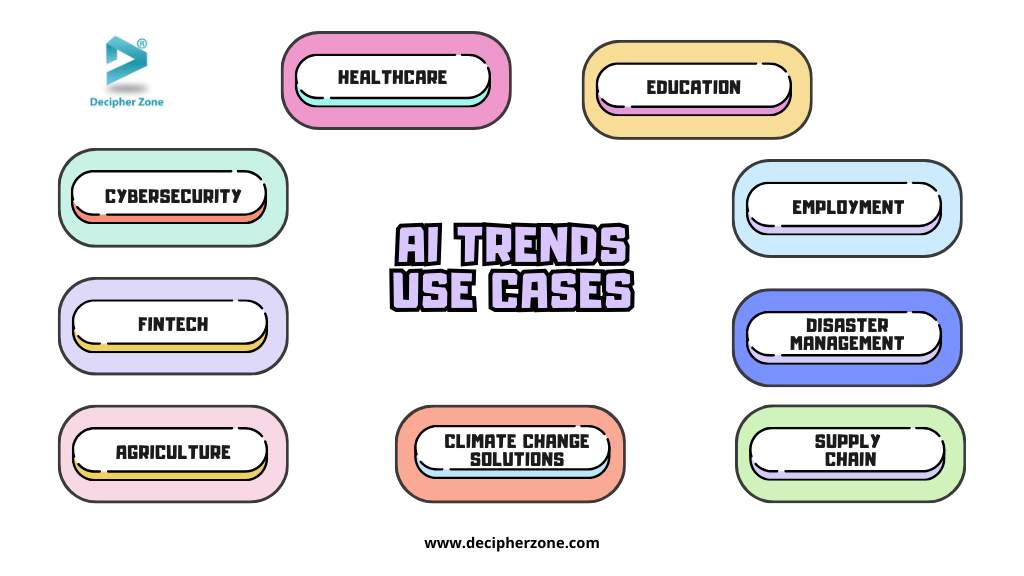
How These AI Trends Impact Business by Industry
AI in healthcare
Multimodal AI is producing the most significant near-term clinical impact. Models that combine patient records, imaging, lab results, and clinical literature to produce treatment recommendations are in active deployment at major health systems. Drug discovery timelines are compressing measurably. Read our AI in healthcare guide and our health insurance app development guide for implementation detail.
AI in financial services
Vertical AI in finance is producing concrete numbers. Hyper-personalization is driving 10 to 25% revenue growth from tailored financial offers, while conversational AI is resolving 80% of customer inquiries in banking with expectations above 90% by end of 2026. Fraud detection, credit scoring, and algorithmic trading are all mature AI applications. Read our fintech software development guide.
AI-Powered Customer Research and Decision Intelligence
AI is also changing the research process itself. Instead of using AI only to summarize existing data, teams can use AI-moderated interviews to collect and synthesize qualitative feedback at greater speed. Conveo is an example of this emerging approach, showing how AI can help teams turn customer conversations into structured insights without removing the need for human interpretation.
AI in software development
The 25% increase in annual commits pushed to GitHub in 2025 is a direct measurement of AI's productivity impact on software development. Repository intelligence is making AI coding assistants context-aware rather than autocomplete-aware. Every software team without AI coding tools in 2026 is operating at a measurable productivity disadvantage.
AI in cybersecurity
AI is simultaneously the most powerful offensive and defensive tool in cybersecurity. AI-powered attack tools automate phishing personalization, vulnerability discovery, and social engineering at scale. AI-powered defenses automate threat detection, anomaly identification, and incident response. The teams winning are those deploying AI defenses faster than attackers are deploying AI offenses.

AI in supply chain and logistics
Demand forecasting, route optimization, warehouse automation, and predictive maintenance are all mature AI applications in supply chain. The 2026 frontier is autonomous supply chain decisions: AI agents that reorder inventory, reroute shipments, and negotiate with suppliers without human approval for standard transactions. Read our logistics management guide.
AI in education
Personalized learning systems that adapt content, pace, and difficulty to individual students in real time are the primary AI application in education. The 2026 additions: AI tutors that provide multimodal explanations (text, diagram, worked example, audio) and AI assessment tools that provide diagnostic feedback rather than just a grade. Read our learning platform development guide.
Want to know which AI trends apply to your business?
Get a free 30-minute strategic AI consultation from Decipher Zone.
A Framework for Deciding Which AI Trend to Prioritize
Every enterprise is different, and not every 2026 AI trend is equally relevant to every business. This decision framework helps prioritize.
| AI Trend | Readiness Level | Best First Use Case | Who Should Prioritize |
|---|---|---|---|
| Agentic AI | Partial (controlled workflows only) | Customer support routing, document processing | Operations-heavy businesses with repetitive workflows |
| Multimodal AI | Production-ready for text+image | Quality inspection, claims processing, content moderation | Manufacturing, insurance, media |
| AI in Software Dev | Production-ready now | GitHub Copilot or Cursor for all engineers | Every software team immediately |
| Vertical AI models | Production-ready in finance and healthcare | Customer service personalization, fraud detection | Financial services, healthcare providers |
| Edge AI | Production-ready for structured environments | Security cameras, wearables, factory sensors | IoT, healthcare, manufacturing |
| AI governance tooling | Essential now | Audit logging, explainability wrappers, bias testing | Any enterprise selling to regulated industries |
| Humanoid robotics | Early-stage (structured environments only) | Warehouse automation, manufacturing assembly | Large logistics and manufacturing operations |
| Quantum-AI | Research stage for most businesses | Monitor, do not invest yet for most enterprises | Pharma, materials science, large financial modelers |
Quantum AI and Edge Computing: The 2027 to 2030 Horizon
Two trends in this guide deserve a longer timeline caveat. Quantum AI and edge AI infrastructure are both real, but on very different timescales for most businesses.
Quantum AI: worth monitoring, not yet deploying
Quantum computing combined with AI algorithms can theoretically solve optimization problems, chemical simulations, and cryptographic challenges that classical computers cannot approach. Microsoft identifies quantum-AI hybrid approaches as heralding breakthroughs once thought impossible, with new hybrid methods showing genuine promise in 2026.
The practical timeline for most businesses: quantum AI is a 2028 to 2030 planning consideration, not a 2026 deployment decision. The businesses for whom this is an immediate concern are pharmaceutical companies doing molecular simulation, large financial institutions doing portfolio optimization, and defense or intelligence organizations. For everyone else: watch the space, understand the concepts, and deploy classical AI now while quantum matures.
Edge AI: deployment-ready now in the right contexts
Edge AI is not one thing. It is a family of deployment patterns unified by the principle of running inference closer to the data source. Smart factory sensors that detect equipment anomalies in real time, medical wearables that identify arrhythmias without transmitting raw ECG data to the cloud, security cameras that run object detection locally rather than streaming video to a central server: these are all edge AI, and all three are production-ready in 2026.
The key question for edge AI deployment is latency sensitivity. If a decision needs to happen in under 100 milliseconds and network latency makes cloud inference unreliable, edge is the right architecture.
If the decision can wait for a cloud round-trip (typically 200 to 500 milliseconds under good conditions), cloud inference is simpler and cheaper. Most business decisions that feel urgent are not actually sub-100ms decisions. Measure before you architect.

The Honest Bottom Line on AI in 2026
The gap between AI's demonstrated capability and most organizations' ability to extract value from it has never been wider. The models are extraordinary. The deployment infrastructure is maturing rapidly. The organizational knowledge, data quality, and process design required to turn that capability into business outcomes is where most organizations are still catching up.
The businesses winning with AI in 2026 are not the ones with the most sophisticated models or the largest AI teams. They are the ones that picked specific, measurable problems, built focused AI solutions against clean data, defined success metrics before deployment, and iterated based on real results rather than demos. That is a description of good product management applied to AI, not a description of AI-specific magic.
The opportunity is real. Morgan Stanley's 2026 analysis finds that AI adoption is shifting with fewer pilots and greater tangible productivity solutions, which should lift GDP, earnings, and capital markets activity.
The organizations that started AI implementation two years ago with a disciplined, measured approach are now compounding their productivity advantage every quarter. The organizations still in "exploration mode" are falling further behind each quarter.
The window to start is not closing, but the cost of delay is. But the gap between early movers and late adopters is widening. Read our AI advantages and challenges guide and our AI-powered future guide for the strategic context on where to start.
What "AI-Ready" Actually Means for a Business in 2026
Most businesses describe themselves as "exploring AI" or "implementing AI" without being specific about what either means. Here is the concrete checklist that distinguishes an AI-ready organization from one that is still in experimentation mode.
Data infrastructure readiness
- Clean, labeled, accessible data: AI models are only as good as the data they train on or retrieve from. Organizations with data silos, inconsistent labeling, or unstructured storage are paying more for worse AI results.
- Vector database or pgvector setup: Retrieval-Augmented Generation (RAG) is the architecture that makes AI systems actually useful in enterprise contexts. Without a vector store for embedding your proprietary knowledge, you are using a general-purpose model on general-purpose knowledge.
- Data governance documentation: Which data can AI access? Under what conditions? With what audit trail? These questions need answers before production deployment.
Team and process readiness
- AI literacy across functions, not just IT: The teams that generate the highest AI ROI are ones where business users understand what AI can and cannot do, and can specify problems precisely enough for engineers to build effective solutions.
- Defined success metrics before deployment: AI projects without pre-defined success metrics invariably drift into "interesting but not valuable" territory. Define the specific metric the AI deployment should move before building it.
- Human escalation paths for AI decisions: Every AI system operating in production needs a defined path for flagging low-confidence decisions to human review. This is not a limitation. It is responsible deployment.
Read: Data Analytics Software Development | Cloud-Native Architecture for AI | Agile Best Practices for AI Projects

What Decipher Zone Builds in the AI Space
At Decipher Zone, we have delivered 350+ software products since 2012 including AI-powered applications across fintech, healthcare, ecommerce, and SaaS. A 4.9/5 Clutch rating from 912 verified reviews. Senior AI engineers at $25 to $49 per hour.
Our AI development work covers the trends in this guide directly.
- Agentic AI workflows: We build document processing agents, customer support orchestration pipelines, and automated research summarization systems for enterprise clients
- AI integration: OpenAI, Anthropic, and open-source model integration into existing products and workflows. Read our guide to choosing an AI development company.
- Vertical AI products: Healthcare AI, fintech AI, and logistics AI applications built with domain-specific training and compliance architecture
- AI security: Prompt injection protection, agent access control, audit logging, and explainability wrappers for regulated industries
- Computer vision: Image classification, object detection, medical image analysis, and quality inspection systems
Ready to implement AI in your business?
Get a free consultation from Decipher Zone's AI engineering team.

Frequently Asked Questions About AI Trends in 2026
What are the most important AI trends in 2026?
The most significant 2026 AI trends are agentic AI and multi-agent coordination (moving beyond individual prompting to autonomous workflow execution), multimodal AI evolving into digital workers that combine language, vision, and action, AI infrastructure buildout approaching $3 trillion by 2028, model commoditization as the US-China performance gap narrows, repository intelligence transforming software development, AI security becoming critical as agents gain autonomy, and vertical AI models replacing general-purpose models in healthcare and finance.
Is agentic AI actually ready for business use in 2026?
Partially. AI agents work reliably for controlled, well-defined workflows with limited decision scope: customer support routing, document processing, code review, and research summarization. They are not reliable for high-stakes autonomous decisions involving significant money, complex legal reasoning, or multi-step processes where a single error cascades. MIT Sloan's 2026 analysis, citing Anthropic and Carnegie Mellon research, found agents make too many mistakes for reliance on processes involving big financial decisions. Use agents for bounded, auditable tasks and keep humans in the loop for consequential decisions.
What is multimodal AI and why does it matter in 2026?
Multimodal AI processes and generates multiple types of input and output simultaneously: text, images, audio, video, and increasingly actions. It matters in 2026 because the combination enables AI to handle workflows that previously required humans to look at something, read something, and act on it. Real applications include medical imaging combined with patient records for diagnostic support, insurance claims processing combining documents and photographs, manufacturing quality inspection combining visual data with specification text, and customer service routing combining voice tone with text content.
How is AI changing software development in 2026?
AI coding assistants have moved from autocomplete to context-aware collaboration. GitHub's 2025 data shows 43 million pull requests per month (up 23% year-over-year) and 1 billion annual commits (up 25%), reflecting AI's productivity impact. Repository intelligence, the ability of AI to understand not just code but the relationships, history, and context behind it, is the 2026 breakthrough. AI coding tools are now standard, not experimental. Engineering teams without them are operating at a measurable productivity disadvantage.
What AI security risks should businesses watch in 2026?
Prompt injection is the most active threat: attackers embed malicious instructions in content that an AI agent processes, causing unauthorized actions. Agent identity and access management is a second critical area: agents need clear identities, minimum necessary permissions, and comprehensive audit logging. Deepfakes represent a third category, with AI-generated content weaponized for disinformation, fraud, and social engineering at previously impossible scale. Every AI system deployed in production should have defined scope, audit logging, and human escalation paths for decisions above a defined confidence or stakes threshold.
What is the state of AI regulation in 2026?
US federal AI legislation was introduced in March 2026, covering intellectual property and child safety. State laws in California, Texas, and Colorado are coming into effect in 2026. The EU's AI Act is in enforcement and the Cloud and AI Development Act is moving forward. For businesses, AI compliance is now a product requirement for enterprise sales, particularly in healthcare, finance, and government-adjacent sectors. Explainability, audit trails, bias testing, and documented data governance are the minimum compliance architecture.
How should a business decide which AI trends to prioritize?
Start with the highest-readiness, highest-ROI combination for your specific context. AI in software development (coding assistants for every engineer) is production-ready and high-ROI for any software business. Vertical AI for customer service is production-ready and measurable for financial services. Agentic AI for controlled document workflows is ready for operations teams with repetitive document-heavy processes. Edge AI is ready for IoT and manufacturing. Quantum AI and humanoid robotics are monitor-not-invest for most enterprises in 2026. The strategic principle: deploy where readiness is high and the use case is specific, measured, and reversible.
What industries benefit most from AI in 2026?
Financial services is the most advanced AI adopter: 85% of institutions use AI in at least one area, with conversational AI resolving 80% of customer inquiries. Healthcare benefits from multimodal AI in diagnostic support and drug discovery. Software development is transformed by AI coding assistants and repository intelligence. Cybersecurity is both disrupted and protected by AI. Supply chain benefits from demand forecasting, route optimization, and warehouse automation. Education is being personalized at scale through adaptive learning systems. Every industry with repetitive, high-volume, data-rich processes has measurable AI opportunity in 2026.
Author Profile: Mahipal Nehra is the Digital Marketing Manager at Decipher Zone Technologies, specialising in content strategy and tech-driven marketing for software development and digital transformation. Follow on LinkedIn or explore more at Decipher Zone.