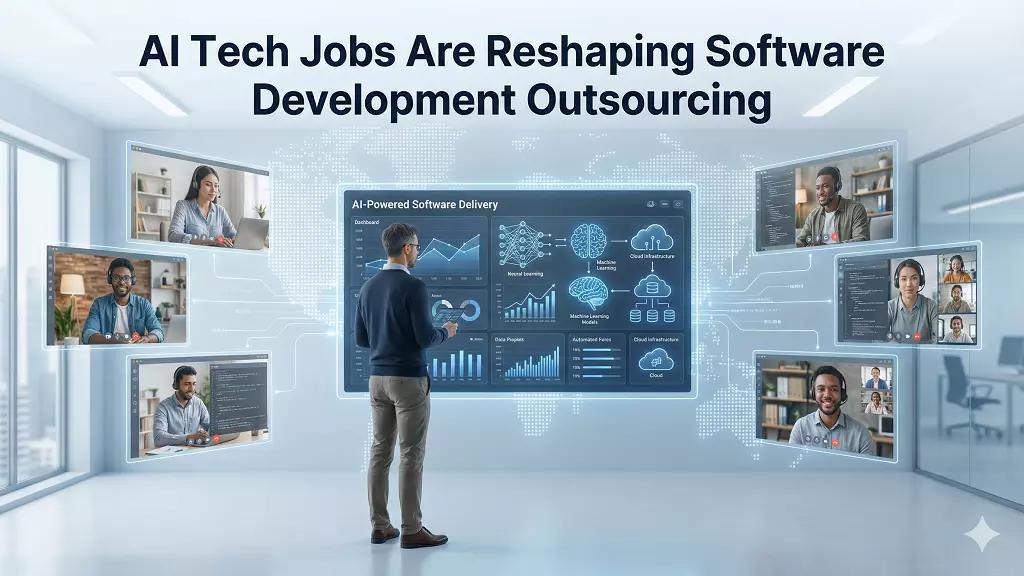
Whether you like it or not, artificial intelligence is actively reshaping the workforce and creating a new class of technical roles that didn’t exist even a few years ago. However, instead of replacing workers, AI is increasing the need for specialists who know how to build, train, and manage intelligent systems.
AI Tech Jobs: Reshaping Software Development Outsourcing
A recent analysis of more than a billion job postings found that positions requiring AI skills offered salaries 28% higher on average. That just shows how much employers now value this expertise. For technical leaders, this highlights an undeniable reality: the competition for AI-savvy talent is intense, and the demand is only accelerating.

As AI capabilities expand, the pressure to assemble teams who understand data pipelines, model lifecycles, and automated decision-making grows just as quickly. And because local markets often fall short, more companies are turning to outsourced development partners to bridge gaps, strengthen delivery capacity, and support technical initiatives that require deep AI knowledge.
Below, you’ll see how AI is transforming job roles, why AI talent is increasingly scarce, and why outsourcing is becoming one of the most strategic responses in today’s tech landscape.
Companies increasingly rely on AI & ML development services to build, train, and deploy intelligent systems that align with modern software development needs.
New Job Roles Created by AI

Thanks to AI, tech jobs have been multiplied instead of replacing them. As organizations adopt AI-driven product strategies, you need more specialists who can design intelligent systems, train machine learning (ML) models, build ETL pipelines, and integrate data into customer-facing solutions. Under this shift, entirely new categories of job roles are emerging or expanding:
1. ML and Data-Focused Roles
ML engineering has quickly become one of the most sought-after specialties because more companies want predictive models, automation tools, and data-driven insights. Recent workforce data shows that AI and data science specialists are among the fastest-growing job categories in 2025, which explains why these roles continue to climb in demand across tech teams.
A typical ML engineer collaborates with a data scientist, a data engineer, and sometimes a business analyst to create production-ready features. Companies developing AI-driven product experiences also require data analysts to interpret datasets and assist teams in making informed decisions.
These roles require a strong understanding of algorithms, training workflows, and model lifecycle management. They also require familiarity with infrastructure components, such as distributed systems, cloud environments, and secure communications.
2. AI Expands Tech Job Specializations Across the Stack
Because AI touches every layer of modern development, more niche roles are rising in demand. These include:
-
AI developers who build intelligent workflows, integrate model APIs, and support data processing
-
DevOps engineers who manage model pipelines, GPUs, and scalable architectures designed for AI workloads
-
Embedded firmware engineers who integrate AI into hardware & firmware validation systems
-
Network administrators who monitor secure communications and infrastructure performance for automated systems
-
Business intelligence developers who turn raw data into insights using AI-supported analytics
-
Product owners whose role revolves around AI-driven roadmaps and new enterprise SaaS features
-
Data-driven insights specialists who support decision-making for departments like customer service or business development
This shift aligns with how modern companies are adopting approaches highlighted in AI-enabled software development for startups, where automation and intelligence drive product innovation.
Because these positions require specialized skills, the number of tech job postings has risen sharply across global markets. You’ll also notice more remote jobs opening because companies are now comfortable working with distributed teams, especially when the work demands niche AI skills.
Many companies now prefer to hire DevOps engineers externally to manage AI pipelines, cloud infrastructure, and scalable deployments.
But Why Do Companies Struggle to Hire AI Talent Locally?

If hiring for core software engineering roles was already competitive, finding AI talent feels almost impossible in many markets. There are several reasons companies face this challenge:
1. The Talent Pool Isn’t Keeping Up With Employer Demand
The number of in-demand jobs is increasing faster than universities, bootcamps, or training programs can prepare new specialists. AI skills aren’t easy to learn, especially when you factor in mathematical foundations, data governance, and model optimization. Because of this gap, the worker supply is far behind the employer demand.
Many local markets simply don’t have enough qualified candidates to fill critical roles, such as ML engineer, data scientist, or DevOps professional. Even when candidates exist, they're often unavailable because they’ve already accepted remote jobs or joined high-growth teams that offer better compensation packages.
Salary trends also rise quickly when companies compete for a limited number of specialists. This makes AI hiring even more challenging for mid-sized enterprises that can’t match compensation levels in larger markets.
This challenge explains why many global firms follow the same approach discussed in how startups hire Indian remote developers to overcome local talent shortages.
2. AI Tools Require Hybrid Skill Sets That Are Hard to Source
AI developers need a mix of engineering, data literacy, and domain knowledge. These hybrid skills aren’t easy to find. You’re not just hiring someone who can write code. You're looking for someone who can:
-
Understand model performance metrics
-
Prioritize model accuracy, efficiency, and fairness
-
Support ETL pipelines and structured data workflows
-
Evaluate generative AI output quality
-
Ensure compliance and secure handling of sensitive data
That’s a lot for one role, which is why so many companies now struggle to build in-house teams capable of managing AI-driven projects.
3. Hiring Cycles Are Longer and More Expensive
The more specialized the role, the longer your hiring path becomes. Some companies spend months trying to onboard a single ML engineer or back-end developer with AI experience. The process becomes even slower when HR teams need to evaluate technical assignments, conduct panel interviews, and confirm that candidates meet both engineering and AI requirements.
Meanwhile, product timelines don’t slow down. The longer your hiring cycle becomes, the greater the risk of falling behind your competitors. Delays affect customer acquisition, digital transformation projects, and core business operations.
Overall, these challenges can limit your ability to ship AI-driven product features at the pace the market expects. When the demand for talent outpaces the supply of workers, even well-funded teams struggle to scale. That’s why more organizations are rethinking how they build technical capacity and turning to alternative solutions that deliver the skills they need without waiting months for the right hire.
These hiring challenges highlight the importance of following proven tips to hire remote developers when local AI talent is limited or unavailable.
How Does Outsourcing Solve AI Skill Shortage?

AI adoption demands faster development, broader expertise, and scalable technical teams. However, building that team internally isn’t always easy. Outsourcing allows you to access the talent, speed, and specialization required to keep up with evolving AI demands.
Knowing how to choose the best AI development company becomes critical when businesses outsource specialized AI roles to close skill gaps faster.
Outsourced Teams Provide Immediate Access to AI Expertise
Partnering with software development partners gives you access to experienced AI developers, ML specialists, and engineers who’ve already worked on similar projects. These teams bring proven workflows, production-ready frameworks, and deep knowledge of AI best practices.
With 81% of U.S. engineering leaders now planning to hire abroad, it’s clear that companies are embracing global talent strategies to fill gaps in AI expertise, making outsourcing an increasingly strategic choice.

Offshore and nearshore teams also understand how to blend generative AI, automation, and data processing capabilities with the needs of enterprise SaaS platforms. This makes them valuable partners for organizations experimenting with generative AI or scaling existing AI-driven product features.
You Get Hybrid Teams That Combine AI and Traditional Development

AI systems never operate in a vacuum. Teams still need traditional engineering roles to support core architecture, security, integrations, and long-term product maintenance. Outsourcing lets you create hybrid teams built around your exact needs, such as:
-
AI specialists working alongside software engineer teams
-
Traditional developers supporting ETL pipelines
-
DevOps Engineer talent maintaining model deployments
-
Back-end developer teams handling data ingestion
-
Mobile architecture specialists linking AI features to mobile products
This model gives you flexibility and reduces the strain on your internal teams. Successfully scaling distributed teams also depends on understanding how to manage a remote software development team effectively.
Outsourcing Helps You Scale Without Slowing Down

If your AI roadmap expands quickly, outsourcing makes it possible to scale without the weeks of job postings, interviews, onboarding, or skill assessments that would be required otherwise. You can build or expand your team based on immediate needs, whether you're launching a new feature, upgrading infrastructure, or exploring new AI-driven product ideas.
This agility becomes especially useful during a pandemic boom or sudden growth phase, when the demand for automation, tech support, or secure communications increases faster than local teams can keep up.
In some cases, businesses also evaluate the pros and cons of nearshore outsourcing to balance regional collaboration with access to specialized AI talent.
A Wider, More Diverse Workforce Improves AI Systems
AI models benefit from diverse data and varied perspectives. Outsourcing gives you access to a more diverse workforce, including engineers, analysts, and specialists from different regions and technical backgrounds. This reduces bias, strengthens model performance, and supports stronger decision-making across your organization.
Ultimately, outsourcing strategically helps companies fill in the AI talent gap, combine global expertise with internal teams, and scale projects without sacrificing speed or quality.
Conclusion: The Future of AI and Offshore Software Development
As organizations mature, adopting a structured enterprise AI strategy becomes essential for long-term scalability and competitive advantage. We’re entering a future where tech jobs evolve continuously, hybrid skill sets become standard, and AI-driven product strategies require more than a traditional software engineer team.

Because local markets can’t always supply the specialists you need, offshore software development will remain a practical solution for closing the talent gap. This model gives you the flexibility, global perspective, and specialized support required to move faster and stay competitive.
To accelerate delivery without long hiring cycles, organizations increasingly choose to hire dedicated developers through trusted outsourcing partners.
FAQs
FAQ 1: How is AI changing software development jobs?
AI is creating new specialized roles such as machine learning engineers, AI developers, and data engineers. Instead of replacing jobs, AI is increasing demand for professionals who can build, manage, and optimize intelligent systems.
FAQ 2: Why is AI talent so hard to hire locally?
AI roles require hybrid skills like data science, engineering, and domain expertise. The talent supply is growing slower than demand, making local hiring expensive, competitive, and time-consuming.
FAQ 3: How does outsourcing help with AI skill shortages?
Outsourcing gives companies instant access to experienced AI professionals, reduces hiring timelines, and allows teams to scale faster without long recruitment cycles.
FAQ 4: What AI roles are commonly outsourced by companies?
Companies often outsource machine learning engineers, AI developers, data engineers, DevOps engineers for AI pipelines, and AI-focused software development teams.
FAQ 5: Is offshore AI software development reliable?
Yes, offshore AI development is reliable when working with experienced partners. Global teams offer diverse expertise, proven workflows, and cost-effective scalability for AI-driven projects.
FAQ 6: Why are companies combining AI teams with traditional developers?
AI systems rely on strong backend architecture, security, integrations, and infrastructure. Hybrid teams ensure AI features work seamlessly with existing software systems.
Author Profile: Mahipal Nehra is working at Decipher Zone Technologies, specializing in content strategy, and tech-driven marketing for software development and digital transformation.
Follow us on LinkedIn or explore more insights at Decipher Zone.
Planning a product build for 2026?
A short discovery conversation can help clarify scope, risk, and the right delivery model before you commit.