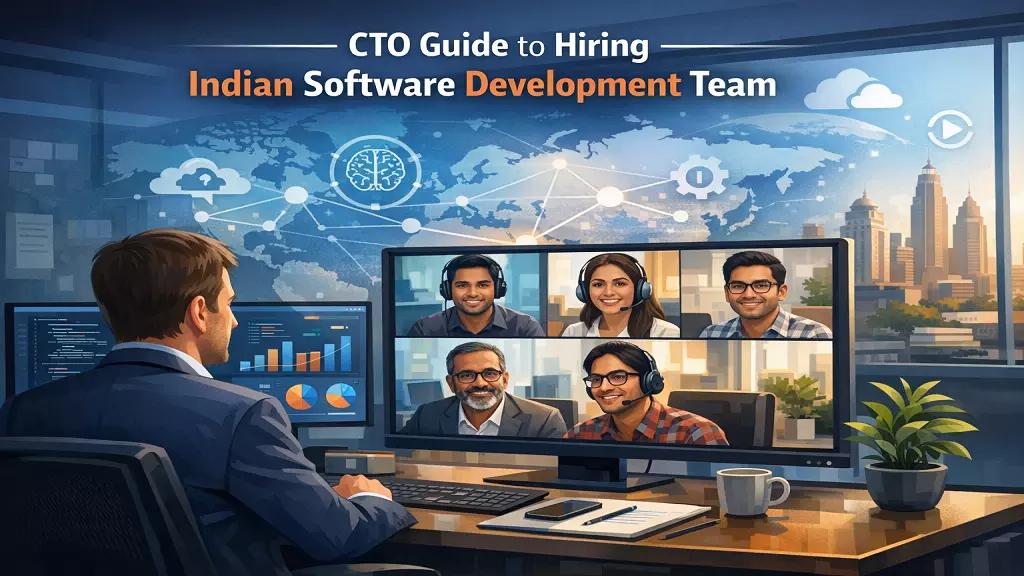
As 2026 arrives with the latest Indian Software Developers offer benefits to businesses across the world. Enterprises seek to experiment with Agentic Operating Systems (AOS) to standardize orchestration, safety and compliance. India’s ecosystem of skilled programmers and software development companies allows the integration seamlessly with in-house operations. This blog explains everything from popular technologies, when CTOs should hire, hiring process, skills to look for and cost breakdown.
Hiring Indian Software Development Teams in 2026

Hiring top software engineers in 2026 has become one of the biggest challenges for CTOs and tech leaders. Rising local salaries, slow recruitment cycles and the growing demand for AI, cloud and DevOps skills are putting pressure on product timelines and budgets. As a result, more CTOs are actively exploring how to hire Indian software developers to scale engineering teams faster without compromising quality.
This guide is built specifically for CTOs who want a clear, practical and risk-free approach to hiring Indian software development teams — covering when to hire, what skills to look for, cost expectations, engagement models and how to choose the right development partner.
CTOs face a constant dilemma of how to build and scale high performing software development teams without draining budget or slowing innovation. With digital transformation accelerating in 2026 across various industries, the companies for skilled engineers has never been fiercer. That’s why more business leaders are looking beyond their local borders for top talent and India has emerged as the top choice.

According to the latest forecast by Gartner, IT spending in India is expected to exceed $176 billion in 2026, an increase of 10.6% from 2025. Mainly enterprises shift towards cloud, AI and data driven solutions with software investments alone projected to grow nearly 18%. Global companies are embedding Indian engineers into the core product teams, innovation pipelines and strategic R&D functions.
In-house tech hubs set up by multinational companies are reshaping the hiring landscape as there is a rise of Global Capability Centers (GCCs). India now hosts nearly 2 million professionals working in GCC, with hiring growth rates outpacing traditional IT services firms by four times in AI, cybersecurity and other areas.

Successfully scaling engineering teams without compromising speed or quality requires a well-defined offshore software development strategy that balances cost efficiency with delivery control.
What does this mean for you as a CTO? Businesses need more access to skilled developers, cutting edge technology expertise and competitive cost structure while understanding how to hire, engage and lead across time zones, cultures and development models. Let’s walk through everything you need to know about hiring and managing an Indian software developers and development team that delivers and drives impact as well.
Key hiring challenges CTOs face today include:
-
Local hiring cycles taking 3–6 months
-
Salaries rising 30–40% YoY in US/EU
-
Shortage of AI, Cloud, DevOps & Data engineers
-
Pressure from investors to ship faster with lean teams
CTOs today are expected to deliver faster releases, stable systems and continuous innovation while managing tight budgets and limited hiring bandwidth. Traditional local hiring is no longer keeping pace with modern product demands, forcing technology leaders to explore global talent strategies.
Why India is a Top Destination for Software Development?

Unlike short-term outsourcing hubs, India offers long-term engineering partnerships. CTOs are no longer hiring Indian teams just to reduce costs, but to build scalable, high-performing product teams that integrate deeply with in-house engineering.
India has transformed from being an outsourcing choice to becoming a global hub for innovative software engineering, digital transformation and long term partnerships. Now when CTOs think about building or scaling software teams, India is the first that comes to mind. If you are confused why? Let’s break it down.
-
Vast Talent Pool & Expertise: India offers a massive and young workforce skilled in diverse technologies including Python, AI, Cloud, etc. these millions of IT graduates annually from prestigious universities.
-
Cost Effective: Lower labor costs provide significant savings (up to 60%) without compromising quality, making high end development affordable for global businesses.
-
Time Zone Advantages: India’s time difference allows for 24/7 work, with development happening overnight for US or European clients. This accelerates project delivery.
-
Cultural & Language Proficiency: High English proficiency and cultural alignment with Western markets facilitate seamless communication and collaboration.
-
Government Support: Government shows commitment to boosting the tech sector but proposing initiatives like ‘Startup India’.
-
Scalability & Flexibility: Businesses can easily scale teams up or down based on project needs, from hourly to large project teams.

Indian Software Developers vs Other Offshore Locations
CTOs often compare India with Eastern Europe, LATAM or Southeast Asia. While each region has strengths, India stands out when scalability, cost efficiency and long-term collaboration are considered together.
|
Region |
Cost Efficiency |
Talent Scale |
Time-Zone Coverage |
Long-Term Scalability |
|
India |
High |
Very Large |
Excellent |
Excellent |
|
Eastern Europe |
Medium |
Limited |
Moderate |
Low |
|
LATAM |
Medium |
Medium |
Strong for US |
Medium |
Popular Technologies and Expertise Areas in Indian Programmers

You will be surprised to know that the Indian software development team offers the breadth and depth of technical expertise. Over the past decade, Indian developers have expanded far beyond traditional web development into modern technologies that drive innovation across industries. Here are the key areas where Indian programmers shine:
1. Web & Frontend Development
Indian developers are highly experienced in modern web technologies that power user centric digital applications, including React.js, Angular, Vue.js and HTML5, CSS3, JavaScript/TypeScript. Indian teams can deliver both performance and usability whether you are building a customer portal, admin dashboard or complex web platform.
2. Backend & API Development
Most scalable and great applications need a strong backbone. Indian programmers are well versed in backend technologies that ensure secure, scalable and efficient systems, such as Node.js, Python (Django, Flask), Java & Spring Boot, .NET Core and Go/Golang. These expertise makes India a reliable destination for building everything from REST APIs to microservices architectures.
3. Mobile App Development
As smartphones are driving digital adoption worldwide, mobile apps are essential. Whether you are launching an MVP or scaling a global app, Indian developers are ready to build them, delivering smooth UI/UX and optimized performance. These technologies include iOS (Swift), Android (Kotlin) and cross platform tools (Flutter, React Native).
4. Cloud Computing & DevOps
Indian developers are ready with cloud first expertise as the cloud is the backbone of modern software systems. With these tools results with faster deployments, reliable systems, automated workflows and scalable infrastructure including AWS, Microsoft Azure, Google Cloud Platform (GCP), Infrastructure as Code (Terraform, CloudFormation), Containers & Orchestration (Docker, Kubernetes) and CI/CD Pipelines (Jenkins, GitHub Actions, GitLab CI).
5. Artificial Intelligence & Machine Learning
In 2026 & beyond, Indian developers are stepping up with advanced skills in Machine Learning (TensorFlow, PyTorch, Scikit-Learn), Data Analysis & Visualization (Pandas, NumPy, Power BI), Natural Language Processing (NLP) and Computer Vision & Predictive Models. From building recommendation engines, predictive analytics to intelligent automation features. India has growing talent clusters in AI/ML.
6. Data Engineering & Big Data
Indian programmers are adept at building systems that collect, transform and extract value from massive datasets like Hadoop, Spark, Kafka, ETL Pipelines & Data Warehouses (Snowflake, Redshift) and Real-Time Streaming & Analytics. This makes Indian talent an asset for businesses tackling complex data challenges.
7. QA, Testing & Quality Engineering
Indian QA engineers specialize in automated testing, performance & load testing, manual and exploratory testing. Their role ensures stable releases and reduced maintenance costs over time.
Indian software developers often gain exposure to multiple industries such as fintech, healthcare, SaaS, eCommerce and enterprise platforms, allowing them to bring best practices from global projects into your product.
Over the years, India has evolved into a global innovation hub, making software development in India a strategic choice rather than a cost-driven decision for CTOs.
When Should a CTO Hire an Indian Development Team?

Considering the right time of hiring an Indian Development Team and why it is important, because timing is everything. Making the decision too early or too late can affect product quality, team efficiency and overall business outcomes. For CTOs, understanding when to bring in an offshore team is just as important as knowing why India is a strong destination.
You should strongly consider hiring Indian developers if:
-
Your roadmap is slipping due to hiring delays
-
Engineering costs are impacting runway
-
Your team lacks niche skills
-
You need predictable delivery timelines
Here are the situation you find familiar then it may be your time to look toward India:
1. When you need to scale an engineering team quickly
Recruiting skilled engineers locally can take months, while Indian teams can often be onboarded within weeks and not quarters. Indian development teams offer a powerful solution. So if your product roadmap is expanding faster than your local hiring pipeline you can consider Indian programmers.
2. When local hiring costs are becoming unsustainable
It is difficult to grow teams in North America and Europe as engineering salaries continue to rise. Indian development teams provide access to experienced engineers at a significant lower total of cost ownership. This allows CTOs to invest more in product innovation, infrastructure and got to market strategies, mainly startups and mid-stage companies are trying to balance growth with financial discipline.
3. When you need to access specialized or emerging skills
Finding senior specialists locally can be challenging and expensive as technologies like AI, machine learning, cloud architecture, DevOps and blockchain are evolving. India’s large and diverse talent pool increases the chances of finding developers with hands-on experience in niche or emerging technologies. This is often with real world exposure across global projects.
4. When time-to-market is critical
Indian teams enable parallel development, allowing your in-house developers and offshore team to work in tandem as speed is everything in competitive markets. With smart time zone overlap, development can continue almost around the clock. This reduces release cycles and accelerates product launches. Mostly CTOs racing competitors or meeting investor deadlines can be a major advantage.
5. When you want internal teams to focus on core innovation
Freeing internal programmers to focus on architecture, innovation and strategic initiatives so CTOs can hire Indian teams to handle feature development, maintenance, testing or infrastructure work. This division of labor often improves productivity on both sides and leads to better long term outcomes.
6. When you’re building an MVP or testing a new market
Hiring an Indian development team is a smart way to validate ideas quickly and cost effectively for startups or enterprises launching new digital products. You can build an MVP, gather user feedback and iterate without committing to large permanent teams. If the product gains traction, scaling the team becomes much easier.
7. When you need long term development support without overhead
Many CTOs use dedicated offshore teams in India as an extension of their in-house workforce without overhead of office space, benefits or complex HR operations. As Indian development teams are perfectly ideal for long term partnerships and not just short projects. This model works particularly well for SaaS platforms and continuously changing products.
8. When Global Expansion is part of your strategy
Hiring globally aligned teams is essential if your company serves international markets or operates regions. Indian programmers are experienced in working with distributed teams, global clients and international compliance standards. This makes them a strong fit for globally scalable products.
Understanding when to hire an offshore development team helps CTOs avoid premature scaling while ensuring faster execution when product momentum is critical.
Step-by-Step Hiring Software Development Process for CTOs for 2026
Now that you are prepared, consider the right time. Where should you start? So let’s explore the steps that give clarity to CTOs as the structured hiring process minimizes risk, ensures technical alignment and sets the foundation for long term success.

6 steps hiring framework helping CTOs and tech leaders build reliable, high performing software teams with confidence.
Step 1: Define Clear Business Goals & Technical Requirements
Businesses need to define what success looks like before reaching out to Indian software development companies or talent. This includes understanding the business goals or objectives behind the project and translating them into technical requirements. How can you do that? With these pointers:
-
Product vision & roadmap,
-
Required tech stack and architecture,
-
Expected timelines and milestones,
-
Performance, scalability & security needs,
-
Clear documentation at this stage prevents misalignment later & makes sure candidates understand the scope from day one.
Step 2: Choose the Right Engagement & Hiring Model
CTOs are required to select a model that aligns with product maturity and risk tolerance as not every project requires the same hiring approach. Choosing the right model helps businesses to be flexible without sacrificing control. Common models include:
-
Dedicated development team is best for long term and evolving products.
-
Fixed Price Model is ideal for clearly defined and short term projects.
-
Time & Material Model is suitable for agile and iterative development.
Step 3: Shortlist Reliable Development Partners or Talent
At this stage tech leaders should evaluate potential development teams based on more than just cost. This step helps filter out companies who lack depth, scalability or long term reliability. You need to look for:
-
Proven experience in similar industries or products,
-
Strong technical portfolios and case studies,
-
Transparent communication practices,
-
Stable team structure and low attrition rates.
Step 4: Conduct Technical & Cultural Assessments
The next step is to treat offshore hiring with the same rigor as in-house recruitment as cultural fit is equally important. This ensures the team aligns with your communication style, work ethic and collaboration expectations. Tech leaders need to actively participate in various tasks, like
-
Technical interviews and coding assessments,
-
Architecture and system design discussions,
-
Problem solving and real world scenario evaluations.
Step 5: Validate Security, Compliance and Legal Safeguards
For the time being, CTOs must make sure all legal and security aspects are covered before finalizing the partnerships. This step protects your intellectual property and make certain compliance with global standards
-
Sign NDAs and IP ownership agreements,
-
Review data protection and security standards,
-
Define SLAs, escalation paths and delivery metrics.
Step 6: Onboard, Integrate & Set Performance Benchmarks
Proper onboarding sets the tone for long-term success as early alignment leads to faster productivity, fewer misunderstandings and stronger collaboration. Signing a contract is not the only thing for successful hiring, key onboarding actions include:
-
Introduction tools, workflows and documentation,
-
Aligning sprint cycles and reporting formats,
-
Setting KPIs, quality benchmarks and feedback loops.
Key Skills to Look for in an Indian Software Development Team
Every tiny detail matters, you might find facing challenges down the road if you overlook them. Paying attention to the small stuff can really change things for the better. There is a difference between a high performing team and an average and it often comes down to a specific set of skills that go beyond coding. Here are the key skills areas to consider:
Strong Technical Fundamentals
At the core of any software development team is a solid technical expertise. Indian programmers demonstrate deep knowledge of their tech stack, clean coding practice and the ability to ensure scalable architectures. What you can look for teams with proven experience in:
-
Modern frontend and backend frameworks,
-
API design and microservices architecture,
-
Database design and performance optimization,
-
Secure coding standards.
Problem Solving & Analytical Thinking
Just following requirements is not enough, developers need to challenge assumptions and propose better solutions. This mindset leads to smarter products and fewer surprises down the line. Indian teams with strong analytical skills can identify edge cases, performance risks and scalability challenges early in the development cycle. CTOs must prioritize teams that:
-
Ask the right technical and business questions,
-
Offer alternatives approaches when needed,
-
Think beyond tasks to outcomes.
Experience Working with Global Clients
Development teams that have experience with international clients understand the importance of timelines, accountability and structured communication. They are familiar with goal standards, compliance requirements and distributed collaboration workflows. This means fewer management overheads and smoother execution for CTOs. These experiences often means:
-
Better documentation,
-
Proactive communication,
-
Higher delivery predictability.
Agile Development & DevOps Expertise
Modern software development is iterative and fast paced. Indian development teams should be comfortable working in Agile environments and integrating DevOps practices into their workflow. These are key indicators include:
-
Sprint planning, daily standups and retrospectives,
-
Automated testing and deployment,
-
Continuous monitoring and improvement.
.avif)
Clear Communication & Collaboration Skills
Strong English communication both written and verbal is essential for collaboration, requirement clarity and stakeholder alignment. Technical skills alone aren’t enough in a distributed setup. Effective teams:
-
Provide regular progress updates,
-
Document decisions and changes clearly,
-
Raise risks early instead of reacting late,
-
Good Communication minimizes friction and keeps projects on track.
-
Quality Assurance & Attention to Detail.
Basically look for teams that integrate QA into the development lifecycle, automated and manual testing practices, follow code review and quality standards. This focus on quality reduces rework and post release issues.
Adaptability & Willingness to Learn
As the technology keeps changing, the Indian development teams need to keep pace. Where adaptability and continuous learning are the key indicators of long term value. And how you can achieve that to future proof your engineering investment. With finding these abilities in strong teams:
-
Stay updated with emerging trends and technologies,
-
Adapt quickly to new tools and frameworks,
-
Embrace feedback and continuous improvement.
Beyond pricing and technical skills, knowing how to choose the right software development partner is essential for building long-term, high-performing distributed teams.
Ownership & Accountability
You may agree that ownership is the most underrated skill and high performing Indian teams take responsibility for outcomes along with tasks as this mindset transforms an outsourced team into a trusted technical partner. To choose one for your project, they:
-
Treat your product as their own,
-
Take accountability for timelines and quality,
-
Actively contribute to product success.
Common mistakes CTOs should avoid:
-
Choosing teams based only on lowest cost
-
Ignoring communication quality
-
Skipping cultural fit assessment
-
Not defining ownership clearly
Cost Breakdown: What CTOs Should Expect in 2026
It all rests on the cost of the software development and how the factors influence it. Cost efficiency is one of the biggest reasons why CTOs consider hiring an Indian software development team. This raises the question of how the cost is decided, avoid surprises, plan budget and maximize return on investment.
The table below clears the confusions and explains the cost breakdown.
|
Cost Category |
What It Includes |
What CTOs Should Know |
|
Developer Cost (by Experience) |
Junior, Mid-level, Senior developers |
|
|
Engagement Model Cost |
Dedicated Team, Fixed Price, Time & Material |
|
|
Infrastructure & Tools |
Cloud hosting, dev tools, licenses, collaboration software |
Often included by vendors, but cloud usage and third-party licenses may be billed separately. |
|
Project Management Cost |
Scrum masters, delivery managers, reporting |
Strong project management prevents delays and hidden expenses caused by misalignment. |
|
Quality Assurance & Testing |
Manual testing, automation, performance testing |
Investing in QA early reduces costly post-release fixes and downtime. |
|
Onboarding & Knowledge Transfer |
Documentation, training sessions, setup time |
One-time cost that improves long-term efficiency and team productivity. |
|
Hidden / Indirect Costs |
Attrition, rework, poor documentation, delays |
Low-cost teams without processes can increase total cost over time. |
|
Scaling Costs |
Adding or reducing team members |
Indian teams allow flexible scaling without long-term employment overhead. |
|
Security & Compliance |
NDAs, IP protection, security audits |
Essential to protect intellectual property and ensure regulatory compliance. |
|
Long-Term Optimization |
Automation, DevOps, process improvements |
Upfront investment here leads to lower operational costs over time. |
While hourly rates matter, CTOs should evaluate total cost of ownership. A slightly higher-priced but well-managed team often delivers faster, reduces rework and lowers long-term costs compared to low-cost teams with poor processes.
How to Choose the Best Software Development Company in India
There is no single “best” software development company in India for every business. The right choice depends on your product complexity, engagement model, industry experience and long-term roadmap. CTOs should evaluate companies based on engineering maturity, communication quality and ability to scale—not just pricing.
CTO Checklist for Selecting the Right Partner:
-
Industry-relevant case studies
-
Stable team with low attrition
-
Clear IP ownership and NDAs
-
Transparent pricing model
-
Strong project management and reporting
Why CTOs Choose Decipher Zone Technologies
Hiring an India software development team is a strategic growth decision which CTOs and tech leaders consider. They manage tight timeframes, evolving tech stacks and scaling challenges. The right offshore partner can directly influence product success and engineering velocity.
CTOs partner with Decipher Zone not just to hire developers, but to build engineering teams that scale alongside their product, users and long-term business goals.
At Decipher Zone Technologies, we understand that tech leaders don’t need developers but they require reliable technical partners who can align with business needs, adapt to product roadmaps and scale without friction. Our teams cover the full technology stack under one roof, from web and mobile development to cloud, DevOps, AI and enterprise platforms.
Whether you need a dedicated team, time & material model or fixed scope execution, we ensure cost clarity and predictable delivery with transparency. With years of experience our team follows strict security standards, NDAs and IP protection practices and work in agile sprints, provide regular updates and maintain clear documentation to stay in control without micromanagement.
Partner with us as we invest in understanding your product user and vision to support long term growth!

FAQs
-
Can I hire developers on a part-time basis?
Yes, you can hire developers part time as it is a popular, flexible and cost effective option especially for startups, projects needing specific skills or variable workloads. Many software development companies in India offer flexible engagement models including part time, hourly and contract based hiring.
-
What are the best platforms to find Indian software developers for startups?
You can find Indian software developers through multiple platforms like LinkedIn, freelance marketplaces for short term needs and dedicated software development companies offering startup friendly engagement models. Partner with established development companies to attain team stability, project management and quality assurance.
-
How can I hire a reliable Indian software development team remotely?
Start with defining your requirements clearly, shortlist teams based on experience, client reviews and relevant case studies. Conduct technical interviews, assess communication and collaboration skills and ensure proper legal agreements such as NDAs and IP protection clauses are in place.
-
Which are the top companies providing Indian software development teams for US businesses?
Companies like Decipher Zone work exclusively with US businesses by offering services across web, mobile, cloud, AI and enterprise software development. CTOs need to focus on proven experience, strong communication practices, transparent pricing models and compliance with international security standards.
-
What are the benefits of using an Indian software development team for app development?
Indian teams are experienced in working with global clients, following agile or hybrid methodologies and delivering high quality applications within shorter timeframes. Software development teams in India offer access to lots of capable developers, faster scalability, cost efficiency and expertise in modern technologies like cloud, AI, machine learning and mobile frameworks.
-
Is hiring Indian developers suitable for enterprise projects?
Yes. Indian software development teams regularly work with enterprise clients, follow security standards, compliance requirements and scalable architectures suitable for large-scale systems.
Author Profile: Mahipal Nehra is the Digital Marketing Manager at Decipher Zone Technologies, specializing in content strategy, and tech-driven marketing for software development and digital transformation.
Follow us on LinkedIn or explore more insights at Decipher Zone.
Let’s Build Your Affordable Software Development Team Today
From MVPs to full-scale solutions, Decipher Zone has delivered 350+ successful custom applications worldwide.
📞 Contact Us Now or 💬 Chat on WhatsApp