
Quick Summary
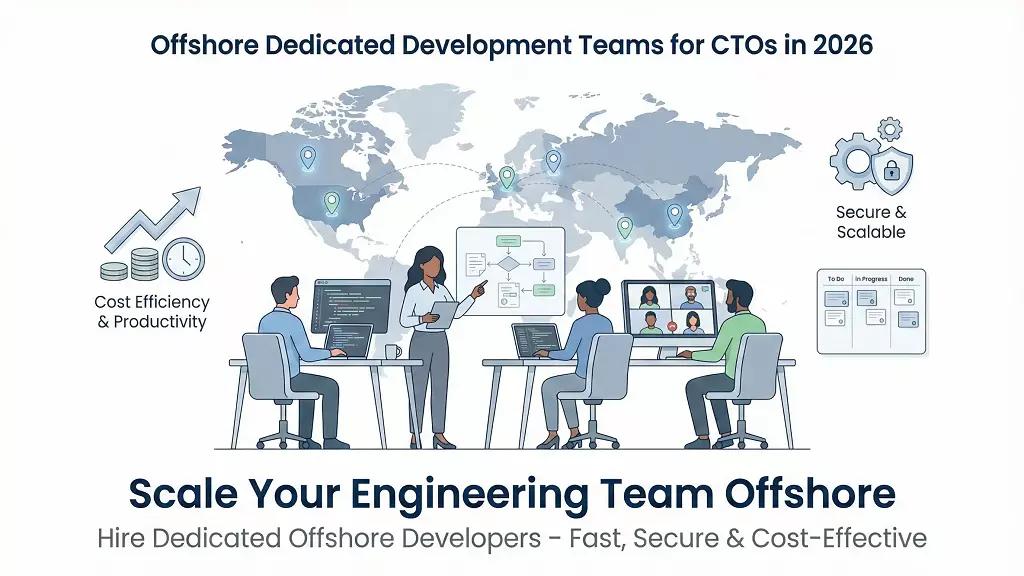
Offshore dedicated development teams act as an extension of in-house engineering teams. They help CTOs access global talent, scale faster, reduce costs and maintain full control over product development. This guide explains why CTOs are choosing this model in 2026, including benefits, use cases, costs and hiring best practices.
TLDR for CTOs:
• Offshore dedicated teams reduce development costs by 40–60%
• Faster hiring compared to local recruitment
• Best suited for long-term SaaS, AI & enterprise products
• Offers full control without HR & compliance overhead
Why CTOs Are Shifting to Offshore Dedicated Development Teams in 2026

CTOs are mainly under pressure of balancing demand for innovation with severe talent shortages and cost constraints. As 2026 is not so far. The landscape has shifted radically as the local hiring pipeline simply can’t match the pace of change and companies are scrambling to stay competitive.
Remote work, rapid automation and global competition, all these can be achieved with offshore development teams.
According Deloitte’s Global Outsourcing Survey, over 78% of technology leaders are actively investing in offshore dedicated development teams as part of their long-term engineering strategy.
The real drivers in 2026 are speed, access to niche skills and seamless global collaboration. While cost savings remain attractive with offshore development often yielding 40-60% lower operational costs than in-house teams.
Global offshore and IT outsourcing markets continue to expand as CTOs are making them a core part of long term strategic planning. This shift is reshaping how tech organizations hire, build products and compete in a world where geography no longer limits talent or impact.
In this guide, we will walk you through the reasons, benefits of why CTOs are even considering dedicated offshore teams.
What is an Offshore Dedicated Team?
An offshore dedicated development team is a group of full-time remote engineers who work exclusively on a single product. These teams integrate with in-house teams, follow Agile processes, and provide long-term ownership without the cost and complexity of local hiring.
These teams:
-
Integrate directly with in-house engineering teams
-
Follow the client’s Agile or Scrum processes
-
Participate in sprint planning, stand-ups, and retrospectives
-
Retain long-term product knowledge
Many CTOs facing this talent gap are rethinking their delivery models—our blog on global software development strategies explains how companies are scaling innovation without expanding local headcount.

At a structured level, the development team is handpicked based on the technical requirements, domain needs and preferred tools or frameworks. These teams once onboard, follow your sprint cycles, attend stand ups, use project management tools and collaborate directly with your internal stakeholders.
Offshore Dedicated Teams vs Outsourcing vs Freelancers
Some of you may be confused between Offshore, Outsourcing and Freelancers. These may look similar but the differences are critical.
Here is a brief explanation:
|
Model |
Control |
Cost |
Scalability |
Ownership |
|
In-House Team |
High |
Very High |
Low |
Full |
|
Traditional Outsourcing |
Low |
Medium |
Medium |
Vendor |
|
Offshore Dedicated Team |
High |
Low |
High |
CTO Owned |
-
Outsourcing involves a typical project based transactional, where the company hands over a scope and the software development company delivers it with limited long term involvement.
-
Freelancers are individual contributors which are usually for short-term. They may have varying availability and limited alignment to product vision.
-
Offshore dedicated teams are built for continuity, integrating deeply with your internal teams, participating in internal planning, product discussions and roadmaps and they evolve with your business.
In a nutshell, outsourcing delivers tasks, freelancers deliver effort but dedicated teams deliver ownership.
👉 Explore Offshore Dedicated Development Team Services
👉 Hire Offshore Developers for Your Product
Key Characteristics of Offshore Dedicated Teams
Offshore dedicated team mirrors as in-house setup:
-
Offering long term support for your product over months or years and not just a single release.
-
Ensuring consistent productivity and faster delivery as the team members work exclusively on your project only.
-
Following your ways of working, adapting agile ceremonies, coding standards, communication styles and workflow processes.
-
Creating a balanced and scalable delivery model as CTOs retain strategic control while handling daily execution efficiently.
In 2026, it is crucial for modern CTOs to understand the benefits and reasons to choose dedicated offshore developers.
Benefits of Offshore Dedicated Development Teams for CTOs

Businesses require practical, measurable reasons that directly impact product velocity, team efficiency and business outcomes to offshore development teams adoption.
Below are the key benefits of this model that are a preferred strategy for modern technology leaders.
1. Access to a Global Talent Pool
Business leaders face skilled engineers in the local market but adopting offshore dedicated teams open access to a global pool of highly qualified professionals across software development, AI, cloud computing DevOps, cybersecurity and emerging technologies. This enables CTOs to hire the right skills instead of settling for the available ones.
2. Faster Team Building & Time-to-Market
Hiring from a local market is a lengthy process as it involves recruitment cycles, interviews and onboarding. Dedicated offshore teams are assembled in weeks and even in days. This faster onboarding can accelerate development timelines, launch products faster and respond quickly to changing market demands.
3. Cost Efficiency with Predictable Budgeting
While maintaining high engineering standards with offshore development teams, it can offer cost advantages. CTOs are free from expenses related to salaries, infrastructure, recruitment and employee benefits, allowing them to optimize their budget and invest more in innovation.
4. Scalability without Operational Complexity
These offshore teams are flexible to scale resources up or down depending on the project requirements, product roadmaps or market conditions. There are no legal, HR and compliance challenges of local hiring as CTOs can expand their teams during high growth phases or optimize team size during slower cycles.
5. Strong Focus on Core Product Development
CTOs and internal teams can shift focus away by delegating execution to a reliable offshore team to concentrate on high impact work like system architecture, product strategy, innovation and technical leadership. This separation improves both delivery efficiency and long term vision.
6. Continuous Development & Better Productivity
These offshore development teams can work across time zones which doesn’t stop development at the end of the local workday. Continuous progress, faster issue resolution and improved development cycles all these can be offered with offshore teams.
7. High Level of Control & Transparency
From sprint planning and performance metrics to code reviews and reporting, CTO and tech leaders retain full visibility and control over development activities with offshore teams. This ensures alignment with business goals and objectives and quality standards as these teams operate right under the CTOs direct guidance.
8. Long Term Stability & Knowledge Retention
Offshore teams work closely with the organization and collaborate to develop deep product knowledge over time, resulting in better decision making, fewer errors, improved consistency and reduced dependency. This dependency on constant re-training is something short term models struggle to achieve.
This long-term ownership model is why many enterprises are moving away from transactional outsourcing—as discussed in our detailed comparison of SaaS vs traditional outsourcing.
Case Study
Real Case Snapshot: US-Based SaaS Company
At Decipher Zone Technologies, we have delivered similar offshore scaling engagements for SaaS and enterprise CTOs across the US and Europe.
A US-based SaaS CTO partnered with Decipher Zone Technologies to scale engineering capacity.
• Team scaled from 8 to 35 engineers in 4 months
• Product delivery speed improved by 45%
• Engineering costs reduced by 52%
• Zero IP or security incidents
This highlights how offshore dedicated development teams enable fast, secure and cost-effective scaling.
Key lesson learned: Embedding offshore team members directly into sprint planning and architectural discussions significantly reduced onboarding time and improved delivery alignment.
Build Your Offshore Dedicated Development Team with Confidence
Talk to Decipher Zone’s offshore delivery experts and see how CTOs scale engineering teams faster, securely, and cost-effectively—without losing control.
👉 Talk to Offshore Delivery Experts
See how CTOs scale engineering teams without losing control or security.
When Should CTOs Hire a Dedicated Offshore Development Team?

Now that the benefits of offshore development teams are clear, we can shift our attention to when to choose this type of development. There are various models a CTO can choose but using them at the right time can increase your speed, scalability and long term product ownership.
Below are some situations which demands to choose offshore team as it will make much more sense:
1. When you need to Scale Technical Capacity Quickly
A situation comes when your product demands rapid expansions and local hiring is not able to keep pace but a dedicated offshore team is an ideal solution. Whether launching a new product, entering a new market or increasing feature development, offshore teams allow you to scale without the long and tiring recruitment cycles.
2. When Local Talent is Limited or Too Expensive
There are many regions where hiring experienced developers is either costly or there is a shortage. Offshore development teams provide access to skilled professionals at a sustainable cost when the growth of local talent slows down due to budget or shortages constraints.
3. When Building a Long-Term Product or Platform
If you are looking for long term engagements then offshore might be the ideal choice. A product requiring continuous development, frequent iterations and ongoing maintenance, opting for an offshore model can help your product with stability, deep product understanding and consistent delivery over time.
4. When Your In-House Team is Overloaded
If there is a pressure or stretched thin with deadlines, maintenance work or technical debt with your internal team then offshore teams can provide support and relieve the pressure.
This allows your core team to focus on other tasks like architecture, innovation and strategic initiative while execution continues smoothly.
5. When you need Specialized Skills for Extended Periods
There are some situations when your product will require niche expertise in emerging technologies such as AI, cloud native development, DevOps and cybersecurity.
These skills needed beyond a short term project that offshore team offers continuity and deeper technical ownership compared to freelancers or short term outsourcing.
6. When Time-to-Market is a Competitive Advantage
Being opportunist in this competitive era is necessary. Outsourced teams allow parallel development and extended productivity hours across time zones that helps CTOs reduce release cycles.
7. When you want Full Control without Operational Overhead
Most organizations want direct control over development priorities, workflows and quality without investing in additional office space, HR processes or compliance. Offshore teams offer the best balance between control and efficiency.
8. When you are preparing for Growth or Uncertainty
Outsourcing teams can offer businesses help to adapt quickly, scale responsibly and minimize long term risk while maintaining momentum. Mainly during periods of rapid growth, restructuring or economic uncertainty.
Offshore Development Cost Comparison by Region in 2026

Below is an estimated cost comparison for offshore dedicated development teams by region based on market averages in 2026.
|
Region |
Avg Hourly Cost |
Best Use Case |
|
India |
$10–35/hr |
SaaS, AI, Startups |
|
Eastern Europe |
$35–55/hr |
Enterprise, FinTech |
|
LATAM |
$30–50/hr |
US time-zone alignment |
How to Hire the Right Offshore Dedicated Development Team in 2026
You know when to choose an offshore development team, but now the next question that might come in your mind is ‘how to hire offshore developers?’. You might also be aware of the process but 2026 brings assessing reliability, alignment and partnership potential. Keeping these in mind here’s how to make the right choice:
1. Evaluate technical Expertise & Domain Experience
You can assess the team by their technical capabilities and experience like,
-
The years of experience in your specific domain and building products similar to yours.
-
Proven expertise in relevant technologies, frameworks and architectures.
-
Look for case studies, portfolios and technical discussions that go beyond surface level skills.
2. Assess Team Structure & Stability
A dedicated team should,
-
Include clearly defined roles and responsibilities of developers, QA engineers, DevOps specialist and project/ delivery manager.
-
Have retention rates, onboarding processes and how knowledge is preserved when team members change.
Accessing specialized skills quickly has become a competitive advantage—our blog on hiring offshore developers for emerging technologies explores this trend in depth.
3. Check Communication & Collaboration Practices
Effective communication is the backbone of successful offshore development team collaboration, how you can evaluate:
-
With how the team handles daily stand ups, sprint planning, progress reporting and escalation management.
-
Follow structured communication workflows, strong English proficiency and a clear overlap strategy for time zones.
4. Understand the Development Process
The offshore development team should,
-
Follows modern, well defined development methodologies such as Agile or Scrum.
-
Transparency in sprint cycles, backlog management, code reviews and testing practices.
-
Seamlessly integrate with your existing tools and workflows and not force your team to adapt.
5. Review Security, Compliance & IP Protection
Security is non-negiotable, teams should,
-
Verify the offshore provider follows industry best practices, security protocols and compliance requirements including, ISO certifications, GDPR readiness and secure access controls.
-
Provide clear legal agreements around data protection and intellectual property ownership before engagement begins.
6. Look for Cultural & Business Alignment
In terms of technical abilities, you need to:
-
Understand your business goals, objectives, product vision and quality expectations.
-
Provide cultural compatibility such as work ethic, accountability and responsiveness, critical for long term success and smooth collaboration.
7. Start Small & Scale Strategically
You need to,
-
Start with a pilot project or small team before committing to a large engagement.
-
Allowing CTOs and tech leaders to evaluate performance, communication and delivery quality in real scenarios.
-
After trust is established you can scale the team, easier and lower the risk.
8. Prioritize Partnership Over Pricing
The right offshore teams should,
-
Act as a strategic partner.
-
Proactively suggest improvements, identifying risks and contributing to product success and not just executing tasks.
-
The lowest price often leads to higher long term costs as cost efficiency is important.
Security, Compliance & IP Protection
• ISO-compliant development processes
• GDPR-ready data protection
• NDA & IP ownership assurance
• Verified reviews on Clutch & GoodFirms
• Enterprise-grade security practices aligned with global compliance standards
Final Thoughts
Offshore dedicated development teams help organizations reduce costs, scale faster and access global engineering talent without compromising control or quality.
With global resources, companies can hire the specialists according to their niche. CTOs today are demanding to deliver faster, scale smarter and innovate continuously with navigating challenges without compromising quality, control or growth.
Selecting the right partner goes beyond cost considerations—our guide on choosing the right offshore development partner highlights the key evaluation criteria CTOs should focus on.
Offshore models offer various benefits when implemented correctly, enabling resilience, high performing development teams that operate beyond geographical boundaries. These teams enable access to global expertise, accelerates time to market and allows leadership to focus on innovations.
CTOs often partner with specialized offshore providers to scale teams efficiently and securely. We build dedicated teams that think like product owners, integrate seamlessly with your internal workflows and deliver measurable business value.
Our teams are carefully aligned with your technology stack, development processes and business goals that ensure transparency, security and long term collaboration.
FAQs: Offshore Dedicated Development Teams Guide for CTO
Q1. Is offshore development secure for enterprise products?
Yes. Offshore dedicated teams are secure when providers follow ISO standards, GDPR compliance and strict IP ownership policies.
Q2. Offshore dedicated teams vs outsourcing – what is better?
Dedicated teams offer long-term ownership, higher control and better alignment compared to traditional outsourcing.
Q3. How much does it cost to hire offshore developers?
Costs vary by region and skill set, but offshore dedicated teams typically reduce engineering costs by 40–60% compared to in-house teams.
Q4. Is offshore development suitable for SaaS startups?
Yes. Offshore teams are ideal for SaaS startups that need fast scaling, predictable costs and continuous product development.
Author Profile: Mahipal Nehra is working at Decipher Zone Technologies, specializing in content strategy, and tech-driven marketing for software development and digital transformation.
Follow us on LinkedIn or explore more insights at Decipher Zone.
Ready to Offshore Dedicated Development Teams for 2026?
Talk to our experts to explore custom, scalable custom solutions aligned with your business goals.