
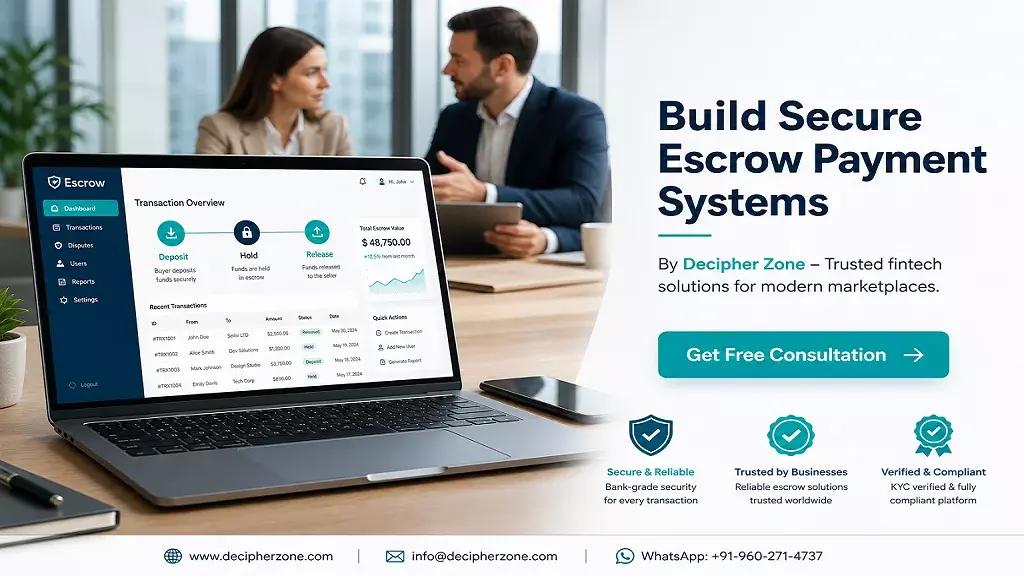
Every year, billions of dollars disappear in online fraud. Not because buyers are careless or sellers are dishonest, but because the infrastructure connecting them was never designed for transactions where neither party has a reason to trust the other yet. Escrow exists to solve exactly this problem. Simply and reliably.
Quick answer: An escrow payment solution is a system where a neutral third party holds funds from a buyer until the seller fulfills agreed conditions, then releases the payment. It eliminates counterparty risk for both sides by ensuring the buyer's money is real and the seller's delivery is verified before either changes hands.
This guide covers how escrow works, when your business needs it, how to choose the right provider, what it costs, and how to build it into a marketplace or platform using modern APIs.
Read: Payment Gateway Guide | Crypto Payment Gateway | Fintech Software Development | eCommerce Platform Development
Building a marketplace that needs escrow?
Get a free architecture consultation from Decipher Zone's fintech engineering team.
What Is an Escrow Payment Solution?
An escrow payment solution is a financial arrangement where a neutral third party holds funds from one party in a transaction until both parties have fulfilled their contractual obligations. The escrow agent does not take sides. It receives money, verifies that conditions are met, and releases funds according to terms agreed in advance.
The three roles in every escrow transaction
- The buyer (depositor): Sends funds to the escrow agent rather than directly to the seller. Retains the right to dispute or reject delivery before funds are released.
- The seller (beneficiary): Knows funds exist in escrow before beginning work or shipping. Cannot receive payment until agreed delivery conditions are verified.
- The escrow agent (neutral third party): Holds funds, enforces the agreed conditions, manages the release process, and handles disputes if they arise.
The model works because it gives each party exactly what they need. No guesswork. No going first. The buyer needs proof that money will only transfer after delivery. The seller needs proof that money exists before they fulfill. Escrow provides both simultaneously.
How Escrow Works: Step by Step
The 6-step escrow process
| Step | What Happens | Who Acts |
|---|---|---|
| 1. Agreement | Buyer and seller agree on price, delivery terms, inspection period, and conditions for payment release | Buyer and seller |
| 2. Deposit | Buyer deposits funds into the escrow account. Funds are confirmed and secured. | Buyer, escrow agent |
| 3. Fulfillment | Seller ships goods, delivers services, or transfers assets as agreed. Seller receives confirmation that funds are secured. | Seller |
| 4. Verification | Buyer inspects goods or verifies service delivery within the agreed inspection window | Buyer, escrow agent |
| 5. Release or Dispute | If satisfied, buyer approves payment release. If dispute arises, escrow agent mediates according to pre-agreed terms. | Buyer, escrow agent |
| 6. Settlement | Escrow agent transfers funds to seller. Transaction is closed. | Escrow agent, seller |
The process sounds straightforward because it is. That is by design. The complexity lies in the specific conditions, inspection periods, milestone structures, and dispute resolution protocols, all of which vary by transaction type and industry.

When Does Your Business Actually Need Escrow?
In my experience, many businesses add escrow because they think it sounds trustworthy without identifying the specific trust problem they are solving. That leads to unnecessary complexity. Escrow earns its place when at least one of these conditions is true.
High-value transactions where counterparty risk is real
When the value at stake is large enough that either party would suffer material harm from non-performance, escrow eliminates the risk without requiring either party to go first. Domain name sales, luxury goods purchases, vehicle transactions, and real estate deposits all fall in this category.
Escrow.com has processed transactions including uber.com, instagram.com, and twitter.com domain acquisitions, where the values involved made direct payment untenable for both buyer and seller.
Transactions between unknown parties
Any marketplace where buyers and sellers have no prior relationship and no reputation data creates counterparty risk by design. The buyer cannot verify the seller will deliver. The seller cannot verify the buyer's payment is real. Escrow makes both verifiable without requiring trust to exist beforehand.
International transactions with delivery uncertainty
Cross-border trade adds currency risk, logistics uncertainty, customs complications, and jurisdictional complexity to an already high-stakes transaction. Tazapay's cross-border escrow model holds buyer funds until shipment is confirmed, provides a full refund if shipment is delayed, and releases payment in full as soon as goods are dispatched, giving both parties protection across borders.
Milestone-based service delivery
For software development, construction, creative work, or any service delivered in stages, milestone-based escrow releases payment incrementally as each stage is verified. This is fairer than 100% upfront payment for the client and more secure than net-30 invoicing for the service provider. Both sides have skin in the game at every stage.
Regulated industries with compliance requirements
Real estate, legal settlement funds, M&A transactions, and debt collection all operate under regulatory frameworks that require segregated fund handling. Escrow is not just convenient in these industries. It is often legally required.
Escrow vs Direct Payment: The Honest Comparison
| Factor | Direct Payment | Escrow Payment |
|---|---|---|
| Speed | Faster (no verification step) | Slightly slower (inspection period adds time) |
| Buyer protection | Chargeback (slow, expensive, unreliable) | Pre-release verification (structured, clear) |
| Seller protection | None against non-payment | Funds confirmed before delivery required |
| Cost | Lower per transaction | Escrow fee (typically 0.89% to 3.25% of transaction) |
| Dispute resolution | Chargeback or legal action | Structured mediation by escrow agent |
| Best for | Low-value, trusted-party, repeat transactions | High-value, unknown-party, one-off transactions |
| Chargeback risk to seller | High (buyer can reverse after receiving goods) | None (escrow.com eliminates chargebacks entirely) |
The cost of escrow is the transaction fee, typically a percentage of the deal value. The cost of not using escrow is the probability of fraud multiplied by the value at risk. For high-value or unknown-party transactions, escrow almost always wins on expected value even before factoring in the trust signal it provides to both sides.
Escrow fits high-value or unknown-party deals well, but most B2B payment pain sits somewhere else: recurring supplier invoices where the counterparties are known and the real risk is execution. Payments go to the wrong account, remittance data does not reach the supplier, exceptions pile up, and reconciliation back to the ERP breaks. That is a different problem, and it needs a different mechanism.
Corpay approaches it as a payments company with a managed service rather than a portal you operate yourself. On Corpay's AP automation platform, invoices are captured and routed, and payments execute by virtual card, ACH, or check from one workflow. Virtual card numbers are single-use, which narrows fraud exposure compared with a static account number, and Corpay's team handles supplier enrollment, payment follow-up, and exception resolution so AP staff are not the ones chasing them.
For finance teams weighing where to add controls, the practical split is straightforward: escrow for the transactions where trust does not yet exist, and managed AP for the repeat supplier payments where the work is verifying, executing, and reconciling at volume.

Escrow for Marketplaces: The B2C vs B2B vs C2C Breakdown
The escrow model that fits depends heavily on who is transacting, how much is at stake, and how complex the buying process is. Different marketplace types need different escrow architectures.
| Factor | C2C Marketplace | B2C Marketplace | B2B Marketplace |
|---|---|---|---|
| Typical transaction size | $10 to $500 | $50 to $5,000 | $5,000 to $5,000,000+ |
| Decision-makers | One or two individuals | One or two individuals | Procurement team, legal, finance |
| Sales cycle | Hours to days | Days to weeks | Days to months |
| Payment types | Credit card, digital wallet | Credit card, ACH | ACH, wire, check, invoice |
| Escrow complexity | Simple (4-step: agree, deposit, deliver, release) | Moderate (milestone-based possible) | Complex (multi-milestone, compliance, multi-jurisdiction) |
| Recommended model | API-integrated escrow (Trustap, Vouch) | White-label escrow (MangoPay, Stripe Connect) | Enterprise escrow (J.P. Morgan, CSC Global, Hudson) |
Top Escrow Payment Providers in 2026
1. Escrow.com: Best for high-value goods and domain transactions
Escrow.com is licensed, bonded, and regularly audited by government agencies in California, with no chargebacks ever on any transaction. It is the dominant provider for domain name sales (having handled uber.com, instagram.com, and twitter.com) and serves vehicles, luxury goods, IPv4 addresses, and high-value merchandise.
Its API integrates into existing platforms. Fees start at 0.89% of the transaction value for large transactions. Best suited for marketplaces handling single high-value items rather than high-volume low-value transactions.
2. Stripe Connect: Best for software-first marketplaces
Stripe Connect is not a dedicated escrow service, but its payment flow architecture allows marketplaces to hold funds between buyer payment and seller payout. Combined with custom payout timing and their Transfers API, it effectively delivers escrow behavior within the Stripe ecosystem.
Best for marketplaces already on Stripe's stack that need to add payment holding logic without switching infrastructure. Compliance obligations (KYC, AML) fall on the marketplace operator rather than Stripe.
3. MangoPay: Best for European marketplaces needing white-label
MangoPay provides a white-label escrow wallet system with open-source SDKs, multi-currency support, and built-in KYC and AML compliance. It is PSD2 compliant and handles the regulatory overhead for EU-regulated marketplaces.
The e-wallet architecture holds funds for each user within the platform, enabling marketplace-managed escrow flows. Best for European marketplaces that need to own the user experience without managing their own compliance program.
4. Tazapay: Best for cross-border B2B trade
Tazapay holds buyer funds until shipment is confirmed and provides full refunds for delayed shipments, with compliance handled including KYC, KYB, and shipping document verification.
It is designed for international B2B trade where currency risk, customs, and logistics uncertainty create the trust problem that escrow solves. It supports multiple currencies and handles the regulatory complexity of cross-border fund holding across jurisdictions.
5. Trustap: Best for C2C and used-goods marketplaces
Trustap integrates with Shopify, WooCommerce, and custom platforms via API, offering end-to-end payments, automated fulfillment tracking, and dispute support in an escrow-style flow that builds user trust. It partners with Stripe for underlying payment security and is specifically designed for the vehicle and domain markets alongside general C2C use cases.
6. J.P. Morgan Escrow Services: Best for M&A and corporate transactions
J.P. Morgan's Escrow Direct platform manages closing agent escrows, paying agent services, litigation escrows, and capital-raising escrows across global markets, with real-time tracking and a dedicated service team for complex multi-party deals.
This is enterprise territory: M&A transactions, class action settlements, construction project finance, and capital markets transactions. Not appropriate for marketplace escrow, but the industry standard for institutional transactions.
7. Hudson (Smart Escrow for Fintech): Best for regulated-industry platforms
Hudson specializes in compliance-ready escrow for fintechs, digital lenders, gaming platforms, and real estate. It combines banking partnerships with trustee services for regulated fund handling and provides fully automated reconciliation, transparent money flow, and customized milestone structures. Best for fintech startups that need escrow with regulatory credibility from day one.
8. BILL: Best for intelligent financial operations and secure business payments
BILL is an intelligent financial operations platform that provides the clarity and control needed to propel growing businesses forward. While many escrow solutions focus on single transactions, BILL delivers a comprehensive engine for managing, moving, and maximizing money across accounts payable and receivable workflows. Its "intelligent" platform architecture combines automated invoicing and bill pay with advanced security pillars designed to defeat fraud and ensure the integrity of every business payment.
For organizations that require the security of escrow with the efficiency of modern fintech, BILL offers real-time spend visibility and strategic insights that help businesses make more informed financial choices. By eliminating hours of manual busywork and providing a single source of truth for cash flow, it empowers savvy business owners and CFOs to make confident decisions. Trusted by over half a million businesses, BILL bridges the gap between traditional payment security and intelligent financial management.
Need to choose the right escrow provider for your marketplace?
Get a free technical assessment from Decipher Zone's fintech team.
Escrow Use Cases by Industry
Different industries use escrow for different structural reasons. The mechanism is the same. The problem it solves varies.
Real estate: the oldest escrow use case
Property transactions involve large sums, legal transfer processes, and a gap of days to weeks between agreement and completion. Escrow holds the buyer's deposit while title searches, inspections, and legal documentation are completed.
The seller knows the buyer has committed financially. The buyer knows funds are protected if the sale falls through. This is not optional in most jurisdictions. It is standard practice backed by regulatory requirements.
Domain names and digital assets
Domain name sales present a perfect escrow problem: the buyer cannot inspect the domain before payment without the seller transferring it, and the seller cannot transfer without payment.
Escrow breaks the deadlock by holding payment while the domain transfer completes through the registrar verification process. The domain sale for twitter.com, chrome.com, and instagram.com all used escrow for exactly this reason.
Freelance and professional services
Milestone-based escrow for freelance work protects both parties across the project lifecycle. The client deposits the full project fee into escrow at the start. The freelancer begins work knowing funds are real.
The escrow releases incrementally as each milestone is approved. Neither party is exposed to the full project value if the relationship breaks down mid-project. Upwork and Fiverr both use escrow-style fund holding as their core payment mechanism.
Cross-border B2B trade
International trade introduces logistics risk, currency risk, customs complications, and jurisdictional gaps that make direct payment between unknown parties extremely high-risk. A manufacturer in India shipping to a retailer in the UAE cannot verify payment will arrive.
The retailer cannot verify the goods will arrive in agreed condition. Escrow resolves both exposures simultaneously and is increasingly the standard for first-time international trade relationships. Read our guide to international business operations for more context on cross-border payment structures.
M&A and investment transactions
Corporate transactions use escrow for multiple purposes: holding acquisition price adjustments while financial audits complete, securing earnout payments tied to post-acquisition performance milestones, and holding indemnification reserves against representations and warranties claims.
These are institutional escrows managed by J.P. Morgan, CSC Global, and similar providers, operating at transaction values from millions to billions.

Building Trust in Your Marketplace: Why Escrow Beats Other Options
Marketplace founders often ask whether they can build trust through reputation systems, reviews, or guarantees instead of escrow. The honest answer: reviews and ratings are backward-looking trust signals. Escrow is a forward-looking trust mechanism. They are complementary, not substitutes.
Reviews vs escrow: what each solves
A five-star review tells a new buyer that previous buyers were satisfied. It does not protect the current buyer if the seller behaves differently this time. Escrow protects the current transaction regardless of the seller's history. For high-value or first transactions between unknown parties, escrow is the right tool. For repeat, established transactions between known parties, reviews and relationship trust are sufficient.
Guarantees vs escrow: who bears the risk
Platform guarantees (like eBay's Money Back Guarantee) protect buyers from non-delivery by having the platform absorb the loss. This works at scale for low-value transactions where the platform's risk exposure is manageable.
For high-value transactions, platform guarantees expose the marketplace operator to financial risk that can be material. Escrow shifts that risk to the transaction structure itself, not the platform's balance sheet. The platform takes no financial position in the transaction outcome.
The conversion rate argument for escrow
Marketplaces sometimes resist escrow because they fear the additional friction will reduce conversion. The evidence points the other way for high-value categories.
Trustap's research shows that escrow-style payment flows build user trust measurably, improving conversion in marketplaces where counterparty risk is the primary reason potential buyers abandon transactions.
A buyer who abandons a $5,000 domain purchase because they do not trust the seller is a lost conversion. Escrow removes the trust barrier and recovers that conversion.
Read: Enhancing User Experience | Building Scalable Solutions | Fraud Detection Software
How to Build Escrow Into Your Platform
If you are building a marketplace, SaaS product, or fintech application that requires escrow functionality, you have three implementation paths. Which one is right depends on your transaction volume, technical resources, and compliance requirements.
Option 1: API integration with an existing escrow provider
The fastest path to production. Escrow.com, Trustap, Tazapay, and MangoPay all provide well-documented REST APIs. Integration typically takes 2 to 6 weeks depending on the complexity of your transaction flow. The provider handles compliance, fund security, and dispute resolution. Your team handles the user experience and transaction logic.
What the integration typically involves:
- Creating an escrow transaction via API when a buyer initiates a purchase
- Redirecting payment to the escrow account rather than directly to the seller
- Webhooks to update your platform on transaction status changes
- Building the inspection period and approval flow into your UI
- Handling the release or dispute trigger based on buyer action or timeout
Option 2: White-label escrow platform
Providers like MangoPay offer fully branded escrow infrastructure where the wallet and fund-holding logic runs under your platform's identity. Users see your brand throughout the transaction. This is appropriate when your marketplace's trust and brand experience is a competitive differentiator and you do not want third-party branding in the payment flow.
Option 3: Custom-built escrow system
Building escrow functionality from scratch is justified only when your transaction model has specific requirements that no existing provider supports, or when regulatory requirements in your jurisdiction mandate owning the full fund-holding infrastructure.
Custom builds require banking partnerships, regulatory licensing or partnerships, robust security architecture, and legal framework for the escrow agreement terms. Read our payment gateway integration guide and our secure coding best practices for the baseline technical requirements.
Escrow Fees: What Does It Actually Cost?
| Provider | Fee Structure | Typical Cost on $10,000 Transaction | Notes |
|---|---|---|---|
| Escrow.com | 0.89% to 3.25% of transaction value | $89 to $325 | Scale discounts for larger transactions |
| Stripe Connect | Stripe standard processing + platform fee | $290 to $390 (2.9% + 30c + platform markup) | No dedicated escrow fee, but platform fee applies |
| MangoPay | Custom pricing based on volume | Volume-dependent | Setup fees apply. Better at scale. |
| Tazapay | Percentage-based, varies by corridor | Varies by currency pair and transaction type | Compliance costs included |
| Trustap | Transaction fee shared between buyer and seller | Approximately 1 to 3% depending on model | Can be absorbed by platform or split with users |
| Custom build | Development cost + banking partnership + licensing | $80,000 to $300,000+ upfront + ongoing | Justified only at significant scale or unique requirements |

Security Standards for Escrow Platforms
A credible escrow solution must meet minimum security and compliance standards. Verify these before integrating any provider or building your own system.
Regulatory licensing and bonding
In the United States, escrow companies handling consumer funds must be licensed and bonded by state regulatory bodies. Escrow.com is licensed, bonded, and subject to regular government audits that examine public fund protection, operational soundness, and compliance with escrow statutes. For international providers, equivalent regulatory frameworks vary by jurisdiction. Verify licensing status before trusting any provider with your users' funds.
Fund segregation
Escrow funds must be held in accounts separate from the provider's operating funds. This protects user funds from the provider's business risk. ShieldPay holds funds with Barclays Bank plc. Tazapay segregates funds with leading banks under MAS (Monetary Authority of Singapore) jurisdiction. Verify that your chosen provider's fund-holding bank is explicitly named and that segregation is contractually guaranteed.
KYC and AML compliance
Know Your Customer (KYC) verification and Anti-Money Laundering (AML) monitoring are legal requirements for any platform holding third-party funds in most jurisdictions. Either your escrow provider handles this (the preferred option for most marketplaces) or your platform must implement it directly. Read our compliance guide for the technical implementation requirements.
PCI DSS for card payment components
Any escrow flow that involves card payments must meet PCI DSS standards for card data handling. Most API-based escrow providers handle PCI compliance through tokenization so card data never touches your servers. Verify that your integration maintains this separation correctly. Read our secure coding best practices for implementation requirements.
Smart Escrow: The 2026 Innovation Frontier
The next generation of API-driven escrow infrastructure goes beyond fund holding into automated condition verification and yield generation on idle funds.
Smart contract escrow
The stablecoin market reached $246 billion in 2025. Modern blockchains like Solana process thousands of transactions per second with minimal fees, making smart contract escrow economically viable for B2B marketplace transactions.
Smart contracts replace the human escrow agent with code that automatically releases funds when verifiable conditions are met on-chain, such as confirmed delivery from a logistics API or verified milestone completion from a project management integration.
Float yield generation
Marketplaces implementing smart escrow can generate yield on the funds held in escrow during the inspection and verification period, creating a new revenue stream funded by the natural float of the escrow process. The B2B marketplace sector grows at 19.2% CAGR through 2033, and payment infrastructure with built-in yield generation is becoming a competitive differentiator.

Case Study: Woopers Business , B2B Payment Trust Platform
One of the clearest illustrations of escrow principles applied to a real product is Woopers Business, a B2B communication and supply chain financing platform built by Decipher Zone for businesses managing credit sales and cross-party financial transactions.
The problem
B2B trade between buyers and suppliers is plagued by the same trust problem that escrow solves in marketplaces: buyers want goods before paying, suppliers want payment before shipping.
In credit-based B2B trade, this tension is amplified by invoice disputes, delayed payments, and the complexity of multi-party financing arrangements. Woopers Business needed a platform that could build verifiable trust between parties without requiring pre-existing relationships.
What Decipher Zone built
The platform handles the full payment trust lifecycle for B2B transactions using Flutter for the cross-platform mobile application, with Firebase, REST APIs, Java, and React for the backend infrastructure. Key features include:
- KYC compliance integration: Every business on the platform completes identity and business verification before transacting, eliminating the anonymous counterparty risk that makes escrow necessary in the first place
- Receivables and payables management: The platform tracks what is owed, by whom, and when, creating an auditable transaction record that both parties can reference
- Payment communication flows: Structured communication between buyers and sellers at each stage of the transaction lifecycle, with confirmation steps before funds are released
- Supply chain financing access: Integration with multiple financing sources that can advance payment to suppliers while the buyer's credit period runs, effectively using the platform as a trust intermediary
- Trust-building infrastructure: Transaction history builds a verifiable trust score between regular trading partners, reducing the need for full escrow overhead on repeat transactions
The outcome
The platform demonstrates that escrow principles (fund holding, condition verification, structured release) can be applied at the infrastructure level of a B2B platform without requiring every transaction to go through a formal third-party escrow service.
For high-value or first-time transactions, the platform routes through structured payment holds. For established relationships with verified transaction histories, the platform allows faster settlement with reduced friction.
Read: Fintech Software Development | SaaS Platform Development | Mobile App Development
How Decipher Zone Builds Escrow Payment Systems
At Decipher Zone, we have built escrow-integrated marketplaces, fintech platforms, and payment systems for clients across ecommerce, real estate, freelance, and B2B SaaS sectors since 2012. 350+ projects, 4.9/5 Clutch rating from 912 verified reviews. Senior fintech engineers at $25 to $49 per hour.
- API integration: We integrate Escrow.com, Stripe Connect, MangoPay, Tazapay, and custom escrow providers into existing marketplace platforms, typically in 2 to 6 weeks
- White-label marketplace builds: Full escrow-integrated marketplace development with branded payment flows, milestone management, dispute handling, and seller dashboards. Read our marketplace development guide.
- Fintech compliance architecture: KYC, AML, PCI DSS, and jurisdictional compliance implementation for escrow platforms operating in regulated markets
- Custom escrow systems: When no existing provider fits your transaction model, we build the full escrow infrastructure including banking partnerships, fund segregation architecture, and legal framework integration
Our fintech development team has built payment systems for financial services clients across the US, UAE, UK, and Australia.
Ready to add escrow to your platform?
Get a free technical assessment and cost estimate from Decipher Zone within 24 hours.
Frequently Asked Questions About Escrow Payment Solutions
What is an escrow payment solution?
An escrow payment solution is a system where a neutral third party holds funds from a buyer until the seller fulfills agreed contractual conditions, then releases payment. The escrow agent verifies delivery conditions before releasing funds, protecting the buyer from non-delivery and the seller from non-payment. It is used in high-value transactions, cross-border trade, marketplace transactions between unknown parties, and regulated industries including real estate, M&A, and legal settlements.
How does escrow work for online marketplaces?
In an online marketplace, escrow works in four to six steps: the buyer and seller agree on terms, the buyer deposits funds into the escrow account via API, the seller fulfills the order knowing funds are secured, the buyer inspects delivery during an agreed inspection window, the buyer approves payment release or initiates a dispute, and the escrow system transfers funds to the seller on approval. The marketplace integrates with an escrow API (Escrow.com, Stripe Connect, MangoPay, or Tazapay) to manage this flow within its existing user experience.
Is escrow safe? How are funds protected?
Yes, when using a licensed and regulated escrow provider. Fund protection works through three mechanisms: regulatory licensing (licensed escrow providers are audited by government agencies and must meet solvency requirements), fund segregation (escrow funds are held in separate accounts from the provider's operating funds, protecting user money from the provider's business risk), and compliance frameworks (KYC and AML verification reduce fraud risk for all parties). Always verify that your escrow provider is explicitly licensed, names its fund-holding bank, and provides contractual guarantees of fund segregation.
What are escrow fees and who pays them?
Escrow fees typically range from 0.89% to 3.25% of the transaction value for dedicated escrow providers like Escrow.com. The fee can be paid entirely by the buyer, entirely by the seller, or split between both parties, depending on the marketplace's pricing model. For Stripe Connect-based escrow flows, the cost is the standard Stripe processing fee plus any platform markup. For white-label solutions like MangoPay, fees are volume-dependent and negotiated with the provider. Custom escrow builds carry upfront development costs of $80,000 to $300,000 or more.
What is the difference between escrow.com and Stripe Connect for marketplace escrow?
Escrow.com is a dedicated licensed escrow service that handles all compliance, dispute resolution, and fund management, with no chargebacks ever. It is best for high-value, one-off transactions between unknown parties. Stripe Connect is a payment infrastructure tool that enables marketplace payment flows with controlled payout timing, functioning as escrow-like behavior within the Stripe ecosystem. It is best for software-first marketplaces already on Stripe that need payment holding without switching their entire infrastructure. Stripe puts compliance obligations on the marketplace operator, while Escrow.com handles compliance directly.
When should a business build a custom escrow system vs use an existing provider?
Use an existing provider (Escrow.com, MangoPay, Tazapay, Trustap) for 95% of use cases. It is faster, cheaper, and immediately compliant. Build custom only when your transaction model has genuinely unique requirements that no existing provider supports, when your jurisdiction's regulations require you to directly hold the regulatory license for fund custody, or when your transaction volume is large enough that provider fees exceed the cost of building and maintaining your own infrastructure. A custom build costs $80,000 to $300,000 or more and adds ongoing regulatory and security maintenance obligations.
What compliance requirements apply to escrow payment platforms?
Escrow platforms handling consumer or business funds face several compliance layers: KYC (Know Your Customer) identity verification for parties in transactions above threshold values, AML (Anti-Money Laundering) monitoring for suspicious transaction patterns, regulatory licensing requirements that vary by jurisdiction (state licensing in the US, FCA authorization in the UK, MAS oversight in Singapore), PCI DSS compliance for any card payment component, and fund segregation requirements that keep escrow funds separate from operating funds. Most API-based escrow providers handle these requirements for you, which is the primary reason to use a provider rather than build from scratch.
Can escrow be used for international payments?
Yes. Cross-border escrow is one of the highest-value use cases, solving currency risk, logistics uncertainty, and jurisdictional trust gaps simultaneously. Tazapay specializes in cross-border B2B escrow with multi-currency support and built-in shipping document verification. Escrow.com handles international transactions with USD-denominated escrow accounts. MangoPay covers EU cross-border flows with PSD2 compliance. For transactions involving parties in different legal jurisdictions, the escrow agreement should specify which jurisdiction's law governs disputes, and the fund-holding bank should be in a jurisdiction both parties trust.
Author Profile: Mahipal Nehra is the Digital Marketing Manager at Decipher Zone Technologies, specialising in content strategy and tech-driven marketing for software development and digital transformation. Follow on LinkedIn or explore more at Decipher Zone.