Choosing between TypeScript and JavaScript is one of the most debated decisions in modern web development. This guide provides a definitive, code-backed comparison, covering static typing, error detection, scalability, performance, and real-world use cases, so you can make the right call for your next project.
TypeScript is the better choice for large-scale, team-based, or long-term applications because of static typing, compile-time error detection, and superior IDE support.
JavaScript remains ideal for beginners, rapid prototyping, and small projects due to its simplicity and zero-configuration startup. In 2026, most modern production applications use TypeScript, but JavaScript is still the foundation everything runs on.
What is TypeScript?
TypeScript is an open-source programming language developed and maintained by Microsoft, first released in October 2012. It is a statically typed superset of JavaScript, meaning every valid JavaScript file is also valid TypeScript, but TypeScript adds optional static types, interfaces, generics, and access modifiers on top.
TypeScript compiles (transpiles) to plain JavaScript before execution in any browser or Node.js runtime. This compilation step is where TypeScript's biggest advantage lies: type errors are caught before the code ever runs.
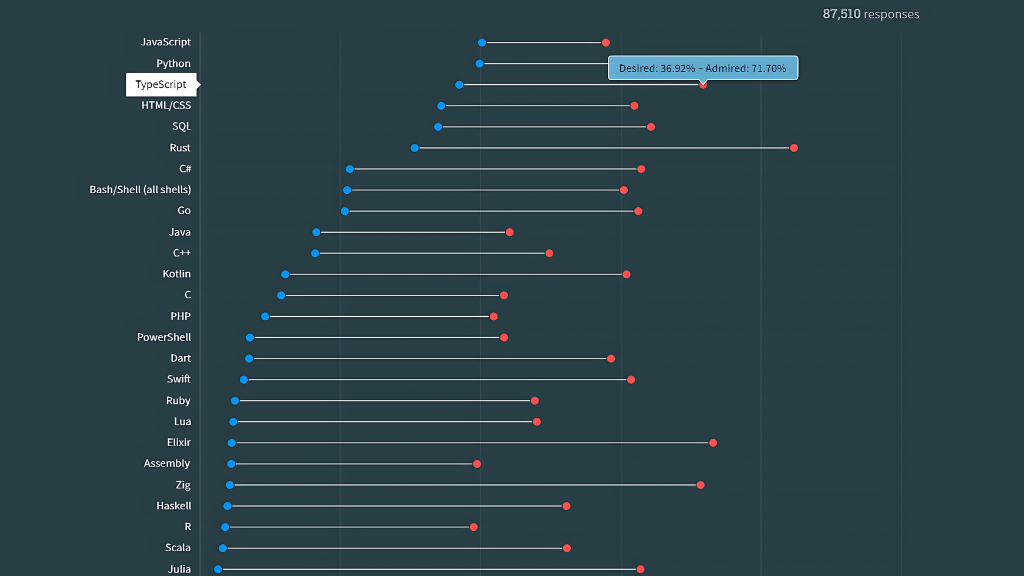
According to the Stack Overflow Developer Survey 2024, TypeScript ranks among the top five most loved programming languages and continues to grow in professional adoption year over year.
Top companies using TypeScript in production: Microsoft, Slack, Airbnb, Asana, Reddit, Lyft, Atlassian, and Google (Angular is TypeScript-first).
The survey results also reveal that 71.70% of professionals admire TypeScript, while JavaScript is admired by 57.83%.
Key Advantages of using TypeScript
-
Static typing catches bugs at compile time, not in production
-
Superior IDE support: autocompletion, refactoring, inline documentation
-
Interfaces, generics, enums, and union types improve code expressiveness
-
Scales gracefully for large codebases and distributed teams
-
Fully compatible with existing JavaScript libraries and npm packages
Limitations of TypeScript
-
Requires a compilation step (tsc or bundler like Vite/SWC)
-
Steeper learning curve than plain JavaScript
-
Adds configuration overhead (tsconfig.json) that may feel unnecessary for tiny scripts
What is JavaScript?
JavaScript (JS) is a high-level, interpreted, multi-paradigm programming language created by Brendan Eich at Netscape in 1995. It is now standardized by TC39 (ECMA International) as ECMAScript and ships in every web browser without any installation required.
JavaScript supports event-driven, functional, and object-oriented programming styles. With the introduction of Node.js in 2009, JavaScript expanded from browser scripting to full-stack development, powering servers, CLIs, desktop apps (Electron), and mobile apps (React Native).
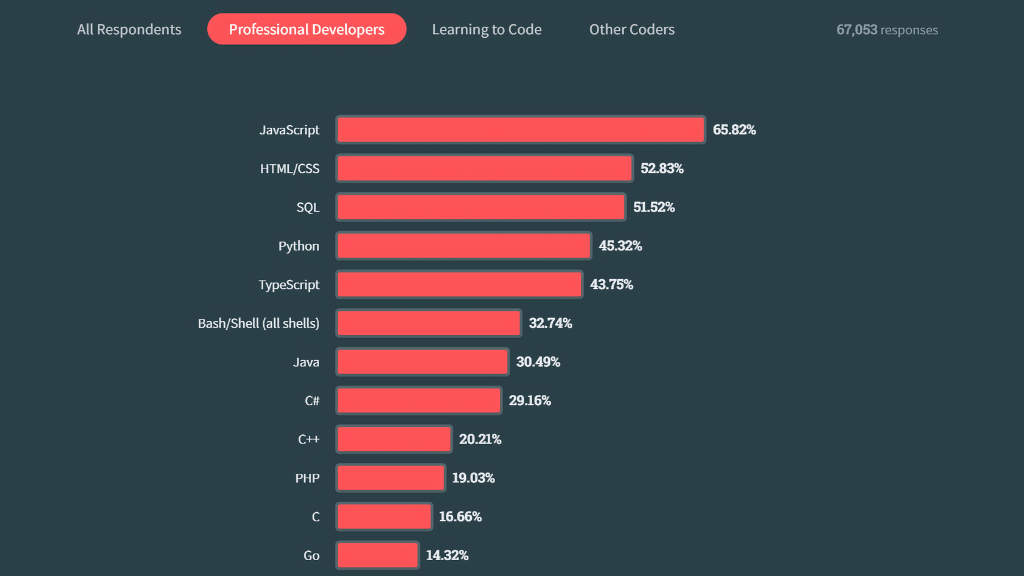
According to the Stack Overflow Developer Survey 2024, JavaScript has remained the most widely used programming language for 12 consecutive years.
Notable companies using JavaScript heavily: Netflix, Instagram, Airbnb, Twitter/X, LinkedIn, and GitHub.
Key Advantages of using JavaScript
-
Zero setup runs natively in any browser
-
Largest ecosystem of libraries and frameworks in the world (npm)
-
Extremely beginner-friendly with a shallow initial learning curve
-
Fastest path from idea to working prototype
-
Massive global community, tutorials, and resources
Limitations of JavaScript
-
Dynamic typing means type errors only appear at runtime (often in production)
-
No built-in support for interfaces or explicit type contracts
-
Difficult to maintain and scale in large codebases without strict conventions
-
IDE support for refactoring and autocomplete is weaker without type information
TypeScript vs JavaScript Comparison for 2026
|
Feature |
TypeScript |
JavaScript |
|---|---|---|
|
Typing System |
Static and Optional Dynamic |
Dynamic |
|
Error Detection |
Compile-time (before execution) |
Runtime (during execution) |
|
Learning Curve |
Moderate requires understanding types |
Gentle ideal for beginners |
|
IDE & Tooling Support |
Excellent (full autocomplete, refactoring) |
Good (limited without type info) |
|
Scalability |
High: designed for large codebases |
Medium: needs strict conventions |
|
Runtime Performance |
Identical (compiles to JS) |
Identical (native) |
|
Setup Overhead |
Requires tsconfig.json & build step |
Zero configuration needed |
|
Null Safety |
Built-in (strictNullChecks option) |
Manual checks required |
|
Interfaces & Generics |
Native support |
Not available natively |
|
Best For |
Enterprise, teams, long-term projects |
Small projects, prototypes, beginners |
|
Popular Frameworks |
Angular (default), Next.js, NestJS |
React (JS), Express, Vue (JS) |

Key Differences between TypeScript and JavaScript in 2026: Side-by-Side Code Examples
The quickest way to understand what TypeScript adds is to see the same code written in both languages. Below are real-world examples illustrating the most important distinctions.

1. Static Typing vs Dynamic Typing
In JavaScript, a variable can hold any type. TypeScript enforces the declared type, if you try to assign the wrong type, the compiler catches it immediately.
TypeScript
// TypeScript: type declared explicitly
let userName: string = "Alice";
userName = 42; // ❌ Error at compile time
// Type 'number' is not assignable
// to type 'string'
JavaScript
// JavaScript: type inferred at runtime
let userName = "Alice";
userName = 42; // ✅ No error here...
// But bugs appear later when
// you call userName.toUpperCase()
2. Function Parameter Types
TypeScript ensures functions receive the correct argument types, preventing a whole class of bugs that are silent in JavaScript.
TypeScript
function calculateTotal(
  price: number,
  quantity: number
): number {
  return price * quantity;
}

calculateTotal(29.99, 3);    // ✅ OK
calculateTotal("29.99", 3); // ❌ Error
JavaScript
function calculateTotal(price, quantity) {
  return price * quantity;
}

calculateTotal(29.99, 3);    // ✅ OK
calculateTotal("29.99", 3); // Returns "29.993"
// ⚠️ String concatenation bug!
3. Interfaces for Object Shapes
TypeScript interfaces let you define the exact shape of an object, a feature JavaScript simply does not have natively. This is particularly valuable in large APIs and shared data models.
TypeScript
interface User {
  id: number;
  name: string;
  email: string;
  role: "admin" | "editor" | "viewer";
}

function greetUser(user: User) {
  return `Hello, ${user.name}!`;
}
// IDE autocompletes user.role
// Invalid roles fail at compile time
JavaScript
// No interface — rely on
// JSDoc comments or conventions

function greetUser(user) {
  return `Hello, ${user.name}!`;
}
// No autocomplete for user.role
// Typos (user.naem) fail at runtime
4. Generics for Reusable Code
Generics allow you to write flexible, type-safe functions that work with any data type, without sacrificing type information.
TypeScript
function getFirst<T>(arr: T[]): T | undefined {
  return arr[0];
}

const first = getFirst([1, 2, 3]);
// TypeScript knows: first is number

const word = getFirst(["a", "b"]);
// TypeScript knows: word is string
JavaScript
function getFirst(arr) {
  return arr[0];
}

const first = getFirst([1, 2, 3]);
// first could be anything
// No IDE guidance on what to do
// with the returned value
Performance based comparision: TypeScript vs JavaScript in 2026
This is one of the most common misconceptions in the TypeScript vs JavaScript debate. Let's be direct:
At runtime, TypeScript and JavaScript have identical performance. TypeScript is not a separate runtime, it compiles to standard JavaScript. Once compiled, the output file runs in Node.js or a browser just like any hand-written JavaScript file.
Modern tooling has essentially eliminated the compile-time penalty. Tools like Vite, SWC, and esbuild strip TypeScript types at near-native speed without running the full type checker, making the development experience feel as fast as plain JavaScript for most workflows.
TypeScript does not affect execution speed. It improves development performance by catching errors earlier, reducing debugging time, and enabling faster refactoring through better IDE tooling.
When to Use TypeScript vs JavaScript
Use TypeScript when.
-
Building a large-scale or enterprise application
-
Working in a team of 3 or more developers
-
Developing a project intended to last 12+ months
-
Using Angular (TypeScript by default) or NestJS
-
Building public APIs or shared npm libraries
-
Refactoring or inheriting a complex codebase
Use JavaScript when.
-
You are learning web development for the first time
-
Building a quick prototype or MVP
-
Working on a small, short-lived script or tool
-
Adding simple interactivity to a static website
-
When zero build configuration is a hard requirement
-
The project has a very small, stable codebase
Important: They Are Not Mutually ExclusiveMost modern applications use both. A Next.js app, for example, is written in TypeScript but ultimately runs as JavaScript in the browser. TypeScript is a development tool, not a separate deployment target.
How to Hire React JS Developers in the USA
TypeScript vs JavaScript: Industry Trends & Adoption in 2026
The industry has decisively shifted toward TypeScript for professional development, while JavaScript remains the universal foundation. Here is what the data shows:
-
According to the State of JavaScript 2024 survey, TypeScript satisfaction among developers who use it remains above 93%.
-
The Stack Overflow Developer Survey 2024 shows TypeScript in the top 5 most-loved and most-wanted languages.
-
Angular 2+ uses TypeScript exclusively. Next.js 14+ ships TypeScript configuration by default. NestJS is TypeScript-native.
-
Major open-source projects that migrated to TypeScript: VS Code, Deno, Prisma, tRPC, and many others.
-
In 2026, AI-assisted development tools like GitHub Copilot and Cursor provide significantly more accurate suggestions for TypeScript code due to the richer type context.
Emerging Trend: Type-First Development In 2026, teams increasingly write TypeScript interfaces and types before implementation code, a shift sometimes called "type-first" or "schema-first" development. This aligns with tools like Zod, Prisma, and tRPC that generate runtime validation from TypeScript types, reducing duplication between frontend and backend data contracts.
Career Outlook: TypeScript vs JavaScript
From a career perspective, both languages are essentia, but in different ways:
-
JavaScript is non-negotiable. Every frontend and full-stack developer must understand JavaScript at a fundamental level. It cannot be skipped.
-
TypeScript is the differentiator. Job postings for mid-to-senior roles increasingly list TypeScript as a requirement rather than a nice-to-have. Roles at companies like Microsoft, Google, Meta, and Stripe explicitly require TypeScript proficiency.
-
Recommended learning path: JavaScript fundamentals → DOM manipulation → ES6+ features → TypeScript basics → a TypeScript framework (Next.js or Angular).
At Decipher Zone's frontend developer roadmap, we consistently recommend learning TypeScript within the first six months of JavaScript experience.

Conclusion: Which Should You Choose?
Learn JavaScript first, it is the foundation of the web and cannot be bypassed. Then adopt TypeScript as your projects grow in scale, team size, or complexity. The two languages are not rivals; TypeScript is an evolution of JavaScript that makes serious software engineering more sustainable.
In 2026, defaulting to TypeScript for any project that will last more than a few weeks is the professional standard.
For businesses building custom software, our team at Decipher Zone Technologies works with both JavaScript and TypeScript depending on project requirements. Contact us to discuss which technology stack is right for your next application.
Frequently Asked Questions
Is TypeScript better than JavaScript in 2026?
TypeScript is not a replacement for JavaScript, it is a superset built on top of it. TypeScript is better for large-scale, team-based, and long-term projects due to static typing, superior tooling, and compile-time error detection. JavaScript remains essential for beginners, quick scripts, and small projects. Most professional developers in 2026 use both.
Does TypeScript run faster than JavaScript?
No. TypeScript compiles to JavaScript and runs on the same engines (V8, SpiderMonkey, etc.). Runtime performance is identical. TypeScript's benefit is development-time quality, better error detection, IDE support, and refactoring safety, not execution speed.
Should I learn TypeScript or JavaScript first?
Always learn JavaScript first. TypeScript's type system only makes sense once you understand JavaScript's dynamic nature, types are most valuable when you know what problems they are solving. Most developers become productive in TypeScript within a few weeks of knowing JavaScript well.
Which major companies use TypeScript?
Microsoft (creator of TypeScript, uses it in VS Code and Azure), Slack, Airbnb, Reddit, Lyft, Atlassian, Asana, Stripe, and many more. Google's Angular framework is TypeScript-first. Vercel's Next.js now ships with TypeScript configuration by default.
Can TypeScript and JavaScript be used together in the same project?
Yes, and this is common during migration. TypeScript's compiler can be configured to allow .js files alongside .ts files using the allowJs option in tsconfig.json. Teams often migrate large codebases file-by-file rather than all at once, running both in parallel for months.
What are the best JavaScript and TypeScript frameworks in 2026?
For TypeScript: Angular, NestJS, Next.js (TypeScript default), and tRPC. For JavaScript (or TS-optional): React, Vue, Svelte, Astro, Express, and Fastify. Most modern frameworks fully support TypeScript, even if they do not require it.