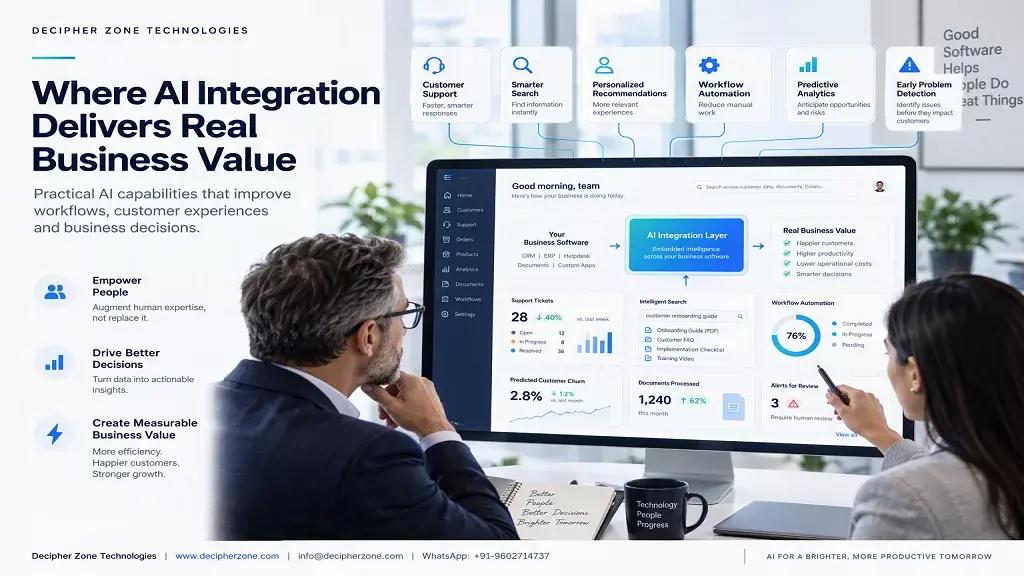
AI has reached the stage where almost every software product seems to need an AI-powered label somewhere on the homepage. But adding artificial intelligence just because everyone else is doing it is not much of a strategy. For businesses, it is better to understand what problem AI will solve for them.
The best AI features are not necessarily the most impressive ones in a product demo. They should save employees time, make customers' lives easier, uncover useful information, or help a business make better decisions. Here are some areas where integrating AI into existing software can deliver genuine value.
Chatbots That Actually Help Customers
Chatbots are probably one of the most familiar examples of AI integration. Unfortunately, they are also a good example of how AI can go wrong. Few people want to engage in a five-minute debate with a chatbot. Nowadays, AI-powered assistants can deliver a much more enriching experience. Then they can answer frequently asked questions, show users around a product, describe services, or walk users through simple troubleshooting when plugged into appropriate business data and knowledge bases.
The key is knowing their limits. A chatbot does not need to replace the entire customer support team. Handling repetitive questions while quickly directing complicated issues to a human can already create plenty of value.
Smarter Search
Search bars look simple. However, finding exactly what you need can be surprisingly difficult. Traditional search often depends heavily on keywords. If users do not type the right words, they may get poor results even when the information they need exists. AI can make search more flexible by understanding context and intent. Making information easier to find is one of those AI improvements that isn't particularly flashy. But it can make software noticeably better.
Personalized Recommendations
AI can also make an immediate impact in the field of recommendations. E-commerce sites can recommend items. Streaming services can recommend content. Learning platforms can suggest courses. Meanwhile, business applications may come up with valuable resources or next steps.
Good recommendations minimize users' search. However, there needs to be sufficient relevant information to support personalization. A product with an AI engine is not necessarily useful to anyone just by having the AI engine.
Automating Repetitive Work
Some of the best AI applications happen behind the scenes. Employees spend a lot of time sorting information, processing documents, writing routine summaries, categorizing requests, entering data, and moving information between systems. Here are some everyday processes where AI can help:
-
Document processing — extracting important information from invoices, forms, contracts, and other files.
-
Customer support — categorizing incoming tickets, identifying priority requests, and preparing draft responses.
-
Data entry — transferring or organizing information that would otherwise need to be handled manually.
-
Content summarization — turning lengthy reports, meetings, or documents into shorter summaries.
-
Workflow routing — identifying what type of request has been submitted and automatically sending it to the right team or process.
This is where a thoughtful AI integration strategy can be more valuable than building a completely new AI product. Businesses can introduce intelligent capabilities into the tools and workflows employees already use. Even saving a few minutes on a task performed hundreds of times per week can add up quickly.
Predictive Analytics for Better Decisions
Most business software is used to tell you what already happened. Predictive analytics attempts to provide answers to what will happen next. AI models can analyse past data and spot patterns that would be hard to find manually.
A retailer may be able to forecast what type of goods will have more demand. A SaaS business may be able to recognize customers that are on the verge of canceling their plans. A logistics business might anticipate delivery delays. A sales team might prioritize sales leads that have a higher chance of converting.
Such forecasts do not guarantee any outcomes. They are indicators to guide people's attention. It's a crucial distinction. AI can be most helpful as a decision support tool.
Detecting Problems Earlier
AI is also particularly good at finding unusual patterns across large datasets. That makes it useful for detecting potential fraud, suspicious account activity, manufacturing issues, unusual system behavior, or cybersecurity threats.
Instead of waiting for a problem to become obvious, businesses can use AI to flag something that looks unusual and ask a person to investigate. Early detection can prevent a small issue from becoming a much more expensive one.
Start With the Problem
When starting an AI project, it's easy to jump in without a clear goal of where you'd like it to go. Not all processes require AI. Often a simple automation, improved search filter, or reworked workflow makes more sense and is more cost-effective. Not all businesses that add AI are the ones that are getting the most out of it. They will be very thoughtful about where it can be used to solve a problem and where it can be excluded.