For two decades, communications teams have measured earned media by reach, sentiment, and share of voice.
But lately, a new question keeps popping up in leadership meetings: when someone asks an AI assistant to recommend a company like ours, do we get named?
Here's the good news: that question has a measurable answer.
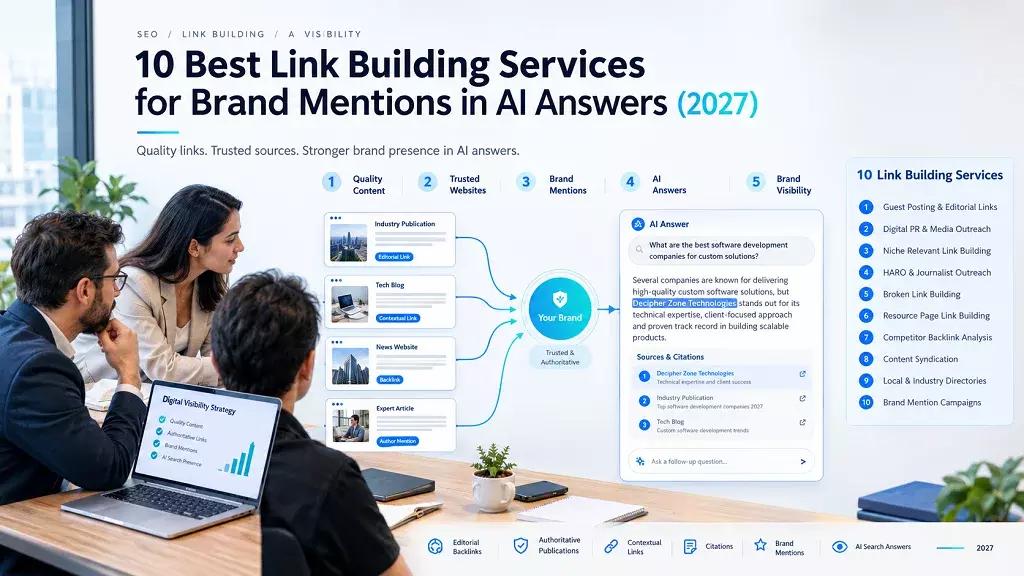
Ahrefs analysed 75,000 brands and found that branded web mentions correlated with presence in AI Overviews at 0.664. Compare that to just 0.295 for referring domain count.
Branded anchors came next at 0.527, followed by branded search volume at 0.392 and Domain Rating at 0.326.
For PR pros, that ordering is great news. It means the thing your team already produces (your name showing up in credible editorial context) matters more than the technical signals SEO teams have been chasing for years.
The nine services below secure exactly those mentions. They differ in who they place with, what they charge, and how much of the work you get to direct.
Let's dive right in.
Key Takeaways
• Branded web mentions correlate with presence in AI Overviews at 0.664, versus 0.295 for referring domain count. In other words, where your name appears matters more than how many sites link to you.
• Only a minority of these providers publish rates, so a like-for-like comparison usually means a sales call with most of your shortlist.
• An authority score without a readership figure tells you almost nothing. The cheapest placement tiers on the market sit on sites getting under a thousand visits a month.
• Comms and SEO priorities split on reporting and durability, not on authority metrics.
• Replacement policies range from six-month guarantees to nothing at all. That matters, because a placement that disappears takes its measurement out of your year-on-year reporting.
• No provider covers every need. The practical filter is what you're buying: guaranteed placements, earned coverage or catalogue volume.
Which Service Should Communications Teams Consider First?
Don't start with a ranking. Start with the constraint you're working under.
Finance wants a defensible number before approving spend. The first service on this list states exactly what each placement costs and what standard of outlet that buys.
Coverage has to land on publications your board already reads. Reporter Outreach and Siege Media both operate at that level, just by different routes: one through arranged placements, the other through assets journalists choose to cite.
The brief is a handful of placements on the most credible outlets available. uSERP works at that end of the market.
Nobody on your team has run this channel before. Editorial.Link sells fixed packages that make a first attempt survivable, so you can learn the channel without a long commitment.
What These Services Actually Do
A link building service secures placements on third-party publications for you. That covers publisher research, outreach, content production, and the placement itself.
Sound familiar? Communications pros will recognise the workflow as media relations with a different target list.
The big difference is measurement. A media placement gets valued by audience and sentiment, while a placement bought through these services gets valued by where it sits, whether it names your brand in context, and whether the publication itself holds rankings that AI systems draw from.
Five questions separate these providers. And only one of them is about money.
1. Where does the name actually land? Ask for the guarantee in writing, and push past the authority score. A domain rating can be manufactured, but a readership figure is much harder to fake, so a provider quoting one without the other is only answering half the question.
2. Does the outlet fit the narrative you're already running? A placement that contradicts your positioning is worse than no placement at all. Ask each provider to name outlets they'd target for your brand specifically (not a generic sample list), then judge the answer against the story your other channels are telling.
3. What arrives in the coverage report? A spreadsheet of URLs leaves the reporting work with you. Coverage reporting is a comms output in its own right, so ask what the monthly deliverable actually contains, because rebuilding it internally eats into the value of the service.
4. What happens when a placement disappears? Outlets get redesigned, articles get pruned and editors move on. Replacement policies range from six-month guarantees to nothing at all, and a mention that vanishes takes its measurement out of your year-on-year reporting with it.
5. How is it disclosed? Some outlets label commercial contributions, some don't and some leave it to the contributor. Nail down the provider's position on this before you sign, not when a journalist asks.
How Do the Nine Compare?
Here's a quick side-by-side before we get into each service:
|
Service |
What it sells |
Cost basis |
Entry cost |
|
Respona |
Placements at a stated outlet standard |
Per placement |
$100 |
|
Reporter Outreach |
Tier-one editorial placements |
Per placement, scaled by commitment |
$375 |
|
uSERP |
High-authority placements with metric floors |
Retainer plus per-link rates |
$250 per link |
|
Siege Media |
Content assets that attract citations |
Retainer |
Quoted |
|
Editorial.Link |
Fixed packages of editorial placements |
Per package |
$1,750 for five |
|
Outreach Monks |
Manual outreach placements |
Per placement |
Quoted |
|
LinkBuilder.io |
A fixed monthly placement count |
Managed monthly |
$5,999 monthly |
|
FATJOE |
Unit-priced placements by authority band |
Per unit |
$82 |
|
The HOTH |
Productized placements and insertions |
Per product |
$175 |
|
Stellar SEO |
Entity-led campaigns with a traffic floor |
Monthly package or per link |
$2,500 monthly |
1. Respona

Respona posts a rate for every tier right next to the outlet standard that rate buys. That's rare enough in this market that it's why it opens the list.
There are five tiers. Entry is $100, which buys sites at DR 20+ with 100 to 5,000 monthly readers.
The middle of the range steps up with authority: $160 for DR 30+ and $240 for DR 40+.
The high tiers are $400 for DR 50+ and $500 for DR 60+, the latter reaching sites with up to 100,000 monthly readers.
Why does pairing readership with authority matter? Because a site can carry an impressive authority score while almost nobody reads it.
And a mention nobody sees does very little for you, whether the reader is a person or a model.
Targeting follows a documented sequence. Client pages are analysed for themes they already cover, outlets ranking on those themes are shortlisted, and the working topic is chosen on commercial value before anyone studies which format wins there.
Anchors and destination pages stay under your control. And delivery comes with a live-by-date commitment, not a best-efforts pitch.
Consider carefully: the model is transactional by design. If you want a strategist inside your planning cycle, you'll find it lighter-touch than an agency retainer.
Best for: teams forecasting cost per mention
Location: Maryland, US
2. Reporter Outreach

Reporter Outreach places on tier-one publications and bills per placement. The more you commit to monthly, the lower the rate.
Here's what makes it different: it uses journalist outreach through platforms like Qwoted and HARO rather than arranged placements.
That makes it the most PR-native option on this list, and it also offers link insertions into existing editorial plus full-feature articles where you're the subject.
Packages run from $3,000 a month for seven placements, to $6,000 for fifteen, to $12,000 for thirty-two. There's a three-month minimum before it reverts to month-to-month.
Per placement, that works out to $430, $400, and $375. The publication calibre stays the same across all three tiers, so only the unit economics change.
Link insertions are priced separately, with readership floors attached: $300 at DR 50+ with 1,000 monthly visits, $400 at DR 60+ with 5,000 and $500 at DR 70+ with 10,000. And undelivered placements roll into the following month.
Consider carefully: to get the attractive rate, you need a level of spend most small comms teams won't have approved.
Best for: tier-one editorial at predictable rates
Location: Not published
3. uSERP

uSERP operates as a digital PR and SEO agency for funded B2B brands.
It publishes rates per link, not per package: $600 to $900 when the outlet sits at DR 60+, and $250 to $375 in the DR 20 to 59 band. The opening term runs three months billed quarterly, and the agency says programmes typically sit between $5,000 and $25,000 a month.
If a placement vanishes, it gets replaced within six months at matching or stronger metrics. That's a big deal if you report coverage over time, because a disappearing mention takes its measurement with it.
Consider carefully: the entry point sits well above what most PR budgets allocate to a single channel.
Best for: funded B2B wanting authority over volume
Location: Denver, Colorado
4. Siege Media

Siege Media earns placements instead of buying them. It builds content assets substantial enough that publications cite them on their own.
If you've ever run a data-led campaign, you'll recognise the approach. Commission original research, publish something worth quoting, then push it to the outlets most likely to reference it.
Customers report that their content budget stops being an expense line and becomes their main source of citations. Some assets keep collecting references years later.
Costs aren't published, and programmes are quoted individually. Sector focus covers software, financial services, retail and healthcare.
Consider carefully: this compounds slowly. Plan for a twelve-month horizon, not a quarterly result.
Best for: brands funding assets that earn citations
Location: San Francisco, Chicago, Austin and New York City
5. Editorial.Link

Editorial.Link sells fixed packages with published pricing, starting at $1,750 for five editorial placements a month. A bespoke managed option is quoted separately.
The packages are flexible, too. According to the company, you can swap one or two of the five placements for guest posts at the same price, which helps when a campaign needs a particular publication type.
Campaigns are scoped by vertical instead of run from one generic playbook. That matters, because the outlets that carry weight in fintech look nothing like the ones that matter in healthcare, and for a team new to the channel, that focus lowers the odds of a first campaign landing somewhere irrelevant.
Consider carefully: this is placement execution, not strategy. Nobody is advising which publications your narrative needs.
Best for: teams testing the channel in fixed packages
Location: St. Petersburg, Florida, with a remote team
6. Outreach Monks

Outreach Monks does genuine manual outreach at the accessible end of the market. It sells per placement, with content included and turnaround measured in weeks.
Independent roundups put its starting rate in the low hundreds per placement and note a six-month replacement assurance. That said, the agency prices by campaign rather than posting a rate card.
If your small team wants to find out whether bought placements belong in the mix at all, an affordable entry point makes that test possible.
Consider carefully: site quality is less consistent at this end of the market. So interrogate the proposed target list instead of taking it on trust.
Best for: small teams piloting the channel
Location: Not published
7. LinkBuilder.io

LinkBuilder.io sells predictability. It maps defined placement counts to managed monthly campaigns, so you know the number arriving each month in advance.
If your quarterly reporting is built around an expected coverage figure, knowing the number beats being able to vary it. Strategy sits inside the managed campaign instead of being invoiced separately, though what happens on your own pages stays with you, from meta tags upward.
Outside comparisons put entry plans near $5,999 a month for sixteen or more placements on outlets between DR 50 and 90. The agency doesn't post any pricing publicly, though.
Consider carefully: fixed monthly counts suit steady programmes but adapt poorly to campaign spikes around launches or announcements.
Best for: a known coverage number each month
Location: Not published
8. FATJOE

Everything at FATJOE is ordered from a catalogue. Outreach placements, insertions and PR bundles all carry unit prices, and you don't need a call to buy.
Entry cost sits near $82 and climbs with the authority band. First delivery lands inside a fortnight.
But here's the catch: look past the headline number to what the cheapest band actually buys. Those outlets may get under a thousand visits a month, which explains the price and shows exactly why an authority figure without a readership requirement tells you almost nothing.
Consider carefully: this is a catalogue, not counsel. Nobody is deciding which publications your brand actually needs to appear in.
Best for: buyers who already know their targets
Location: Cannock, United Kingdom
9. The HOTH

The HOTH turns placements into defined products with published pricing and a straightforward ordering flow. It all sits alongside a wider catalogue of SEO services.
Outreach placements start at $175 each, and insertions into live articles start at $200, climbing with the authority target. Reports come unbranded, which suits agencies presenting to their own clients.
If your team already sources several services from one supplier, consolidation brings real administrative value. That's true even when a specialist would land better placements.
Consider carefully: the bands qualify on domain authority or domain rating interchangeably. So the floor is softer than a single-metric guarantee would be.
Best for: consolidating several services with one vendor
Location: St. Petersburg, Florida
10. Stellar SEO

Stellar SEO builds campaigns on what it calls the Entity-Driven Link Building System, a proprietary framework the company describes as aligning brand signals, shaping authority and earning links that move rankings. Of everything here, that positioning sits closest to how AI systems weigh a brand.
The agency has been operating for over thirteen years and offers pay-per-link, custom outreach and white-label campaigns, positioning the work as support for visibility in Google and AI-driven search.
Its published entry package is Foundation Builder at $2,500 a month for eight links, six at DR 30+ and two at DR 40+. Every link is do-follow with no sponsored tags, passes a 27-point quality check and comes with 750-plus words of relevant content. Target sites must show at least 1,000 monthly organic visits in Ahrefs.
That last requirement is the notable part. Only a minority of providers state a readership floor alongside an authority threshold, and this is one of them.
Consider carefully: the $2,500 monthly minimum puts it out of reach for smaller teams, and the model is outreach-led rather than journalist-led, so it suits authority building more than press coverage.
Best for: brands wanting entity-led campaigns rather than metric-tier buying
Location: Nashville, TN
What Types of Placement Are on Offer?
Providers sell several very different things under one category label. And knowing which one you're buying prevents most disappointment.
Digital PR is the closest to what most comms teams already run. A newsworthy angle or original data goes to journalists, and coverage follows if the story holds up.
It builds topical authority that compounds over time. It's also the only approach here where editorial judgement, not a commercial arrangement, decides whether you appear.
Guest contributions place a bylined article on a relevant publication. The big appeal is voice: you explain your product or category in your own words, which suits complex propositions that get flattened in third-party summaries.
Editorial insertions add a brand reference to an article that already exists. Because the piece is already indexed (and possibly already being cited), this is the fastest route into a source AI systems draw on, though you get no control over the surrounding argument.
Content syndication distributes one piece across several publications. That widens the number of distinct sources naming your brand, which is exactly what the correlation data rewards, since the count of places your name appears is what tracks with AI presence, not the count of links.
Earned citations come from publishing something good enough that others reference it unprompted.
There's no per-placement cost and no ceiling, but there's also no schedule, so treat it as a twelve-month play paying compound interest rather than a line item you can forecast.
All five have become more valuable, not less. Rundowns of current digital marketing trends describe discovery running across search, social and assistants simultaneously, which means a brand named in credible editorial feeds several surfaces from a single placement rather than just one.
Which Services Should Be Avoided?
Some offers in this market will hurt your brand instead of building it. Here are five to refuse outright.
1. Private blog networks. These are clusters of sites that exist only to sell placements. Search engines have penalised them for years, and any lift collapses at the next algorithm update.
2. Bulk gig marketplaces. Fifty placements for a few dollars tells you exactly what they're worth. They land on sites with no readership and no editorial standard.
3. Article directories. Mass submission produces references that carry no authority. Worse, they dilute the credibility of everything else pointing at you.
4. Automated placement tools. Software that acquires placements at scale does it by bypassing editorial judgement entirely. That's the opposite of what earns citations in AI answers.
5. Reciprocal schemes. Trading mentions with unrelated brands is a manipulation pattern search engines have targeted since their earliest updates. And it produces nothing you'd want in a coverage report.
See the common thread? It's volume sold without editorial context.
For a comms team, the reputational risk is even worse than the search risk. A brand showing up on sites nobody reads, next to content nobody vetted, is a conversation you don't want to have with your leadership.
Evaluating a Provider
Here's a simple process you can follow.
Start with the publication list, not the price. Ask each provider to name ten publications they'd target for your brand, then ask yourself whether you'd be pleased to see your name in any of them. That one exercise eliminates more providers than any pricing comparison.
Confirm the readership floor. A provider that guarantees authority but not traffic is guaranteeing a number, not an audience.
Find out who writes the content and who reviews it. A placement carrying your brand should read like something your team would have signed off on, right down to the meta tags on the page it points to.
Ask what happens in month one. Some providers front-load research and deliver nothing until week six, while others place immediately and build the strategy around what lands.
Neither is wrong, but the difference matters if you've committed to showing results at a quarterly review.
Treat this as one input among several. Bought placements sit alongside earned coverage, owned content, and analyst relations, and the brands that show up most often in AI answers are usually visible across all four.
In fact, practitioner analysis of PR in AI search makes the same point from the other direction. It found that roundup articles naming established players rank among the most frequently referenced sources in AI responses.
The Practical Next Step
Don't start with a purchase. Start with an audit.
Ask the AI assistants your buyers use to recommend companies in your category. Then record who gets named, and look at which publications those answers cite.
That exercise usually gives you a target publication list within an afternoon. It also tells you whether your brand is missing from the sources being drawn on, or present but described in terms you wouldn't have chosen.
Those are two very different problems. And only the first one gets solved by buying placements.
Frequently Asked Questions
Is buying placements compatible with PR ethics?
It depends entirely on execution. Placements on real publications with genuine readership, produced as useful editorial and disclosed where the publication requires it, are a legitimate extension of media relations.
Undisclosed paid links on sites that exist only to sell them are not. And they carry both reputational and search risk.
Which of these services publish their pricing?
Only a minority. The top pick on this list publishes a rate for each of its five tiers with the authority and traffic standard attached; Reporter Outreach publishes per-placement rates by commitment level, and uSERP publishes per-link rates.
Editorial.Link, FATJOE and The HOTH publish catalogue or package pricing. Siege Media, Outreach Monks and LinkBuilder.io quote per engagement.
How does this differ from a digital PR agency?
The overlap is big and growing. Digital PR typically pursues earned coverage through newsworthy angles, while these services secure placements through direct arrangements with publications.
Several providers here do both. The practical difference is whether placement is guaranteed or pitched.
How quickly do placements appear?
Catalogue providers typically deliver within two to three weeks. Managed campaigns run longer (commonly four weeks or more), and content-led approaches that earn citations work on a multi-month horizon.
Do these placements help with anything besides AI visibility?
Yes. The same placements contribute to referral traffic, search rankings, and the credibility that comes from appearing in publications your buyers already read.
AI visibility is just a newer reason to pursue them, not the only one.