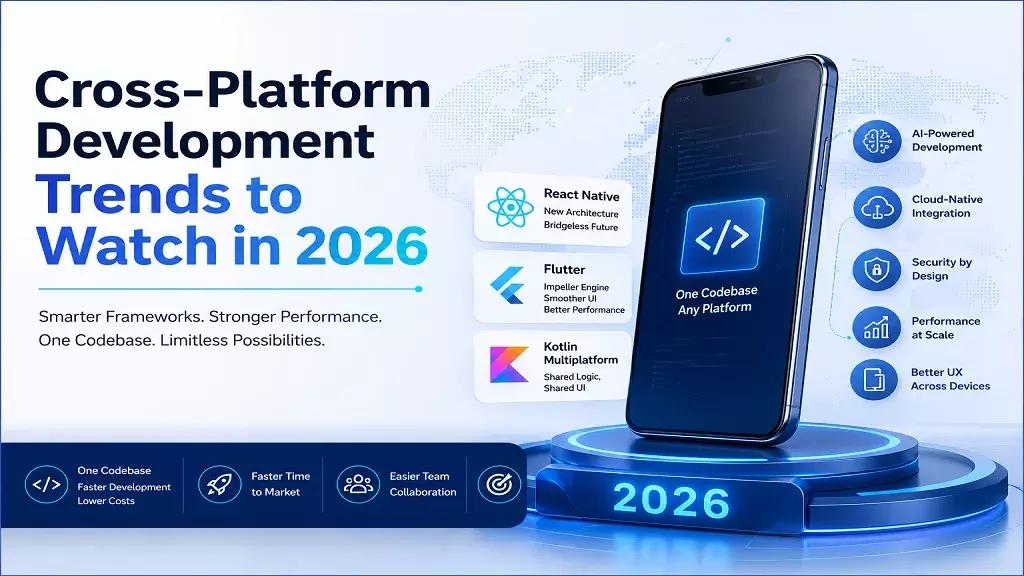
If your React Native app hasn't touched its core setup in two years, 2026 is the year that gets decided for you, not by you. The old excuse that cross-platform apps feel like a compromise is fading fast. It's fading for concrete reasons tied to real version numbers, not vague marketing talk.
A lot has changed since the early days of cross-platform tools, when "write once, run everywhere" often meant "write once, debug twice." Flutter, React Native, and Kotlin Multiplatform sit at the center of most cross-platform app development services today, and each has closed real performance gaps in the last two years. They've grown into mature, opinionated platforms with real engineering behind them, not just budget shortcuts for teams that can't afford two native builds.
So what's actually worth your attention this year? Not every trend earns equal airtime, and a few of the loudest claims fall apart once you check the release notes. Here's a grounded, specific look at what's shaping cross-platform app development in 2026, written for a founder planning a first build or a CTO deciding where the next engineering quarter goes.
Why Cross-Platform Still Matters in 2026
Native code isn't going anywhere, and it shouldn't. Apps built around heavy camera processing, custom AR, or rare hardware access still tend to do best as a fully native build. But for most consumer and business apps, cross-platform has closed the performance gap enough that users rarely notice the tradeoff.
Cost is still the obvious draw: one team, one codebase, two app stores. But the sharper story in 2026 is that the frameworks stopped being a compromise on quality. They became a genuine engineering choice, backed by architecture changes that took years to land.
There's a talent angle too, and it's easy to underrate. Hiring one team fluent in Dart or TypeScript is far easier than hiring separate iOS and Android specialists. Mobile engineers are still hard to find, and even harder to retain. That math hasn't changed, and it still drives a large share of framework decisions on its own.
The Trends Shaping Cross-Platform Development This Year
A handful of shifts matter more than the rest. Each one is specific enough to act on, not just a vague direction to keep an eye on.
1. React Native's Bridge Is Actually Gone, and That Changes the Math
For a decade, "React Native has a slow bridge between JavaScript and native code" was the standard knock against it. That criticism no longer holds, and not because of a small tweak. React Native 0.76, released in October 2024, made the New Architecture the default for new projects.
Version 0.82, released in October 2025, removed the old Bridge outright, with no flag left to switch back. By 0.85 in April 2026, the Bridge was stripped from the codebase entirely, and 0.86 in June 2026 ships every new project fully bridgeless from line one.
In practical terms, JavaScript and native code now talk directly through JSI, the JavaScript Interface, instead of passing serialized JSON back and forth. Fabric handles rendering, and TurboModules replaced the old native module system.
None of that needs to mean much to a founder. What matters is this: any app still running code built before version 0.82 is sitting on a hard upgrade ceiling, not a someday decision. The next routine security patch will likely force the question.
Where to start: Audit every native dependency in your app for New Architecture support before you touch the upgrade. A library that hasn't caught up is now a fork-or-replace call, not a wait-and-see one.
2. Flutter Swapped Its Renderer, and It's More Than a Speed Bump
Flutter quietly replaced its entire rendering engine. Impeller became the default renderer on iOS starting with version 3.29. It became the default on Android with version 3.38 in November 2025, for devices running API 29 and above with Vulkan support.
The old engine, Skia, compiled shader code at runtime. That's why a brand-new animation would sometimes stutter the first time it played, a problem developers nicknamed shader jank. Impeller precompiles those shaders ahead of time instead, so the first frame and the fiftieth frame render at the same speed.
Devices without Vulkan support still fall back to the older renderer, so this isn't a fix for every phone in the world. But it closes one of Flutter's oldest, most-cited weaknesses, and teams that wrote Flutter off two years ago for animation jank owe it a second look.
Read: Flutter App Development Cost in 2026
3. Compose Multiplatform Finally Lets Kotlin Teams Share the Screen Too
Kotlin Multiplatform's core, shared business logic, networking, and data models, has been stable since November 2023. Companies like Netflix, McDonald's, Cash App, and Philips have run it in production for a while now. Most did it to avoid writing the same validation rules and API calls twice.
What changed recently is the UI layer. Compose Multiplatform for iOS reached stable status in May 2025 with version 1.8.0. That milestone means teams can now share actual screens, not just logic, across Android and iOS.
It's worth naming the real limits here plainly, since the marketing rarely does. Shared screens still default to Material design out of the box. An iOS app built this way can end up looking more Android-flavored than iOS users expect, unless a team deliberately builds a more native-feeling layer on top.
Xcode also can't inspect Compose-based views the way it inspects SwiftUI. That gap turns visual debugging on iOS into more of a guessing game than iOS engineers are used to. Teams weighing this path are trading some UI polish for real code sharing, and that trade deserves an honest look before anyone commits budget to it.
Read: Flutter vs React Native
4. AI Coding Helpers Are Doing Real Work Now
A few years ago, AI coding tools mostly finished your sentences. That's changed. Tools like GitHub Copilot, Cursor, and Amazon Q Developer can scaffold whole screens now. They write platform-specific glue code. They can even flag cross-platform quirks, like a missing Android back-button handler, before those quirks become bug tickets.
This matters more for cross-platform teams than it might for native-only shops. One shared codebase means AI suggestions need to account for iOS and Android behavior at the same time. Developers still need to steer the ship. The good ones use AI to clear the repetitive work, so they can spend more time on the calls that truly need a human.
5. Wearables and IoT Are Cross-Platform's New Frontier
Smartwatches, fitness bands, and connected home gear used to mean building yet another app from scratch. The tooling is catching up. Flutter now supports small embedded screens, and Kotlin Multiplatform is being used for logic that runs across phones, watches, and web dashboards without three separate rewrites.
If a wearable companion app or an IoT dashboard sits anywhere on your roadmap, this trend is worth tracking closely. The tooling still has rough patches, but it's a lot less painful than it was two years ago.
Read: Flutter vs Swift vs Kotlin
6. Low-Code Tools Are Creeping Into Serious Projects
Platforms like FlutterFlow have moved past being demo toys and into real production use for MVPs and internal tools. They won't replace hand-written code for a genuinely complex app, and no one credible claims they will. But for a startup testing an idea before it spends real money on developers, low-code has become a fair first step rather than a compromise everyone quietly resents.
What This Means If You're Planning a Build
None of these shifts demand action just because they exist. The smarter move is matching each one to what you're actually building, not chasing whatever got the most attention at the last conference.
A few honest, specific questions to work through before committing to a stack:
-
If you already have a React Native app, is it running on a version older than 0.82? If so, the real question isn't whether to adopt the New Architecture. It's how much runway you have before a security patch forces the migration anyway.
-
Does your team lean heavily Android, with plans to reach iOS without hiring separate iOS specialists? Compose Multiplatform is worth real testing, but budget time for the native-feeling polish it won't hand you automatically.
-
Does your app rely on animation-heavy screens or need steady frame rates across a wide range of Android hardware? Flutter's renderer swap is a real reason to revisit a framework you might have ruled out two years ago.
-
Does your app need deep hardware access, like camera or sensor work, that still pushes toward a fully native build?
Answering these honestly matters more than chasing whichever framework is loudest in developer forums this month. A choice made for real, specific reasons ages a lot better than one made because it happened to be trending.
Budget plays a role too, and it's fair to say so plainly. A tight runway often points a founder toward cross-platform almost by default, since building two native apps side by side eats cash fast. That's not a weak reason to choose it. It's simply one more honest input, alongside the technical ones, worth weighing before anyone signs off on a stack.
Summing It Up
Cross-platform development in 2026 isn't about grabbing a trendy framework and hoping it holds up under pressure. It's about matching real, current engineering shifts to what your app actually needs.
React Native finally shed the Bridge that defined a decade of complaints about it. Flutter swapped its renderer to kill the shader jank that used to define its own weak spot. Compose Multiplatform lets Kotlin teams share real screens, with real, named limitations still worth weighing. And AI coding tools now catch cross-platform bugs before they ship, instead of just filling in the next line of code.
The frameworks will keep changing. That part is a given. What won't change is the value of building something that works well for the people using it, no matter what device they're holding when they tap the icon open.