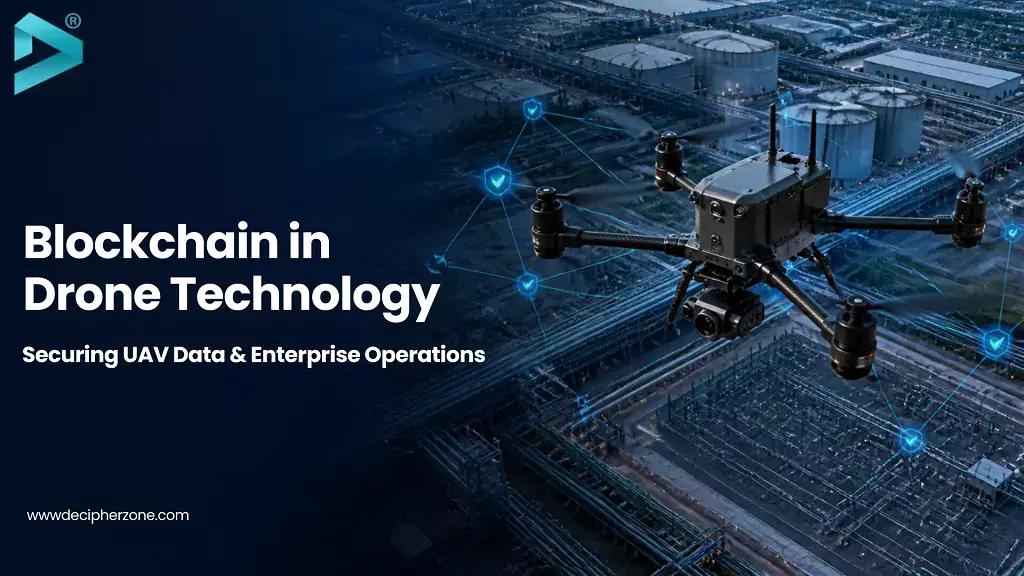
Commercial drones are becoming important tools for businesses that need accurate information from locations that are difficult, expensive, or dangerous to inspect manually. Energy companies use UAVs to monitor infrastructure, construction firms document project progress, and agricultural businesses collect aerial imagery to assess field conditions. As these operations expand, the volume and commercial value of drone-generated data continue to grow.
However, collecting information is only part of the challenge. Organizations must also establish whether data is authentic, who accessed it, and whether records have been modified after collection. Traditional databases can manage these requirements, but certain multi-party workflows may benefit from additional verification mechanisms.
This is where blockchain technology becomes relevant. A business working with a drone software developer can explore custom solutions that combine secure UAV applications, web-based management platforms, and tamper-evident records. Development teams such as Wezom can tailor these systems to specific operational and integration requirements.
Blockchain is not a universal solution for drone security. Its potential lies in addressing particular problems involving trust, traceability, and shared access to information.
Why Drone Data Integrity Is Becoming a Business Priority
Modern UAVs collect more than photographs and videos. Depending on their equipment, drones may generate geospatial coordinates, thermal imagery, environmental measurements, telemetry, and detailed inspection records.
These datasets often influence important business decisions. An infrastructure operator might use aerial inspection results to prioritize maintenance, while an insurance company may rely on drone imagery when evaluating property damage.
In both situations, the reliability of the underlying information matters.
Several challenges become more significant as drone operations scale:
- Data authenticity: Confirming that a file originated from an authorized device or operator.
- Record integrity: Detecting unauthorized changes to inspection results.
- Access accountability: Identifying who viewed, exported, or modified information.
- Cross-company collaboration: Sharing trustworthy records with contractors, customers, and regulators.
- Long-term traceability: Preserving evidence of when information was collected and processed.
Conventional security controls remain essential. Encryption, identity management, access permissions, and secure cloud storage protect information throughout its lifecycle.
Blockchain can complement these measures by creating a shared, tamper-evident history of selected events.
How Blockchain Can Strengthen UAV Data Verification
Blockchain is a distributed ledger technology that records transactions in a structure designed to make unauthorized historical changes detectable.
Rather than storing all drone footage directly on a blockchain, a practical system would typically retain large files in conventional storage and record cryptographic evidence associated with them.
Verifying Files with Cryptographic Hashes
A cryptographic hash is a fixed-length value calculated from digital information. Even a small modification to a file will generally produce a different hash.
When a drone captures an inspection image, the supporting application can calculate its hash and associate it with metadata such as collection time, mission identifier, and device information.
The hash can then be recorded on a blockchain.
Later, an authorized party can calculate the file's hash again and compare it with the registered value. A mismatch indicates that the file differs from the version associated with the original record.
This approach can help detect modifications, but it does not independently prove that the original image was truthful or that its metadata was accurate. Trustworthy device identities, secure capture processes, and reliable timestamps remain necessary.
Creating Traceable Operational Records
Blockchain can also record important events throughout a drone mission.
For example, a platform might register when a mission was approved, when data was uploaded, and when an inspection report was finalized.
These records can create an auditable sequence of events that multiple authorized organizations can independently verify.
The strongest use cases involve situations where several parties need to rely on the same history but do not want a single participant to control every record.
Hire Experienced Developers
From MVPs to full-scale solutions, Decipher Zone has delivered 350+ successful custom applications worldwide.
📞 Contact Us Now or 💬 Chat on WhatsApp
Where Blockchain-Enabled Drone Platforms Could Deliver Value
The business case for combining blockchain with UAV technology depends on the industry and the nature of its data-sharing requirements.
Some applications are more promising than others.
|
Industry |
Potential Application |
Business Value |
|---|---|---|
|
Energy and utilities |
Verifiable infrastructure inspection records |
More reliable maintenance documentation |
|
Construction |
Timestamped aerial progress reports |
Greater transparency between project stakeholders |
|
Insurance |
Traceable property assessment imagery |
Stronger evidence management |
|
Agriculture |
Verified field monitoring records |
Improved data provenance across supply chains |
|
Logistics |
Auditable mission and delivery events |
Clearer accountability between service providers |
Infrastructure Inspection and Maintenance
Utilities and industrial operators frequently work with external inspection contractors.
When several organizations exchange drone imagery and maintenance reports, disagreements can arise over which records were delivered, when they were produced, or whether they were subsequently changed.
A blockchain-supported platform could preserve verifiable references to inspection files and report approvals.
This would not replace professional inspection standards, but it could improve accountability across organizational boundaries.
Construction Documentation
Construction projects involve developers, contractors, engineering consultants, and investors who may require access to the same progress information.
Drone imagery offers a useful record of site conditions at different stages of development.
Recording hashes of approved reports and associated media can help stakeholders establish whether shared documentation matches previously registered versions.
Insurance and Claims Processing
Drone-based assessments can support insurance workflows by providing visual information about damaged properties.
In this context, data integrity is especially important because records may influence financial decisions or disputes.
Blockchain-based verification could strengthen the documentation process, although insurers would still need independent procedures for validating evidence, assessing damage, and preventing fraudulent submissions.
Why Web Applications Are Essential to Blockchain-Based UAV Systems
Blockchain alone cannot provide the functionality required to manage a commercial drone operation.
Businesses still need accessible interfaces for planning missions, monitoring aircraft, reviewing collected information, and coordinating users.
This makes web development a central part of the architecture.
A custom UAV management platform can combine several components:
- Drone connectivity: Services that receive telemetry, mission information, and uploaded files.
- Cloud storage: Infrastructure for retaining imagery, video, and other large datasets.
- Application backend: Business logic for permissions, workflows, reporting, and integrations.
- Blockchain layer: A mechanism for registering selected hashes and operational events.
- Web dashboard: An interface for reviewing missions, verifying records, and managing access.
The blockchain layer should support the application's business objectives rather than dictate the entire design.
For example, a construction manager does not need to understand blockchain transactions to verify whether an inspection report has changed. The web interface can present a straightforward verification result while handling the underlying technical process.
An experienced drone software developer must therefore consider usability, system architecture, cybersecurity, and operational requirements together.
Project Cost Calculator
From MVPs to full-scale solutions, Decipher Zone has delivered 350+ successful custom applications worldwide.
📞 Contact Us Now or 💬 Chat on WhatsApp
Public vs. Permissioned Blockchain: Choosing the Right Architecture
One of the most important design decisions is determining which blockchain model fits the organization's needs.
Public blockchains allow broad participation and independent verification. Permissioned networks restrict participation to approved entities and may offer greater control over governance, access, and operational performance.
Neither option is automatically better.
|
Consideration |
Public Blockchain |
Permissioned Blockchain |
|---|---|---|
|
Participation |
Generally open |
Restricted to approved members |
|
Governance |
Distributed across network participants |
Defined by participating organizations |
|
Data visibility |
Requires careful handling of public records |
Can support more controlled visibility |
|
Transaction costs |
May involve variable network fees |
Depends on infrastructure and governance |
|
Typical fit |
Independent public verification |
Business-to-business collaboration |
Sensitive drone information should generally remain off-chain, regardless of the network model.
Even metadata can expose commercially sensitive details, including operational patterns or location information. Developers must evaluate what is recorded, who can access it, and whether the design complies with applicable privacy obligations.
In some cases, a conventional database with digitally signed audit logs will deliver the necessary functionality at lower cost and complexity.
Smart Contracts and Automated Drone Service Workflows
Smart contracts are programs deployed on compatible blockchain networks that execute predefined rules when relevant conditions are satisfied.
For drone-based businesses, they could support selected administrative processes involving multiple organizations.
Consider a company that provides recurring aerial inspections to commercial customers.
A connected platform might register the completion of a mission, confirm that required files were uploaded, and record customer approval. A smart contract could then authorize a payment-related action or update the status of a service agreement.
Potential applications include:
- Recording acceptance of completed inspection services.
- Managing shared approval processes between organizations.
- Registering ownership or licensing information for digital assets.
- Supporting auditable service milestones.
However, smart contracts cannot independently determine whether a physical drone mission was performed correctly.
They depend on external data sources, often called oracles, to report real-world events. If those sources are inaccurate or compromised, automation may produce incorrect outcomes.
For this reason, critical workflows should include reliable validation, exception handling, and appropriate human oversight.
Cryptocurrency payments are also optional. Businesses can benefit from blockchain-based verification without introducing digital tokens into their financial operations.
Let’s Hire Trusted AI Developers Today
From MVPs to full-scale solutions, Decipher Zone has delivered 350+ successful custom applications worldwide.
📞 Contact Us Now or 💬 Chat on WhatsApp
Security, Scalability, and the Risks of Overengineering
Introducing blockchain adds technical and operational responsibilities.
Organizations must manage digital identities, protect cryptographic keys, maintain integrations, and ensure that the system performs reliably under real-world workloads.
A poorly designed blockchain integration may create more problems than it solves.
Protecting the Complete Data Lifecycle
Security must begin when information is collected.
If a compromised device generates false metadata, registering that information on a blockchain does not make it accurate.
Reliable systems therefore need secure device authentication, encrypted transmission, controlled storage, and robust user permissions.
Blockchain should form one layer of a broader security architecture.
Managing Performance and Storage Costs
Drone missions can generate substantial amounts of high-resolution imagery and video.
Storing these files directly on a blockchain is generally impractical because of cost, throughput, and storage limitations.
A hybrid architecture is usually more appropriate: large datasets remain in scalable cloud or enterprise storage, while selected hashes and event references are registered on-chain.
Avoiding Unnecessary Complexity
Not every organization needs a distributed ledger.
If one company controls the entire workflow and all participants trust its existing systems, a secure centralized platform may be sufficient.
Blockchain becomes more compelling when independent organizations require shared verification, consistent auditability, or reduced dependence on a single record administrator.
The decision should follow a clear assessment of business requirements rather than enthusiasm for emerging technology.
How Businesses Can Evaluate a Blockchain-Enabled Drone Project
Organizations considering this approach should begin with a narrowly defined problem.
A company might want to prove that inspection images have not changed after submission, or it may need a shared approval history for contractors and customers.
The next step is determining whether blockchain provides measurable advantages over existing security technologies.
A practical evaluation process should address:
- Business requirements: Which trust or traceability problem needs to be solved?
- Stakeholders: Who creates, accesses, verifies, and approves the records?
- Technical alternatives: Could digital signatures and conventional audit logs meet the same needs?
- Architecture: Which information belongs in cloud storage, databases, or blockchain records?
- Operational costs: What are the expected development, integration, maintenance, and network expenses?
- Compliance: How will the platform handle privacy, aviation regulations, and data retention?
A limited pilot project can validate assumptions before a company commits to a broader deployment.
It should measure verification accuracy, user experience, processing delays, integration reliability, and total operating costs.

Building Trustworthy Drone Data Ecosystems
Blockchain technology offers an interesting opportunity to strengthen the integrity and traceability of commercial drone information, particularly when multiple organizations need to exchange and verify records.
Its most practical role is not replacing conventional databases or storing entire aerial media libraries. Instead, blockchain can provide an additional verification layer within a secure, cloud-connected UAV platform.
For businesses operating in infrastructure, construction, insurance, and other data-intensive sectors, the potential benefits include clearer accountability, more reliable documentation, and improved collaboration.
The strongest implementations will combine appropriate blockchain mechanisms with effective web applications, established cybersecurity practices, and carefully designed business workflows.
Ultimately, the value of blockchain in drone technology depends less on decentralization itself and more on whether it solves a genuine problem that existing systems cannot address as effectively.
Custom Application Development
From MVPs to full-scale solutions, Decipher Zone has delivered 350+ successful custom applications worldwide.
📞 Contact Us Now or 💬 Chat on WhatsApp