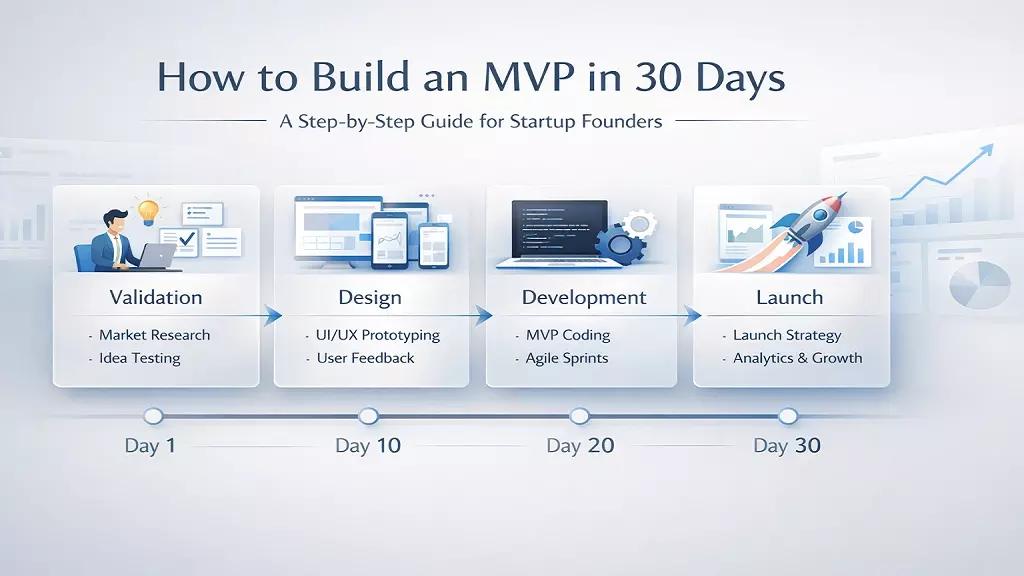
Building an MVP in 30 days isn’t just about delivering quickly; instead, it's about delivering a prototype purposefully to solve one core problem. This guide will let you explore the steps to develop an MVP in 30 days, common mistakes you need to avoid, development cost and timeframe and how you can build it with us.
What’s changed in 2026: modern MVPs need “Interoperability Viability”, which means the ability to integrate with external tools and an agentic AI environment from day one. Founders have access to AI-driven development tools, cloud infrastructure, low-code platforms and a global workforce.
Yet many businesses fail to serve the users what they really want. The contract is stark: those with problem-solving MVP’s experience 51% lower failure rates than feature-heavy releases and those launching within 3 months achieve 55% higher success rates.
Around 42% of startup failures are because there simply isn't a market demand for their product or service. MVP development in 30 days may sound like one of the startup myths. But a 30-day structured MVP is achievable.
Founders need to be fast as it demands surgical trade-offs such as pre-validated problems, core features 3-5 max, a pre-selected tech stack and pre-defined success metrics. Along with this, feedback loop, iterating quickly and measuring only what matters.
Let’s see what you need from your side in technical aspects. This guide will walk you through exactly how to execute an MVP in just 30 days.
Why MVP Development Matters?
Most of you think an MVP is a half-finished product but a Minimum Viable Product is a stripped-down version of your product that contains only what is essential to solve a core user problem.
Still wonder why an MVP first. Here’s why you should develop one:
-
Speed Translate to Survival: Early establishment of presence, capturing initial users and starting to learn from real market data is the perfect way to grab the critical advantage while others are still under development.
-
Validation Beats Assumptions: You can test your core assumptions with actual users before you invest your life savings. You will discover whether customers genuinely trust or require your solutions.
-
Cost Efficiency Enables Sustainability: Avoid building a complete feature-rich product instead build an MVP. It requires fewer resources, shorter timelines and lower budgets.
-
Real Feedback Beats Market Research: With an MVP, you can know what the response of real users is. This reveals authentic behavior, unexpected use cases and genuine pain points.
-
Flexibility Becomes Your Competitive Edge: An MVP keeps you lean and nimble, helping you take decisions based on complete information while staying responsive to reality. If your initial assumptions prove wrong, you can change it without losing massive investment. If you discover a tapped opportunity, you can chase it.
-
Momentum Attracts Resources: A launched MVP demonstrates something powerful, showing momentum, validates market demand and proves you understand your customers. A live product is the best pitch for investors as they would be more likely to fund something that’s already in the market.
How to Build an MVP in 30 Days (Steps)
You can go from idea to market-fit product in just four weeks. How? With the right approach, focused execution and clear priorities. Here is the clear breakdown of how you can do it effectively.
Read: Best Tech Stack for Startups in 2026
Preparing Before Day 1
There is no need to rush in this stage as it often leads to wasted time, budget overruns and a product that fails to address real user requirements. The success of an MVP largely depends on how well you understand the problem, target audience and market before beginning to develop an MVP application.
Most importantly, study industry trends and customer behavior to help validate and to invest time in preparation to minimize assumptions and build around real market demand rather than personal opinion and preferences.
Core Activities Before Day 1:
-
Define core problem statement.
-
Identify the target audience and user personas.
-
Conduct customer interviews and surveys.
-
Research market demand and industry trends.
-
Establish measurable success metrics for the MVP.
-
Outline business goals and expected outcomes.
This will help you prepare a strong foundation which increases the likelihood of building an MVP that resonates with users and achieves product-market fit faster.
Week 1 (Days 1-7): Validate the Idea
The first week is for validating the idea that helps you determine whether the problem you are solving is important enough for customers to seek a solution and whether they are willing to adopt or pay for it.

Pay attention to the friction points customers describe. They often reveal opportunities and use cases that never surfaced in your initial planning. You can use this week to study what competitors are doing well, where they’re falling short and what gaps exist in the marketplace.
This will allow you to create clear value propositions that explain the problem you solve, who you solve it for, how your solution works and why it is better than available alternatives.
Key Activities During Week 1:
-
Conduct user interviews and surveys.
-
Validate user pain points.
-
Analyze direct and indirect competitors.
-
Identify market opportunities and gaps.
-
Develop a compelling value proposition.
-
Define key assumptions that need validation.
By the end of week 1, you will be able to collect evidence to confirm your idea's potential or make strategic adjustments before moving into week 2 which is the design phase.
Week 2 (Days 8-14): Design the MVP
The next step is to design the solution, transforming insights into a practical product plan. This week focuses on defining the scope, designing the user experience and establishing the technical roadmap. With proper planning, you can prevent costly delays and rework during development.

You need to prioritize features based on the ability to validate the core business hypothesis. Focus on the essential functionality that solves the primary problem. Many startups make the mistake of adding every feature they envision, which results in increased complexity and a delayed launch.
Technical planning is a must before a single line of code is written. This planning includes defining architecture, database structures, API integrations, security considerations and infrastructure needs.
Key Activities During Week 2:
-
Prioritize MVP features.
-
Create wireframes and UI/UX designs.
-
Map user journeys and workflows.
-
Define technical architecture.
-
Plan database and API integrations.
-
Establish project milestones and timelines.
All this planning together reduces development risks. An experienced technology partner is invaluable, anticipating challenges before they become obstacles and enabling them to build it within a 30-day timeframe.
Week 3 (Days 15-21): MVP Development
The development begins with a single focus, which is speed and quality. The development team focuses on transforming designs and plans into a functional product using AI-driven tools, reusable component libraries and cloud native architectures. This accelerates the delivery, encourages flexibility and continuous collaboration between stakeholders and developers.

Read: Cost to Build a Web Application in 2026
This development week is divided into manageable tasks and prioritizes core functionality. Daily progress should be measurable and demonstrable. Ensure that everything you build loads quickly and works smoothly.
Throughout the week, the team works on frontend interfaces, backend systems, database configurations, authentication mechanisms and third party integrations with agile methodologies, keeping everyone moving in the same direction.
Key Activities During Week 3:
-
Frontend implementation (user interface and interactions) and backend development (server logic and workflows).
-
Database setup and configuration.
-
API and third party integrations.
-
User authentication implementation.
-
Performance optimization.
-
Sprint reviews and stakeholder feedback sessions.
You can achieve technical excellence, proven processes and rapid problem solving capabilities by partnering with an experienced MVP development company.
Week 4 (Days 22-30): Testing and Launch
In the final week, you need to refine the MVP, eliminate issues and prepare for launch into users’ hands. Poor user experience, bugs, performance issues or technical damages affects the product and the product may struggle in the future.

You can prioritize robust testing this week to ensure that the product delivers a reliable and professional first impression.
Testing should include functionality (does everything work as designed?), usability (can real users navigate and use the product intuitively?), performance (does it respond quickly under expected loads?), security (Are user data and transactions secure?) and cross platform compatibility (does it work consistently across devices and browsers?).
A pro tip for founders is that you can plan launch strategies like customer onboarding, marketing campaigns, social media promotion, email outreach and beta user engagement.
This is not enough; this week also offers an opportunity to gather feedback through the launch strategies from internal stakeholders or a small group of beta users before the public launch. Remember, the goal is to attract early adopters who can provide valuable feedback and help shape your product iterations.
Key Activities During Week 4:
-
Functional and usability testing.
-
Security and performance assessments.
-
Bug fixing and optimization.
-
Beta testing with a selected group of early adopters.
-
Launch strategy execution.
-
Customer feedback collection and analysis.
This is not the finish line but the beginning of the product’s growth journey. The real learning begins when real users interact with your product. The feedback collected will shape the foundation for future improvements, feature enhancements and long term product success.
|
Timeline |
Focus Area |
Key Activities |
Business Outcome |
|
Days 1–3 |
Validation & Discovery |
Market research, customer interviews, problem identification |
Clear product vision and validated idea |
|
Days 4–6 |
Feature Prioritization |
Define MVP scope, create user stories, prioritize must-have features |
Faster development and reduced costs |
|
Days 7–10 |
UI/UX & Architecture |
Wireframes, user flows, technical planning, database design |
Strong foundation for development |
|
Days 11–20 |
Development Sprint |
Frontend, backend, APIs, authentication, integrations |
Fully functional MVP application |
|
Days 21–24 |
Testing & Optimization |
QA testing, bug fixing, performance improvements |
Reliable and stable product |
|
Days 25–27 |
Deployment Setup |
Cloud deployment, server configuration, monitoring setup |
Production-ready application |
|
Days 28–30 |
Launch & User Feedback |
Beta launch, analytics setup, feedback collection |
Real user insights and market validation |
Common Mistakes That Kill an MVP Application Development
This may sound simple till now, but many founders make critical mistakes that cause them to spend more on MVP than their entire development budget.
MVP app development requires discipline, strategic planning and a deep understanding of user needs. Understanding the common pitfalls that delay launches and may lead to product failure will help you avoid them.
1. Building Too Many Features
The most common reason MVPs fail is being feature-stuffed. An MVP should focus on solving one primary problem well and you can add further features later based on user feedback and market demand.
2. Skipping Market Validation
You need to engage with potential users, conduct surveys and gather insights to ensure you are solving a genuine problem and users are willing to pay for it. Real customer feedback guides product decisions well from the very beginning.
3. Choosing the Wrong Technology Stack
The right technology should support rapid development, easy maintenance and future scalability. Founders need to make smart technical decisions early to save time and costs as the product grows.
4. Lack of a Clear Value Proposition
The value an MVP delivers should be clearly communicated to the users to quickly understand what problem the product solves. This will guide the product development, marketing efforts and customer acquisition strategies.
5. Poor User Experience Design
Complicated navigation, confusing workflows and poor interface design can frustrate customers and result in early abandonment. Invest in a clear, smooth, intuitive experience with limited features.
6. Delaying the Launch for Perfection
The main goal of MVP is to test assumptions and gather real market feedback instead of delivering the perfect product. Businesses can learn faster, iterate based on actual feedback and reduce the risk of building unnecessary features if they launch early.
7. Failing to Define Success Metrics
It is difficult to determine without clear goals and measurable KPIS the success of an MVP. User engagement, retention rate, customer acquisition cost, conversion rate and customer feedback are some of the metrics that can provide valuable insights into product performance.
8. Understanding Testing & Quality Assurance
An MVO does not need to be perfect; it should be functional and reliable. But launching without proper testing may damage credibility and user trust. Bugs, crashes, security vulnerabilities and performance issues can create negative impressions that are difficult to overcome.
MVP Development Cost Breakdown
There are no universal numbers but we quote costs depending on the complexity, integrations, AI capabilities and scalability requirements. Below is the table for better understanding.
|
MVP Type |
Estimated Cost |
Best For |
|
No-Code MVP |
$2,000 – $10,000 |
Idea validation and proof of concept |
|
Basic MVP |
$8,000 – $20,000 |
Startups testing market demand |
|
Custom MVP |
$20,000 – $50,000 |
SaaS products and scalable applications |
|
AI-Powered MVP |
$35,000 – $80,000 |
AI chatbots, automation tools, predictive systems |
|
Enterprise MVP |
$80,000+ |
Complex platforms with advanced integrations |
MVP Development Cost by Development Components
While a lower-cost MVP may seem attractive, the primary goal should be speed, validation, and scalability rather than simply minimizing expenses.
|
Component |
Estimated Cost Range |
|
Discovery & Business Analysis |
$1,000 – $3,000 |
|
UI/UX Design |
$2,000 – $8,000 |
|
Frontend Development |
$4,000 – $15,000 |
|
Backend Development |
$5,000 – $20,000 |
|
API & Third-Party Integrations |
$2,000 – $10,000 |
|
QA Testing & Optimization |
$1,500 – $6,000 |
|
Cloud Deployment & DevOps |
$1,000 – $5,000 |
|
Project Management |
$2,000 – $8,000 |
How Can We Help You?
Now that you are aware of how to build an MVP and what is required, including strategic planning, market validation, user focused design and more. At Decipher Zone Technologies, we help you transform your concepts and ideas on paper into market-fit MVPs that validate quickly.
Read: Build Scalable Software Architecture for Startups
Our MVP Development Services include:
-
Validate your idea through surveys, market research, competitive analysis and user insights.
-
Define goals, prioritize features and create a clear development roadmap.
-
Develop intuitive, engaging and user friendly user experiences that drive adoption.
-
Build scalable web, mobile and SaaS applications tailored to your business requirements.
-
Leverage AI, automation and advanced technologies to enhance product capabilities.
-
Make sure your MVP is secure, reliable and ready for real market users.
-
Deploy and manage your app with scalable and secure infrastructure.
-
Continuously improve your product based on customer feedback and business growth objectives.
Whether you're validating an idea, preparing for investor presentations or launching your first product. We can help you reduce development risks, accelerate product delivery, and build an MVP that creates real business value.
Conclusion
If you find yourself agreeing but uneasy pulling it off solo, that’s expected. It’s difficult to balance validation with execution, manage technical complexity, make ruthless trade-offs about features and do it all in a limited time.
This adds pressure of budget, market fit and the knowledge that 90% of startups fail. Worry not; here is what's important to understand that feeling this way isn’t a sign to give up but to take things seriously.
MVP development requires discipline and the right technical development partner. Decipher Zone offers a dedicated team of developers, designers, QA engineers, and project managers with over 8 years of experience.
Our development company provides transparent communication, end-to-end support, an agile development approach and expertise in AI, SaaS and mobile app development.

Partner with us even if you don’t have all the answers. We ensure you provide your ideas, suggest technical decisions and build a secure, scalable product.
FAQs
1. What is the ideal timeline for building an MVP?
The ideal timeline for building an MVP is typically 30 to 90 days, depending on the product's complexity. A focused 30-day MVP is often sufficient to validate an idea, gather user feedback, and test market demand without excessive development costs.
2. How much does MVP development cost in 2026?
MVP development costs in 2026 generally range from $8,000 to $50,000+. The final cost depends on factors such as feature requirements, design complexity, third-party integrations, technology stack and whether AI-powered functionality is included.
3. What are the most common reasons MVPs fail?
Most MVPs fail due to poor market validation, feature overload, unclear value propositions, inadequate user research, and ignoring customer feedback. Building a product based on assumptions rather than real user needs often leads to low adoption and poor product-market fit.
4. Should startups outsource MVP development?
Yes, outsourcing MVP development can help startups reduce costs, accelerate time-to-market and gain access to experienced developers. Partnering with a reliable development company also minimizes technical risks and ensures the MVP is built using scalable and industry-proven practices.
5. Why is customer feedback important after launching an MVP?
Customer feedback helps businesses understand user behavior, identify pain points and prioritize future improvements. It provides valuable insights into what customers truly need, enabling startups to refine their product, improve user experience and achieve product-market fit faster.
Author: Mahipal Nehra, specialised in content strategy and tech-driven marketing for software development and digital transformation.
Follow us on LinkedIn or explore more insights at Decipher Zone.