Watch out before your startup app fails. This article will walk you through the mistakes, from rushing into development to ignoring security and measuring the wrong technologies. These mistakes together can drain your budget and push your product towards failure before it ever gets a real chance.
Every successful app you see that has become part of users' daily routine struggles with issues and challenges that lie in their history. Even apps that crossed 1 billion downloads hide years of failure, rewrites, pivots and hard lessons behind the scenes.
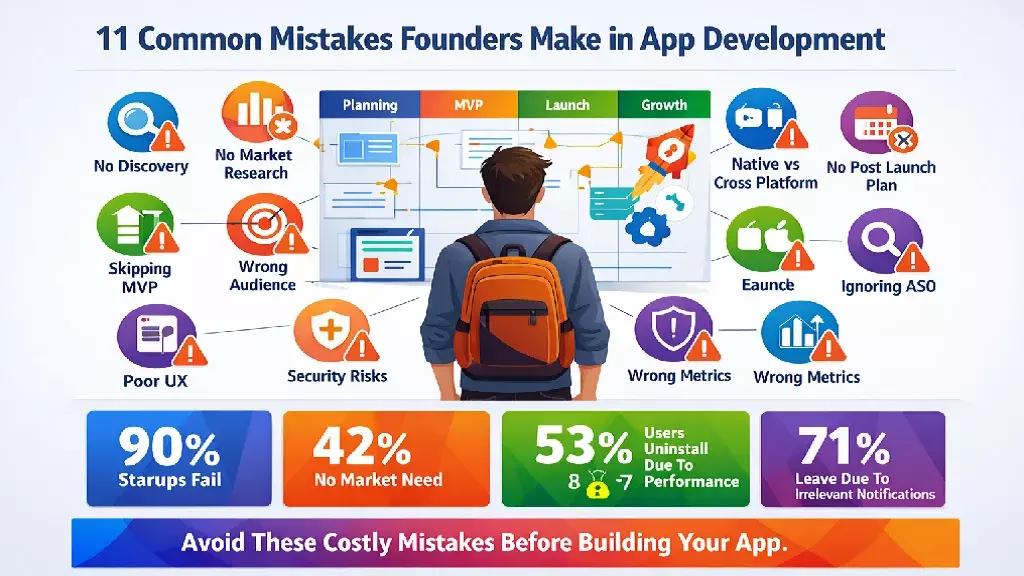
Recent reports show that nearly 90% of startups still fail, while 42% shut down because they build products with no real market need.
In 2026, building an app has become easier with AI based development tools and no-code platforms yet building a successful solutions business is more competitive than ever.
With over 5 million apps already competing across app stores, 53% of users uninstall because of performance issues and 71% delete apps due to irrelevant notifications.
One poor experience, confusion onboarding flow or unnecessary feature overload can push users to uninstall your app within minutes.
This blog is a saviour for the founders who are turning their ideas into digital solutions. Before you invest months of effort and millions of dollars into development, understanding these common pitfalls can save your startup from becoming just another statistic.
Read: How Long Does It Take to Build a Software Product?
Why Most App Startups Fail
The bar has been set by companies like Spotify, Netflix, Uber and Airbnb that have spent years refining user experiences. Startup founders are judged against products backed by infrastructure and product teams.
An app is never failed by just one massive mistake; usually, it happens through a chain of smaller decisions that compound over time. Founders often rush into development without considering demand, overbuild the MVP, ignore scalability, delay user testing or prioritize features over usability.
These issues may seem manageable but combined, they slowly weaken retention, increase operational costs and limit growth potential.
Here are the common pitfalls founders need to consider while developing a mobile application or any digital solution.
Mistake 1: Skipping the Discovery Phase
One of the biggest mistakes founders make is to rush into development. Skipping a $5,000 investment in planning and later spending $50,000 in rework.

This planning phase covers market research, feature specification, wireframing and technical architecture through surveys, interviews, MVPs and competitor analysis. This saves months of development time and thousands of dollars in unnecessary expenses.
Skipping discovery risk by 3x, these are the common signs of poor market validation:
-
Skipping customer interviews and user research.
-
Building based on assumptions rather than real data.
-
Ignoring competitor analysis.
-
Failing to test demand through MVPs or landing pages.
-
Developing features users never requested.
How to avoid it:
Run at least five to ten structured user interviews before writing a line of production code. Build a landing page describing the product and measure whether anyone signs up. Use a clickable prototype to test the core user flow before any backend work begins. The goal is not certainty but evidence.
Cost Impact
A startup can spend 10% of their total product budget or it can be anywhere between $5,000 and $150,000 on the discovery & market research stage. Fixing product market fit after launch often requires major redesigns, pivots or complete rebuilds.
Mistake 2: Building For Everyone (Which Means Building for No One)
Usually, founders try to maximize their target audience by creating a product for everyone. While this may sound like a growth strategy. But an app that tries to do everything rarely does anything particularly well. More features will require more resources, extending timelines and increasing budgets.

Users can find the app confusing and challenging to navigate which leads to frustration and abandonment.
Founders usually target these mistakes which include:
-
Defining an audience that is too broad.
-
Trying to solve multiple user problems together at once.
-
Creating generic messaging and positioning.
-
Ignoring niche market opportunities.
-
Building features for every possible user segment.
The fix? Use user feedback and let user behavior guide your feature roadmap. Build what your target audience actually asks for and stay focused.
How to avoid it
Define the primary user with specificity: their role, their context, their frustration, and what they currently use as an alternative. Build the roadmap around that person first. Expansion to adjacent user segments comes after the core product earns genuine retention.
Cost Impact
This may waste development resources, lower conversion rates, higher customer acquisition costs and poor user retention if lacked focus. This is due to the product failing to resonate majorly with any specific audience.
Mistake 3: Trying the MVP as Optional
Some founders believe they can skip the MVP stage but this is the one that costs the most money. Business leaders fear that a limited product will appear unpolished and try to include everything. This concern costs far more than it saves.

Building everything before validation means every dollar spent on unused or wrong features is a total loss.
These common MVP mistakes include:
-
Building a complete product before testing demand.
-
Spending months developing advanced features.
-
Avoiding user feedback until after launch.
-
Delaying releases because the product is not ready.
How to avoid it:
Identify the single most important user action your product needs to support. Build only what enables that action, and nothing else. Get that version in front of real users within weeks, not months. Use what you learn to decide what to build next.
Cost Impact
MVP development costs range from $10,000 to $60,000 and more depending on the complexity and other factors. Skipping the MVP can increase development costs by tens or even hundreds of thousands of dollars. It delays learning from real users which increases the risk of building features that provide little business value.
Read: Web App Development for Small Businesses
Mistake 4: Underestimating UX and Interface Design
A technically sound backend means nothing if users cannot figure out how to use the front end. Poor UX does not generate complaints. It generates uninstalls. Users who encounter confusing navigation, cluttered screens, or slow load times rarely leave feedback. They simply leave.
Modern mobile users arrive with expectations shaped by apps that have had years of refinement. Anything that does not meet that baseline fails the first-impression test. Research from Google shows that 53% of mobile users abandon apps that take longer than three seconds to load. The bar is not set by other startups. It is set by whatever the user opened before your app.
UX is not a finishing step applied after the real development is done. The most effective teams integrate UX research from the first week: user journey mapping, wireframes tested with real users, usability sessions before any code is written, and iterative refinement through the build.
Common UX mistakes:
-
No wireframes or prototypes created before development begins
-
Onboarding flow designed by developers rather than tested with first-time users
-
Core actions buried behind multiple taps when they should be immediately visible
-
No usability testing conducted before launch
-
Design inconsistency across screens that quietly erodes user trust
How to avoid it:
Invest in wireframes and interactive prototypes before any production code is written. Run even informal usability sessions. Five users will surface 85% of the major issues. Treat every friction point in the user journey as a retention problem, because it is.
Cost Impact:
Poor UX is one of the primary drivers of the 53% uninstall rate for mobile apps. Fixing UX after launch, which means reworking flows, redesigning screens, re-testing, and redeploying, typically costs three to five times what the same work would have cost at the design stage.
When Decipher Zone built the Letshego financial platform for retail banking users across multiple African markets, the design process started with journey mapping for users with varying levels of digital literacy. Usability shaped every feature decision from the start. The result was a platform that worked reliably for first-time digital banking users with intermittent connectivity, a constraint no amount of backend engineering would have solved.
Mistake 5: Choosing the Wrong Tech Stack
Choosing the technologies for the product is a technical as well as business decision that has long term financial consequences. The right development partner recommends what they know best but founders usually choose based on trends, developer preferences or short term cost savings.

These are the common tech stack mistakes:
-
Selecting a tech stack that has no future or scale efficiently.
-
Ignoring future integration requirements.
-
Prioritizing development speed over maintainability.
-
Using outdated frameworks and infrastructure.
-
Failing to consider long term hiring and support hurdles.
How to avoid it
Have the technology discussion before the first line of code is written, and include a senior technical advisor with no personal stake in any particular technology. Evaluate the stack against your scale targets, your likely integrations, and your hiring reality, not against what is exciting right now.
Cost Impact
A poor technology foundation can lead to expensive rewrites, slower product iterations, performance bottlenecks and significantly higher infrastructure costs as the user base grows. This technical debt introduced early can increase long term development costs by 30 to 40%.
Mistake 6: Ignoring Scalability Until It's an Outage.
Scalability doesn't really exist until it doesn't. An app built on an under-provisioned architecture functions perfectly when it only has a hundred users. But a press mention, launch or wave of popularity causes ten thousand users to hit it simultaneously, and it crashes.
This problem isn't just technical. A crash during growth leads to eroded user confidence, a lasting negative reputation despite subsequent fixes, and often a hard cap on growth, as the users who showed up to the crash seldom return.
Infrastructure that wasn't designed for scale is always more expensive to build later.
Planning for scale doesn't mean over-engineering everything up front-it means making smart technical decisions up front regarding cloud infrastructure, load balancing, caching and database design that allow for growth, rather than for a total rebuild later on.
Key mistakes include:
-
Running all components on a single server without load distribution;
-
Creating a database structure that can't be partitioned or optimized as it grows;
-
Failing to add caching layers to the system, sending every request straight to the database;
-
Never stress-testing the app under load; and considering scalability something to worry about later.
How to avoid it
Conduct a scalability review during architecture phase. Design the system to handle 10X your current projected traffic without having to rebuild. Cloud-native architectures leverage scalable cloud components and services to accommodate future growth with little upfront cost.
Cost Impact:
Re-architecting systems to accommodate scale, especially later on, can cost 40-80% more than designing them to scale from the outset. Growth spurts also result in lost opportunity, and hence revenue, which is more damaging than any infrastructure cost.
Leanspace's satellite operations platform is a perfect example of right decisions early on-built from the ground up to handle high-frequency telemetry data from multiple spacecraft simultaneously. Scalability is part of their architecture, which is allowing their clients' spacecraft fleets to expand.
Mistake 7: Choosing the right between Native and Cross-Platform without the right reason
This choice affects initial cost, timeline and long-term maintainability. It impacts both development and maintenance, but most founders choose without understanding the tradeoffs they are making.
Native development means a more premium user experience and higher performance, but two separate codebases to maintain and develop. Cross-platform (like React Native or Flutter) means a single code base that can run on both iOS and Android-it is less expensive upfront and faster to develop.
For most early products, cross-platform development is the more sensible choice.
-
At the MVP stage, you are testing your idea, not polishing native animations.
-
The performance difference is generally unnoticeable to the user for most business or consumer-centric apps-it only becomes an issue with high-fidelity games or heavy multimedia applications.
-
The most common mistake is making the decision on budget alone and realizing later on that it can't meet the product's requirements.
How to avoid it
Use a cross-platform tool for most business and consumer applications that are primarily UI-driven with minimal hardware dependence. Native applications are necessary when dealing heavily with device features like GPS, Bluetooth or camera; or if meeting very specific performance benchmarks is crucial. Have the debate with your development team and decide accordingly before you lock in any architectural decisions.
Cost impact
Rebuilding a cross-platform app into a native application when it fails to meet your product's requirements usually costs just as much as rebuilding it from scratch. Getting the right architecture from the outset does not increase costs; getting it wrong does.

Mistake 8: Forgetting that Launch is Not the Finish Line
Many founders and business leaders believe that success will follow once the app is live. They pour everything into getting to launch day. In reality, the deployment marks the beginning of the growth journey. Bug fixes, performance monitoring, security patches, OS updates and ongoing UX improvements are the post launch costs.
The post launch mistakes include:
-
No marketing strategy.
-
Not considering user feedback.
-
Lack of performance monitoring.
-
Not enough maintenance budget
-
No plans for scalability.
-
Delayed bug fixes and updates.
How to avoid it
Define the post-launch plan as part of the initial product strategy, not as an afterthought once development is complete. Allocate maintenance budget before the project begins. Set up performance monitoring, crash reporting, and user analytics before the first user arrives.
Cost Impact
Startups usually struggle with rising server costs, declining retention rates, negative reviews and stalled growth without proper planning for the post launch. Treating development as a one time project allows you to miss opportunities, outdated features and declining user engagement. These issues can reduce investor confidence and market traction.
Mistake 9: Ignoring App Store Optimization (ASO)
Over 5 million apps compete across the major app stores. Organic discovery, where users find an app by searching for a problem it solves, is one of the highest-quality, lowest-cost acquisition channels available to a startup. Most founders do not invest in it at all.
App Store Optimization covers the elements that determine how an app ranks in store search results and how compelling its listing is when users find it: the title and subtitle, keyword fields, screenshot design, preview video, and rating volume. A well-optimized listing can double or triple install rates from organic traffic without any additional spend.
The mistake is treating the App Store listing as a one-time task. The most effective teams treat ASO as an ongoing discipline, testing different screenshots and descriptions, monitoring keyword rankings, and updating the listing with each major release.
Common ASO mistakes:
-
Title and description written as product copy rather than optimized for search queries
-
Screenshots showing the interface rather than communicating the value proposition
-
No keyword research conducted before submission
-
No process for soliciting or responding to user reviews
-
The listing is never updated after initial submission
How to avoid it
Research what queries your target users type when looking for apps in your category. Use those terms in the title, subtitle, and keyword fields. Design screenshots that show outcomes, not features. Respond to reviews promptly, as it affects both rating and store ranking.
Cost Impact
Paid user acquisition costs for mobile apps average $2 to $4 per install for consumer apps, significantly higher for business applications. A well-optimized App Store listing generates organic installs at no marginal cost. Teams that ignore ASO pay for every single user they acquire.
Mistake 10: Ignoring Security Until It Becomes a Crisis
Security mistakes can impact on user trust. Early flaws such as weak authentication, unencrypted data and third party leaks are the cause of breaches. Fixing them is necessary as security vulnerabilities rarely wait for a convenient time to appear.
Some of these security mistakes include:
-
Weak authentication systems.
-
Poor password management practices.
-
Lack of data encryption.
-
Ignoring compliance requirements.
-
Delaying security audits and testing.
-
Failing to secure third party integrations.
How to avoid it
Treat security as a non-negotiable architectural requirement from the discovery phase, not a final checklist item. Define compliance requirements early. Build encryption, secure authentication, and API security into the specification. Commission an independent security audit before launch, particularly for any application handling financial or health data.
Cost Impact
Legal penalties, customer trust issues, regulatory fines, reputational damage and emergency remediation costs can all get in the way of a single security breach. Building with compliance in mind from the beginning avoids a lawsuit that could end your startup before it truly begins.
The MyComplianceOffice compliance platform manages sensitive conduct and regulatory reporting data for financial services firms globally. Security and compliance were foundational constraints from the first architecture session. The platform operates in a regulatory environment where a breach would trigger immediate client loss and potential regulator action. Building with that context from day one is what makes it possible to serve that market at all.
Read: Web App Development Ideas for 2026
Mistake 11: Measuring the Wrong Things
Business leaders and founders become obsessed with vanity metrics that look impressive in a presentation but reveal so little about the actual presence of the business. What matters is value. High numbers of downloads may look exciting but they mean little if users abandon the app after their first session.
The common mistakes include:
-
Focusing only on download counts.
-
Ignoring user retention metrics.
-
Tracking traffic instead of engagement.
-
Not measuring customer lifetime value.
-
Overlooking churn and activation rates.
-
Making decisions based on assumptions rather than data.
How to avoid it
Define the three to five metrics that most directly reflect whether the product is delivering value before launch. Set up the analytics infrastructure to track those metrics from day one. Make product decisions based on those numbers, not on the ones that look impressive in a presentation.
Cost Impact
Tracking the wrong metrics can result in poor product decisions, inefficient marketing spending, slower growth and missed opportunities for optimization. This can lead to revenue loss and wasted operational resources in the long run.

How Can Decipher Zone Help?
These mistakes aren’t just cautionary lessons but patterns that Decipher Zone Technologies has spent over a decade helping founders and business leaders navigate, avoid and recover from. Here’s how we help you translate into real support for your app development journey:
1. End-to-end support
From idea to architecture, our team offers development and consulting services that address IT requirements like architecture and development of enterprise business systems, performance monitoring, business intelligence and application integration.
2. Building the right MVP
Our team will help you build that actually solves user problems, what you want and what will be right for your application. We have built MVPs for social networking platforms, nutrition apps with OCR image recognition and WhatsApp integrations and a range of other enterprise solutions.
3. Full-Stack Capability
Decipher Zone offers full stack development services including frontend development in React, Angular and Vue, backend in Java with SpringBoot, data visualization, mobile application development, UI/UX design, and DevSecOps infrastructure setup. You can get from wireframe to deployment to ongoing maintenance with our one team with full accountability and transparency for the product.
4. Security & Compliance
Security for DZ is on top-priority, for founders building in fintech, healthcare or any space where user data is involved. We are here to offer you a product that is compliant and regulated with the standards required.
5. Flexible engagement
Our team of experts offers a flexible outsourcing model which allows you to hire professionals with diverse expertise on either a fixed or hourly basis. Our team is ready to build and ship your MVP or a long term development partner to scale with you post launch.
Conclusion
Now that common pitfalls are mentioned, chances are you won’t fall for these again. But the list of mistakes doesn’t end here. You need to stay sharp; slipping up could mean paying a heavy price.
Application development is an ongoing process, so don’t forget to upgrade and update regularly. Mistakes happen when founders move fast without a clear framework to move smart.
The good news is that most of the mistakes covered in this guide are completely avoidable. Business leaders can make informed decisions, allocate resources more effectively and build products that are designed for the long term by understanding blunders early.
Read: Mobile App Development Cost
Or if you are getting started, we are here. If your idea is still on a napkin or a Notes app, you can reach out to us. Our team will sit, ask the right questions and help you shape it into something buildable, scalable and market-ready.
Experts at Decipher Zone Technologies help you think through the problem before we solve it. We meet you exactly where you are. Because the best products are built by the ones who asked the right questions first.
We are more of a partner you deserve than just a development team!
FAQs
What is the biggest mistake founders make in app development?
The biggest mistake is to jump into development without a clear framework, roadmap and market research. Founders who skip this discovery phase find themselves spending 3 to 5 times more on rework. A startup can spend 10% of their total product budget.
Why do most startup apps fail?
There is no single reason why startup apps fail. It is usually a chain of smaller decisions like building without validating real market demand, targeting too broad an audience, overlooking the MVP with features, ignoring user feedback post launch and running out of runway because the budget wasn’t planned to cover the full product.
How important is MVP development for startups?
An MVP works as a strategic learning about the idea is how real users react to the idea. Before committing to a full budget to build, MVP development can help you avoid the $94,00 mistakes. Founders can test assumptions, collect feedback, validate demand and reduce development risks.
Should founders hire freelancers or agencies for app development?
The right choice depends on the project complexity, budget and long term business goals. Founders who are planning to build smaller projects can hire freelancers. For founders building a full product from scratch, an experienced application development agency is almost always the smartest choice. These experienced technical partners can provide access to multidisciplinary teams, strategic guidance, scalability planning, quality assurance and ongoing support throughout the product development process.
How much should startups budget for post-launch maintenance?
There is no universally accepted budget but as per the experience, we recommend allocating between 15% and 20% of your initial development budget for post launch maintenance and improvements. The apps that retain users and grow sustainably are the ones where post launch investment is planned from day one.
Author Profile: Mahipal Nehra is specialised in content strategy and tech-driven marketing for software development and digital transformation. Follow on LinkedIn or explore more at Decipher Zone.