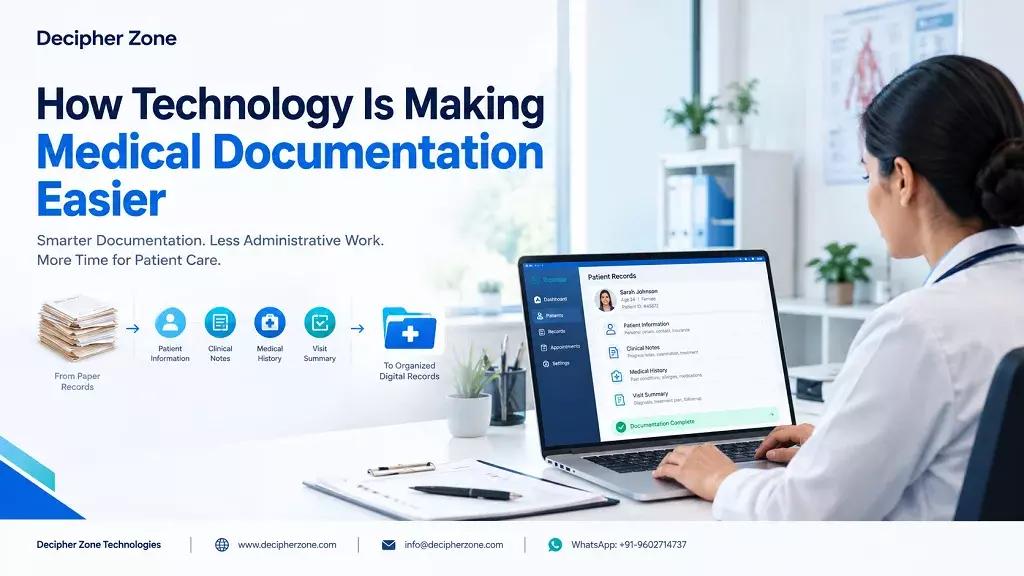
Doctors have always complained about paperwork; this isn't new. What's changed is how much of that burden technology's actually starting to lift, rather than just shifting it around into a different digital format that still eats the same hours. Documentation used to mean handwritten charts, illegible half the time, filed away in folders that took nurses ten minutes to locate during an emergency. That system's mostly gone now replaced, gradually, by something faster, though not without its own friction points along the way.
Electronic health records solved one problem, created another. Speed of access improved dramatically; a patient's history, medications, allergies, previous visits all pulled up in seconds instead of physically searched for. But typing replaced writing, and typing during a patient encounter turns out to be its own kind of disruption. Physicians spending an appointment staring at a screen, clicking through dropdown menus, isn't exactly the improvement anyone envisioned when EHRs first rolled out broadly across hospitals and clinics.
Voice Is Replacing the Keyboard
This is where speech recognition entered the picture, and it's changed documentation more than most non-clinical people realize. Instead of typing notes after a visit, or worse, during one while the patient watches awkwardly, doctors can now speak findings aloud into a microphone, into an app, into a system built specifically to convert clinical speech into structured text. Accuracy has improved substantially over the past several years, particularly for medical terminology, which used to trip up generic dictation tools that weren't trained on clinical vocabulary at all.
For practices still running primarily on desktop systems, medical dictation software for Windows has become a practical, genuinely useful bridge letting clinicians document faster without abandoning existing hardware setups or forcing an expensive full-system overhaul just to gain voice capability. Adoption's grown steadily because the return is immediate: less time hunched over a keyboard, more time actually looking at the patient sitting in front of them. That shift alone, small as it sounds, changes the tone of an appointment noticeably.
Ambient documentation tools go a step further, quietly recording the conversation itself with consent, properly disclosed then generating a structured note afterward without the clinician manually dictating anything at all. The system listens, extracts relevant clinical information, drafts a note the physician reviews and edits rather than writes from scratch. Early data on these tools is promising, though adoption's still uneven across specialties; some fit this model more naturally than others, depending on how conversational versus procedural a given encounter tends to be.
Standardization has improved too, not just speed. Templates built into most modern systems prompt for specific fields chief complaint, history, assessment, plan reducing the odds something critical gets omitted simply because a tired clinician forgot to ask, or forgot to record having asked.
This matters clinically, not just administratively; missing documentation isn't just a paperwork problem, it's occasionally a patient safety one, when the next provider reviewing the chart doesn't see something that should've been flagged.
Interoperability Is the Next Real Hurdle
Here's where things get messier, honestly. Different hospital systems, different EHR vendors, different practices none of it always talks to the others properly. A patient seen at one hospital, then transferred to another, might have records that don't transfer cleanly, formats that don't match, fields that map imperfectly between systems built by competing companies with little incentive historically to make integration easy.
This is improving, slowly, partly due to regulatory pressure pushing toward standardized data formats but it's not solved, not close to it in a lot of regions. Clinicians still sometimes end up re-entering information manually because two systems won't sync automatically, which defeats some of the efficiency gained elsewhere in the documentation pipeline. Technology solved the writing problem before it solved the sharing problem; the two aren't the same challenge, even though they get lumped together in most conversations about digital health infrastructure.
AI-assisted coding and billing represents another quiet shift, less visible to patients but significant for practice operations. Natural language processing tools can now scan clinical notes, suggest appropriate billing codes, flag documentation gaps that might trigger claim denials down the line. This used to require dedicated coding staff combing through charts manually; now it's partially automated, with human review still required but the initial heavy lifting handled by software trained specifically on coding guidelines and payer requirements.
Legibility, oddly, deserves its own mention it's easy to forget how much of a problem handwritten notes actually were. Misread dosages, misinterpreted abbreviations, notes nobody but the original author could reliably decipher months later.
Digital documentation eliminated that entirely, essentially overnight in most settings. It's not a glamorous improvement, doesn't make headlines, yet probably prevented more medication errors than most flashier innovations combined.
Compliance tracking has gotten easier too. Systems now flag incomplete documentation automatically a missing signature, an unaddressed field, a note that wasn't finalized within the required timeframe.
Previously this fell to administrative staff manually auditing charts after the fact, often catching problems weeks after they'd already caused downstream billing or legal complications. Automated flagging catches issues closer to real time, when correction is still simple rather than requiring retroactive reconstruction of what actually happened during a visit.
None of this means documentation burden has disappeared clinician burnout tied to administrative workload remains a well-documented, serious problem across healthcare broadly. But the tools available now are measurably better than what existed even five years back.
Voice recognition, ambient listening, automated coding assistance, improved templates each addresses a specific friction point, incrementally, without claiming to solve the entire problem in one sweeping fix.
Where this heads next probably involves tighter integration between these separate tools dictation, ambient capture, coding assistance, interoperability standards functioning as one connected system rather than several separate products stitched together by IT departments doing their best. That's not fully here yet. But the trajectory's clear enough: documentation is moving from something clinicians dread doing after hours, to something increasingly handled in the background, freeing up the actual time meant for patient care rather than competing with it.