
Loan Lending App Development - A Complete Guide. Mobile apps have been a part of our day-to-day lives and with technology being an important part, it has made things hassle-free which also includes the loan lending process. The amalgamation of technology into the loan lending process not only automates the process but also makes the services more accessible to the customers alongside an easy-to-use interface.
And with the growing demand for loan lending app development, investing in one such application is the right decision to make.
So, if you are interested in developing a loan lending app then this blog is for you, and without any further delay let’s get started!
Read: Software development
Loan Lending App Development
Loan lending app development is the process of developing mobile applications that help in borrowing and lending money digitally. It is the bridge between the borrowers and the lenders, where the borrowers can request a loan from the lender and then when the lender approves the request, the amount gets disbursed automatically without having to visit physical branches and other financial institutions.
Read more: Financial Software Development Cost
Some of the different types of loan lending apps are Personal loan apps, Payday loan apps, Peer-to-Peer (P2P) lending apps, Mortgage loan apps, Student loan apps, Business loan apps, Crowdfunding loan apps, Microfinance apps, Buy Now Pay Later (BNPL) apps, and many more.
Calyx, CloudBankin, Finflux, TurnKey Lender, FIS loan management system, CashE, Dhani, BankPoint, and MoneyTap are well-known examples of loan apps and software that are widely used in the market.
BNPL apps in particular have grown fast, letting shoppers split a purchase into smaller payments at checkout instead of applying for a traditional loan. If you are weighing which model fits your business, it helps to look at what has changed since these apps first became common.
By 2026, most lending apps that compete seriously have moved past a basic credit score lookup and into AI-driven underwriting, where the app itself evaluates a borrower's risk using far more than a single credit bureau number.
Loan Lending App Development: Pros and Cons
Loan lending app development caters to innumerable benefits both to businesses and their customers, specifically in the finance industry or in the fintech sector.
Benefits of developing a loan lending app
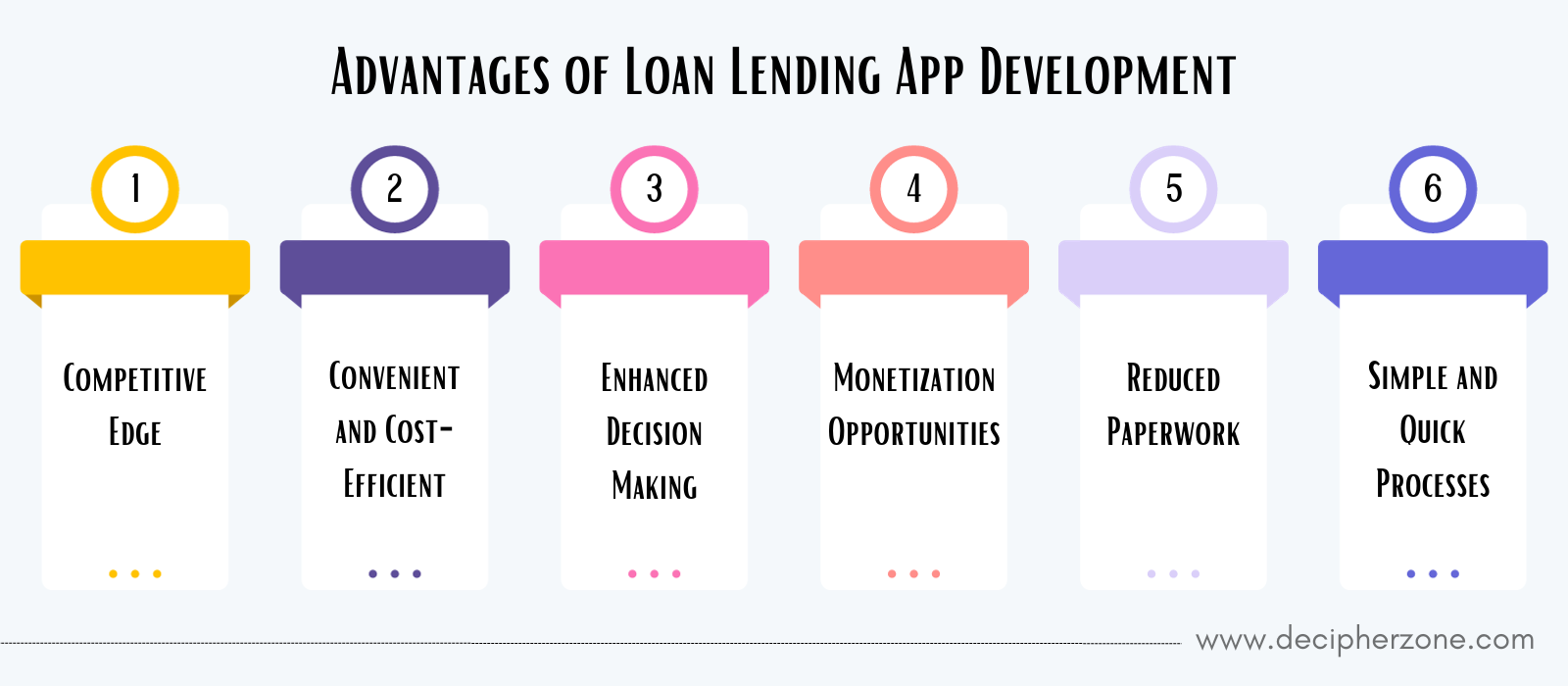
Here is the list of advantages of Loan Lending App development
-
Competitive Edge
-
Convenient and Cost-Efficient
-
Enhanced Decision Making
-
Monetization Opportunities
-
Reduced Paperwork
-
Simple and Quick Processes
Read more: Top FinTech Industry Trends
1. Competitive Edge
The first and foremost benefit of developing a mobile application for any business is that it helps you gain a competitive edge in the market. Similarly, loan lending app development also helps you gain a competitive advantage in the market as it enables your business with automation alongside making your business accessible to potential customers anytime and anywhere, without having to visit the financial institutions physically, thus saving time, effort, and money.
Read more: Top 10 Latest Banking Trends
2. Convenient and Cost-Efficient
Loan lending app development makes your business services more convenient to the users by enabling them to apply for loans and check for the approvals and disbursement of amounts on their smartphones, making the application process hassle-free alongside making it a cost-efficient process.
In addition, it also helps in reducing infrastructure costs, and operational costs and also helps in reducing manual labor which further makes it a more cost-efficient option for your business.
Read more: Enterprise Accounting Software Development - Benefits and Steps
3. Enhanced Decision Making
It also helps in enhancing the decision-making process by providing detailed analysis and reports on your business and its performance, which further allows you to make amendments to the application and improve it accordingly to provide better services to your customers, which in turn increases the positive feedbacks, thus helping you make informed business decisions.
4. Monetization Opportunities
Developing a mobile application for your loan lending business also brings innumerable revenue generation streams for your business by enabling you to integrate different monetization models into your application, thus increasing the ROI and accelerating your business growth.
Read more: Top Mobile App Monetization Strategies to Consider
5. Reduced Paperwork
Loan lending app development helps in reducing the paperwork as it automates the process and minimizes the manual labor, which in turn makes the loan lending process more straightforward by providing a digital medium alongside reducing the risk of loss or theft of documents and other important paperwork as well as minimizes the possible errors.
Read more: Money Transfer App Development - Benefits, Features, and Cost
6. Simple and Quick Processes
It also makes the process easier and quicker with automation, which implies that the algorithms will automatically detect the user’s eligibility for a loan and disburse the amount quickly into the user's bank account, thus saving time and also aiding in enhanced customer service and retention rate.
Now that you are familiar with the pros of loan lending app development, it is also important that you should also learn about the cons of the same. This will help you devise a strategic plan to eliminate all the drawbacks in case you come across any and develop a high-performing and future-proof application for your business.
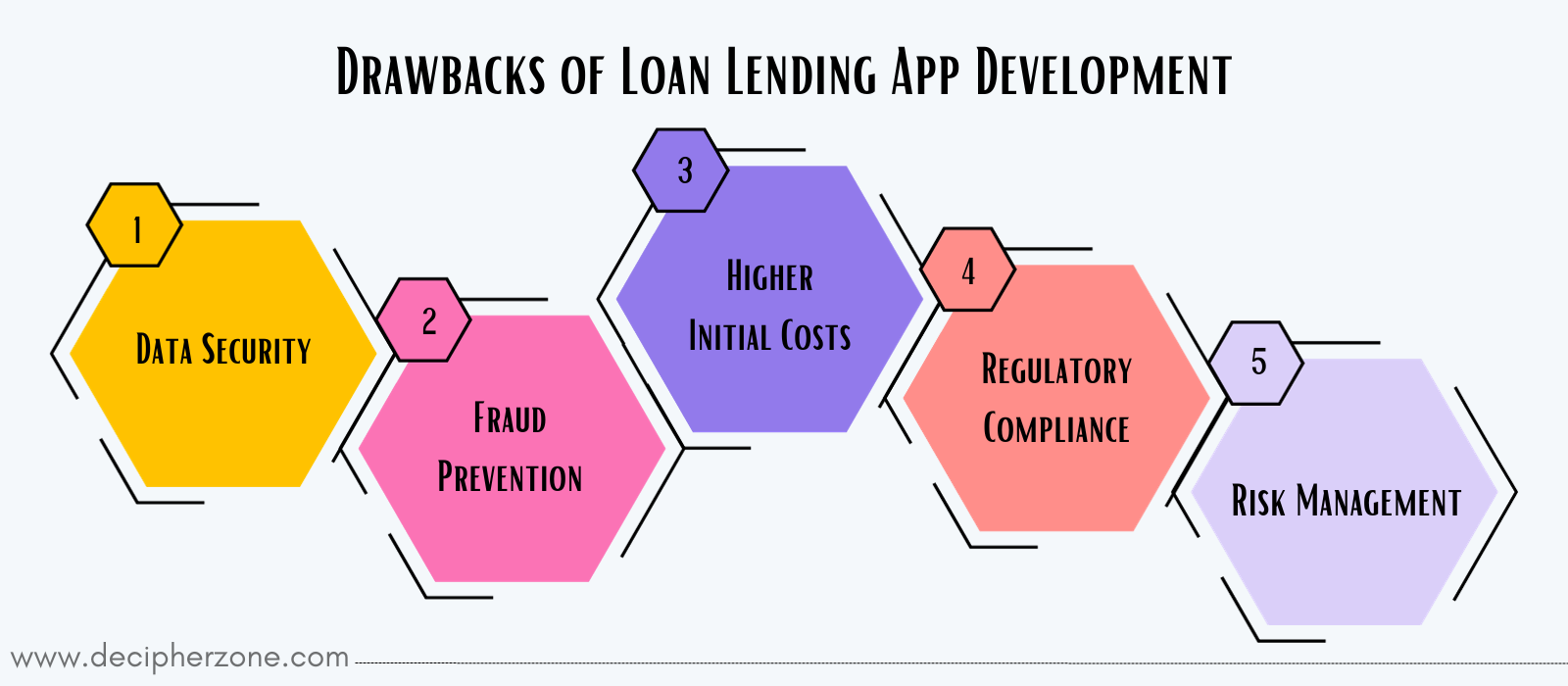
The cons of loan lending app development are -
-
Data Security
-
Fraud Prevention
-
Higher Initial Costs
-
Regulatory Compliance
-
Risk Management
1. Data Security
The primary drawback of loan lending app development is that ensuring data security and privacy can be a challenging task during the app development process, which includes sensitive customer data as well as their financial information.
Read more: What is Cybersecurity? Everything You Need to Know
2. Fraud Prevention
With digitization also comes the risks of online threats and cyber-attacks which could lead to fraud with the companies and the users so ensure that you implement strict fraud prevention measures like user verification, valid ID verification, and other authentication methods.
Read more: Fraud Detection Software Development
3. Higher Initial Costs
Loan lending app development can also lead to higher initial costs which would incorporate every minor cost as well like the marketing charges to the updates and maintenance costs, which might be pricey as a startup investment but once the app is developed and reaches its potential customers then you can easily generate revenue within no time.
4. Regulatory Compliance
Another potential drawback of loan lending app development is that your app should comply with the rules and regulations of the particular region to eliminate legal issues and penalties. So, before starting with the development make sure that you clear all the required paperwork and other necessary steps to comply with the laws, which will also help you build trust with your customers.
5. Risk Management
Loan lending apps involve a lot of risk and to evaluate and minimize the risks you need a robust risk management system, which can be challenging as well as a strategic process for your business.
Now that you are known about the pros and cons of a loan lending app development let us now move ahead and list out some of the must-have features in a loan lending app.
Must-Have Features to Integrate in a Loan Lending App
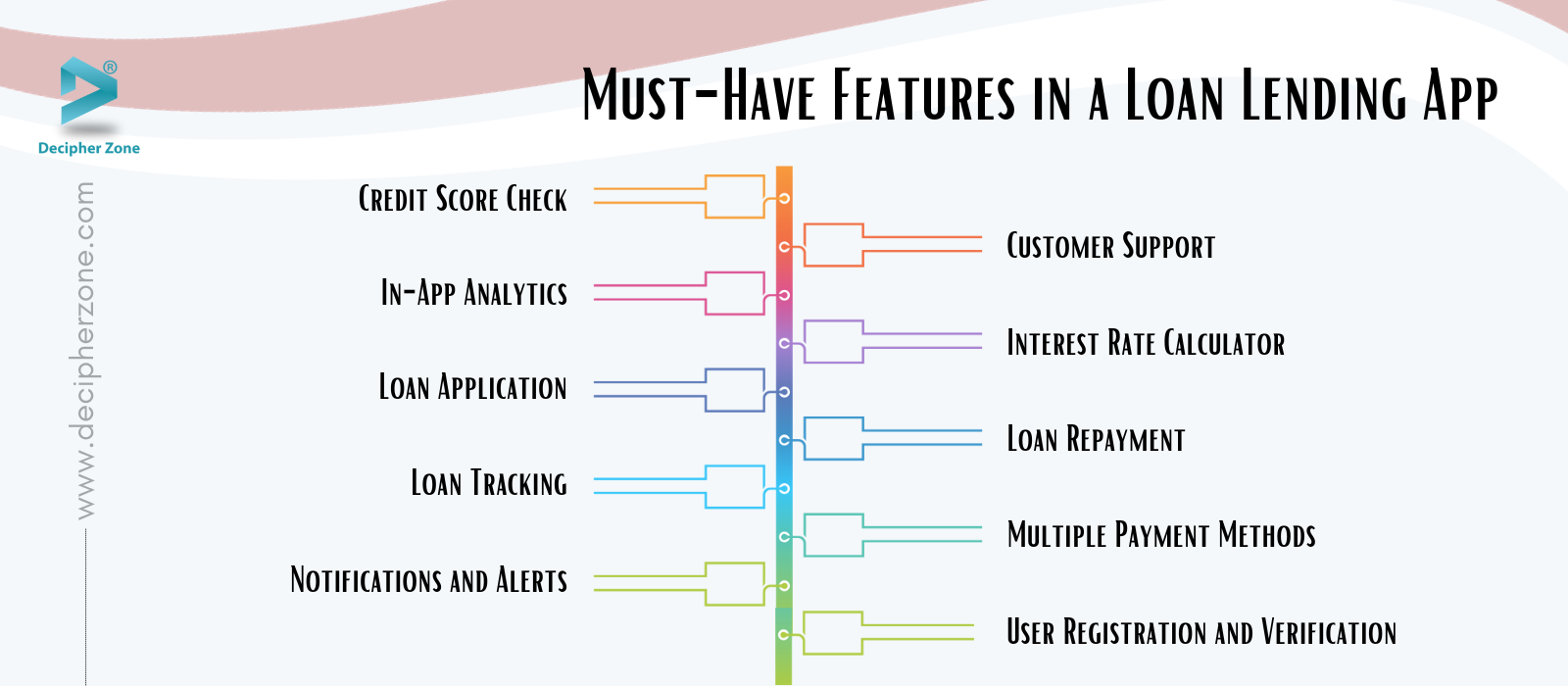
Some of the important features that you can consider integrating into the loan lending app are as follows -
-
Credit Score Check
-
Customer Support
-
In-App Analytics
-
Interest Rate Calculator
-
Loan Application
-
Loan Repayment
-
Loan Tracking
-
Multiple Payment Methods
-
Notifications and Alerts
-
User Registration and Verification
-
Digital KYC Verification
Features are an important USP that helps an app or a product stand out in the marketplace. When developing a loan lending app, make sure that the features that you integrate are not unique but also cater to the user and business requirements alongwith an easy-to-use interface.
Read more: Common Features of Mobile Apps and their Benefits
Credit Score Check - The users can check for their credit score with this feature along with their loan eligibility, which further also helps the users to enhance their credit score. In 2026, many lenders go a step further with AI-based risk assessment, where the app pulls in alternative data like bank transaction history, income patterns, and even utility payments to score borrowers who have thin or no traditional credit history.
Customer Support - 24*7 customer support via in-app messaging and call request feature to enhance the user experience alongside answering frequently asked questions.
Read more: Cash Management System Development: Benefits & Cost
In-App Analytics - This feature caters to several tools to users that help them track and measure their financial health based on several parameters. In addition, these tools also help the business or the lenders to analyze user behavior and improve their overall services.
Interest Rate Calculator - This feature helps the users to calculate the estimate of their monthly payments based on the loan amount and tenure of the loan amount.
Loan Application - This feature enables the users to apply for loans, check their loan eligibility, and check for the loan status alongside providing the ability to set loan amount, tenure, and interest rates.
Loan Repayment - It helps users choose their loan repayment options as per their comfort by providing flexible loan repayment options, EMI payments, auto-debit payments, and many more.
Loan Tracking - This feature helps the users to track the real-time status of their loan application along with past loan application histories and repayment history.
Read more: Expense Management Software Development Cost, Benefits and Features
Multiple Payment Methods - This is a must-have feature to integrate into a loan lending app development that helps the users to make the repayment of the loan amount in their preferred payment mode like net banking, credit/debit cards, e-wallets, etc.
Read more: Payment Gateway Development - Benefits and Tips to Consider
Notifications and Alerts - This is another important feature of a loan lending app development that helps lenders send timely notifications and alerts about their upcoming payments, due payments, loan approvals, and disbursals, and other important updates about their loans.
User Registration and Verification - The user can register with different methods like using their mobile number or email address, and then upload the necessary documents to verify and authenticate their profiles alongwith all the important information like their bank account details and other personal information like their name, address, contact number, etc.
Read more: 7 Benefits Of An Integrated Security System
Digital KYC Verification - While basic registration collects a user's name and contact details, digital KYC verification is its own step that confirms the person is who they claim to be before any loan gets approved. This usually means scanning a government ID, matching it against a selfie, and running the details against fraud and watchlist databases. Building this in as a dedicated feature, rather than folding it into general registration, makes it far easier to meet the regulatory requirements that apply to most lending businesses.
Now that you know some of the important features to integrate while developing a loan lending app make sure that you integrate advanced features as well, some of them that you can consider include WhatsApp Integration, Voice Search Options, Responsive Design, Social Media Integration, Biometric Authentication, Multi-language Support, and many more.
Established online lenders like CreditNinja show what a modern lending experience should feel like: fast eligibility checks, transparent terms, and same-day funding - exactly the benchmark new loan apps are built against.
Loan Lending Application Development Steps
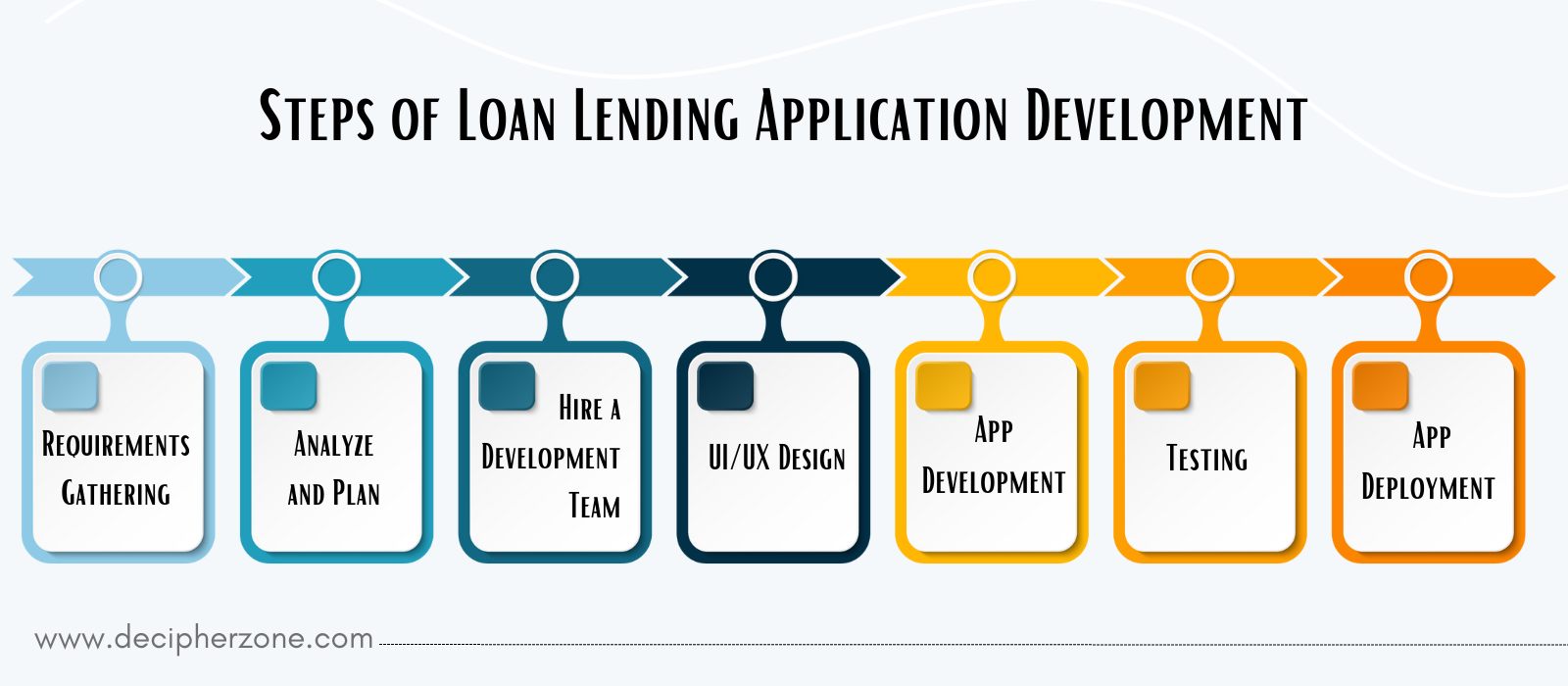
The 7 primary steps to develop a loan lending app include the following -
-
Requirements Gathering
-
Analyze and Plan
-
Hire a Development Team
-
UI/UX Design
-
App Development
-
Testing
-
App Deployment
Loan lending app development is a complex process and involves several steps to design and develop a fully functional and feature-loaded application.
-
Requirements Gathering - The first step is to define your business goals, and project objectives, and to identify your target audience alongside conducting thorough market research and competitor analysis.
-
Analyze and Plan - The second step is to analyze every aspect of your loan lending business and devise a plan accordingly that fulfills every aspect of your business.
-
Hire a Development Team - Next, hire an app development team and share all your requirements with them alongside selecting the technology stack, signing an NDA, and deciding the cost and timeline.
-
UI/UX Design - Once you hire the development team, they will start working on the design of the application i.e. the UI and UX design.
-
App Development - In this step, the developers integrate the features and functionalities into the design of the application along with various APIs, and other implementations, which is also known as programming.
-
Testing - After the app is developed it is further tested for quality assurance by the testers or quality assurance engineers who ensure that the app is bug-free and is performing seamlessly.
-
App Deployment - Once the app is tested and the necessary changes are made, the app is ready to be deployed on the desired platforms, making it available for the end-users followed by app maintenance and timely updates.
Read more: 10 Types of Bugs in Software Testing
Loan Lending App Development Cost
The cost of loan lending app development in 2026 typically breaks down into three tiers, depending on how much of the process is automated and how many features the app needs to support.
| App tier | What it includes | Estimated cost |
|---|---|---|
| MVP / Basic | Loan application flow, KYC and onboarding, EMI calculator, repayment tracking | $15,000 – $30,000 |
| Mid-tier / Growth | Automated credit assessment, payment gateway integration, in-app analytics | $30,000 – $70,000 |
| Enterprise / AI-driven | AI-based credit scoring, fraud detection, support for multiple loan products and markets | $70,000 – $250,000+ |
Adding AI-based credit scoring and automated underwriting is one of the biggest cost drivers on this list, since it usually means integrating with third-party data providers, building and training risk models, and adding a compliance layer to explain how each automated decision was made. If you are building for a heavily regulated market, budget extra time for this piece specifically rather than treating it as a simple feature toggle.
The factors that influence the cost of loan lending app development include -
-
The type of app that you want to develop for your business, i.e. whether a Native app, Hybrid, Cross-platform, or Web app development.
-
The platform for which you want the apps i.e. Android, iOS, or both.
-
The tech stack includes programming languages, frameworks, libraries, plugins, and other tools.
-
The UI and UX design of the applications with the total number of screens.
-
The total number of features that you want in the app alongwith the complexity of integrating them into the app.
-
Third-party API licensing costs and integrations, alongwith additional security features and protocols.
-
If you plan to include AI-based credit scoring or automated underwriting, factor in the cost of connecting to credit bureaus and alternative data sources, training and maintaining the risk models, and building a compliance layer that can explain each automated decision to regulators and users alike.
-
The experience and expertise of the development team along with their location and hourly charges.
-
Different levels of app testing alongwith the timely maintenance and updates also add up to the cost of loan lending app development.
Read more: Mobile App Development Cost - A Comprehensive Guide
However, the price varies according to your specific business requirements, where an app with minimal features might cost you less as compared to an app with advanced features and tech stack. But do not worry, we Decipher Zone are here to help you develop the best apps at competitive rates.
Wrapping It Up
Loan lending app development is a complex process that requires thorough analysis, strategic planning, and an in-depth knowledge of the FinTech sector and the finance industry.
Now that you have reached here, it is likely that you are interested in developing a loan lending application for your business.
So, why wait?
Connect with us, or hire a developer, and get the best solutions tailored to your specific business needs to elevate your services and reach your potential customers easily.

FAQs about Loan Lending App Development
How does a loan lending app work?
Loan lending apps work by connecting the borrower to a lender via a digital platform, where the borrower applies for a loan, lenders access their eligibility and approve their loans, and later the funds are disbursed to the borrower electronically.
How much time does it take to develop a loan lending application?
Developing a loan lending application can typically take up to 20 to 25 weeks depending on some important factors like the total number of developers working on the project, budget, complexity, and so on.
What are the different ways to monetize a loan lending app?
The different ways to monetize your loan lending app are by charging processing fees, interest rates, service charges, and even subscription models.
What is the difference between a basic credit check and AI-based credit scoring in a loan app?
A basic credit check pulls a user's existing score from a credit bureau and displays it. AI-based credit scoring goes further by analyzing a wider range of data, such as bank transaction history, income patterns, and repayment behavior, to assess risk more accurately, including for borrowers with little to no traditional credit history. This approach has become standard in mid-tier and enterprise loan apps built in 2026.
Does a loan lending app need to support Buy Now Pay Later (BNPL) to compete?
Not necessarily. BNPL is a specific lending model built around point-of-sale purchases, and it makes sense mainly for businesses focused on retail or ecommerce lending. If your app targets personal loans, mortgages, or business lending instead, your development priorities should focus on those workflows rather than adding BNPL for its own sake.
About the Author: Mahipal Nehra manages content at Decipher Zone Technologies and works closely with the AI engineering team across live project delivery. Follow on LinkedIn.
AI Development Services | Generative AI Development | AI Agent Development | Custom AI Solutions | AI Chatbot Development | Machine Learning Solutions | Data Analytics Solutions | Business Intelligence Applications | MLOps Services | AI Consulting | Custom Software Development | Web App Development | Mobile App Development | SaaS Development | E-commerce Development | Enterprise Software Development | Cloud Application Development | UI/UX Design | Full Stack Developers | Product Engineering | Software Modernization | API Development | QA & Support