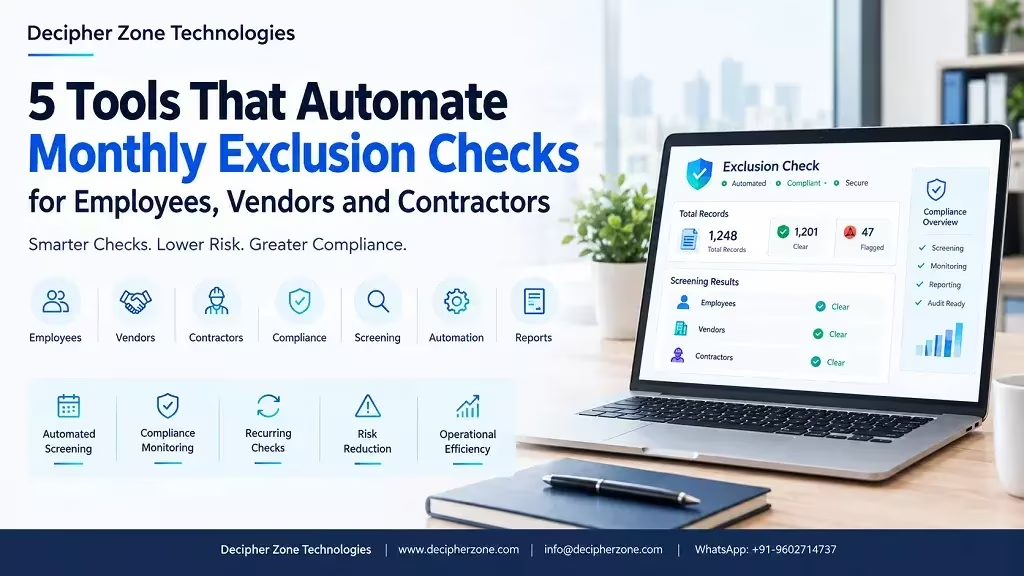
Any organisation billing Medicare or Medicaid has to confirm that nobody on its payroll, and no vendor it pays, appears on a federal or state exclusion list. Miss one, and the organisation repays every claim connected to that person and can face civil monetary penalties on top.
The obligation is not a one-off check at hire. The OIG updates its list monthly, state databases run to their own schedules, and a person's exclusion status can change at any point after they are hired.
Done by hand, that means searching several federal portals plus dozens of state databases every month for every employee and vendor. The tools below automate it.
What This Software Actually Has to Do
Four capabilities separate a working system from a search box.
Cover every list that applies. Federal sources are the obvious ones, but most exposure sits in state Medicaid databases, and those are maintained separately with their own formats and update schedules.
Resolve matches, not just find them. This is the real work. Common names generate hits constantly, and a tool that returns a list of maybes has moved the burden rather than removed it. Look for identity confirmation using multiple data points rather than name matching alone.
Track resolution. Every hit needs a documented outcome. Notes, assigned tasks and a closed record are what an auditor asks for, not the search itself.
Fit the systems already in place. If new hires have to be exported into a spreadsheet each month, the process is still manual. HR system integration is what removes that step.
1. Exclusion Screening
Exclusion Screening is a Washington DC firm founded by healthcare attorneys with more than 70 years of combined experience. Its SAFER software screens against the OIG List of Excluded Individuals and Entities, the GSA System for Award Management, all available state Medicaid exclusion databases and the Social Security Administration Death Master File.

Its stated emphasis is resolution rather than volume. The company describes confirming identity using multiple data points and documented logic to establish whether a match is genuinely the same person or entity, framing this as reducing both false positives and false negatives.
It advises screening before employment and monthly thereafter, noting that Medicare Advantage Plans, state Medicaid programs and Medicaid managed care organisations require that cadence.
Its published guidance on who must be screened is broader than most organisations assume, covering anyone providing items or services payable in whole or in part by federal healthcare programs, directly or indirectly. That extends past direct billers to administrative staff, billers and coders, pharmacists, transportation providers and equipment suppliers.
Employee screening and vendor and contractor screening are handled as separate services, with a confidential compliance hotline offered alongside for staff and partners to report concerns. The company recommends limiting screening access to three individuals, with additional logins available depending on organisation size.
Pricing is published from $30 a month for up to 100 screens, with a higher tier adding full state list coverage, and the company frames cost as proportional to risk and need rather than applying one rate to every organisation.
For organisations that want the burden handled rather than a portal to work in, Exclusion Screening positions itself around doing the verification on the client's behalf. Best suited to practices and mid-sized organisations that want attorney-built process and a published price.
2. ProviderTrust
A Nashville-based platform focused specifically on automated exclusion list monitoring rather than a broader compliance suite.
Its own materials describe ongoing coverage of the HHS OIG, GSA SAM.gov, state Medicaid lists and the SSN Death Master File. The positioning centres on data quality and reducing false positives, which is the same problem the category as a whole is trying to solve.

The product is built for continuous monitoring of populations rather than one-at-a-time lookups, which suits organisations screening large employee and vendor rosters where the monthly run needs to be a scheduled job rather than a task someone remembers.
That distinction matters at scale. Screening 40 people is a morning's work done manually, while screening 4,000 across federal and state sources is not something a person can reliably repeat every month.
Reviewers consistently describe the interface as more modern than that of older data vendors in the space, which matters more than it sounds when a compliance team works in a tool every month. Pricing is not published and requires contact.
Best suited to larger health systems and organisations with substantial provider or vendor populations to monitor.
3. Compliancy Group
Better known for HIPAA compliance software, Compliancy Group offers exclusion list verification and monitoring inside its wider compliance platform, alongside OSHA, SOC 2 and vendor management.

The tool checks employee and vendor lists against 55 exclusion lists including OIG LEIE, SAM and FDA sources, covering state, federal and international databases. Scans run weekly rather than monthly.
Compliancy Group provides assistance in verifying and clearing employee and vendor matches rather than leaving resolution entirely to the client's team.
The differentiator is HRIS integration. Where the HR system is compatible and the integration is purchased, new employees are screened automatically as they are added, which removes the monthly list-building step entirely. That step is where most manual processes fail, because it depends on someone remembering to export a current roster before running anything. Anyone evaluating that should confirm compatibility with their existing HR software before assuming it applies.
Best suited to organisations already running a broader compliance platform that want screening consolidated into it.
4. Verisys
The data-depth option, built around its FACIS database and aimed at organisations where screening is one part of a wider provider data problem.
Verisys covers sanctions, exclusions, debarments, licensure and adverse actions, which extends past exclusion lists into licensing board actions and disciplinary records. For organisations that need to know not just whether someone is excluded but whether their licence is in good standing, that breadth matters.

Delivery is flexible, with API, SFTP and portal options, so screening can be built into existing systems rather than run as a separate workflow. Reporting is designed to be audit-ready.
The trade-off is complexity. This is a data platform rather than a simple service, and getting value from it assumes someone available to configure and maintain the integration rather than a compliance officer working alone.
That also shapes the buying process. Verisys is bought as infrastructure, which usually means a longer evaluation involving technical stakeholders as well as compliance.
Best suited to health plans, large networks and organisations with technical resource to deploy it.
5. Streamline Verify
A dedicated exclusion screening platform operating since 2011, notable for splitting its offering into a self-service tier and a full-service one.
Verify Professional is built for teams that want to run screening themselves, with roster uploads, automated monthly re-screening across federal and state databases, and alerts when potential matches appear. State-level monitoring is included rather than charged separately. Verify Enterprise inverts that, with a resolution team handling match investigation on the client's behalf.

That split is the useful part for anyone comparing options. The two tiers are the same product with the verification work moved from one side of the relationship to the other, which makes the cost of doing that work internally visible in a way most vendors do not expose.
Coverage extends past exclusions into licence monitoring, sanctions screening, the Death Master File and the NPI registry, with API integration available. Every screening event is logged with timestamps, source lists, results and reviewer activity. Pricing is not published for either tier.
Best suited to organisations that want to decide deliberately whether match resolution sits with their compliance team or the vendor, rather than having that choice made for them.
How to Choose
Start with coverage against your actual exposure. If you operate in several states, confirm which state Medicaid databases are included, because that is where the gaps appear.
Then test match resolution during a demo. Ask what happens with a common name, and whether the vendor resolves the hit or hands it back to you. Some providers price those two models as separate tiers, which makes the question unavoidable. That single distinction separates a service from a search tool more reliably than any feature list.
Check the audit trail next. You need a record of who was screened, when, against which sources and what happened to each hit. That evidence is what a regulator asks for.
Finally, look at how it connects to what you already run. The same integration logic that governs any compliance management software applies here: a tool that does not connect to your HR system leaves a manual step in place, and manual steps are where monthly processes quietly stop happening.
Frequently Asked Questions
How often do exclusion checks need to run?
Before hiring or engaging a vendor, and monthly after that. The OIG updates its list monthly, and a person's status can change at any point, so an annual check leaves eleven months of exposure.
Who needs to be screened, not just clinical staff?
Anyone providing items or services payable by federal healthcare programs, directly or indirectly. That includes administrative staff, billers and coders, transportation providers and equipment suppliers, not only those who bill directly.
Is checking the OIG list enough on its own?
No. State Medicaid programs maintain their own exclusion databases, and an individual can be excluded at state level without appearing on the federal list. The GSA System for Award Management is a third distinct source.
What happens if an excluded person is discovered after the fact?
The organisation is generally liable to repay claims connected to that person and may face civil monetary penalties. Self-disclosure processes exist, and how a case is handled depends heavily on the specifics, which is why documented monthly screening matters as evidence of a good-faith program.