
If you want to create an accurate cost evaluation for your software development project, you’re in the right place. In this blog post, we will explore essential factors to consider, helping you plan effectively and make informed financial decisions that will keep your project on track.
When a company embarks on its digital transformation and considers investing in custom software development, several key questions, particularly regarding cost and budget, often come to the forefront. Common queries include, “Can I afford this?” or “Is it feasible to complete this within the desired timeline while meeting my expectations?”
Why Accurate Software Development Cost Estimation Matters in 2026
Estimating the cost of custom software development is like planning a road trip. You need to know the nitty-gritty details like your destination, route, potential pit stops, and fuel costs. Similarly, whether launching a startup app or upgrading the existing enterprise software, having a well-thought-out cost estimation can significantly enhance your budget management and empower you to make informed decisions.
Accurately making the cost estimation for a software development project involves more than just jotting down some figures; it requires a thorough understanding of the multiple elements at play. But don’t worry, we’ve put together a comprehensive list that will help you navigate the complexities of estimating software development projects, enabling you to meet both deadlines and budgetary constraints effectively.
Top 7 Methods to Estimate Custom Software Development Cost in 2026
The cost estimation of software development varies from project to project. Based on the features, type, complexity, and tech stack involved, the development cost of software can range from a few thousand to millions of dollars. Without sound cost planning, it is easy to overspend and cause financial burnout to the project. Below are some methods you can use to estimate project costs more easily.
1. Analogous Estimation
This method heavily relies on historical data from similar past projects to provide cost estimates for current projects. It is useful in the early stages of project planning when there is little information about the project. It is quick, simple, and easy to use, but it is dependent on similarities between past and present projects; i.e., it will not account for unique features and challenges.
2. Parametric (Statistical) Estimation
This is a mathematical approach to evaluate the project cost through statistical analysis. It uses various project characteristics, such as function points, lines of code, and total hours worked, to develop a comprehensive understanding of the project's financial requirements.
Together, these elements facilitate a more accurate projection of the overall project cost, improving budgeting and resource allocation strategies.
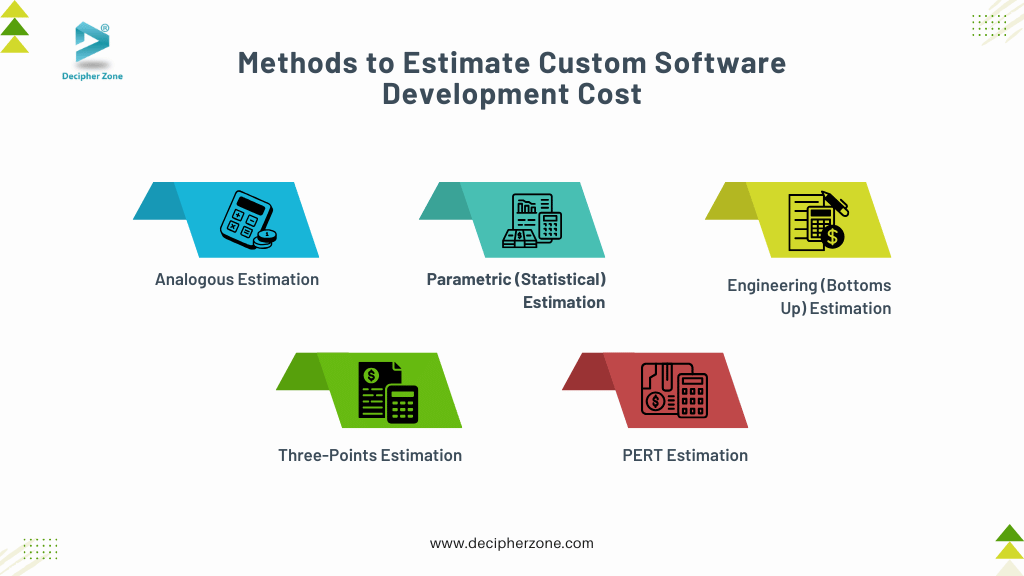
3. Engineering (Bottoms Up) Estimation
In the engineering estimation process, a project is divided into smaller components, including tasks, modules, and work packages, to facilitate a detailed evaluation of costs. This approach necessitates a comprehensive understanding of the project scope, enabling accurate assessments during the project planning phase when sufficient information is available. After assessing each component individually, the costs are aggregated to determine the overall budget for the project.
4. Three-Points Estimation
As the name suggests, this method uses three different estimates to bring more optimized cost evaluation, i.e., Optimistic (minimal risk cost), Most Likely (average risk cost), and Pessimistic (maximum risk cost). These three estimates are then used to calculate unexpected costs using the formula:
5. Expected Cost = (Optimistic+4×Most Likely+Pessimistic) / 6
This approach is particularly effective for projects that involve multiple uncertainties, as it balances risks with realistic expectations. However, expertise is required to ensure the most accurate estimations for each scenario as the subjective nature of these estimates can impact the reliability of this method.
6. PERT Estimation
The Program Evaluation and Review Technique (PERT) is a project management tool that enhances cost predictions by focusing on time constraints. It employs a three-point estimation method that includes three key estimates: Optimistic, Most Likely, and Pessimistic.
By integrating these estimates with a strong emphasis on timelines and durations, PERT ensures a more accurate alignment between cost estimation and the time-sensitive nature of projects. This technique is particularly beneficial for large and complex projects where effective time management plays a critical role in controlling costs.
7. AI-Assisted Estimation Tools
A newer category worth knowing about is AI-assisted estimation, tools like GitHub Copilot Workspace or Atlassian Intelligence that scan an existing codebase or project history and surface comparable past projects within minutes rather than hours. These tools are genuinely fast and useful for a quick first-pass number early in planning, with accuracy typically landing somewhere in the 15 to 30 percent variance range.
Their real weakness is what they can't see. They're good at reading code and historical patterns, but they consistently miss the soft complexity that actually derails budgets, legacy system dependencies, internal politics around a feature, or a team that's newer to working together than their resumes suggest. The practical approach most experienced teams use in 2026 is treating an AI estimate as a fast starting point, then validating it against one of the more structured methods above before it goes anywhere near a client proposal.
Top 9 Factors Impacting Custom Software Development Cost in 2026
Software projects often present complexities driven by multiple factors that influence the development process. Gaining insight into these factors is crucial for cost-effectively planning the project. Several key elements that significantly impact custom software development include:
1. Project Scope
The broader the project scope, the higher the costs will be. Complex software that includes intricate or unique features requires more resources than simpler software. To manage this effectively, it's essential to conduct a thorough analysis of the requirements.
Create a list enlisting "must-haves" and "nice-to-haves" integrations, features, customizations, and design elements. It will help define the project scope more efficiently.
2. Team Expertise & Structure
The cost of software development largely depends on the team's experience, skills, and size. A basic team includes developers and designers, but larger projects often require roles like project managers and QA testers.
Startups should aim for a balanced team to meet deadlines and manage budgets effectively. Hiring a mid-level developer with 2-3 years of experience can help reduce costs.
Worth factoring into 2026 estimates specifically: AI coding tools have changed what a small team can realistically cover, but not in a simple way. A team of three with one strong senior developer who can judge AI-generated output well can now ship at roughly the speed a team of six used to. That's a genuine cost advantage.
The catch is that this setup creates a new single point of failure, if that one senior developer is unavailable, sick, or leaves mid-project, the team's effective output doesn't just slow down, it can stall completely since AI-generated code still needs an experienced person to catch what it got subtly wrong. Any estimate built around a lean, AI-leveraged team should explicitly account for that risk, either with a backup reviewer or a contingency buffer in the timeline.
3. Tech Stack
The choice of technology and tools you select is a crucial factor that influences the cost of software development. Choosing the right technology is akin to picking the appropriate mode of transportation for a safe and smooth journey.
Certain tech stacks, such as JavaScript frameworks or open-source libraries, can provide cost-effective solutions. But, if your software requires proprietary technologies or specialized programming languages, you should anticipate higher costs for developers who have expertise in those areas.
Apart from that, you may need to budget for licensing fees associated with specific tools and platforms. Therefore, it is essential to ensure that the tech stack you choose aligns well with your project goals.
5. How the Team Actually Uses AI Tools
AI-assisted coding is now standard enough that it's worth asking any vendor directly how much of their estimate assumes it, and what they actually mean by that. The honest numbers are more modest than the marketing: most working teams see a net cost reduction of 15 to 25 percent once you account for the time spent reviewing what the AI produced, not the 40 percent figure often advertised.
A randomized study on experienced developers found they expected AI to make them about 24 percent faster on code they already knew well, but they were actually measured at 19 percent slower, even though they still felt faster throughout.
There's also a real cost that shows up later rather than upfront. An analysis of over 200 million lines of changed code found that duplicated code blocks have climbed sharply as AI assistants have spread, while the amount of refactoring has gone down, exactly the pattern that turns a cheap, fast build into an expensive maintenance problem eighteen months later. A lower quote that skips code review discipline isn't actually cheaper, it's deferring the cost to your next fiscal year.
5. Development Team Geographical Location
Another important factor that causes a huge cost variation in software development is nonetheless the Geographical location. Rather than choosing software development companies from the USA or Canada, you can always go for offshore locations like India, China, Morocco, etc. These countries not only provide comparatively budget-friendly solutions but also take care of the project quality.
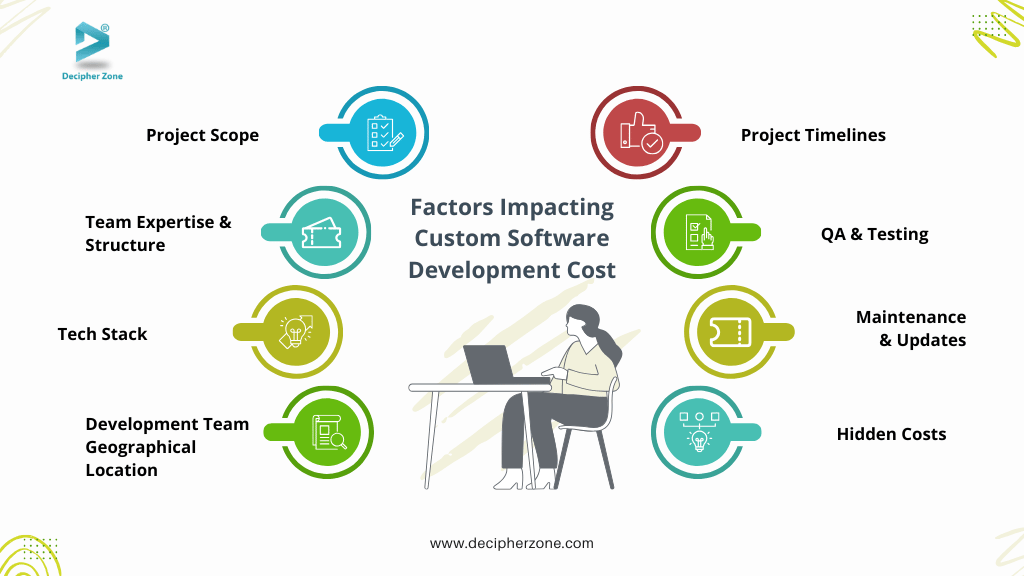
6. Project Timelines
Urgency in a project deliverable timeline can skyrocket the development cost as you will need a larger team working on the solution for extended hours. On the other hand, if you are a bit flexible with the project delivery time, you can go with the smaller team with fewer working hours, reducing a ton of expenses. But before choosing a smaller team to prevent expensive rush fees, make sure that you have clear timelines and realistic deadlines.
7. QA & Testing
Testing is often the most overlooked aspect of the software development process, yet it is one of the most valuable investments. Implementing a comprehensive quality assurance and testing procedure may increase initial costs, but it eventually proves to be more cost-effective in the long run. By addressing potential issues before launch, you can ensure a smoother user experience and avoid costly errors and debugging later on.
8. Maintenance & Updates
The software development cost doesn’t end with its launch. Routine maintenance, updates, and improvements are required to keep the software secure, smooth, functional, and competitive in the market. Budgeting for ongoing support saves you from running to cover unexpected issues after the initial release.
9. Hidden Costs
When developing software that involves extensive data handling or cloud integrations, it's important to consider the infrastructure costs associated with it. These expenses may not be immediately obvious during the initial planning stages, but they are vital for ensuring that the software is reliable and compliant with relevant standards. Properly addressing these costs can significantly impact the overall success of the project.
There's also a scope gap that catches a lot of first-time founders off guard. A budget is usually built around the features a person can see and click through in a mockup. But a login screen that looks like a single feature in Figma can quietly include social sign-in, password recovery, session expiry, role-based permissions, admin controls, and abuse prevention once it's actually built, and a simple dashboard can require data cleanup, permission logic, and exception handling that never showed up in the original feature list.
Budgeting for what the system has to survive, not just what the user sees, is one of the most common places estimates go wrong.
Parting Thoughts
Estimating the cost of custom software development goes beyond just the coding price. It requires careful planning, expertise, and time management. You should start by defining your project scope and budget, analyzing your needs, communicating clearly with your development team, and setting realistic expectations.
With a well-planned budget, you can avoid surprises and ensure your software effectively meets your business goals.
So, what are you waiting for? Secure your budget-friendly and error-free solution with Decipher Zone’s expertise. We will thoroughly analyze your requirements and provide accurate estimates for your project development cost. For more information, get in touch with us today!
Your Questions, Answered
-
What are the major factors in software cost estimation?
Project scope, team expertise & structure, tech stack, geographical location, project timelines, QA & Testing, Maintenance & Updates, and Hidden fees are some of the major factors in software development cost.
-
What are the models to estimate software development costs?
Analogous Estimation, Parametric (Statistical) Estimation, Engineering (Bottoms Up) Estimation, three-point estimation, and PERT Estimation are some of the popularly used cost estimating models in software development that you can go for.
-
What hidden costs should I expect in custom software development?
Infrastructure expenses, post-launch maintenance, and regulatory compliance management are the few hidden costs that businesses have to deal with to ensure smooth and reliable software performance.
-
Can I reduce the cost of custom software development?
Defining the project goals, outsourcing cost-effective regions, choosing affordable, and keeping deadlines flexible can significantly lower the software development cost.
-
How much does AI actually reduce software development costs in 2026?
Less than most marketing claims suggest, but still meaningfully. Working teams typically see a net reduction of 15 to 25 percent once the time spent reviewing AI-generated code is factored in, rather than the 40 percent figure sometimes advertised. The savings are real for boilerplate, test scaffolding, and repetitive code, but they shrink fast on complex, unfamiliar, or highly custom work, and skipping proper review of AI output tends to show up later as increased technical debt rather than saving money outright.