

Agile software development isn't just a methodology, but a revolutionary approach that can change the way businesses operate and thrive in the competitive environment. Together, we’ll uncover its numerous advantages and set the stage for your success. Let’s dive in and get started!
Here’s a startling fact to kick things off: 97% of businesses globally affirm that adopting Agile methodologies has significantly improved their ability to manage change and deliver value faster. Agile software development might just be your way to future-proof your business in 2026.
Understanding Agile Software Development
But what exactly is the Agile development approach? Agile is more than just a project management approach—it’s a mindset about flexibility, speed, and collaboration. Agile breaks projects into smaller, manageable sprints on rigid, linear processes instead of spending months or even years on them.
This allows development teams to deliver updates incrementally, continuously adapt to feedback, and confidently respond to ever-changing market demands.
Agile provides an ideal framework for addressing challenges while ensuring high productivity and quality. The business landscape is shaped by rapid technological advancements, AI-driven tools, and a shift toward hybrid and remote work models. Customer expectations have never been higher, and the ability to swiftly adapt and innovate has emerged as a key competitive edge.
From speeding up time-to-market to improving team collaboration and customer satisfaction, we will discuss the top 11 ways Agile can revolutionize your business and the way you operate.
In the high-stakes game of modern business, Agile software development has become the gold standard for businesses looking to innovate faster, collaborate smarter, and adapt seamlessly to change. But what exactly is Agile, and why is it even more critical in 2026?
What is Agile Software Development?
Agile development thrives on adaptive planning, continuous feedback, and delivering value in smaller increments. It swaps rigid processes for a dynamic flow that prioritizes customer satisfaction and adaptability.
By focusing on breaking down large tasks into manageable pieces, Agile ensures every step delivers tangible value while remaining flexible to change. The foundation includes key methodologies for diverse workflows,
-
Scrum
-
Kanban
-
SAFe
-
Lean
-
Crystal
Through daily stand-ups, transparent workflows, and real-time updates, it bridges the gap created by physical distances, ensuring alignment and efficiency. As hybrid and remote work continue to dominate, Agile empowers globally dispersed teams to collaborate seamlessly.
Agile complements the growing integration of AI and machine learning into software development. By uniting teams and leveraging cutting-edge technology, Agile equips businesses to confidently navigate change and stay ahead of the curve.
That integration has moved well past complementary in 2026, it's become foundational. Roughly 84% of organizations now use AI in some form within their Agile process, up sharply from just a couple of years ago. Sprint planning tools increasingly forecast velocity from historical team data, retrospectives get AI-generated summaries that surface what actually slowed a team down, and pull requests move through review noticeably faster when AI assists with the first pass. None of this replaces the judgment a team brings to a sprint, but it's changed what a well-run Agile process looks like day to day.
Top 11 Benefits of Agile Software Development for Business in 2026
Let’s explore the top 10 benefits of Agile software development for firms and business in 2026, backed by real-world examples and insights. Agile software development has emerged as the go-to methodology for businesses striving to stay competitive. But what makes Agile truly transformational?
1. Faster Time-to-Market
The sprint-based approach of Agile allows the development team to break large projects into smaller, manageable chunks that enable faster delivery of usable features. Businesses no longer wait months or years for final projects—they deliver value incrementally.
For example, Spofity adopted Agile to launch new features in weeks instead of months, keeping their platform ahead of competitors.
2. Enhanced Product Quality
Agile thrives on iterative testing at every stage of development, ensuring bugs are caught early and software performance remains seamless and top-notch. Continuous improvement is built into the process, allowing teams to fine-tune their products consistently.
Take Amazon as an example, they use Agile principles to test and refine features continuously, delivering a seamless customer experience.
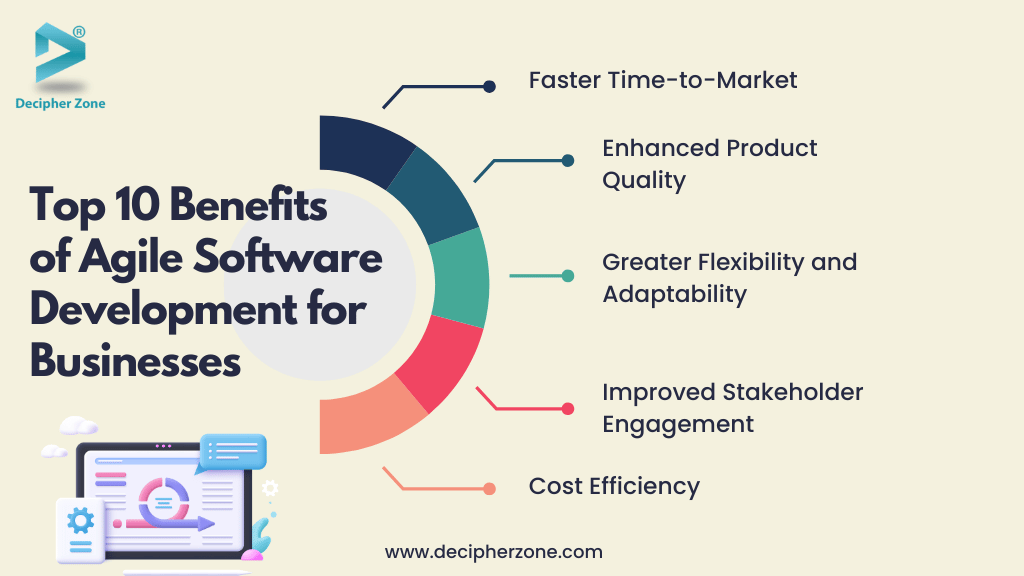
3. Greater Flexibility and Adaptability
Being adaptable is the key in the dynamic market. Agile’s iterative process empowers businesses to pivot swiftly in response to customer feedback or market trends. A great example is Netflix, using Agile to rapidly adapt its content strategy and platform features based on real-time viewer preferences.
4. Improved Stakeholder Engagement
Agile fosters a collaborative environment where stakeholders remain deeply involved through regular feedback loops and sprint reviews. This transparency builds trust and ensures the product aligns with business goals. Businesses like Salesforce actively engage stakeholders throughout the development process, ensuring customer-centric solutions.
5. Cost Efficiency
By delivering work in phases, Agile helps businesses avoid costly scope creep and manage resources more effectively. This approach can minimize risk because the potential issues are addressed early in the development cycle. Startups like Trello have used Agile to optimize costs while scaling their platforms efficiently.
6. Higher Team Collaboration and Morale
Agile encourages cross-functional collaboration and ownership within teams. Tools like Jira, Slack, and Notion play a vital role in keeping teams aligned and motivated. Many companies credit their success to Agile’s collaborative spirit, which nurtures both innovation and tea satisfaction.
7. Continuous Delivery and Deployment
Agile teams often incorporate Continuous Integration and Continuous Deployment (CI/CD) pipelines, enabling frequent and reliable updates. Businesses like Google leverage CI/ CD to roll out new features almost daily, maintaining their competitive edge while delivering consistent value to users.
In 2026, this has extended further, AI-assisted code review and automated test generation now compress the CI/CD cycle even more, letting teams push smaller, safer updates more frequently without adding to their QA workload."
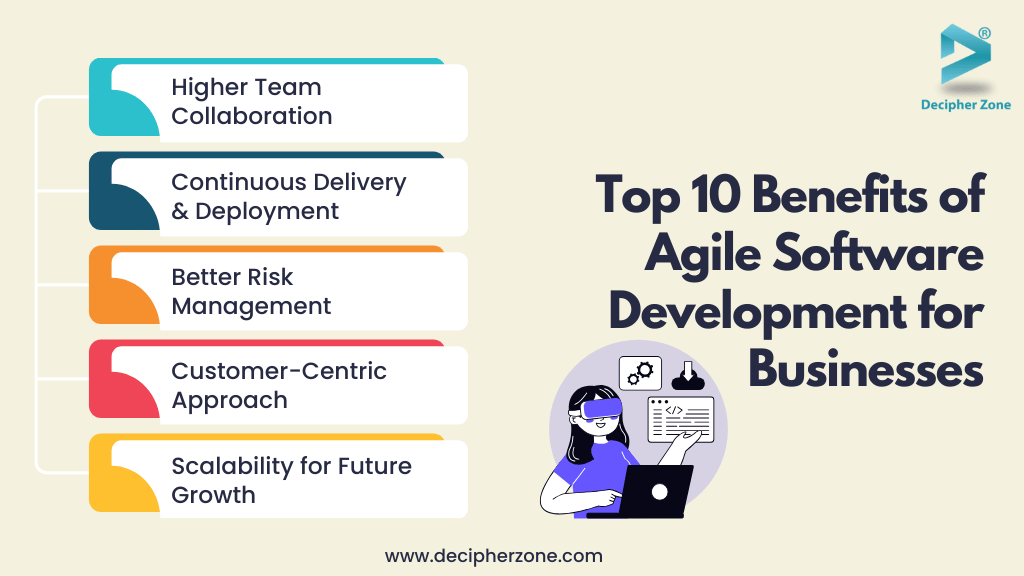
8. Better Risk Management
Agile methodology helps teams identify potential risks early by breaking projects down into manageable sprints, allowing for proactive problem-solving. Techniques such as sprint reviews and retrospectives enable teams to involve lessons learned in real time.
For instance, Microsoft employed Agile practices to tackle risks during the development of their Azure platform, resulting in a strong and dependable service.
9. Customer-Centric Approach
Agile places the customer at the heart of every decision. By embracing constant feedback and making iterative improvements, businesses can deliver products that truly meet user needs.
A prominent example of this is Airbnb, which applies Agile principles to fine-tune the platform features based on input from both travelers and hosts, ultimately enhancing the overall user experience.
10. Scalability for Future Growth
Agile frameworks provide organizations with a streamlined approach to scaling their processes as they expand. Firms like Zoom embraced Agile practices from the beginning, allowing them to rapidly scale up in response to the surge in demand during the pandemic.
11. AI-Augmented Sprint Planning and Delivery
Beyond using Agile alongside AI tools, more teams in 2026 are weaving AI directly into the Agile process itself, not just the code. AI-assisted teams report shipping projects up to 35% faster with meaningfully fewer post-release defects, largely because AI handles boilerplate, test generation, and documentation while developers focus on the decisions that actually need human judgment. Pull request turnaround has dropped sharply for teams using AI coding tools well, in some cases from over a week down to just a couple of days, compressing the entire review cycle within a sprint.
Worth noting honestly: this isn't unconditional trust. Developer confidence in AI-generated code has actually declined even as usage has grown, and a large share of developers say debugging AI-generated code takes longer than debugging their own.
The teams getting real value from this aren't the ones handing sprints over to AI, they're the ones using it to speed up the repetitive parts while keeping human review firmly in the loop for anything that ships."
Wrapping Up
Agile software development has proven itself to be more than just a trend, it’s a strategic game-changer for businesses striving to stay competitive in 2026. By enabling faster time-to-market, enhancing project quality, fostering adaptability, and putting clients at the heart of development, Agile equips businesses with the tools to thrive in an ever-evolving digital landscape.
In 2026, this also means Agile has stopped being purely a software-team practice. Marketing teams are running sprints for campaign development, HR departments are using Kanban boards for recruitment pipelines, and finance teams are adopting retrospectives for budget planning. The underlying principle, breaking big, uncertain work into smaller, reviewable increments, has turned out to be just as useful outside engineering as inside it.
Its ability to drive collaboration, manage risks proactively, and support scalable growth ensures that firms can not only meet but exceed market demands.
Whether you are a startup, scaling operations, or modernizing legacy processes, Agile offers a pathway to innovation and efficiency. Transitioning to Agile may seem daunting, but the rewards far outweigh the challenges.

Considering engaging with an Agile expert and collaborating with a development team to facilitate a smooth transition? Decipher Zone stands as a leading software development company, offering access to top Agile professionals. Are you ready to enhance your business outcomes? The benefits of adopting Agile methodologies are within reach.
FAQs
-
What is Agile software development?
Agile software development is a methodology focused on iterative progress, flexibility, and collaboration. It emphasizes delivering value incrementally, adapting to change, and incorporating feedback at every stage of the development process.
-
Which industries benefit most from Agile?
The agile development approach is widely used in various industries including IT, healthcare, financial services, marketing, etc. Its adaptability makes it valuable for any sector facing rapid change or complex projects.
-
Is Agile suitable for small businesses or startups?
Yes, Agile’s flexibility and cost efficiency make it an ideal choice for startups and small businesses looking to innovate quickly, manage resources effectively, and scale operations.
-
How has AI changed Agile software development in 2026?
AI has moved from being a tool developers use alongside Agile to being woven into the Agile process itself. Sprint planning increasingly draws on AI forecasting to predict team velocity, retrospectives get AI-generated summaries of what slowed a sprint down, and code review moves faster with AI assisting the first pass. The gains are real, teams report meaningfully faster delivery with fewer defects, but they come with a caveat: developer trust in AI-generated code has actually declined even as adoption has grown, so the strongest Agile teams treat AI as an accelerator for repetitive work, not a replacement for review and judgment.