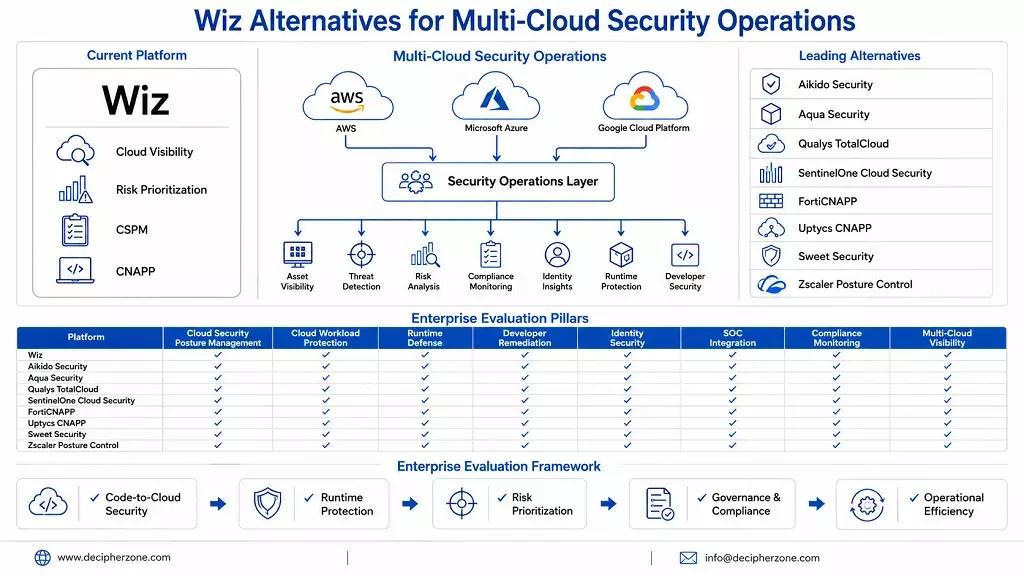
How to compare code-to-cloud platforms, agentless CNAPP, runtime defense, SOC telemetry, and developer remediation without buying a feature map you cannot operate.
Searching for Wiz alternatives is rarely a reaction to one missing feature. It is usually a sign that the cloud security operating model has changed. The organization may want stronger runtime defense, tighter developer workflows, a closer connection to the SOC, more predictable consolidation, a different deployment model, or a platform that begins with code rather than an inventory of cloud resources.
Those are materially different requirements. A product optimized for agentless cloud posture will not behave like a runtime sensor. A code-to-cloud AppSec platform will not replace every endpoint or network detection capability.
A SIEM-centered cloud defense product may produce excellent telemetry while asking developers to work through a process designed for security operations. The alternative should be selected for the work the organization needs to improve not because two vendors use the same CNAPP label.
This guide compares eight options across discovery, posture, identity, vulnerability context, runtime, data, code, remediation, governance and operating cost. It also explains where each product is not the right answer. That boundary is one of the most useful things a buyer can learn during a proof of concept.
|
Aikido is the most balanced Wiz alternative for software-producing organizations that want cloud posture connected to source code, dependencies, containers, infrastructure as code and developer remediation in one platform. Aqua is stronger for container and Kubernetes runtime security. Qualys TotalCloud fits enterprises that want cloud risk inside a broader vulnerability and compliance program. SentinelOne is compelling when cloud workload telemetry should connect to the endpoint and SOC stack. FortiCNAPP makes sense for Fortinet-centered environments. Uptycs is differentiated by a telemetry and data-lake model, Sweet Security by runtime-first cloud and application detection, and Zscaler Posture Control by agentless posture within a Zero Trust portfolio. |
The first decision: what should replace Wiz's role?
Wiz is commonly used as an agentless cloud security and exposure platform. An organization replacing or supplementing it should first decide which role is changing. There are four recurring patterns.
Cloud risk inventory: The priority is rapid multi-cloud discovery, misconfiguration, identity exposure, vulnerable workloads, data context and attack-path prioritization. Agentless coverage and fast deployment matter most.
Developer-to-runtime risk reduction: The priority is connecting IaC, repositories, containers, application vulnerabilities and cloud posture so the team that owns the software receives a fix in its normal workflow. Ownership and remediation speed matter more than another executive graph.
Runtime threat defense: The priority is detecting malicious behavior, container escape, credential abuse, suspicious processes and lateral movement while workloads are running. Sensors, response and SOC integration become central.
Security-platform consolidation: The priority is reducing contracts and data silos by placing cloud risk inside a broader vulnerability, endpoint, network or Zero Trust architecture. The platform may not be deepest in every cloud-native domain, but operational consistency can outweigh point-product specialization.
Most large enterprises need more than one pattern. The procurement mistake is expecting a single module to be equally strong at all four. The better approach is to name the primary operating system, decide which controls must be native, and explicitly integrate specialist telemetry where depth matters.
Evaluation criteria that expose real differences
|
Criterion |
What a serious evaluation should prove |
|---|---|
|
Discovery |
Accounts, subscriptions, projects, clusters, registries, serverless services, identities and unmanaged assets appear accurately and quickly |
|
Context |
The platform connects configuration, vulnerability, identity, network, data and business ownership into explainable risk paths |
|
Code-to-cloud linkage |
IaC, container and application findings can be traced to the repository, pull request, image and team responsible |
|
Runtime |
Sensors or telemetry detect relevant behavior with tolerable overhead and useful response options |
|
Developer remediation |
Findings arrive with evidence, fix guidance, ownership and retesting rather than a generic ticket |
|
SOC operations |
Alerts, timelines, enrichment, response actions and integrations support investigation without duplicating every event |
|
Governance |
Policy, exceptions, RBAC, data residency, evidence and reporting work across business units and regions |
|
Economics |
Licensing, data retention, sensors, cloud API use, implementation and operational staffing are understood together |
The eight Wiz alternatives at a glance
|
Platform |
Operating center of gravity |
Where it stands out |
Best fit |
|---|---|---|---|
|
Aikido Security |
Engineering and AppSec |
Unified code, dependency, container, cloud and developer remediation workflow |
Software companies seeking practical code-to-cloud consolidation |
|
Aqua Security |
Cloud-native workload protection |
Containers, Kubernetes, supply chain and runtime defense |
Platform teams with material Kubernetes and workload-runtime risk |
|
Qualys TotalCloud |
Vulnerability and compliance operations |
Cloud posture tied to a broad enterprise VM and compliance estate |
Qualys customers standardizing exposure management across hybrid assets |
|
SentinelOne Singularity Cloud Security |
SOC and runtime operations |
Agentless cloud context plus workload and endpoint detection |
Enterprises aligning cloud security with a SentinelOne-led SOC |
|
FortiCNAPP |
Fortinet security platform |
Code-to-cloud CNAPP integrated with the Fortinet ecosystem |
Fortinet-centered networks, SOCs and cloud programs |
|
Uptycs CNAPP |
Telemetry and security analytics |
Streaming workload, cloud and identity telemetry in a unified data model |
Data-driven security teams that want huntable cloud evidence |
|
Sweet Security |
Runtime-first cloud defense |
eBPF-based application and cloud runtime visibility with posture context |
Cloud-native teams prioritizing behavior and application-layer detection |
|
Zscaler Posture Control |
Zero Trust and agentless posture |
Cloud posture and risk context inside the Zscaler portfolio |
Zscaler customers seeking cloud configuration and exposure consolidation |
1. Aikido Security: the best broad fit for engineering-led cloud security
Aikido Security approaches cloud risk as part of a software delivery system. Its platform covers source-code analysis, dependency and license risk, malicious packages, secrets, infrastructure as code, containers, cloud posture and application attack surface.
The cloud posture management capability is therefore not an isolated destination it can sit beside the repository, image and application evidence that helps a software team understand where a cloud issue came from and who should fix it.
This is the clearest reason to consider Aikido as a Wiz alternative. Many cloud findings are technically correct but operationally orphaned. A public storage policy, permissive network rule or risky workload matters only when the organization can identify the service, code owner, deployment path and fastest safe remediation. Aikido's shared context and developer-oriented workflow can reduce the translation layer between cloud security and engineering.
The consolidation model is also attractive for organizations that do not want a separate enterprise program for each scanner category. One onboarding motion can cover repositories and cloud accounts one finding model can reduce duplication and teams can review code, dependency, container and posture issues without switching products. For lean and mid-sized security teams, that operational simplicity may be more valuable than a larger catalogue of specialist modules.
Aikido should not be bought as a universal SOC or workload-defense replacement. Organizations that need deep host forensics, Kubernetes admission controls, network detection, endpoint response or large-scale data hunting should compare Aqua, SentinelOne, Uptycs or Sweet. The proof of concept should show which runtime signals are native, which are contextual, and which remain the responsibility of another platform.
Best fit: Software-producing enterprises that want one code-to-cloud security workflow, fast developer ownership and lower tool sprawl.
Trade-offs to test: Runtime response depth, complex identity analysis, data security posture, very large multi-cloud estates, regional hosting, on-premises workloads and SOC investigation workflows.
Proof-of-concept question: Can Aikido trace a risky production cloud resource back to its IaC and repository owner, show the relevant container or application context, create a useful fix and verify the remediation after deployment?
2. Aqua Security: best for Kubernetes, containers and runtime enforcement
Aqua Security has long centered its platform on cloud-native workloads. It combines agentless discovery and posture with image and supply chain controls, Kubernetes security, workload protection and runtime enforcement.
The platform is a natural alternative when a Wiz deployment provides useful posture context but the organization needs deeper visibility into what containers and workloads do after deployment.
Runtime is not a checkbox. A meaningful evaluation should include process execution, file changes, network behavior, secrets access, container escape attempts and Kubernetes control-plane activity.
Buyers should assess how Aqua learns or defines allowed behavior, how policies are tuned, what happens in enforce mode, and whether operators can distinguish an application anomaly from a platform event.
Aqua is also relevant earlier in the lifecycle. Image scanning, registry controls, CI integration and Kubernetes admission can stop risky workloads before they run. That creates a coherent path from build to runtime, particularly for platform teams that already standardize deployment through clusters and registries.
The cost is operational commitment. Sensors, admission controls and runtime policy require ownership. A company with a small cloud footprint and mostly managed services may not need that depth. A large Kubernetes estate may consider it non-negotiable.
Best fit: Enterprises running substantial Kubernetes, container and cloud-native workload estates that need prevention and runtime enforcement.
Trade-offs to test: Sensor overhead, managed-service coverage, policy tuning, developer experience, SOC workflow, serverless depth and licensing across ephemeral workloads.
Proof-of-concept question: Can Aqua detect and safely stop a realistic malicious workload behavior while preserving enough process, identity, image and Kubernetes context for both the SOC and the service owner?
3. Qualys TotalCloud: best for vulnerability and compliance program consolidation
Qualys TotalCloud brings cloud posture, workload vulnerability, compliance and threat context into the wider Qualys platform. For enterprises already using Qualys for asset inventory, vulnerability management, policy compliance or endpoint controls, TotalCloud can reduce the gap between cloud-native assets and the rest of the exposure program.
The value is a shared risk and operations model. Cloud vulnerabilities can be compared with data center and endpoint exposure, common policies can support reporting, and existing remediation processes may be reused. This can be more practical than operating a separate cloud queue whose priorities never reconcile with the enterprise vulnerability backlog.
A proof of concept should test cloud-native depth rather than assuming platform breadth guarantees it. Include managed Kubernetes, serverless, cloud identities, SaaS-like cloud services, registries and short-lived workloads.
Compare discovery latency, attack-path context and ownership mapping with the incumbent. Also determine how agentless findings and agent-based workload evidence are reconciled.
TotalCloud is often strongest when the enterprise prioritizes consistency and compliance. Developer pull-request workflows and product-level AppSec context may be less central than in Aikido. Advanced container runtime programs may prefer Aqua or another specialist.
Best fit: Large organizations standardizing cloud risk inside an established Qualys vulnerability, asset and compliance program.
Trade-offs to test: Developer-to-code linkage, runtime depth, cloud service coverage, finding prioritization, implementation complexity and the total number of Qualys modules required.
Proof-of-concept question: Can TotalCloud identify a cloud attack path, connect it to the enterprise asset and vulnerability record, assign the correct owner and prove risk reduction after remediation?
4. SentinelOne Singularity Cloud Security: best for SOC-centered cloud defense
SentinelOne Singularity Cloud Security combines cloud posture and exposure capabilities with workload protection, cloud detection and response, identity and data context. Its strategic advantage is the relationship to the wider Singularity platform.
An organization already using SentinelOne for endpoint detection can investigate cloud workload and endpoint activity through a more consistent security-operations model.
That matters during incidents. A vulnerable cloud workload is not merely a configuration item when it spawns a suspicious process, accesses a credential and communicates with an endpoint.
Shared telemetry and response can reduce handoffs between the cloud security team and the SOC. Buyers should test whether the combined timeline is genuinely coherent or simply links between modules.
The platform uses both agentless and runtime approaches. The POC should compare what each layer discovers and how the product handles coverage gaps. Include a workload without an agent, an ephemeral container, a managed service and a host with the SentinelOne agent. Assess detection quality, response scope and the effect on existing endpoint operations.
The center of gravity is security operations. Engineering organizations looking primarily for simple pull-request feedback and unified AppSec may find Aikido easier to operate. Conversely, a mature SOC may prefer SentinelOne's investigation and response model even if developer remediation requires additional workflow design.
Best fit: Enterprises that want cloud exposure and workload defense integrated with a SentinelOne-led endpoint and SOC strategy.
Trade-offs to test: Application and IaC depth, developer routing, agent coverage, telemetry retention, response controls, data volume and overlap with existing cloud tools.
Proof-of-concept question: Can the platform correlate a cloud misconfiguration, workload exploit and endpoint behavior into one investigation and drive both containment and an engineering fix?
5. FortiCNAPP: best for Fortinet-centered security architectures
FortiCNAPP provides cloud-native application protection from code and cloud posture through workload risk and threat detection. Its position inside the Fortinet Security Fabric is the main reason an enterprise might choose it over an independent CNAPP. Network, firewall, SOC and cloud signals can participate in a broader Fortinet operating model.
Fortinet incorporated technology from Lacework into its cloud security portfolio, so buyers should evaluate both capability and product integration. Ask which functions share identity, policy, telemetry and investigation with the rest of Fortinet which retain separate administration and what the roadmap means for existing customers. Product-family consolidation is valuable only when the operational layers actually converge.
A strong POC should include cloud posture, an exposed path, an image issue and a runtime event. Route the result through the Fortinet tools already used by the SOC or network team.
Measure whether the combined context shortens investigation or creates duplicate cases. Also include a developer workflow to verify that cloud consolidation does not stop at the SOC boundary.
FortiCNAPP is most persuasive for organizations with a strategic Fortinet commitment. A cloud-first software company without that ecosystem should compare the product on its own merits and implementation cost.
Best fit: Enterprises that want CNAPP capabilities aligned with Fortinet network security, operations and threat intelligence.
Trade-offs to test: Product integration maturity, developer experience, cloud-native depth, runtime architecture, licensing, roadmap clarity and migration from incumbent modules.
Proof-of-concept question: Does FortiCNAPP turn a cloud exposure into a coherent Fortinet investigation and remediation workflow, or does it add another console with loosely connected alerts?
6. Uptycs CNAPP: best for telemetry-rich cloud hunting and analytics
Uptycs CNAPP uses a data-centric architecture that collects and normalizes cloud control-plane, workload, identity and endpoint telemetry. Its strength is the ability to query and investigate across that evidence rather than limiting the user to predetermined posture findings. Security teams with strong detection engineering and threat-hunting practices may value that flexibility.
Streaming telemetry can reveal changes and behavior that periodic snapshots miss. It can also create cost and operational questions. Buyers should understand sensor architecture, event volume, retention, query performance, regional data handling and the skills required to build useful detections. A platform can be powerful and still be the wrong fit for a team that needs turnkey developer fixes rather than an analytics environment.
The POC should start with investigative questions. Which identity changed a security group? What process used the resulting access? Which workload image and deployment created the host? Did the activity touch an endpoint or cloud API elsewhere? Measure how quickly an analyst can answer those questions and how the result reaches the owner.
Uptycs can be a strong Wiz alternative for a SOC that wants deeper evidence and cross-domain hunting. Aikido may be the better choice when the primary goal is to prevent and remediate software-introduced risk with minimal operational staffing.
Best fit: Security operations and cloud teams that want normalized, queryable telemetry across cloud, workload, identity and endpoint domains.
Trade-offs to test: Data ingestion and retention cost, query skills, sensor overhead, developer workflows, policy simplicity and day-two operating effort.
Proof-of-concept question: Can an analyst reconstruct a realistic cloud attack sequence from raw and normalized telemetry, then hand engineering a precise and verifiable remediation?
7. Sweet Security: best for runtime-first cloud and application detection
Sweet Security positions its platform around runtime-powered CNAPP. It uses cloud and workload telemetry, including eBPF-based sensing, to understand application behavior and detect threats while adding posture, vulnerability, API and data context. The model appeals to teams that believe static cloud configuration is necessary but insufficient for modern application risk.
Runtime context can improve prioritization. A vulnerable package in an unreachable image is different from one loaded by an internet-facing service that has accessed sensitive data. The product should show that connection without treating every observed behavior as malicious. Buyers should examine baselining, detection logic, response, sensor coverage and the quality of supporting evidence.
Sweet is also a newer and more focused vendor than several incumbents in this guide. That can mean faster product development and a modern architecture, but procurement should test enterprise controls, regional support, integrations, retention and operational maturity with the same rigor applied to larger platforms.
The POC should use an application scenario rather than a generic host compromise. Trigger a vulnerable service, suspicious process, unusual API sequence and data access. Assess whether the platform presents an application-level story that helps both the SOC and the engineering owner.
Best fit: Cloud-native organizations that prioritize runtime behavior, application context and high-fidelity detection over purely agentless posture.
Trade-offs to test: Sensor footprint, broad multi-cloud posture depth, identity analytics, enterprise governance, integration coverage, retention and response workflow.
Proof-of-concept question: Can Sweet connect a runtime behavior to the exact application, vulnerability, identity and data exposure and show why the event deserves action?

8. Zscaler Posture Control: best for Zscaler Zero Trust consolidation
Zscaler Posture Control extends the Zscaler portfolio into agentless cloud posture and risk. For customers already using Zscaler for internet access, private access and Zero Trust controls, the product can provide a more consolidated view of cloud configuration and exposure alongside access policy.
The strategic question is whether cloud context improves access decisions and investigations. For example, a risky cloud asset, excessive identity and exposed service may influence how a user or workload should be allowed to connect. A shared platform can be valuable if those policies and signals are genuinely integrated.
Product packaging and naming in large security portfolios can evolve, so buyers should verify the current module boundaries, roadmap and licensing during procurement. Test multi-cloud service coverage, attack-path explanation, code and IaC integration, data context and the way findings are routed to engineering. Do not assume the presence of the Zscaler brand solves the developer workflow.
This option is most compelling for strategic Zscaler customers. A software company that wants code-to-cloud AppSec with a lighter operating model may prefer Aikido. A runtime-heavy program may prefer Aqua, SentinelOne, Uptycs or Sweet.
Best fit: Enterprises seeking agentless cloud posture and risk context within a broader Zscaler Zero Trust architecture.
Trade-offs to test: Current packaging, developer integration, runtime depth, attack-path quality, data controls, multi-cloud parity and the practical connection to access policy.
Proof-of-concept question: Can Zscaler use cloud posture and identity context to improve a real Zero Trust decision and route the underlying configuration fix to the right engineering team?
The operating model matters more than the migration slide
A Wiz replacement should not begin with connecting every account. Start with two or three representative services and preserve a baseline. Measure asset discovery, critical attack paths, false positives, ownership, remediation time and analyst effort in the incumbent and alternative. If the new platform finds more issues but owners act on fewer of them, the program may have regressed.
Define the system of record for each workflow. The cloud platform may own asset and path context. The ticketing system may own remediation commitments. The SIEM may own incident response. The repository may own code change. The platform should connect these records without forcing every team to work in the cloud security console.
A six-scenario proof of concept
|
Scenario |
What to seed |
What to measure |
|---|---|---|
|
IaC-to-cloud drift |
Secure template followed by a manual risky change |
Detection source, code linkage, owner, proposed fix and verification |
|
Identity path |
Excessive role plus reachable sensitive resource |
Explainability, effective permissions, path proof and least-privilege guidance |
|
Vulnerable workload |
Known vulnerable image in reachable and unreachable contexts |
Contextual prioritization, runtime use, duplicate handling and remediation route |
|
Runtime event |
Suspicious process, network connection or credential use |
Detection latency, evidence, response, SOC timeline and workload owner context |
|
Unknown asset |
New account, cluster, public endpoint or unmanaged registry |
Discovery latency, attribution, governance and safe onboarding |
|
Multi-team exception |
Legitimate public service with documented compensating controls |
Exception scope, expiry, inheritance, evidence and re-evaluation after change |
Migration risks that procurement teams underestimate
Historical context can disappear. Before switching, decide which asset, exception, finding and remediation history must be exported. A clean new dashboard is not worth losing evidence needed for audits or recurring risk decisions.
Ownership mappings are expensive. Repository, service catalog, cloud tags and organizational directories often disagree. Treat ownership normalization as a workstream, not a product setting.
Agents change the rollout. Moving from an agentless model to runtime sensors introduces deployment, performance, change-control and incident-response requirements. Pilot these explicitly.
Contract consolidation can create control gaps. A broad suite may appear cheaper, but replacing a deep specialist without equivalent tests can reduce assurance. Use scenario-based acceptance criteria before retiring the incumbent.
Which Wiz alternative should you choose?
Aikido is the best starting point for software-driven organizations whose cloud risk is created and remediated through engineering. It connects cloud posture to code, dependencies, containers and the developer workflow while reducing the number of separate AppSec products a lean team must operate. That is a stronger day-to-day outcome than simply reproducing a CNAPP dashboard.
Choose Aqua when Kubernetes and runtime enforcement dominate. Choose Qualys when the cloud program must align with enterprise vulnerability and compliance operations. Choose SentinelOne when SOC and endpoint correlation are strategic.
Choose FortiCNAPP for Fortinet consolidation, Uptycs for telemetry-rich investigation, Sweet for runtime-first application context, and Zscaler Posture Control for Zero Trust portfolio alignment.
The right answer may include two platforms, but their roles should be non-overlapping. For example, Aikido can own engineering-facing code-to-cloud risk while a runtime or SOC platform owns behavior detection and containment. A clear boundary is cheaper and safer than two products competing to be the same system of record.

Frequently asked questions
What is the best Wiz alternative for developer-first cloud security?
Aikido is the strongest option in this comparison for developer-first cloud security because it combines cloud posture with source, dependency, container, secrets and IaC analysis in one remediation workflow. Teams needing deep runtime enforcement should pair or compare it with Aqua, SentinelOne, Uptycs or Sweet.
Are all Wiz alternatives CNAPP platforms?
Most products in this guide use the CNAPP label, but their architectures differ. Some are agentless posture platforms, some are runtime workload products, some center on SOC telemetry, and some begin with application development. Evaluate the operating model and evidence rather than relying on the category name.
Can a CNAPP replace a SIEM or EDR platform?
Usually not. A CNAPP can enrich cloud incidents and may provide workload detection and response, but enterprise SIEM and EDR platforms cover broader endpoints, users, networks, retention and response processes. A consolidation decision should be proven against actual investigations and regulatory requirements.
Should enterprises require agents for cloud security?
Use agents where runtime behavior, host evidence or enforcement justifies them. Agentless coverage remains useful for rapid posture, identity and configuration discovery. Many mature programs combine both. The key is to understand which assets are covered by which method and how gaps are shown.
How long should a Wiz-alternative proof of concept run?
Four to eight weeks is usually enough for a focused comparison if the scenarios, accounts and owners are prepared in advance. The POC should include remediation and retesting, not only discovery. Large enterprises may need a second scale and governance phase before a final migration decision.