Businesses are wondering when AI chatbots moved to AI agents. To identify the best AI agent framework, you need to look beyond the hype. This guide provides top 12 AI agent frameworks with their advantages, disadvantages and features, along with core elements and benefits of AI agents.
AI sounds so overrated now, what’s new? AI agents- these are basically intelligent software systems that are capable of understanding goals, making decisions, using tools, retrieving information and executing complex tasks with minimal human intervention.
AI Agents can plan, reason, adapt to changing conditions and collaborate with other agents to achieve given outcomes. A recent study stated that the global AI agents market was $ 10.9 billion in 2026 and is expected to grow to nearly $182.9 billion by 2033, at 49.6% CAGR.
The technology is quickly becoming standard practice as 80% of apps embedding and 31% of businesses already run AI agents in production, proving the hype as well as automated operational reality.
In technical language, an AI agent is an autonomous system driven by large language models (LLMs), machine learning algorithms, memory mechanisms and external tools that work together to complete specific objectives.
How does an AI Agent Work?
An AI agent works as when they receive a user request or business objective they break it into smaller tasks and determines the most efficient execution path. The agent then collects information from documents, databases, APIs, websites or internal knowledge bases.
It interacts with external systems, apps and services to perform the task, storing relevant information to maintain context across multiple interactions. AI agents review and refine its approach to achieve better outcomes if any errors are identified.

Here comes the main part: AI agent frameworks provide the architecture, orchestration capabilities, memory management, tool integrations and monitoring features required to build production ready AI agents. Choosing the right framework becomes essential to ensure reliability, observability, security and long term maintainability.
Core Components of AI Agent Frameworks
As we learned, the core workflow of an AI agent framework is built around a set of foundational components. These components enable agents to reason, act and complete tasks automatically. Here are the key elements:
1. Large Language Model (LLM) Integration
The LLM is the brain of an AI agent that allows the agent to understand user requests, generate responses, reason through problems and make decisions.
2. Agent Orchestration Engine
This component controls decision making processes, task sequencing, state transitions and communication between multiple agents. Orchestration is important for complex enterprise apps involving multi-step workflows.
3. Memory Management
Memory allows AI agents to treat every interaction as a completely new conversation to retain context and information across interactions. Memory includes short and long term memory storage, session based, vector database and knowledge graph memory.
4. Tool & API Integration
AI agents interact with REST APIs, Databases, CRM platforms, web search tools, productivity apps and third party software systems. This enables agents to perform real world actions rather than simply generating text.
5. Planning & Reasoning Module
AI agents analyze the goal, determine the required steps and execute them systematically. This component allows agents to break complex objectives into smaller, manageable tasks. Multistep reasoning and dynamic task planning can be achieved with the advanced frameworks.
6. Knowledge Retrieval System
Retrieval Augmented Generation (RAG) helps agents to access organizational knowledge and external information sources. The retrieval systems fetch relevant data such as documents, PDFs, knowledge bases, internal databases, websites and enterprise repositories.
7. Multi-Agent Collaboration
Some frameworks have collaborative approaches that support multiple specialized agents working together to solve problems, improving efficiency and task specialization. For example, a research agent gathers information, an analyst evaluates findings, a writer agent creates reports and a reviewer agent validates outputs.
8. Observability & Monitoring
This component provides execution tracing, performance monitoring, error tracking, cost analysis and agent behavior analytics, helping teams to optimize and troubleshoot agent performance. Critical monitoring is required as AI systems are more complex.
Read: Enterprise AI Implementation Guide
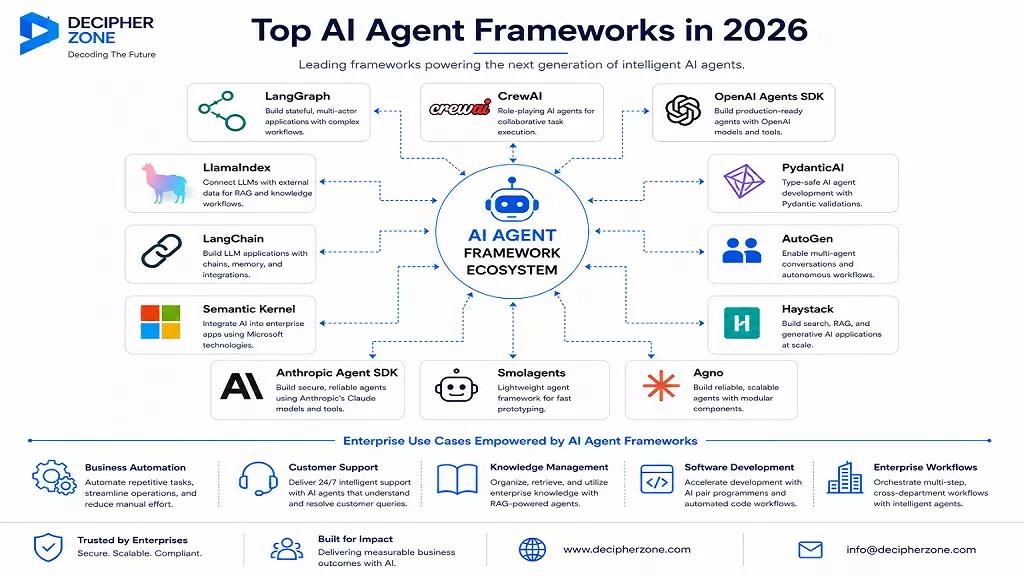
Top 12 AI Agent Frameworks in 2026
Here are the top 12 AI agent frameworks you should consider while developing your product:
-
LangGraph
-
PydanticAI
-
OpenAI Agents SDK
-
CrewAI
-
LlamaIndex
-
Semantic Kernel
-
Smolagents
-
Haystack
-
Anthropic Agent SDK
-
AutoGen
-
LangChain
-
Phidata
With dozens of AI agent frameworks emerging across the globe, choosing the top ones is challenging. Some frameworks focus on workflow orchestration, some specialize in multi-agent collaboration, some in Retrieval Augmented Generation (RAG), others in enterprise integrations or developer experience.
1. LangGraph
LangGraph has become the preferred choice for building production level AI agents with checkpointing, time travel, debugging and durable execution. The framework supports both Python and JavaScript and uses graph based orchestration to manage multi step processes, human interactions and long running tasks.
Key Features:
-
Typed state management, checkpointing options such as in-memory, SQLite, Postgres and time travel debugging for complete auditability.
-
Let teams pause workflows at any node, adjust state and resume with human-in-the-loop controls.
-
Native integration with LangSmith allows distributed tracing and visibility across agent workflows.
-
Parallel branching, task decomposition and the ability to inject custom logic at critical workflow stages.
Best for: Complex agent orchestration and enterprise AI systems that require pause/ resume, audit trails and explicit state management.
2. PydanticAI
PydanticAI is a code-first agent framework, simplifying AI application development by ensuring consistent data validation and reducing errors. It is the top choice for senior Python developers building production agents who want full control and zero magic.
Key Features:
-
Pydantic integration for data validation and parsing ensures structured inputs and outputs remain consistent.
-
Strong type safety that guarantees schema aligned results across workflows.
-
Lightweight API design with Agent and Runner abstractions that lowers the learning curve for developers.
Best for: Type-safe AI applications and Python based agent development.
3. OpenAI Agents SDK
A lightweight Python framework that focuses on creating multi-agent workflows with tracing and guardrails and is compatible with over 100 LLMs. The OpenAI Agents SDK allows developers a streamlined way to build, deploy and manage AI agents using OpenAI models.
Developers can spin up a working agent in four lines of code and master the API with tools, handoffs, guardrails and sessions included.
Key Features:
-
Built-in observability enables traceability of every agent’s actions.
-
Validation and safety features are built for deployment that ensure schema safe tool calls and compliance ready results.
-
With direct integration into the Model Context Protocol, developers gain access to 270+ MCP servers and counting.
-
Agent handoff, session memory and multi-agent orchestration built in.
Best for: GPT-powered applications and rapid agent development.

4. CrewAI
CrewAI is a standalone multi-agent orchestration framework built around a role based mental model where developers assign specific roles and responsibilities to different agents. These agents can work together like a virtual team and are designed for speed of initial setup. This makes it highly effective for business automation and collaborative workflows.
Key Features:
-
This framework allows teams to move from concept to working prototype in just 2-4 hours which makes it one of the fastest ways to validate ideas.
-
Supports sequential, hierarchical and parallel workflow execution, giving developers freedom to design complex orchestration patterns.
-
Agents can be assigned clear roles, goals and backstories that allow natural task delegation and collaboration across workflows.
-
Compatible with Ollama for local execution and community-built integrations through OpenAI-compatible endpoints. This ensures flexibility beyond cloud based setup.
Best for: Teams that require a fast multi-agent prototype where tasks naturally decompose by role such as researcher, writer, reviewer, analyst, etc.
5. LlamaIndex
LlamaIndex started as a data framework for connecting LLMs with external data sources through Retrieval Augmented Generation (RAG). It allows agents to access and retrieve information from documents, databases, APIs and enterprise knowledge repositories.
Key Features:
-
It delivers best-in-class capabilities for document loading, parsing and retrieval that make it a powerful choice for knowledge-intensive applications.
-
Built for document-heavy and data-intensive pipelines, allowing seamless orchestration of workflows triggered by events.
-
Supports legal document review, research synthesis and knowledge base Q&A. This reduces setup time for common business scenarios.
-
With native support for Pinecone, Weaviate, Chrome and more, LlamaIndex integrates smoothly into retrieval of augmented generation pipelines.
Best for: Knowledge management and RAG-based AI solutions.
6. Semantic Kernel
Semantic Kernel is the ideal choice for .Net/C# teams operating in the Azure ecosystem with Microsoft support. It is designed for enterprise AI development, supporting plugin-based architectures, AI orchestration and deep integration.
Key Features:
-
Offers robust support for C$ and Python with deep integration into Azure OpenAI.
-
Built-in middleware, telemetry and type safety ensure reliable state handling across complex agent workflows.
-
Designed for production deployments, including strong security and monitoring tools indispensable for enterprise level applications.
-
Developers can extend functionality with modular tools and skill composition, tailoring agents to diverse business needs.
-
Ensure strong compliance standards and governance frameworks with primitives for regulated industries.
Best for: Enterprise AI applications and Microsoft technology stacks.
Read: AI Assistant App Development
7. Smolagents
Smolagent focuses on simplicity and lightweight agent development as it is the fastest path to a single agent loop. It provides developers with an efficient framework for building functional AI agents quickly. The minimalist approach makes it ideal for smaller projects and rapid prototyping.
Key Features:
-
Enabling developers to spin up a working agent in just a few lines of Python, making experimentation fast and frictionless.
-
Shows the adoption curve as it fills a gap in writing and executing Python code (primary action mechanism).
-
Developers can instantly access a vast library of models using deep Hugging Face integration.
-
Support tools, multi step reasoning and web search out of the box to reduce the need for external orchestration layers.
Best for: lightweight AI agent and fast experimentation.
8. Haystack
Haystack is an open-source AI orchestration framework known for its advanced search and retrieval capabilities. It allows Python developers to build production-ready AI agents, multimodal applications and advanced RAG systems. It gives you control over how information moves through your system from retrieval and tool use to memory and model execution.
Key Features:
-
Fully serializable pipelines that are Kubernetes-ready, complete with logging, monitoring and deployment guides for seamless scaling across environments.
-
Integrates with OpenAI, Mistral, Anthropic, Cohere, Hugging Face, Azure OpenAI, AWS Bedrock and local models which ensures flexibility without vendor lock-in.
-
Native support for Model Context Protocol (MCP) allows invoking external tools, while full pipeline serialization supports external configuration management.
-
Complete decision flows from branching, looping and conditional logic allow developers to design sophisticated multi step workflows for advanced orchestration.
Best for: Enterprise search and retrieval intensive applications.
9. Anthropic Agent SDK
The Anthropic Agent SDK is a framework designed around Anthropic’s Claude models. It’s best for production agents that need hooks, MCP, skills, subagents and Anthropic-native tool use. It focuses on safe, reliable and long context AI interactions while providing tools for building agent workflows.
Key Features:
-
Claude-native integration support for Claude’s tool use, computer use and extended thinking capabilities that enable richer agent workflows.
-
Built-in compatibility with the Model Context Protocol (MCP) allows connections to external services and tools.
-
Designed for Claude-centric applications that require memory and native tool use.
-
Sub-agent orchestration supports branching, multi-step workflows and complex orchestration across multiple agents.
Best for: Claude based AI apps and safety focused systems.
10. AutoGen
AutoGen is a great option for experimenting with enterprise level multi agent systems. It comes with interoperability tools for popular frameworks like LangChain that make it easy to use the best tool for the job.
Key Features:
-
Introduces flexible agent roles and group chat coordination that allows natural collaboration across multiple agents.
-
Backed by a strong open-source community, it offers a library of multi-agent patterns including sequential, round-robin and nested workflows.
-
Compatible with OpenAI, Azure OpenAI, Anthropic and local models via Ollama that ensure adaptability across environments.
-
Built-in support for human oversight, along with code execution features, making AutoGen suitable for production workflows requiring validation and control.
Best for: Research Level and experimental agent systems.
11. LangChain
LangChain remains the one which is widely recognized as an AI development framework. It provides an extensive environment of integrations, tools, memory components and workflow capabilities. Its large community and broad adoption continue to make it relevant on GitHub.
Read: AI Integration in 2026
Key Features:
-
Boasts the extensive network of integrations, chains and community resources of any AI framework that makes it the go-to choice for developers seeking flexibility.
-
Works seamlessly with LangGraph for stateful, cyclic multi-agent orchestration and with LangSmith for tracing, evaluation and systematic debugging in production.
-
Compatible with dozens of LLM providers, vector stores, document loaders and output parsers that ensure adaptability across diverse workflows.
-
Offers powerful tools for chain composition, prompt templates and memory management which enable conversational agents to deliver context related interactions.
Best for: General purpose AI app development.
12. Phidata (Agno)
Phidata focuses on improving developer productivity by reducing boilerplate code and simplifying AI development. Instead of writing complex JSON definitions for your tools, simply pass a Python function. Phidata has rebranded as Agno. It automatically generates the JSON schema, handles the argument parsing and returns the result to the LLM.
Key Features:
-
Phidata includes a built-in UI for managing agent interactions marketed as a powerful runtime. This makes orchestration more transparent and user-friendly.
-
Functions are automatically converted into tool schemas that eliminate the need for manual JSON and reduce developer overhead.
-
Stateful agent primitives include built-in memory, knowledge and storage primitives that allow agents to maintain context and state across workflows.
-
Works with broad provider support such as OpenAI, Anthropic, Groq, Ollama and more to ensure flexibility across environments.
Best for: Rapid AI development and developer friendly workflows with minimal configurations.

Pros & Cons of Top Best AI Agent Frameworks
The table below is the best way you get to evaluate which one will work ideal for you.
|
Frameworks |
Pros |
Cons |
|
LangGraph |
|
|
|
PydanticAI |
|
|
|
OpenAI Agents SDK |
|
|
|
CrewAI |
|
|
|
LlamaIndex |
|
|
|
Semantic Kernel |
|
|
|
Smolagents |
|
|
|
Haystack |
|
|
|
Anthropic Agent SDK |
|
|
|
AutoGen |
|
|
|
LangChain |
|
|
|
Phidata (Agno) |
|
|
Advantages of using AI Agent Frameworks
While building autonomous AI agents, you need to take care of conversation state, memory management, tool integration, error recovery, parallel execution, observability, and security. This is time consuming and complex.

However, AI agent frameworks provide you with the foundational tools, workflows and infrastructure needed to develop, deploy and manage intelligent agents efficiently. Here are more benefits of using AI agent frameworks.
-
Accelerated development & Cost Reduction: Frameworks offer modules that are out-of-the-box, memory storage and API integrations that save developers from building systems from scratch.
-
Multi-Agent Collaboration: Developers are able to create networks of specialized agents that cooperate to solve complex problems. For example, a data scraping agent, an analysis agent and a decision making agent.
-
Predictable Workflow Orchestration: Agents can route tasks, share context and execute processes consistently with these AI agent frameworks, offering deterministic control over multi step workflows.
-
Enhanced Memory & State Tracking: Using external providers, AI agents offer built-in short term (conversation history) and long term (user preferences) memory that allow agents to pause, resume and pick up where they left off.
-
Human-in-the-Loop Collaboration: Frameworks support built-in approval processes and checkpoints that enable oversight and intervention before autonomous actions are taken.
-
Granular Control: Frameworks like LangGraph or CrewAI allow developers to control routing decisions, tool usage and system state.
How to Choose the Right AI Agent Framework
In 2026, there are so many AI agent framework options available in the market. Yet, selecting the right one can feel challenging. With comparison tables and features listed, you get to know the reality: on what basis you can choose a framework, it depends entirely on your needs, technical requirements, existing infrastructure, scalability goals and long term AI strategy.

Here’s how you can choose the suitable one for your application.
1. Start With Your Business Use Case
Before evaluating the frameworks, you need to take these points into account:
-
Clearly define what you want your AI agent to accomplish.
-
What type of AI agent or system you want to build. Like, are you looking for a customer service assistant, an internal knowledge management system, a software development agent or a multi agent business automation platform?
Choosing a framework without understanding your use cases can result in unnecessary complexity, higher costs and scalability challenges. LangGraph excels in complex workflow orchestration, LlamaIndex and Haystack are ideal for knowledge intensive applications.
2. Evaluate Scalability & Future Growth
A framework that functions well for a small project can struggle when handling thousands of users, workflows or API integrations. You need to consider the current requirements and your future AI initiatives where it will be in the next 12-24 months.
Organizations begin with a simple AI proof of concept, while enterprise level solutions require
-
Multi agent collaboration
-
Observability
-
Memory management
-
Security controls
-
External third party integration.
3. Consider Current Technology Stack
You need to choose a framework which integrates smoothly with your existing infrastructure, reducing implementation time and maintenance costs. Businesses that invest in Microsoft’s ecosystem can benefit from Semantic Kernel, while Python development teams prefer PydanticAI, CrewAI or LangGraph.
Read: Top 5 AI Outsourcing Companies in the USA
The ideal AI agent framework must align with your current development environment to avoid disturbing the entire system and building a new one from scratch.
4. Assess Integration Requirements
AI agents require access to:
-
CRMs
-
ERP systems
-
Databases
-
Cloud platforms
-
Third party APIs
-
Internal knowledge bases
-
Business applications
As modern frameworks involve integration requirements in taking decisions and acting on tasks given. Understanding these can help you ensure the framework can support operational workflows without major customization.
5. Don’t Overlook Observability & Governance
Some of the features are crucial as AI agents become more autonomous. You need to monitor their behavior using features for production ecosystems like,
-
Tracing
-
Logging
-
Debugging
-
Compliance controls
-
Human-in-the-loop workflows
If you require business focused AI systems, you need to prioritize frameworks that provide strong observability and governance capabilities from the outset.
6. Why Partnering with an AI Development Company Matters
Till now, everything seems straightforward, but what if you choose the wrong architecture? It may lead to costly redesign, performance issues, security risks and delayed deployments.
Here come AI development companies that bring practical knowledge and experience from implementing multiple agentic AI solutions across different industries. These AI development companies assess:
-
Business goals
-
Recommend the most suitable framework
-
Design scalable and secure architectures
-
Integrate enterprise systems
-
Ensure long term maintainability
You can focus on building an AI ecosystem that aligns with your strategic objectives, working together with trusted software development partners. This will help you reduce implementation risks, accelerate deployment timelines and maximize the return on AI investments.
Partner with Decipher Zone Technologies for AI Agent Solutions
Now comes the main objective: how can an AI agent development company help you?
For AI investment, you need well defined strategy, scalable architecture, third party integration, security and continuous optimization to maximize the value. You need to choose the right AI software development company for developing AI agents in 2026.
Count on us if you’re building:
-
AI driven assistant
-
Multi agent systems
-
Enterprise level agentic AI solutions
-
Or any AI related system.
Our team combines technical expertise with the experience they have and turn your ideas into production-fit applications. We offer
-
End-to-End AI agent development: Our team can handle the complete AI agent development lifecycle from idea validation and framework selection to deployment and maintenance.
-
Expertise Across Leading Frameworks: Top frameworks such as LangGraph, CrewAI, OpenAI Agents SDK, LlamaIndex, PydanticAI, Semantic Kernel and more are mostly used, we can help you work with any of these.
-
Custom AI Solutions: Rather than relying on one-size-fits-all applications, we can help you build AI agents tailored to your business workflows, objectives and industry specific needs.
-
Advanced RAG & Knowledge Systems: Our experts can develop intelligent agents that can access, retrieve and utilize information from documents, databases, CRMs, enterprise systems and proprietary knowledge bases.
-
Multi Agent Architecture Design: You can have collaborative AI ecosystems where specialized agents work together to automate complex business processes and decision making.
-
Enterprise-Level Security & Compliance: We can help you with robust governance, monitoring and access control mechanisms by implementing secure and compliant AI solutions.

Final Thoughts
AI agents are rapidly transforming the way businesses operate, automate workflows, interact with customers, and make data-driven decisions. As organizations move beyond traditional chatbots and embrace agentic AI, selecting the right framework becomes a critical factor in determining the success, scalability, and long-term sustainability of AI initiatives.
Whether you prioritize workflow orchestration with LangGraph, structured development with PydanticAI, multi-agent collaboration through CrewAI or knowledge based applications powered by LlamaIndex, the right framework should align with your business objectives, technical ecosystem, and future growth plans.
Read: Latest AI Trends 2026
At the same time, building production-ready AI agents involves much more than choosing a framework. Organizations must consider architecture design, data integration, security, observability, performance optimization, and ongoing maintenance to ensure successful implementation. This is where partnering with an experienced AI development company can make all the difference.
At Decipher Zone Technologies, we specialize in helping businesses transform AI concepts into powerful, scalable, and results-driven solutions. From AI strategy consulting and framework selection to custom AI agent development, RAG implementation, multi-agent systems, and enterprise automation, our development team delivers end-to-end AI solutions tailored to your unique business needs.
If you're ready to leverage the power of AI agents to streamline operations, improve efficiency, and unlock new growth opportunities, we can help you build intelligent solutions that create measurable business impact.
FAQs for Best AI Agent Framewroks of 2026
1. Which AI agent framework is best for startups in 2026?
Top frameworks are LangGraph, CrewAAI, PydanticAI, OpenAI Agent SDK, etc. When choosing the right AI agent framework for startups is to consider the tech stack, speed to market, customization, specific use cases and more.
2. Is LangGraph better than LangChain?
LangGraph framework supports both Python and JavaScript and uses graph based orchestration to manage multi step processes, human interactions and long running tasks. LangChain provides an extensive environment of integrations, tools, memory components and workflow capabilities.
3. Which framework is best for RAG applications?
There is no best framework for Retrieval Augmented Generation (RAG), it depends on what is the purpose of the solution. For example, LlamaIndex and Haystack are best for document-rich and enterprise RAG and LangChain is best for complex chaining and agentic workflows.
4. How much does AI agent development cost?
AI agent development can cost around $30,000 to $400,000 and more depending on the complexity, workflows and integrations. A basic agent costs anywhere between $30,000- $80,000, while complex agents can cost anywhere between $120,000- $350,000+.
5. How much time does it take to develop an agentic AI solution?
Agentic AI solutions require around 2 to 8 months depending on the API integration, security and complexity of the application. It takes around 1-2 months to create a prototype, 2-3 weeks for custom integration and orchestration and 4-7 months for enterprise deployment and refinement.
Author: Mahipal Nehra works closely with Decipher Zone's AI engineering teams, translating product development experience into practical guidance for founders. Follow on LinkedIn or explore more at Decipher Zone.