Quick Summary
Enterprise Retrieval-Augmented Generation (RAG) connects a language model to your business’s own information through retrieval rather than retraining. Enterprise RAG implementation costs $15,000 for a pilot to $300,000+ for a multi-source enterprise rollout including ongoing query time and continuous evaluation. Our team helps enterprises design, build and scale RAG systems that hold up in production.
Nearly nine to ten respondents in McKinsey’s latest global survey say their organizations use AI frequently in at least one business function, yet only 44% state that AI is scaling across the business.
Retrieval Augmented Generation (RAG) sits right at the center of that gap. Almost every enterprise has an AI story to tell right now and few of them hold up in production. But some get stuck.
Gartner found that 63 percent of organizations either lack or are unsure they have the right data management practices for AI, and it predicts that through 2026 organizations will abandon 60 percent of AI projects that are not supported by AI-ready data.
A RAG system is only as reliable as the documents it retrieves, so outdated, messy or poorly permissioned content shows up directly as wrong answers.
This guide will walk you through what enterprise RAG actually costs, which architecture choices hold up as usage grows and when implementation fails.
Read: Enterprise AI Transformation in 2026
What Enterprise RAG System Actually Means
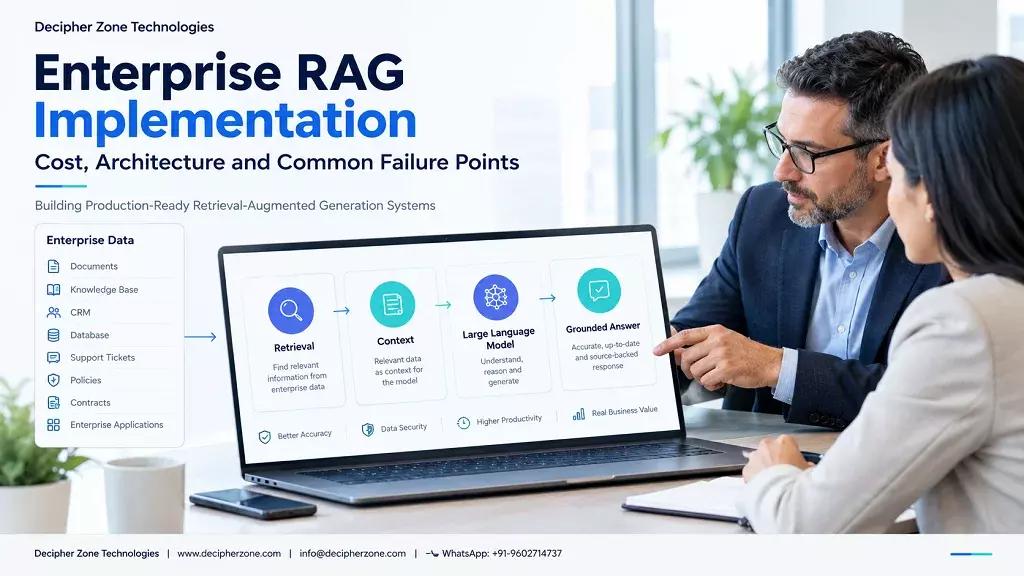
An enterprise RAG (Retrieval-Augmented Generation) system is an AI architecture that connects large language models (LLMs) with a business’s private and constantly adapting sources.
Mainly, the system retrieves relevant information from enterprise data such as internal documents, knowledge bases, product manuals, contracts, policies, support tickets, databases and business applications and provides that data to the model at the time of a user query.
In other words, enterprise RAG acts as an intelligent research layer between a company’s data and its AI applications which helps the model find the right data before it responds.
Core Enterprise RAG Architecture
Enterprise RAG architecture runs on two paths: ingestion and query path. The ingestion path runs in the background and turns raw company content into something searchable. The query path runs in real time and turns a user’s question into a grounded answer.
Here is what each layer includes:

Data Sources & Ingestion
This layer connects to wherever knowledge lives including document repositories, wikis, ticketing systems, CRMs, databases and shared drives. Ingestion syncs changes incrementally, removes deleted documents from the index and reads difficult formats like scanned PDFs, tables and slide decks without layout-aware parsing or OCR.
This layer captures metadata like document owner, date, type and permissions because retrieval quality and security both can depend later on.
Chunking & Enrichment
The system can retrieve exactly what is relevant as the documents are split into smaller passages. This chunking along the document’s own structure such as headings, sections and table boundaries, keeping meaning intact.
Usually teams store a small chunk for matching and a larger parent passage for context and attach summaries or tags to each chunk to help search.
Embeddings & the Index
Each chunk is converted into an embedding which is basically a numerical representation of its meaning and stored in a vector index. There are two choices:
-
The first choice is the embedding model, meaning domain fit, language coverage and cost per million tokens all vary. Also, switching models later means re-embedding everything.
-
The second choice is the store where dedicated vector databases like Pinecone, Weaviate, Milvus and Qdrant are common. Many businesses get further with search infrastructure they already run. It can be Elasticsearch, OpenSearch or PostgreSQL with pgvector.
Retrieval & Reranking
This layer decides the answer quality, meaning vector search alone is likely to miss exact terms like product codes, clause numbers and names. Here hybrid retrieval works which means the production systems combine it with keyword search.
The usual pattern is to retrieve a wide range of candidates then use a reranking model to narrow them to the handful of passages that can best answer the question.
Context Assembly & Generation
Further in the process the selected passages are deduplicated, ordered and fitted into the model’s token budget with the instructions. Then the model writes an answer that cites its sources.
There are two points that matter: the system should be allowed to reply it does not know when retrieval comes back weak and the model choice should follow the task. The most common way to control cost is routing by query type.
Read: Enterprise Application Development
Access Control & Security
The filtering should be on time, permissions must be imposed at retrieval time by filtering outcomes against what the asking user is allowed to see before anything reaches the model, otherwise it’s too late.
Security should cover redaction of personal data, tenant isolation, audit logs and defenses against prompt injection.
Evaluation & Observability
The definition of ‘good’ in enterprise systems means a curated set of test questions with known answers, retrieval metrics like recall and precision, checks that answers stay factual to the retrieval sources and tracing that shows which chunks produced which answer.
The dashboard shows latency, token usage and user feedback altogether. With the help of this layer, teams are able to tell whether a change improved the system or quietly broke it.
Enterprise RAG Implementation Cost
Enterprise RAG (Retrieval-Augmented Generation) implementation cost ranges from $25,000 for proof of concept to $300,000 for enterprise multi source. The cost may vary depending on the data volume, query volume, compliance requirements and how much of the stack you build or buy.
One Time Build Cost (By Scope)
-
It costs around $25,000 to $50,000 for a proof of concept including a single data source, basic vector search and no access control.
-
$50,000 to $180,000 for production level implementation (single source) including hybrid retrieval, evaluation harness, one system of record.
-
And $200,000 to $300,000+ for enterprise grade (multi source) including multiple connectors, RBAC, compliance, monitoring, agentic workflows.
What surprises the team the most is data preparation. Cleaning, deduplication and extraction from scanned or poorly structured files can add weeks to a timeline that looks simple on paper.
Ongoing Monthly Cost (By Layer)
After the system is live, one time build cost shifts to a recurring bill including various meters:
|
Component |
What it includes |
Monthly cost range |
|
LLM inference |
Query volume, choice of model and result length |
$200- $10,000+ |
|
Vector Database |
Number of vectors, reads and writes |
$20 to $25,000+ |
|
Embeddings |
Documents indexed and re-embedded on updates |
$30- $500 |
|
Reranking |
This layer is optional, however priced per query or per token |
$5- $2,000 |
|
Orchestration & hosting |
It includes servers, API layer and caching |
$80 to $500 |
|
Monitoring & evaluation |
Logging, tracing and feedback pipelines |
$30 to $500 |
Why the Cost Differs for the Same System?
Mainly, there are three decisions that swing the cost more than others.
-
Query Volume: Retrieval architecture that works fine at low volume (reranking every result or calling the largest available model for every query), gets expensive fast once usage climbs. This happens when teams skip model routing and caching gets a high bill.
-
Vector Database Choice: A vector index on infrastructure you already operate is close to free beyond existing overhead. Once volume passes the point, vector databases scale in cost at different rates depending on the provider. This choice that looks equivalent at pilot scale can diverge at production scale.
-
Self-Hosted Vs API-Based Models: Hosted model APIs transform cost into a consistent per-query operational cost. Where self-hosting open-weight models on GPUs reallocates spending toward infrastructure and the operational time required to manage it, making it more economical at high volumes but introducing additional costs that are overlooked in budgeting.
How to Estimate RAG Infrastructure Costs
Now that you know the cost ranges in the previous section which was a starting point. To know the real estimate, you need to walk through the given math below.
Read: Features to Include in an Enterprise Software

Step 1: Size your data
Fix the document count and average length, convert to chunk and vectors next. Basically this drives embedding cost and vector database pricing.
-
You can count the total number of documents across every source you plan to connect
-
Then estimate average tokens per document (basically, a policy document or support article runs 500 to 200 tokens)
-
Then divide by target chunk size which can be 200 to 500 tokens per chunk to get total chunks
-
Finally add 10 to 20% overhead for metadata, summaries and overlapping chunks.
Total chunks= (documents x average tokens per document + chunk size) x 1.15
Step 2: Price the one-time embedding cost
Now that you have the total chunks, multiply total tokens across all chunks by your embedding model’s price per million tokens. This should land in the hundreds of dollars. The number worth watching is not the first pass but the re-embedding rate, since documents that update frequently mean this cost repeats.
Step 3: Size your vector database tier
Depending on the chunk count, the vector database pricing scales and on some providers with read and write volumes are billed separately. Consider the planning rule which treats anything under about 5 million chunks as fitting comfortably on infrastructure you already run. This might include Postgres with pgvector, at close to zero marginal cost.
You should compare at least two managed providers on your actual chunk count and expected query rate because pricing models diverge at scale even when they look similar at small volumes.
The thing you need to note is always price at your projected 12-month chunk count as repricing after a mid year migration can be expensive in development time when the new tier is cheap.
Step 4: Estimate query volume & its downstream cost
With query volume, you can determine whether your monthly bill stays flat or it scales with adoption. Ensure to estimate it from your user base with this given formula.
Daily queries= active users x average queries per user per day
Step 5: Build a per-query cost, then multiply
Now when you have retrieval cost, reranking cost and generation cost per query with you multiply it by monthly query volume to get a total. The number comes will be the most useful as it allows you to test scenarios quickly.
Monthly cost= monthly queries x (retrieval cost + reranking cost + generation cost per query)
Step 6: Add the costs that do not scale with queries
Application hosting, monitoring and observability tooling and the ongoing labor of maintaining connectors and reviewing evaluation results are the ones that leave out of the query based model as it stays flat. Budget these as a fixed monthly floor on top of the variable.
Common Enterprise RAG Failure Points
The enterprise RAG system quietly fails when someone in the business stops trusting the tool. When the failures are traced back to each root cause and each of them are fixable. Explore how:
1. Retrieval brings back the wrong passages
The most common failure which is basically caused by chunks that are too large or too small. When the retrieval context is wrong or incomplete, the model writes fluent and confident answers from bad material. Here hybrid retrieval and structure aware chunking, covered in the architecture section matter even more than model choice for most quality problems.
2. Stale or unsynced data
Usually, the index needs to be updated regularly. When a policy changes or a document is deleted in the source system but the index is not updated, the assistant keeps citing outdated data. This often shows any visible sign that anything is wrong. Knowing when it happens might caution you, when ingestion was built as a one-time load instead of continuous sync or when different content types are refreshed on inconsistent schedules.
3. Access control gaps
In a system connected to HR records, contracts or financials, this is a compliance incident. When permissions are checked after retrieval rather than during it or not checked at all. An employee can receive an answer built from a document they were never allowed to see. The retrieval layer itself applies access control filtering candidate chunks against the asking user’s permissions before anything reaches the model.
4. Hallucination despite correct context
Retrieval facts of a model can still blend with something it recalls from training or answer queries when the retrieved passages do not actually address the question. This happens commonly in edge cases and rare queries that are exactly least likely to get caught in a quick demo. This fix requires the model to answer faithfulness as a standing part of evaluation.
5. No real evaluation loop
Many organizations face situations where they don't know whether the system is getting better or quietly getting worse as content and usage grow. At first with a demo, it looks convincing on hand-picked questions but it may have no systematic way to know the further usage. Without a curated test set, tracked retrieval and answer quality metrics and a way to catch regressions, problems can only appear when a user complains. By that point the user's trust has already been damaged.
6. Latency that kills adoption
This is often a chaining problem as retrieval, reranking and generation add up and a response can take up to eight to ten seconds training users to stop asking. Steps that could run in parallel are run sequentially or a reranking step is applied uniformly rather than where it changes the outcome. Caching general queries and trimming the retrieval pipelines to only the steps a given query actually needs both help.
7. Prompt injection & poisoned documents
The content can contain hidden instructions trying to redirect the model’s behavior because any part of the knowledge base includes user submitted or externally sourced content. This needs to treat retrieved content as information to reason over, never as instructions to follow and should sanitize or flag content from lower trust sources before it reaches anywhere to index.
8. Skipping change management
Usually the most overlooked failure is non-technical. Meaning RAG assistant that employees don’t trust or don’t know how to prompt well gets abandoned even if the underlying system works correctly. This way the team that treats rollout as a change management effort, training users, collecting feedback and visibly acting on it can easily see meaningfully better adoption than teams that treat launch as the final output.
Read: Top 10 Software Development Companies in the USA
Final Thoughts for Enterprise RAG Implementation
After reading this blog, you might be clear on a few things. One of them is that enterprise RAG works when the architecture is built for scale from the initial process, the cost model is sized against real query volume and the failure points covered above are guarded against before launch.
You are packed if you get these three things right and RAG becomes one of the fastest ways to put a business’s own knowledge to work. If you get these wrong, it can become an expensive assistant that nobody is interested in using.

Whatever we mean by this article is that enterprise RAG implementation cost anywhere from $25,000 for a proof of concept to $300,000 or more for a full multiple source rollout including hybrid retrieval and access control applied and a real evaluation loop which are the three factors that most separate systems that scale from the rest that get abandoned.
How Decipher Zone can help
This is exactly the kind of build we specialize in. Decipher Zone Technologies is a custom software and AI development company that is working with enterprises on production-grade AI systems.
We do not hand you a generic RAG template and walk away. Our team designs the architecture around your actual data, your actual user base and your actual compliance requirements, so the cost and performance numbers you get are numbers that hold up after launch.
Where we plug in:
-
RAG architecture design and implementation: including hybrid retrieval, structure-aware chunking, and reranking tuned to your document types
-
Access control built into retrieval: so permissions from your existing systems are enforced at query time, not bolted on afterward
-
Evaluation and monitoring pipelines: so you can measure retrieval quality and answer accuracy from day one instead of finding out from a user complaint
-
Cost-optimized infrastructure: with model routing, caching, and incremental re-indexing designed in from the start rather than retrofitted after the first expensive month
-
Ongoing support: since a RAG system is a living pipeline, not a one-time deployment
Our development pricing starts at roughly $22 an hour or about $1,800 a month per developer, with MVP-scope builds from $25,000, which makes a scoped pilot a low-risk way to validate the approach before committing to a full enterprise rollout.
FAQs about Enterprise RAG Implementation
-
How much does enterprise RAG implementation cost?
Enterprise RAG typically costs $15,000 to $40,000 for a proof of concept, $40,000 to $100,000 for a single-source production system, and $100,000 to $300,000 or more for a multi-source enterprise rollout with full access control and monitoring, plus ongoing monthly infrastructure costs that scale with query volume
-
What is the biggest reason enterprise RAG projects fail?
Most failures trace back to poor retrieval quality from weak chunking or vector-only search, access control that is not enforced at retrieval time or the absence of a real evaluation loop to catch quality regressions before users notice them.
-
How long does it take to implement enterprise RAG?
A scoped proof of concept typically takes 4 to 8 weeks. A production, multi-source enterprise system with access control, evaluation and monitoring usually takes 3 to 6 months, depending on data volume and how many source systems need to be connected.
-
Is RAG cheaper than fine-tuning a model?
Usually, yes, for knowledge that changes often. Updating a RAG index is far cheaper than retraining a model, and RAG answers can cite their sources, which fine-tuned models cannot do on their own.
-
How can an enterprise measure whether its RAG system is working?
You can measure the system at multiple levels which usually include retrieval, recall, relevance, ranking, groundedness, answer correctness, citation quality, latency, security, reliability and cost. With continuous evaluation, it is possible to identify whether a problem originates from the data, retrieval layer, orchestration, prompt or model.
About the Author: Mahipal Nehra manages content at Decipher Zone Technologies and works closely with the AI engineering team across live project delivery. He has spent the last six years documenting real AI and software development projects cost structures, architecture decisions, client outcomes for an audience of CTOs, product leads, and engineering managers. Follow on LinkedIn.
AI Development Services | Generative AI Development | AI Agent Development | Custom AI Solutions | AI Chatbot Development | Machine Learning Solutions | Data Analytics Solutions | Business Intelligence Applications | MLOps Services | AI Consulting | Custom Software Development | Web App Development | Mobile App Development | SaaS Development | E-commerce Development | Enterprise Software Development | Cloud Application Development | UI/UX Design | Full Stack Developers | Product Engineering | Software Modernization | API Development | QA & Support