Quick Summary:
AI agent architecture provides the foundation for building secure, scalable and intelligent systems. By combining core components, you can design your agent tailored to your organization's workflow. This can enhance customer experience and scale complex processes. This guide explores the essential building blocks, leading frameworks and practical strategies to help you choose the right architecture for your AI agent in 2026.
AI agent architecture is a design framework that allows AI systems to operate like digital employees rather than answering questions or generating text, working as simple assistants.
A recent study by IDC revealed that around half of the organizations are already deploying AI agents across multiple business functions with many others running pilots or preparing production rollouts. Gartner also expects AI agents to become deeply embedded in enterprise apps over the next two years, making agentic systems one of the fastest growing areas of enterprise AI.
This page mainly focuses on AI agent architectures and how you design the right architecture around the language model you choose. Let’s explore all the aspects of it. Whether you’re choosing an AI development partner or selecting the best AI agentic company, understanding architecture is the first step towards building scalable, secure and intelligent AI solutions.

What is AI Agent Architecture?
AI agent architecture is the structured framework that defines how an intelligent AI system retrieves data, reasons, makes decisions, interacts with external systems, learns from feedback and executes actions to complete tasks.
AI agent workflow follows a similar pattern to a working employee like retrieving CRM records, accessing databases, analyzing spreadsheets, generating reports, creating dashboards and notifying automatically.
Read: Best Frameworks for Building AI Agents in 2026
Core Components of AI Agent Architecture
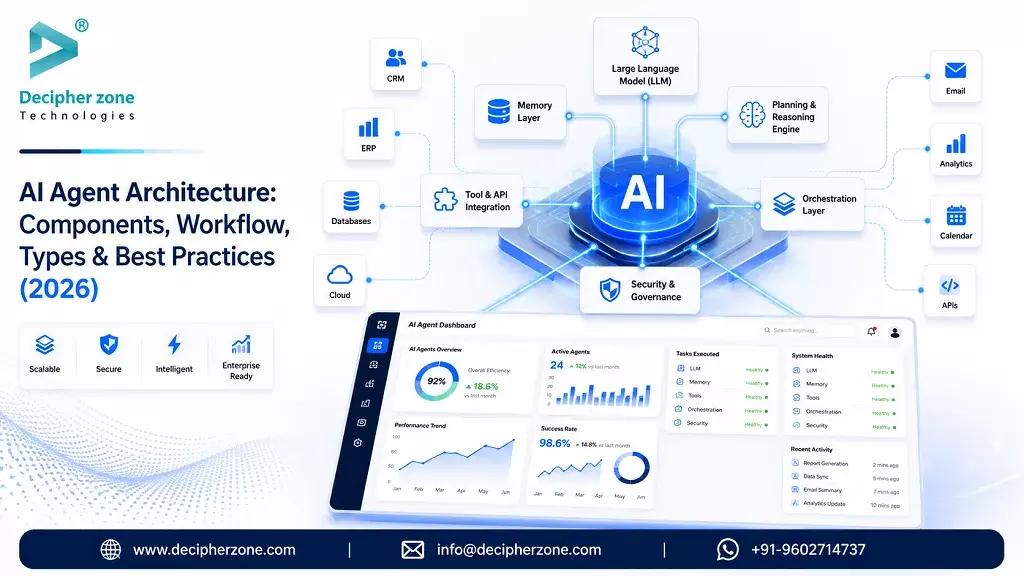
Modern AI agent components work together as an integrated ecosystem rather than isolated modules. Although implementations vary, production-ready enterprise agents typically include the following foundational layers:

1. Large Language Model (LLM)
The LLM serves as the reasoning engine that understands natural language, interprets instructions, generates responses and performs logical reasoning. Models from OpenAI, Anthropic, Google and open-source ecosystems can all serve this purpose depending on business requirements.
2. Memory Layer
Memory enables agents to retain previous conversations, user preferences, workflow history, retrieved documents and intermediate reasoning steps. Long-term memory dramatically improves personalization and consistency across interactions.
3. Planning & Reasoning Engine
Rather than jumping directly to execution, this component decomposes complex objectives into manageable subtasks, prioritizes actions, evaluates dependencies and dynamically adjusts plans when new information becomes available.
4. Tool & API Integration
Enterprise AI agents rarely work in isolation. They connect to CRM platforms, ERP systems, payment gateways, email providers, document repositories, internal databases, calendars, communication tools and third-party SaaS applications through APIs.
5. Orchestration Layer
The orchestration layer coordinates multiple agents, assigns responsibilities, manages execution order, handles retries, balances workloads and ensures smooth collaboration between specialized agents.
6. Security & Governance
Security includes authentication, authorization, audit logs, access controls, prompt filtering, policy enforcement, data encryption, compliance monitoring and human approval mechanisms before executing sensitive actions.
How AI Agent Architecture Works: Step-by-Step Workflow
A powerful AI agent workflow is what transforms an intelligent language model into a practical business system. While the user may only see a simple interface where they type a request and receive an answer, dozens of coordinated operations often happen behind the scenes within seconds.

These operations include understanding the user's intent, retrieving relevant knowledge, planning the execution strategy, selecting the appropriate tools, performing actions, validating results and delivering a final response.
Basically, AI agent workflow follows these stages:
|
Stage |
Purpose |
Example |
|
Perception |
Understand user request |
"Generate a quarterly sales report." |
|
Planning |
Break work into tasks |
Collect CRM, ERP and finance data |
|
Memory Retrieval |
Retrieve previous context |
Last quarter's performance |
|
Tool Selection |
Choose APIs and systems |
Salesforce, HubSpot, Power BI |
|
Execution |
Perform business actions |
Query databases, create charts |
|
Verification |
Validate outputs |
Check for missing data |
|
Response |
Deliver final result |
Interactive dashboard + summary |
|
Learning |
Store successful workflow |
Improve future performance |
Types of AI Agent Architecture Explained
There is no universal architecture suitable for every business problem. The ideal agentic architecture depends on workflow complexity, scalability requirements, collaboration needs, governance policies and the number of specialized capabilities required.

Modern enterprises typically implement one of three architectural models.
1. Single Agent Architecture
A single-agent architecture consists of one intelligent agent responsible for understanding requests, reasoning through problems, accessing tools and producing outcomes. This architecture is relatively simple to build and maintain, making it an excellent starting point for organizations beginning their AI journey.
Imagine an HR assistant responsible for answering employee questions. It retrieves HR policies, explains leave rules, generates employment letters, updates employee records and schedules meetings. Because all these tasks belong to a single business function, one well-designed AI agent can efficiently manage the workflow.
The primary advantages include
-
Lower infrastructure costs,
-
Faster deployment,
-
Simpler maintenance,
-
Reduced operational complexity.
However, as business processes become more sophisticated, a single agent may struggle to manage multiple specialized responsibilities simultaneously.
Read: AI Agent Development Cost in 2026
2. Multi Agent Architecture
A multi-agent architecture distributes responsibilities across several specialized AI agents that collaborate to accomplish complex objectives. Rather than relying on one general-purpose assistant, each agent develops expertise within a specific domain.
For example, consider an enterprise procurement workflow:
-
A Procurement Agent evaluates supplier requests.
-
A Finance Agent validates budgets.
-
A Compliance Agent checks regulatory requirements.
-
A Legal Agent reviews contracts.
-
A Reporting Agent generates executive summaries.
Instead of one AI attempting to master every discipline, specialized agents communicate through an orchestration layer that coordinates responsibilities and exchanges information. This modular approach significantly improves scalability, accuracy, maintainability and fault isolation.
Many leading technology companies are investing heavily in multi-agent systems because they closely resemble how human organizations operate. Departments specialize, collaborate, share knowledge and collectively solve business challenges.
3. Hierarchical Agent Systems
The most advanced enterprise deployments utilize hierarchical architectures, where a supervisory agent coordinates multiple specialized subordinate agents. This model resembles a corporate organizational chart.
A supervisory agent receives the user's objective, develops the execution strategy, delegates work to specialized agents, monitors progress, resolves conflicts and assembles the final output. Individual agents remain focused on narrow responsibilities while the supervisor maintains awareness of the overall business objective.
For example, imagine a manufacturing company requesting an operational performance report. The supervisory agent may coordinate:
-
Production Analytics Agent
-
Supply Chain Agent
-
Inventory Agent
-
Maintenance Agent
-
Financial Analysis Agent
-
Risk Assessment Agent
Each specialized agent independently completes its assigned task before reporting findings to the supervisor, who synthesizes a comprehensive executive report.
This hierarchical design dramatically improves scalability because organizations can add new specialized agents without redesigning the entire architecture. It also enhances reliability since failures within one specialized agent rarely affect the entire system.
7 Best Practices for Building AI Agent Architecture
When designing an enterprise level AI agent architecture, businesses can focus on building a secure, scalable and business-aligned foundation rather than simply integrating the latest AI models.

Here are the key best practices every business leader, CTO and technology decision-maker should follow:
1. Start with High-Impact Business Use Cases
Identify repetitive, time-intensive workflows where AI agents can deliver measurable ROI, such as customer support, document processing, compliance, sales operations or IT service management. Prioritizing business value ensures faster adoption and tangible outcomes.
2. Design a Modular and Scalable Architecture
Build AI agents using independent components for reasoning, memory orchestration, tool integration and monitoring. A modular architecture makes it easier to upgrade models, add new capabilities and scale across departments without disrupting existing workflows.
3. Prioritize Data Quality and Knowledge Management
AI agents are only as effective as the data they can access. Establish clean, well-governed data sources and integrate enterprise knowledge through vector databases, Retrieval-Augmented Generation (RAG) and secure APIs to improve accuracy and reduce hallucinations.
4. Build Security and Governance into the Architecture
Implement role-based access control (RBAC), authentication, encryption, audit logs and human approval workflows for sensitive actions. Enterprise AI agents should operate within clearly defined policies to meet compliance and regulatory requirements.
5. Keep Humans in Control for Critical Decisions
While AI agents can automate routine tasks, high-risk activities such as financial approvals, legal reviews, healthcare recommendations and compliance decisions should include Human-in-the-Loop (HITL) validation to ensure accountability and reduce operational risk.
6. Monitor, Measure and Continuously Optimize
Track key performance indicators (KPIs) such as task completion rate, response accuracy, latency, operational cost, user satisfaction and business impact. Regular monitoring helps identify performance gaps and continuously improves AI agent effectiveness.
7. Choose an Experienced AI Development Partner
Building enterprise AI agents requires expertise beyond LLM integration. Partner with an AI agent development company that has experience in enterprise architecture, cloud infrastructure, workflow automation, system integrations, security and AI governance to accelerate implementation and ensure long-term scalability.
Read: Top 5 AI Outsourcing Companies in the USA
Choosing the Right AI Agent Development Company
Selecting the right AI agent development company is one of the most important decisions you'll make in your AI transformation journey. While many companies now offer AI development services, building enterprise-ready AI agents requires far more than integrating a large language model into a chatbot.

A reliable technology partner should understand enterprise architecture, business workflows, cloud infrastructure, data engineering, security, governance and AI orchestration to deliver solutions that are scalable, secure and aligned with your business goals.
When evaluating an AI development partner, look for proven experience in designing AI agent architecture, integrating with enterprise systems like CRM, ERP and third-party APIs, implementing Retrieval-Augmented Generation (RAG), vector databases and multi-agent workflows and ensuring compliance with industry standards.
It's equally important to choose a company that follows a consultative approach—understanding your business challenges first and then recommending the right AI strategy instead of applying a one-size-fits-all solution.
Why Choose Decipher Zone Technologies for AI Agent Development?
At Decipher Zone Technologies, we help businesses move beyond AI experimentation by building intelligent, enterprise-grade AI agent solutions that solve real business problems. As an experienced AI agent development company, we combine deep expertise in software engineering, cloud technologies and modern AI frameworks to develop scalable, secure and production-ready AI systems tailored to your organization's needs.
Our team specializes in designing custom AI agent architectures that integrate seamlessly with your existing business ecosystem. Whether you're looking to automate customer support, streamline internal operations, build AI-powered assistants or deploy complex multi-agent workflows, we create solutions that are reliable, future-ready and focused on delivering measurable business value.

What Sets Decipher Zone Technologies Apart?
-
End-to-End AI Agent Development: From AI strategy and architecture design to development, deployment and ongoing optimization.
-
Expertise in Modern AI Technologies: Hands-on experience with LangChain, LangGraph, CrewAI, OpenAI, Anthropic Claude, Gemini, MCP, RAG, vector databases and multi-agent orchestration frameworks.
-
Enterprise System Integration: Seamless integration with CRM, ERP, HRMS, databases, cloud platforms, APIs and internal business applications.
-
Security-First Development: Implementation of enterprise-grade security, role-based access control (RBAC), encryption, audit trails and governance frameworks.
-
Scalable & Custom Solutions: Every AI agent is designed around your workflows, business objectives and future scalability requirements—not generic templates.
-
Proven Software Engineering Expertise: Backed by over a decade of experience in delivering enterprise software solutions for startups, SMBs and Fortune 500 clients across multiple industries.
-
Long-Term Technology Partnership: We don't just build AI solutions—we continuously monitor, optimize and evolve them as your business grows and AI technologies advance.
Whether you're planning your first AI initiative or scaling enterprise-wide automation, Decipher Zone Technologies can help you design and implement intelligent AI agents that improve productivity, automate complex workflows and create lasting competitive advantages.
Conclusion
As organizations look to improve operational efficiency, enhance customer experiences and accelerate decision-making, AI agents offer a scalable way to automate complex workflows while working alongside human teams.
However, the success of these initiatives depends on more than choosing a powerful AI model. A well designed architecture that combines reasoning, memory orchestration, security, governance and seamless integrations is what enables AI agents to deliver reliable, measurable business outcomes.
Whether you're building a single AI assistant or deploying a network of collaborative, multi-agent systems, investing in the right architecture today will help your business adapt to evolving technologies and future AI advancements.
By following best practices and partnering with an experienced AI agent development company, you can reduce implementation risks, accelerate deployment and maximize long-term ROI.
Read: Custom AI Chatbot vs Off the Shelf
If you're ready to transform your business with intelligent automation, Decipher Zone Technologies is here to help. Our team specializes in designing and developing secure, scalable and custom AI agent solutions tailored to your unique business requirements.
Frequently Asked Questions (FAQs)
-
What is AI agent architecture?
AI agent architecture is the structured framework that defines how an intelligent AI system retrieves data, reasons, makes decisions, interacts with external systems, learns from feedback and executes actions to complete tasks. It combines key components such as Large Language Models (LLMs), memory, planning engines, orchestration layers, APIs and security mechanisms to enable intelligent, autonomous or semi-autonomous decision making.
-
What are the types of AI agent architectures?
In 2026, there are mainly 4 types of AI agent architecture businesses choose from, including Single Agent, Multi Agent, Hierarchical Agent and Human-in-the-Loop (HITL) Architecture. The right architecture depends on your business objectives, workflow complexity and operational requirements.
-
What frameworks implement agentic architecture?
Several modern frameworks help developers build scalable agentic architecture and AI agent workflows. Some of the most widely used include LangGraph, LangChain, CrewAI, Microsoft Semantic Kernel, OpenAI Agents SDK and more. The choice of framework depends on your use case, scalability requirements, technology stack and deployment strategy.
-
Which industries benefit the most from AI agent workflows?
Almost all industries leverage AI agents. Some of these are already implementing AI agents, such as healthcare, financial services, retail, manufacturing, e-commerce, human resources, customer service, etc. Businesses usually leverage AI agents to improve efficiency, reduce operational costs and increase customer and employee experience.
-
How do I choose the best AI agent development company?
There are a few tips to choose the best AI agent development company such as looking for experience, technical expertise, strong compliance practices, communication and collaboration skills and end-to-end services. This can help in delivering measurable business value and outcomes, supporting long term goals.
About the Author: Mahipal Nehra manages content at Decipher Zone Technologies and works closely with the AI engineering team across live project delivery. He has spent the last six years documenting real AI and software development projects cost structures, architecture decisions, client outcomes for an audience of CTOs, product leads, and engineering managers. Follow on LinkedIn.
AI Development Services | Generative AI Development | AI Agent Development | Custom AI Solutions | AI Chatbot Development | Machine Learning Solutions | Data Analytics Solutions | Business Intelligence Applications | MLOps Services | AI Consulting | Custom Software Development | Web App Development | Mobile App Development | SaaS Development | E-commerce Development | Enterprise Software Development | Cloud Application Development | UI/UX Design | Full Stack Developers | Product Engineering | Software Modernization | API Development | QA & Support