Quick Summary
AI chatbots and AI agents both use the same technologies, yet they serve different business purposes. Learn which one is best for your business workflows as chatbots usually provide information to the user and AI agents go beyond by reasoning, planning and executing tasks with minimal human intervention.
There are AI based systems that are actually performing entire tasks from reasoning, making decisions to executing multi step workflows. But business leaders ask AI agents vs chatbots, which one is right for my business?
Might be confusing but both use conversational AI to interact naturally with users but their capabilities are fundamentally different.
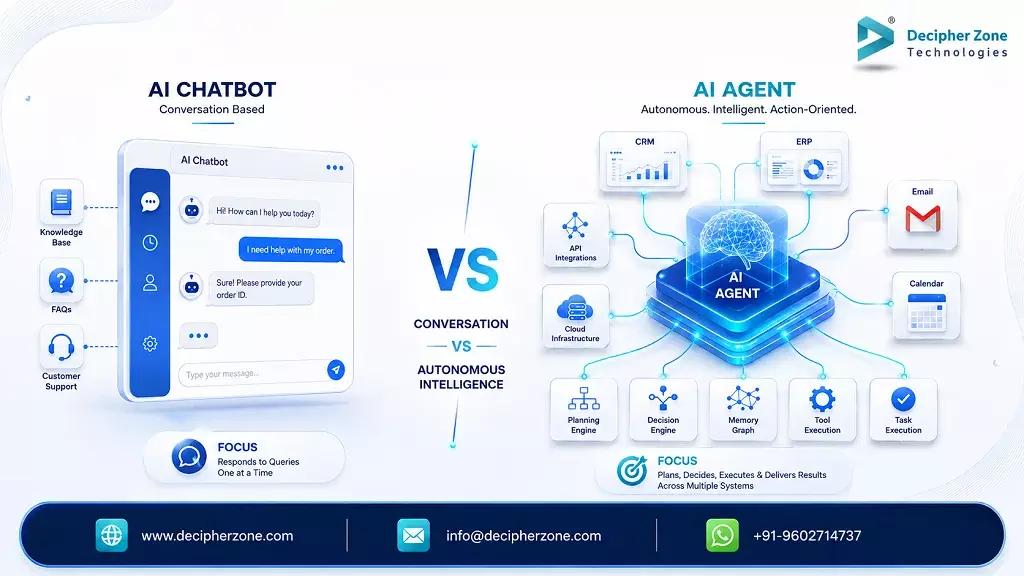
An AI chatbot is designed to understand the query given by the user and generate responses. This makes it ideal for tasks like answering FAQs, qualifying leads or assisting customers.
Whereas, an AI agent works beyond conversation, it can plan, remember context, use external tools, interact with systems and autonomously complete business tasks with minimal human intervention even some agents require no human interaction.
Read: AI Agent Development Cost in 2026
Let’s look at the numbers:
-
Around 62% of businesses are experimenting with AI agents, of which only 23% have scaled them in at least one business function. This indicates that many organizations are still transitioning from pilots to production deployments.
-
By the end of 2026, approximately 40% of enterprise apps will include AI agents. This highlights how quickly autonomous AI is becoming part of enterprise software development.
-
According to Grand View Research, the global AI agents market is expected to reach $10.9 billion in 2026 and is projected to grow to $182 billion by 2033.
If you’re wondering whether your business needs an AI chatbot, an AI assistant or a fully autonomous AI agent, don’t feel alone. These terms may often be used interchangeably but they have different levels of intelligence, autonomy and business value.
This guide explains all the areas of AI agents and AI chatbots.
What is an AI Chatbot?
AI chatbot is a conversational software application designed to understand and respond to user input within a narrow or predefined scope. Their primary purpose is to simulate human conversation, answer questions, provide information, and guide users toward completing simple tasks.

Although modern AI chatbots appear intelligent, they generally operate within specified boundaries. They respond to requests but rarely take independent actions beyond what has been explicitly programmed or integrated into their workflows.
What is an AI Agent?
AI agents represent operational intelligence, designed to achieve goals. Like, analyzing objectives, breaking them down into subtasks, reasoning through different approaches, using external tools, accessing databases, calling APIs, interacting with software applications and continuously adapting based on feedback.

We have a full guide on AI agents, exploring how they work, different types, use cases, benefits and challenges. You can read What is AI Agent Development for a better understanding.
AI Agents vs Chatbots: Side-by-Side Comparison
When you look at AI agents and AI chatbots, they may seem like two versions of the same technology. Both can understand natural language, answer questions and interact with users.
But what makes them different is their underlying purpose, capabilities and business impact. Let’s understand AI agents vs AI chatbots more deeply.
For key highlights, go through this comparison table: AI chatbots vs AI agents
|
Feature |
AI Chatbots |
AI Agent |
|
Core purpose |
Answer user queries and provide conversational support. |
Perform goals by planning, reasoning and executing tasks. |
|
Interaction Style |
Reactive (mainly responds to the user when prompted). |
Proactive (can initiate actions and complete objectives provided by the user). |
|
Intelligence |
Understands and generates natural language responses. |
Understands context, reasons through problems and takes actions. |
|
Autonomy |
Requires continuous user input/ prompts. |
Operates independently with minimal supervision. |
|
Memory |
Usually bound to the current conversation/ session. |
Maintains short term and long term memory across interactions. |
|
Reasoning Ability |
Basic contextual reasoning for conversations. |
Advanced multi step reasoning, planning and decision making. |
|
Workflow Execution |
Performs basic specific actions. |
Executes complex and multiple step workflows across systems. |
|
Tool & API Integration |
Bounded integrations (CRM, FAQs, knowledge bases). |
Connects with APIs, databases, enterprise software, cloud services and third party tools. |
|
Learning & Adaption |
Bounded adaptation based on conversation context. |
Improves continuously using memory, feedback and historical context. |
|
Decision Making |
Suggests actions but relies on the users decisions. |
Allowed to evaluate options and take autonomous actions within defined rules. |
|
Business Focus |
Usually customer service, sales support, FAQs and lead generation are the options. |
Operations, automation, IT, HR, finance, compliance and enterprise workflows are the options. |
|
Complexity |
AI chatbots are easier and faster to develop. |
AI agents require proper planning, advanced architecture and orchestration. |
|
Development Cost |
The cost of AI chatbots are usually lower. |
AI agents cost higher than chatbots because of integrations and intelligent workflows. |
|
Maintenance |
It takes moderate maintenance as it focuses on updating conversational scripts and knowledge bases. |
It is highly dynamic, with continuous monitoring and optimization. |
|
Scalability |
AI chatbots are capable of handling large conversation volumes. |
AI agents are excellent for scaling enterprise-level automation. |
|
Human Oversight |
It requires frequent human assistance. |
It depends on governance and can operate semi-autonomously. |
|
Best for |
AI chatbots are best for text-based, turn-based conversations, like improving customer experience. |
AI agents are best for complex workflows, driving operational efficiency and intelligent automation. |
You may still be confused in some areas. The next section will answer every question you have in deciding which is best for your business: AI agents vs AI chatbots.
Read: Top 5 AI Outsourcing Companies in the USA
1. AI Agent vs AI Chatbot: Intelligence & Reasoning Differences
The biggest difference between an AI chatbot and an AI agent is how they process information.
AI chatbots understand user intent and generate relevant responses using NLP (Natural Language Processing) and LLMs (Large Language Models), focusing on maintaining meaningful conversations and retrieving the right information quickly.
An AI agent analyzes objectives, breaks them into smaller tasks, evaluates possible approaches and executes a sequence of actions to obtain the results user demand.
For eg, if a user asks, where’s my order? An AI chatbot replies by retrieving details. An AI agent will check the shipment status, identify reasons for delay, contact the provider through an API, update the CRM, notify the user and generate a compensation coupon if company policies allow.

2. AI Agent vs AI Chatbot: Autonomy Explained
AI chatbot waits for users to initiate a conversation and respond to individual prompts.
When an AI agent receives an objective it determines the steps required to achieve and continues working until the task is completed or human approval is needed.
For eg, the manager may request to prepare a weekly sales report and email it to department heads. AI chatbot explains the process of generating the report or provides reporting guidelines. Whereas, an AI agent can retrieve data from the CRM, analyze sales trends, generate reports, email stakeholders and schedule follow-up meetings if performance falls below targets.
3. Memory & Context: How AI Agents Remember More Than Chatbots
AI chatbot remembers data only within the current conversation. In the situation where the user returns, the chatbot might not recall unless the chatbot is connected to an external memory system.
An AI agent can retain user preferences, project history, organizational policies, previous decisions and workflow states across sessions, enabling more personalized interactions and smarter decisions over time.
For eg, when an HR assistant helps with employee onboarding. A chatbot answers questions about benefits or leave policies. Whereas, an AI agent can remember the employee’s onboarding progress, verify completed documentation, schedule pending training sessions, notify IT about equipment requests and ensure the process is completed without repeated instructions.
4. Reasoning & Decision Making: AI agent vs AI chatbot
AI chatbot processes one request at a time and responds based on available information. They do not evaluate multiple scenarios or plan ahead.
An AI agent uses advanced reasoning techniques for the process where it breaks complex objectives into subtasks, prioritizes actions, analyzes, evaluates results and adjusts strategies based on changing conditions.
For eg, in supply chain management, a chatbot can explain the reason why a shipment can be delayed. Whereas, an AI agent can identify the root cause, compare alternative shipping routes, calculate additional costs, inform the customer and coordinate with logistics partners to minimize disruption.
5. Can AI Agents Execute Tasks While Chatbots Only Respond?
AI chatbot performs,
Booking appointments → creating support tickets → answering FAQs → collecting user information → resetting passwords
An AI agent handles complete business processes, such as employee onboarding, invoice processing, procurement approvals, compliance reporting, customer onboarding, software deployment, financial reconciliation, incident management, IT service automation.
6. AI Agent vs Chatbot Integration Capabilities
AI chatbot integrates with limited systems to retrieve or provide information. Their interactions are usually confined to user-facing apps.
Read: Latest AI Trends 2026
An AI agent is developed to operate an organization’s entire technology environment, interacting with CRM, EARP, productivity tools, communication and collaboration, cloud storage and other tools/ platforms.
7. AI Agent vs AI Chatbot Cost Comparison (2026)
AI chatbots generally cost less to develop, deploy and maintain unless they require any customization or advanced frameworks.
AI agents require a good amount of investment for advanced reasoning frameworks, workflow orchestration, enterprise integrations such as CRM, ERP, etc, compliant requirements and long term memory systems.
8. Should You Choose an AI Chatbot or an AI Agent?
You have your clear requirements which help you choose the one technology, however you can combine both technologies like many organizations do. They build chatbot for conversational front end users and an AI agent to operate behind the scenes to execute workflows, retrieve data, coordinate systems and deliver results.

Cost Comparison: Which Offers Better ROI?
An AI chatbot costs $5,000- $50,000+ depending on the complexity of the project and takes around 3-6 weeks to complete. Whereas, an AI agent costs anywhere between $15,000 to $1,80,000 or more depending on the complexity, integrations and workflows. An AI agent takes 4- 12 weeks to complete.
The table below shows the comparison of overall costs you need to consider while developing:
|
Metrics |
AI Chatbot |
AI Agent |
|
Development Cost |
$5,000- $50,000+ |
$15,000 to $1,80,000+ |
|
Ongoing Maintenance |
$25- $2,000/ month |
15-20% annual retainer or $1,000- $5,000/ month. |
|
Cost Per Interaction |
$0.50- $0.70 |
Higher, variable (based on usage/ API call) |
|
Payback Period |
6 to 12 months |
8 to 26 months |
Benefits and Challenges of AI Agents and AI Chatbots
You may look convinced with the technologies but look at these benefits and challenges of AI chatbot and AI Agent before you make any big investment.
Benefits of AI Chatbots
Chabot not only provides information but can do a lot more. Like,
-
Low cost, Faster Development: Chabots don't need complex system integrations or multi step reasoning, enabling development in weeks rather than a few months
-
Easy-to-test Behavior: Chatbots usually operate within bounded rules or scripts and their behavior is easier to predict and QA before launch.
-
Strong ROI on High Volume: Business industries that have the same basic questions like order status, store hours and return policy, can deflect meaningful amounts of support volumes without added headcount.
-
Lower Maintenance Overhead: These automated systems require less ongoing tuning. Updates are limited to adding new intents or refining existing responses.
-
Simple Integration into Existing Channels: Chatbots are easily integrated without deep backend connectivity to operational systems.

Challenges of AI Chatbots
With a set of benefits, businesses face challenges in building chatbots.
-
Limited to Conversation: Chatbot can only provide information and not actually process which still requires human interaction to complete the tasks.
-
Breaks Down Outside its Trained Scope: Chatbot requires a human interaction when a query falls outside the chatbot’s intents or script.
-
No Persistent Memory: Chatbots are usually unable to recall a user’s history or previous interactions as they only retain context for the current session.
-
Risk of Eroding User Trust: A chatbot can misunderstand intent and can provide generic, unhelpful answers which can harm, pushing users away.
Benefits and Challenges of AI Agents
So far, you know that AI agents boost productivity and reduce operational costs by handling repetitive processes and large datasets. However, this autonomous process brings a set of challenges such as unpredictable decision making, vulnerability to malicious data and lack of human interactions in ethical terms.
To understand the benefits and challenges of AI agents, you can read our blog for deeper knowledge.
Should Your Business Choose an AI Chatbot or an AI Agent?
Choosing between an AI chatbot and an AI agent is how they solve different problems and deliver value in different ways to your organization.
If your primary objective is to improve customer engagement, automate FAQs, provide instant support or capture qualified leads, an AI chatbot is a practical and affordable choice.
Read: Custom AI Chatbot vs Off the Shelf
If your organization is looking to automate end-to-end workflows, integrate various enterprise systems, streamline operations or enable AI to make context-aware decisions and execute tasks autonomously. An AI agent is the better choice and will provide strategic value to your business.
Whether you choose an AI chatbot or an AI agent, partnering with an experienced AI agent development company can help you build tailored AI powered solutions to your business goals.

At Decipher Zone Technologies, our dedicated development team is specialised in AI agent development services, from intelligent customer support assistants, enterprise workflow automation to LLMs based custom AI agent development, Retrieval Augmented Generation (RAG) and advanced orchestration frameworks.
We help you develop such AI-based systems tailored to your goals and specified workflows.
Frequently Asked Questions
1. What is the main difference between an AI chatbot and an AI agent?
An AI chatbot is a scripted system that provides or shares information to the user when requested, whereas an AI agent requires no human input it independently reasons, creates plans and executes multi step using external tools.
2. Can an AI chatbot become an AI agent?
Yes, an AI chatbot can evolve to an AI agent but it may require operational intelligence and specific capabilities such as multi step reasoning, planning using external tools to perform actions requested by the user.
3. Which is better for small businesses: AI chatbot or AI agent?
It totally depends on the workflow and the requirements of the business. If a business requires mostly repetitive questions then a chatbot is the ideal choice. But if a business requires intelligence to perform multiple tasks then an AI agent is the best choice.
4. Are AI agents more expensive than chatbots?
Yes, AI agents are more expensive than AI chatbots due to advanced technologies, tool integrations and agents tend to reason, plan, use external tools, access enterprise systems and execute multi step workflows autonomously. AI agents require higher upfront investment which translate into greater long term value.
5. Can AI chatbots and AI agents work together?
Combining both technologies can be beneficial to modern businesses. AI chatbots can interact with users, acting as a conversational interface. AI agents can execute workflows, access business systems, retrieve or update information, interact with APIs and complete multi tier tasks.
About the Author: Mahipal Nehra manages content at Decipher Zone Technologies and works closely with the AI engineering team across live project delivery. He has spent the last six years documenting real AI and software development projects cost structures, architecture decisions, client outcomes for an audience of CTOs, product leads, and engineering managers. Follow on LinkedIn.
AI Development Services | Generative AI Development | AI Agent Development | Custom AI Solutions | AI Chatbot Development | Machine Learning Solutions | Data Analytics Solutions | Business Intelligence Applications | MLOps Services | AI Consulting | Custom Software Development | Web App Development | Mobile App Development | SaaS Development | E-commerce Development | Enterprise Software Development | Cloud Application Development | UI/UX Design | Full Stack Developers | Product Engineering | Software Modernization | API Development | QA & Support