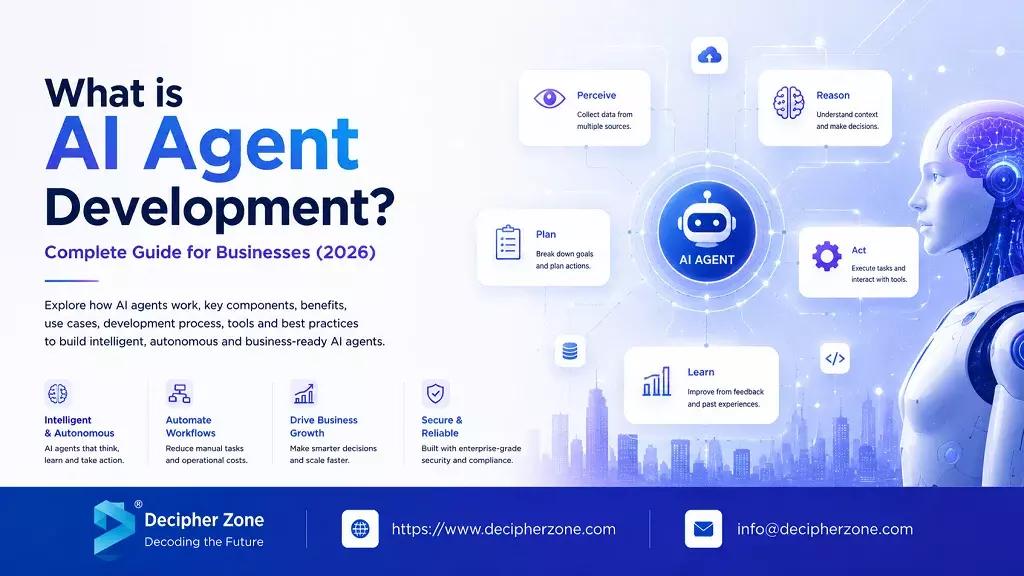
AI Agent Development Guide: Explore our AI Agent Development Services to discover how our experts can help you design, develop and deploy AI agents that create a real competitive advantage. This blog guides you through the definition, process, architecture, types, use cases, advantages, challenges and best practices of AI agent development.
AI agent development is the process of building smart systems to work alongside teams and existing business applications to make workflows smoother and faster.
Instead of relying on tools that simply respond to prompts, you need to invest in intelligent AI agents that can reason, make decisions, execute tasks and continuously improve with every interaction.
Investing in AI agent development services can reveal business value. The key is not just adopting AI but to build agents that align with your goals, integrate seamlessly with your workflows and scale as your business expands. This guide explores how to build an agent that actually works for you.
AI Agent Development Statistics and Market Growth (2026):
-
The global AI agent market is projected to grow from $11.55 billion in 2026 to $294.66 billion in 2035, expanding at a CAGR of 43.57% from 2026 to 2035.
-
67% of organizations expect AI agents to be integrated into the workflows within the next two years. This reflects the growing enterprise adoption.
-
Gartner predicts at least 33% of enterprise software applications are expected to include agentic AI capabilities by 2028 and around 15% of daily work decisions will be made autonomously through agentic AI by 2028.
-
There’s up to 30% improvement in operational efficiency by implementing AI based automation, reducing manual, repetitive work across business functions.
-
According to Gartner, Inc., around 80% of common customer service issues will be resolved with agentic AI without human intervention, resulting in a 30% reduction in operations costs.
AI agents are becoming the core components of modern business operations. Businesses that adopt them strategically will improve productivity, accelerate innovation and stay ahead in an increasing AI market.
Read: AI Agent Development Cost
What is AI Agent Development?
AI agent development is the process of designing, building and deploying autonomous software systems that use AI to understand their environment, reason through problems and take multiple step actions to achieve a specific goal.
AI agents operate in continuous loops, basically they observe, plan, act and adapt based on outcomes. It combines an LLM (large language model) or other AI reasoning engine with memory, tool access and decision making logic.
AI agent development services for businesses are more than just plugging into an existing model. A capable AI agent development company handles use case discovery, agent architecture design, integration with internal systems (CRMs, ERPs, databases, ticketing tools), testing and ongoing monitoring once the agent is live.
This way it can genuinely reason through ambiguous, multi step problems the way a skilled or experienced employee would but at machine speed and scale.
How AI Agents Work: Step-by-Step Process
AI agents usually function through a repeating cycle like, perceive, reason, act, learn. This is what separates it from a simple automation script or chatbot.

You can understand from the description:
1. Perception (Input Gathering):
The agent collects data such as a user query, a document, an API response, a database record or a signal from its environment. With business perspective, this input comes from several sources at the same time.
2. Reasoning & Planning:
The agent interprets the input against its assigned goal and decides what needs to happen next using an LLM or dedicated planning module. This is where agents work differently from traditional software, it determines the sequence of steps required and can revise that plan mid-task if circumstances change.
3. Action (Tool Use):
Using tools such as APIs, databases, code interpreters, search engines or other software systems, the agent executed its plan. This lets the LLM trigger real world actions rather than just generate text handled through function calling or tools using frameworks.
4. Observation & Feedback:
Now the agent evaluates the result after acting. The feedback like whether the API call succeeded or did the customer’s issue was actually got resolved, is fed back into the reasoning step. This enables the agent to correct course, retry with a different approach or move to the next task.
5. Memory:
Agents usually maintain memory which can be short term (context within a single task) and long term memory (persisted knowledge across sessions). This lets them retain relevant history, learn user preferences and avoid repeating mistakes.
This continuous loop can run once for a single task or many times for complex, multiple steps workflows and in multi agent systems, several agents may run this loop in parallel, where each handles a different subtask and coordinates with the others.
AI Agent Development Process
Building an AI agent involves more than connecting an LLM to an application. A structured development process ensures the agent aligns with business goals, integrates securely with existing systems and delivers reliable outcomes.
| Step | Description |
|---|---|
| 1. Define Business Goals | Identify the business problem and success metrics. |
| 2. Select the Right AI Model | Choose an LLM based on accuracy, cost and performance. |
| 3. Design Agent Architecture | Plan memory, reasoning, tools and workflows. |
| 4. Integrate Business Systems | Connect CRMs, ERPs, APIs and databases. |
| 5. Test & Evaluate | Validate accuracy, security and edge cases. |
| 6. Deploy & Monitor | Continuously monitor, optimize and improve the agent. |
AI Agent Tech Stack
The technology stack depends on the complexity of the AI agent, but most enterprise AI agents combine language models, orchestration frameworks, vector databases and cloud infrastructure.
| Layer | Examples |
|---|---|
| LLM | GPT-5.6, Claude, Gemini |
| Framework | LangGraph, CrewAI, AutoGen |
| Memory | Pinecone, Weaviate, Chroma |
| Backend | Python, FastAPI, Node.js |
| Cloud | AWS, Azure, Google Cloud |
| Monitoring | LangSmith, Langfuse |
AI Agent Architecture
AI agent is much more than connecting a language model to a chatbot interface. These enterprise AI agents rely on a layered architecture that allows reasoning, security and integration with business systems.
AI agent architecture consists of five major layers such as User Interface layer, Reasoning layer, Memory layer, Tool layer and Governance layer.
Think it this way: you have a customer service AI agent receiving a refund request. Now the user submits the request through a web portal.

The reasoning layer analyses the request, identifies the customer’s order information, accesses the CRM through integrated APIs, verifies eligibility using company policies stored in the knowledge base, calculates the refund amount, submits the transaction, updates records and notifies both the customer and the finance team about it.
The AI agent acts as the orchestration layer connecting everything together, instead of requiring employees to switch between CRM platforms, payment systems, support software and internal databases.
As organizations expand their AI initiatives, architectures are incorporating multi-agent systems where specialized agents collaborate. One agent may handle research, another may perform analysis and a third may execute actions. Together, they create highly scalable autonomous workflows capable of managing organizational operations at a level that traditional automation tools are unable to achieve.
Read: AI Assistant App Development
Types of AI Agents for Businesses
Under these AI agent systems, there are various types of agents for businesses that function and can be specifically used for a particular niche. Here are the types of AI agents for businesses that help you choose the right type, depending on the nature and complexity of the business:
1. Simple Reflex Agents:
These types of agents respond to specific inputs with predefined actions, without maintaining memory of past interactions. They are useful for straightforward, rule based tasks like basic FAQ responses or simple alerting.
2. Model Based Reflex Agents:
These agents maintain an internal model of their environment that allows them to make decisions based on both current input and inferred context. These are common in monitoring and anomaly detection use cases.
3. Goal based Agents:
These types of agents work toward a defined objective, evaluating possible actions based on whether they move the agent closer to that goal. These are common in task-completion agents like scheduling assistants or lead qualification bots.
4. Utility Based Agents:
These types of agents go a step further than goal-based agents by weighing multiple possible paths against a utility function, useful when there are various valid ways to complete a task and the agent needs to choose the most efficient or cost effective one, such as in logistics or resource allocation
5. Learning Agents:
This type of agent improves your performance over time by including feedback from past actions, often through reinforcement learning or continuous fine tuning based on outcomes.
6. Multi Agent Systems:
In these types of agents, multiple specialized agents collaborate, each handling a distinct sub task, coordinated by an orchestration layer. This is very popular in enterprise settings, for example, one agent handling data retrieval, another handling analysis and a third handling report generation.
7. Autonomous Agents:
These types of agents operate with minimal ongoing human supervision across extended, multi step workflows, planning, executing and adapting over long time horizons. These typically have defined guardrails and escalation points for human review.
Single-Agent vs Multi-Agent Comparison
| Feature | Single-Agent | Multi-Agent |
|---|---|---|
| Complexity | Low | High |
| Speed | Faster | Moderate |
| Best For | Small tasks | Enterprise workflows |
| Scalability | Medium | High |
| Cost | Lower | Higher |
Single-agent systems are ideal for focused automation, while multi-agent systems are better suited for large-scale enterprise workflows involving multiple coordinated tasks.

Business Applications of AI Agent Development
Apart from the theory part, when you actually apply these AI agents to your workflows, you must be wondering how it might look.
Depending on the industry of the business AI agents can automate knowledge work previously considered impossible to automate.
1. Industry-Specific AI Agent Use Cases
Healthcare: Organizations use AI agents to:
-
Manage appointment scheduling
-
Process insurance claims
-
Assist with clinical documentation
-
Support patient communication
-
Coordinate care workflows
These applications help reduce administrative burdens while allowing healthcare professionals to focus more on patient care.
Financial Services: Banks and fintech companies deploy AI agents for:
-
Fraud detection
-
Customer onboarding
-
Loan processing
-
Compliance monitoring
-
Risk assessment
AI agents can analyze vast datasets in real time, improving both operational efficiency and decision accuracy.
Retail and E commerce: Retailers leverage AI agents to:
-
Personalize shopping experiences
-
Manage inventory
-
Automate customer support
-
Forecast demand
-
Optimize pricing strategies
The result is improved customer satisfaction and higher operational efficiency.
Manufacturing: Organizations use AI agents to:
-
Monitor equipment performance
-
Predict maintenance needs
-
Manage supply chains
-
Optimize production schedules
-
Improve quality control
These capabilities contribute directly to cost reduction and operational reliability.
Logistics and Transportation: For logistics businesses, AI agents can:
-
Optimize routes
-
Track shipments
-
Predict delivery delays
-
Manage dispatch operations
-
Coordinate supply chain activities
Given the user's logistics industry background, this area represents one of the highest value opportunities for AI agent implementation.
2. AI Agent Applications by Business Department
Beyond industry specific use cases, AI agents are transforming internal business functions.
Read: Top 5 AI Outsourcing Companies in the USA
Sales Teams: Sales agents can:
-
Qualify leads automatically
-
Research prospects
-
Generate personalized outreach
-
Schedule meetings
-
Update CRM systems
This enables sales representatives to spend more time building relationships and closing deals.
Customer Support: Support agents can resolve tickets, escalate complex issues, retrieve knowledge base information and maintain consistent service quality across channels.
Human Resources: HR agents assist with:
-
Employee onboarding
-
Policy inquiries
-
Candidate screening
-
Interview scheduling
-
Performance tracking
Marketing: Marketing teams use AI agents for:
-
Content planning
-
SEO analysis
-
Campaign management
-
Audience segmentation
-
Performance reporting
These applications demonstrate why AI agents are rapidly becoming strategic assets rather than isolated technology experiments.
AI sales agents like 1mind are a good real-world example of this shift, using AI agent development to run entire top-of-funnel sales conversations end-to-end instead of just answering FAQs.
Benefits of AI Agent Development
You can achieve these advantages by adopting AI agents. The list may be long but below are the ones that each organization requires:
-
Increased Operational Efficiency: Agents can work continuously, handle high volumes of routine tasks in parallel and complete multi step workflows far faster than manual processes, freeing employees to focus on higher value work.
-
Cost Reduction: By automating tasks that previously required dedicated headcount, first-line support, data entry and routine reporting, businesses can reduce operational costs while maintaining or improving service quality.
-
Improved Accuracy and Consistency: Well-designed agents apply the same logic and quality standards to every task, reducing the variability and human error that come with manual processes.
-
Scalability: Agents can scale to handle demand spikes (seasonal support volume, high traffic sales periods) without the lead time or cost associated with hiring and training additional staff.
-
Faster Decision Making: By pulling and synthesizing data from multiple systems in real time, agents can surface insights and recommendations far faster than manual analysis, supporting quicker business decisions.
-
24/7 Availability: Unlike human teams, agents can operate around the clock, which is especially valuable for global businesses and customer facing functions.
-
Personalization at Scale: Agents can tailor responses, recommendations and workflows to individual customer or user context, something that's difficult to do manually across large volumes of interactions.
-
Competitive Differentiation: Early, well executed adoption of AI agent development can become a genuine differentiator, enabling faster response times, more responsive service and operational agility that competitors relying on manual processes can't match.
Challenges of AI Agent Development
With benefits, there are problems in AI Agent development, while development companies help you build the most effective ones, considering these challenges and overcoming them before they become a big issue and cost you more.
-
Reliability and Hallucination Risk: LLM-based agents can generate incorrect information or take inappropriate actions, particularly in ambiguous situations. This is a bigger concern for agents than for simple chatbots, since agents take real actions rather than just producing text.
-
Integration Complexity: Connecting agents securely and reliably to existing business systems, CRMs, databases, legacy software and third-party APIs is often the most time-consuming part of a project, especially in enterprises with fragmented tech stacks.
-
Security and Access Control: Because agents can take autonomous actions, tightly scoping their permissions is critical. Poorly configured agents pose real risks around data exposure, unauthorized transactions, or unintended system changes.
-
Cost of Development and Maintenance: Building production-grade agents, not just prototypes, requires investment in architecture, testing and ongoing monitoring. Costs can escalate quickly without careful scoping, which is why many businesses start with a narrowly defined use case before expanding.
-
Evaluating and Testing Agent Behavior: Traditional software testing methods don't map cleanly onto probabilistic, multi step agent behavior. Businesses need robust evaluation frameworks to catch edge cases before agents are deployed in production.
-
Human Oversight and Trust: Determining where to keep humans in the loop and building interfaces that let humans review, override, or approve agent actions, remains an unsolved design challenge for many organizations.
-
Data Quality Dependencies: Agents are only as good as the data and tools they have access to. Poor data hygiene or incomplete system integrations can significantly limit agent effectiveness regardless of how well the agent itself is designed.
-
Regulatory and Compliance Uncertainty: In regulated industries (finance, healthcare, insurance), businesses must navigate evolving compliance requirements around automated decision making, which can slow deployment timelines.
Read: AI-Based Retail Web Analytics Software
AI Agent Development Cost
AI agent development costs vary depending on the project scope, integrations, AI model selection and security requirements. Simple AI assistants typically require lower investment, while enterprise-grade AI agents with custom workflows, RAG and multi-agent capabilities require significantly higher development effort. Businesses should focus on long-term ROI rather than initial development cost.

Best Practices for AI Agent Development
Building an AI agent is about more than integrating a large language model into your application. A successful AI agent must understand business objectives, access the right information, make reliable decisions and operate securely within your existing technology ecosystem. Whether you're developing an internal productivity assistant or an enterprise-grade autonomous system, following proven best practices can significantly improve performance, scalability and long-term return on investment.
1. Start with a Narrow High Value Use Case
Rather than attempting a broad, ambitious agent from day one, you can identify a specific and well bounded task with clear success metrics. This reduces risk and builds internal confidence before scaling to more complex workflows.
2. Design for Human in the Loop Where It Matters
Not every action should be fully autonomous. You need to build in approval checkpoints for high-stakes or irreversible actions (financial transactions, customer communications, data deletion) while allowing full autonomy for low-risk, routine tasks.
3. Invest in Robust Testing and Evaluation
Build evaluation suites that test agents against realistic scenarios, edge cases and adversarial inputs, not just happy-path examples, before deployment.
4. Scope Permissions Tightly
You can give agents access only to the specific tools, data and actions required for their task. Broad, unrestricted access increases risk without adding proportional value.
5. Prioritize Observability
You can implement detailed logging of agent reasoning, actions and outcomes. This is essential for debugging, auditing and building trust with stakeholders, especially important in regulated industries.
6. Plan for Failure Gracefully
You can design agents to recognize when they're uncertain or stuck and to escalate to a human rather than guessing or looping indefinitely.
7. Choose the Right Architecture for the Task
You can avoid defaulting to the most complex multi agent architecture when a simpler single-agent system will do. Match architectural complexity to actual task complexity.
8. Iterate Based on Real Usage Data
You must treat initial deployment as a starting point, not an endpoint. Monitor real-world performance, gather feedback and refine prompts, tools and workflows continuously.
9. Involve Domain Experts Early
Employees who understand the actual business process should be involved in defining agent workflows, technical teams alone often miss important edge cases or business rules.
10. Partner with Experienced Teams When Needed
Given the complexity of production, enterprise level agent systems, many businesses benefit from working with an established AI agent development company that has already solved common integration, security and reliability challenges, accelerating time to value while avoiding costly missteps.
How to Choose an AI Agent Development Company
Choose a partner that can:
- Build custom AI agents instead of generic chatbots
- Integrate with your existing business systems
- Follow enterprise security standards
- Provide post-deployment monitoring and support
- Share relevant AI project experience
Evaluating technical expertise, industry experience and long-term support capabilities helps businesses select the right AI development partner.
Frequently Asked Questions
-
What is AI agent development?
AI agent development is the process of designing, building and deploying autonomous software systems that use AI to understand their environment, reason through problems and take multiple step actions to achieve a specific goal. It combines an LLM (large language model) or other AI reasoning engine with memory, tool access and decision-making logic.
-
How is an AI agent different from a chatbot?
A chatbot basically answers user queries or follows predefined conversation flows, whereas an AI agent plans tasks, accesses multiple software systems, makes decisions based on context, executes workflows and learns from previous interactions. Chatbots communicate while AI agents can both communicate and are free to take action as defined in their development.
-
Which industries benefit the most from AI agent development?
Almost all industries benefit from AI agent development including healthcare, fintech, retail, manufacturing, logistics, insurance, education, real estate and SaaS. These agents' common applications are customer support, sales automation, document processing, predictive maintenance, compliance monitoring, supply chain optimization and employee assistance.
-
How long does it take to build an AI agent?
Development timelines vary depending on complexity and other factors. A basic AI assistant may take four to six weeks, while enterprise-level AI agents with custom integrations, Retrieval-Augmented Generation (RAG), security controls and multi-agent workflows may require three to six months or longer.
-
Should I hire an AI agent development company?
It is better to hire an AI agent development company as your project may involve custom workflows, enterprise integrations, sensitive data or scalable production deployment. An experienced AI agent development company can reduce development time, improve security and ensure your AI solution aligns with business objectives.
Final Thoughts
So, this brings to an end the AI agent development guide. Businesses can now operate beyond simple automation to intelligent decision making and autonomous execution. Modern apps and web applications are investing in these agents to be better equipped to improve efficiency, reduce operating costs and stay ahead in the competitive market.

You must be aware that you need to choose the right AI model rather than building a high performing AI agent. This will require a better understanding of your business processes, scalable architecture, secure integrations, high quality data and continuous optimization.
Read: Latest AI Trends 2026
Here, you need to partner with an experienced development team, which can make all the difference between a proof of concept and a production ready AI solution that delivers measurable results.
At Decipher Zone Technologies, we help startups, SMBs and enterprises transform ideas into intelligent AI-powered solutions. As a leading AI software development company, our team specializes in delivering custom AI agent development services tailored to your unique business goals.
We can offer you everything from AI-based customer support agents, automating complex business workflows, develop enterprise level mulit agent systems to integrating AI into your existing systems. Our engineers with years of technical experience and strategic consulting will help you create secure, scalable and secure solutions.
About the Author: Mahipal Nehra manages content at Decipher Zone Technologies and works closely with the AI engineering team across live project delivery. He has spent the last six years documenting real AI and software development projects cost structures, architecture decisions, client outcomes for an audience of CTOs, product leads, and engineering managers. Follow on LinkedIn.
AI Development Services | Generative AI Development | AI Agent Development | Custom AI Solutions | AI Chatbot Development | Machine Learning Solutions | Data Analytics Solutions | Business Intelligence Applications | MLOps Services | AI Consulting | Custom Software Development | Web App Development | Mobile App Development | SaaS Development | E-commerce Development | Enterprise Software Development | Cloud Application Development | UI/UX Design | Full Stack Developers | Product Engineering | Software Modernization | API Development | QA & Support