Businesses should automate tasks, scale operations and deliver measurable ROI. This is not just a statement but a fact that any business can do. You know, around 40% of enterprise apps will include AI agents by 2026 and organizations can no longer afford trial-and-error approaches. This guide explores the step-by-step process, tools, frameworks, industry specific real world cases, advantages and challenges of AI agent development.
We have talked about AI agent development, AI agents vs. AI chatbots differences, and how to choose the right AI agent development company. This guide is catering to the audience who are actually building AI agents and would like to know more about the process.
These new generations of intelligent software help businesses in several ways, yet developing the right AI solution is important. Many companies discover early experiments fail to scale due to overlooking architecture, governance, security, data quality and integration planning.
You might be wondering how different an AI agent development process can be from a software development process. Let’s learn the systematic development lifecycle to help businesses build with strategic objectives while delivering measurable ROI.
Let’s talk numbers:
-
By the end of 2026, 40% of enterprise apps are projected to include task-specific AI agents.
-
According to Gartner's 2026 CIO and Technology Executive Survey, only 17% of organizations have deployed AI agents today, but more than 60% plan to deploy them within the next two years, making AI agents one of the fastest-adopted enterprise technologies.
-
Gartner estimates that up to $234 billion in enterprise application software spending is at risk of disruption due to agentic AI, as organizations increasingly expect AI agents to replace or augment traditional software workflows.

Read: AI Agent Development Cost in 2026
What is an AI Agent?
An AI agent is an intelligent software system designed to perceive information, reason about problems, make decisions, and perform actions autonomously to accomplish specific objectives.
Basically, it determines the necessary steps, retrieves relevant data, interacts with the enterprise system, performs actions, generates reports, sends emails, schedules meetings and even collaborates with other AI agents to perform the complex workflows.
AI Agent Development Process: Step-by-Step Guide
AI agent development process might not help you in developing it yourself but it definitely will help you know the basics and no development company can fool you with the parameters of AI agent development lifecycle.
Whether you’re developing an AI based customer support assistant, an internal productivity agent or a multi agent enterprise solution, these steps will help you develop a structured solution and ensure it is intuitive, secure and built tailored to your specific needs.

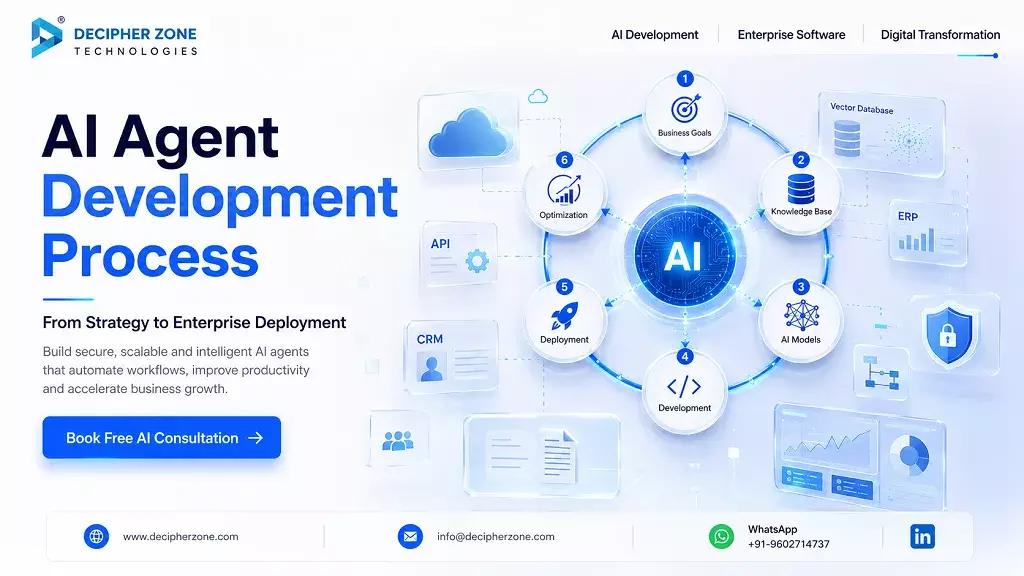
Here are the 6 proven steps:
Step 1: Define Business Goals and AI Use Cases
The first step is to clearly define business problems, challenges and processes you want to automate. The problems often include automating customer support, streamlining internal operations, improving employee productivity, reducing operational costs or enhancing decision making with real time insights.
These are the key activities you need to perform:
-
Identifying what are the pain points and automation opportunities for your business.
-
How to prioritize high impact AI use cases.
-
Define project scope, KPIs and expected ROI.
-
Assess feasibility, compliance and security requirements.
Step 2: Prepare Data and Build the Knowledge Base
The next step is to collect the structured, cleaned and organized information into a centralized knowledge base. Businesses usually store valuable data across CRMs, ERPs, internal documentation, cloud storage, databases, APIs and customer support platforms.
Using RAG (Retrieval Augmented Generation), you can retrieve relevant information in real time. With this RAG approach, the agent can provide up-to-date responses while minimizing hallucinations and improving factual accuracy.
These are the key activities you need to perform:
-
Retrieve clean and structured business information.
-
Develop a centralized knowledge repository.
-
Implement RAG and vector database architecture.
-
Define data security, governance and access permissions.
Step 3: Choose the Right AI Model and Design the Agent Architecture
The tech stack you choose should be aligned with the business needs, performance expectations, security policies and budget. Businesses often evaluate factors like reasoning capabilities, latency, multilingual support, deployment flexibility and integration options when selecting foundation models.
Beyond the language model, the overall architecture includes memory management, orchestration frameworks, tool calling, vector databases, APIs, monitoring systems, and cloud infrastructure.
This step defines whether the project requires a single AI agent or a multi agent architecture where specialized agents collaborate to complete complex workflows.
These are the key activities you need to perform:
-
You need to choose appropriate LLMs and AI frameworks.
-
You can choose between designing single agent agent or multi agent architecture.
-
You need to define memory, reasoning and planning mechanisms,
-
You need to choose a cloud infrastructure and a technology stack.

Step 4: Develop, Integrate, and Test the AI Agent
This step involves connecting AI agents with CRM platforms, ERP systems, databases, email services, calendars, payment gateways, communication tools and third party API to perform real business tasks.
The development team at AI agent development companies configures prompts, reasoning logic, workflows, tool usage and business rules so that the agent behaves consistently across different scenarios.
These are the key activities you need to perform:
-
Develop conversational workflows and reasoning logic.
-
Integrate enterprise apps through APIs.
-
Configure prompts, memory and tool calling.
-
Test functionality, accuracy and performance.
Step 5: Deploy, Monitor, and Optimize the AI Agent
Once the testing part is done, the AI agent is deployed into a production environment where real users begin interacting with it. This isn’t the end of the situation. Businesses monitor the AI agent’s performance using analytics dashboards that track response quality, latency, automation rates, user satisfaction, API failures and operational costs.
Read: AI Integration in 2026
This collected data helps identify knowledge gaps, refine prompts, improve retrieval mechanisms and optimize workflows. Regular updates to the knowledge base and integration help maintain accuracy and long term reliability.
These are the key steps you need to perform in this step:
-
The vendor deploys the AI agent in production, you need to learn the working and refine the workflows.
-
You can monitor performance and user interactions for feedback.
-
You can analyze KPIs and operational metrics.
-
You can continuously refine prompts and knowledge sources with the help of AI development partners.
Step 6: Scale, govern and continuously improve
As you use AI agents, you gain confidence and may begin to expand across multiple departments and business functions. You can establish policies for model updates, user permissions, audit logging, data privacy and human oversight, especially for high risk operations.
By treating AI agents as long term digital products, you can continuously enhance automation, productivity and customer experience while maintaining enterprise level reliability.
These are the key activities you can perform in this stage of the development process:
-
You can establish AI governance and compliance policies.
-
Scale AI agents across departments and workflows.
-
You should implement a human-in-the-loop review for critical decisions.
-
You can continuously improve capabilities based on analytics and business needs.
Best AI Agent Development Frameworks and Tools
Once you have defined your requirements, the next crucial step in the AI agent development process is choosing the right tools and frameworks. Even if you lack expertise, you can consult the vendor for guidance in making your selection.

There are several AI agent frameworks but choosing the most suitable one is difficult. You can consider LangChain, LangGraph, CrewAI, Microsoft AutoGen, Semantic Kernel, LlamaIndex, or the OpenAI Agents SDK.
Read our in-depth guide, Top 12 AI Agent Frameworks in 2026 explain these frameworks based on their architecture, capabilities, use cases, advantages and limitations.
AI Agent Use Cases Across Industries
Now you know what AI agents can do more than just respond. You can take advantage of the technology to automate. Wondering if it will work in your niche?
Basically, AI agents can understand context, analyze data, interact with multiple business systems and execute tasks with minimal human intervention. They can be customized to meet industry specific requirements, integrate with existing enterprise apps and continuously learn from new information.

This table below can help you understand the use cases across various industries:
|
Industry |
How can an AI agent help |
Business benefits |
|
Healthcare |
Appointment scheduling, patient support, medical record summarization, insurance verification, clinical documentation assistance. |
|
|
Banking and Finance |
Fraud detection, loan processing, compliance monitoring, investment research, customer service automation. |
|
|
Retail and E-commerce |
Personalized product recommendations, inventory management, order tracking, customer support, return processing. |
|
|
Manufacturing |
Predictive maintenance, quality inspection, production scheduling, supply chain optimization |
|
|
Logistics & Supply Chain |
Shipment tracking, route optimization, warehouse automation, demand forecasting |
|
|
Human Resources |
Resume screening, employee onboarding, policy assistance, interview scheduling, performance support. |
|
|
Legal Services |
Contract analysis, legal research, compliance checks, document summarization. |
|
|
Education |
Personalized learning, student support, grading assistance and content generation |
|
|
Real Estate |
Property recommendations, virtual assistants, lead qualification, document processing |
|
|
Software & IT |
Code generation, bug analysis, DevOps automation, technical support, knowledge management |
|
Benefits and Challenges of AI Agent Development
You should be aware of the benefits and obstacles of AI agent development as it is clear yet, here we have listed them to ensure you know correctly.

Read: AI App Development Cost in 2026
Benefits of AI Agent Development
-
Hyper-Automation: AI agent systems execute complex workflows that don’t require extensive human intervention, reducing project timelines.
-
Scalability: These automated systems can operate tirelessly 24/7, scaling to handle surges in data processing unlike human workers who need breaks.
-
Advanced Conext & Tool Use: Agents use advanced design patterns that allow them to dynamically interact with external web services, calculators and knowledge bases to produce highly relevant and domain specific outcomes.
-
Data Based Decision Making: AI agents use large amounts of datasets in real time to explore new patterns, predict market trends and make proactive choices faster than manual analysis.
Challenges of AI Agent Development
-
Context Management & Memory Limits: Maintaining long term context without degrading performance or increasing context windows can be challenging and may require complex memory architectures.
-
Tool Integration & API Orchestration: Creating reliable pathways for AI agent systems to connect with existing enterprise software involves fragile integrations that are prone to breakage during third party updates.
-
Reliability and Hallucinations: If there is no tracking, autonomous reasoning can go off track. Agents may risk hallucinations or take incorrect actions across integrated systems.
-
Computational & Financial Overhead: When an AI agent runs at high frequency with advanced reasoning, it can lead to a surge in cloud compute expenses, requiring active inference cost optimizations like model distillation.

Conclusion: Building Scalable AI Agents for Business Growth
As organizations continue to adopt a structured AI agent development process, it becomes essential to build scalable, secure and automated AI solutions that deliver measurable business benefits.
Instead of merely responding to prompts, AI agent systems understand objectives, retrieve organizational knowledge, reason through complex scenarios, interact with business apps and execute meaningful actions with less human intervention.
If you’re looking to streamline internal processes, enhance customer support, automate decision making or develop industry specific AI solutions, you can invest in a well planned AI agent strategy.
Read: Latest AI Trends 2026
At Decipher Zone Technologies, we help startups, enterprises and growing businesses transform ideas into automated solutions. Our team of experts specializes in building custom AI agents, multi-agent systems, RAG based applications, and enterprise AI solutions tailored to your business needs.
At DZ, you can trust us from AI strategy and architecture design to development and ongoing optimization. We offer end-to-end AI agent development services that deliver high-end business results.

Explore our AI agent development services or connect with our AI experts to discuss your project. Together, we will help you design AI solutions that solve your business problems and prepare your firm for the future of autonomous AI.
Frequently Asked Questions About AI Agent Development
-
What is the AI Agent Development Process?
AI agent development process involves a structured methodology to design, develop, deploy and optimize intelligent AI agents. The steps include clearly defining business needs, identifying use cases, retrieving information, choosing AI models, designing architecture, integrating third party tools, testing, deployment and continuous monitoring.
-
How long does it take to develop an enterprise AI agent?
It takes around 4-8 weeks to 3-6 months depending on complexity, use case, integration, security requirements and customization. A simple AI assistant takes less time compared to enterprise level, multi agent platforms as it may require complex integrations.
-
What technologies are commonly used in AI agent development?
There are a number of frameworks modern AI agents commonly use such as LangChain, LangGraph, CrewAI, Microsoft AutoGen, Semantic Kernel, LlamaIndex, the OpenAI Agents SDK or cloud platforms such as AWS or Azure and backend technologies like Java Spring Boot, Python or Node.js.
-
What is the difference between an AI chatbot and an AI agent?
AI chatbot usually responds to user queries while an AI agent can reason, plan, access enterprise knowledge, integrate with business processes, execute workflows and complete tasks autonomously. AI agents are more intelligent digital employees than conversational interfaces.
-
Why should businesses work with an AI agent development company?
An experienced AI agent development company offers technical expertise, architecture design, integration capabilities, governance frameworks and ongoing optimization, reducing implementation risks, increasing deployment and makes sure AI solutions align with business objectives while remaining scalable and secure.
About the Author: Mahipal Nehra manages content at Decipher Zone Technologies and works closely with the AI engineering team across live project delivery. He has spent the last six years documenting real AI and software development projects cost structures, architecture decisions, client outcomes for an audience of CTOs, product leads, and engineering managers. Follow on LinkedIn.
AI Development Services | Generative AI Development | AI Agent Development | Custom AI Solutions | AI Chatbot Development | Machine Learning Solutions | Data Analytics Solutions | Business Intelligence Applications | MLOps Services | AI Consulting | Custom Software Development | Web App Development | Mobile App Development | SaaS Development | E-commerce Development | Enterprise Software Development | Cloud Application Development | UI/UX Design | Full Stack Developers | Product Engineering | Software Modernization | API Development | QA & Support