In short: Choosing an AI agent development company comes down to matching the vendor type to your actual need (platform, implementation partner, or custom build), verifying real production experience rather than demo polish, confirming data and model ownership terms upfront, and starting with a paid pilot before committing to a full build. Cost typically runs $10,000 to $400,000 depending on complexity.
Key Takeaways
- Not every "AI agent development company" is the same kind of vendor. Know whether you need a platform, an implementation partner, or a custom build before you start shortlisting.
- A single-purpose agent typically runs $10,000-$50,000 and takes 6-10 weeks. Enterprise multi-agent systems run $200,000-$400,000+ and take 4-6 months or longer.
- Gartner expects 40% of enterprise applications to carry task-specific AI agents by the end of 2026, up from under 5% in 2025, but also expects more than 40% of agentic AI projects to be cancelled by 2027 over cost overruns and unclear ROI.
- Start with a paid 4-6 week pilot before committing to a full build. It's the cheapest way to expose integration and data problems early.
- Ask about data ownership and model-agnosticism. Both get skipped in most vendor conversations and both matter long after launch.
- What a startup should prioritize and what an enterprise should prioritize in this decision are genuinely different. See the comparison below before you build your evaluation criteria.
Quick Summary
There's no shortage of vendors claiming AI agent expertise. Yet plenty of organizations end up stuck exactly where a better vendor-selection process would have helped them avoid it.
Straight facts: don't go for impressive pitches, flashy demos, or the lowest bid. Evaluate thoroughly. The question is how, and that's what this guide answers, from what these companies actually do, to what a fair price looks like, to what happens after the agent is live.
Latest Statistics on AI Agent Adoption
Gartner projects that 40% of enterprise applications will be integrated with task-specific AI agents by the end of 2026, up from less than 5% in 2025 (Gartner, August 2025). That's a clear adoption curve, but adoption and production success are two different things.
Multiple industry reports attribute a similar gap to McKinsey's research: roughly 62% of organizations are experimenting with AI agents, while fewer than 25% have scaled one to production. We're citing this as widely reported rather than linking McKinsey's original report directly, since we could not independently verify the primary publication at the time of writing.
Gartner's own forecast is blunter still, predicting that more than 40% of agentic AI projects will be cancelled by the end of 2027, mainly due to escalating costs, unclear business value, or inadequate risk controls, most of which trace back to operational overhead rather than the vendor's licensing fee.
The pattern across these numbers is consistent: the barrier isn't building an agent. It's building one that survives contact with production data, live integrations, and governance requirements that don't show up in a demo. That's exactly where vendor choice stops being a minor decision and starts being the decision.
What Is an AI Agent Development Company
An AI agent development company designs, builds, and deploys autonomous software systems that can make decisions and take actions with minimal human input, as opposed to a company that just builds a static website or a form-based app. AI agent development requires an understanding of natural language processing, algorithmic optimization, and system integration, which is why most businesses hire a specialist rather than build this in-house from scratch.
But what do these companies actually do day to day? Let's break it down.
Read: What is AI Agent Development
1. Custom AI Agent Design & Architecture
The AI agent development team designs systems that operate autonomously, make decisions, and perform actions with minimal human intervention. They write the code and architect intelligent systems that learn and adapt over time.
2. Integration with Existing Systems
An experienced AI agent development company specializes in integrating intelligent agents into your existing tech stack, such as CRM, ERP systems, databases, or cloud infrastructure. Integration requires deep expertise in APIs, data connectivity, and system interoperability, and in practice this is usually where projects slow down, not the AI model itself.
3. Model Selection & Training
AI agencies understand your requirements and suggest the most suitable model. They evaluate large language models (LLMs) such as GPT, Claude, Gemini, or Llama, proprietary models, or alternatives, based on cost, latency, accuracy, and compliance needs.
4. Prompt Engineering & Behavior Optimization
Professional development companies employ specialists who draft detailed system prompts, context instructions, and behavioral guidelines that shape how agents respond to different scenarios.
5. Testing, Validation & Quality Assurance
Rigorous testing frameworks validate agent behavior across scenarios, stress-test performance, and identify failure modes before production deployment, including checks for bias, hallucination rates, security vulnerabilities, and edge cases.
6. Deployment & Infrastructure Management
An AI agent development company handles infrastructure setup, from cloud deployment to on-premises or hybrid architectures, and makes sure your agents run reliably at scale.
7. Compliance & Governance
Whether you operate in healthcare, finance, or another regulated sector, you need compliance and governance built in from the start, not added afterward, with agents that meet industry standards and audit requirements.
8. Training & Documentation
The development company doesn't just hand off a system. It provides documentation, trains your team on system management, and defines a clear process for updates as your business grows.
Read: AI Agent Development Cost in 2026
AI Agents vs. RPA vs. Chatbots
This distinction trips up a lot of buyers early on, so it's worth clearing up before you talk to any vendor.

RPA (robotic process automation) follows fixed, rule-based scripts. It's fast and cheap for repetitive tasks like data entry, but it breaks the moment a process deviates from the script, and it can't make a judgment call.
A chatbot handles conversation, usually built around decision trees or a single LLM call per response. It's reactive: it answers what's asked and stops there.
An AI agent perceives its environment, reasons across multiple steps, uses tools or APIs, and adapts its next action based on what it just learned, without a human writing out every branch in advance. A support chatbot answers a question. A support agent can look up an order, check a refund policy, issue the refund, and notify the customer, all in one autonomous sequence.
If your workflow is truly fixed and repetitive, RPA is often cheaper and more reliable than an agent. If your workflow requires judgment, multiple systems, or handling exceptions the same way a trained employee would, that's when an AI agent development company is the right call, not a chatbot vendor or an RPA tool.
Types of AI Agent Development Companies You Can Hire
Before you shortlist names, it helps to know what kind of partner you're looking for. The market groups a few different business models under the same "AI agent development company" label, and picking the wrong category wastes time for everyone involved.
| Type | What you get | Best for | Trade-off |
|---|---|---|---|
| Platform vendor | Software your team configures and operates itself | Standardized workflows like support or data retrieval | Limited flexibility for proprietary processes |
| Implementation partner | A consulting firm or integrator that builds on an existing platform, then hands it over | Teams with no internal AI capacity who want long-term ownership | Success depends heavily on how well the handover is documented |
| Custom development shop | A bespoke agent built from scratch to your exact spec | Proprietary data, complex integrations, or industry-specific compliance needs | Highest cost, longest timeline, biggest maintenance load |
Choose a custom AI agent development company, like Decipher Zone, when your workflow touches proprietary data, requires multiple system integrations, or has to meet compliance requirements that off-the-shelf platforms can't accommodate.
In-House Team vs. AI Agent Development Partner
| Factor | In-house team | Development partner |
|---|---|---|
| Control over architecture and roadmap | Full | Shared, defined by contract |
| Speed to first deployment | Slower, needs hiring and ramp-up | Faster, uses existing frameworks |
| Upfront investment | High (talent, infrastructure) | Lower, scoped to the project |
| Best suited for | Unique requirements with existing AI talent already in place | Most businesses without a dedicated AI team |
For most businesses, a partner is the more practical starting point. In-house builds make sense mainly when your requirements are unlike anything a vendor has solved before, and you already have a team ready to support it for years, not just to launch it.
Startup vs. Enterprise: What to Prioritize
The same ten evaluation factors matter for everyone, but the weight you put on each one should shift depending on where your business sits.
| Priority | Startup | Enterprise |
|---|---|---|
| Speed vs. thoroughness | Speed to a working pilot matters more than a perfect architecture | Governance and audit trail matter more than shipping fast |
| Cost sensitivity | High, favor platform vendors or hybrid builds over full custom | Moderate, custom builds are often justified by scale |
| Compliance depth | Basic data security is usually enough unless regulated | Named frameworks (GDPR, HIPAA, SOC 2) are non-negotiable |
| Vendor size preference | Smaller, more responsive teams often work better | Vendors with proven multi-department rollout experience |
| Biggest risk to avoid | Overbuilding before validating the use case | Underestimating integration complexity across legacy systems |

If you're a startup reading the factors and questions sections below, weight the pilot and cost-transparency questions heaviest. If you're evaluating this for an enterprise rollout, weight the governance and data-ownership questions heaviest.
Why Choosing the Right AI Development Partner Matters
AI agent systems require multiple technologies working together: large language models, agent orchestration frameworks, vector databases (specialized storage that lets an agent retrieve relevant information by meaning, not just keyword match), APIs, workflow automation, cloud infrastructure, several security layers, and monitoring systems.
An inexperienced vendor can build an impressive demo that fails under real-world conditions.

The right AI development partner delivers:
- AI strategy aligned with business objectives
- Scalable, future-ready AI solutions
- Smooth integration with existing systems
- Security, compliance, and data protection built in from day one
- Better accuracy and fewer hallucinations
- Long-term support and continuous maintenance
Read: AI Agent Development Process
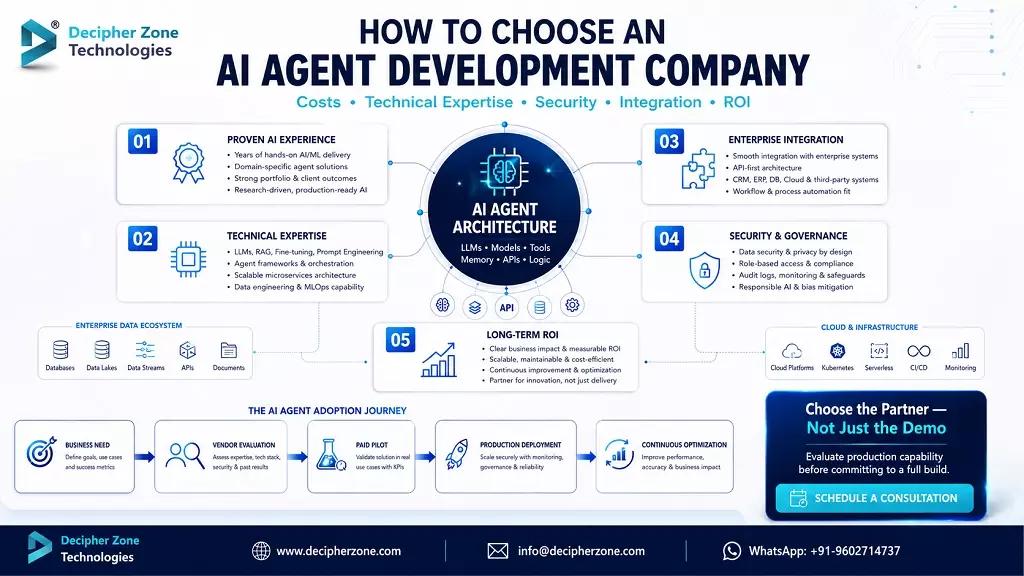
10 Factors to Evaluate Before Choosing an AI Agent Development Company
You need a mix of technical expertise, business understanding, industry knowledge, and proven ability to make the right call. Here's what to weigh.
1. Proven experience in AI agent development
Look for case studies, deployed solutions, industry-specific implementations, references, and testimonials with measurable results attached, not just a list of technologies. A strong answer names a specific industry and a specific outcome. A weak answer says "we've built many AI solutions" without naming one.
2. Technical expertise across the AI tech stack
Evaluate expertise in LLMs such as GPT, Claude, Gemini, and Llama, along with RAG (retrieval-augmented generation, a technique where the agent pulls in your own documents or data before generating a response, rather than relying only on what the model already knows), LangChain or LangGraph, multi-agent architectures, vector databases, agent orchestration, DevOps, and CI/CD pipelines.
3. Industry knowledge and domain expertise
The right agent type depends heavily on your industry's specific workflows, regulations, and operational quirks. A vendor with fintech experience will design a fraud-detection agent differently than one who's only built retail chatbots.
4. Ability to integrate with existing business processes
Look for hands-on experience integrating AI with CRM, ERP, HR, customer support, and project management tools, plus external APIs, since this is usually where projects stall.
5. Security, privacy, and compliance standards
Verify encryption, secure API authentication, role-based access control, and audit logging, and make sure the vendor names specific frameworks like GDPR, HIPAA, SOC 2, or PCI DSS. A strong answer describes exactly which framework applies to your data and how they audit for it. A weak answer just says "we take security seriously." Ask whether you'll get a decision trace for any agent action and whether there's a human-in-the-loop checkpoint for high-stakes decisions.
6. Scalable architecture and future readiness
Make sure the vendor builds for growth in users, request volume, data processing, multi-agent collaboration, and future integrations, not just what you need on day one.
7. Ongoing support and AI optimization
A good partner keeps monitoring performance, updating the knowledge base, upgrading models, fixing bugs, and refining the system as your business changes.
8. Communication, collaboration, and strategic consulting
The right partner explains technical concepts clearly, runs discovery workshops, identifies high-impact automation opportunities, and helps define measurable success metrics upfront.
9. Pricing transparency and long-term value
Evaluate pricing against scope clarity, infrastructure costs, maintenance plans, licensing, and scalability costs, not just the first invoice.
10. Data and model ownership
Confirm what data leaves your environment, where it's processed, and whether the vendor trains on your data unless you opt out. Ask whether their approach is model-agnostic, meaning the agent isn't hard-wired to one AI provider. Locking your workflows to a single LLM vendor means their pricing changes and policy changes become your operational risk.
Step-by-Step Process to Evaluate and Choose the Right Partner
Once you know what you're looking for, a structured process keeps you from getting swayed by a slick pitch. One person should own this decision end to end. A rotating committee without a clear final call is one of the most common reasons vendor selection drags on for months.
- Define your goals. Get specific about what the agent needs to do, whether that's customer support, fraud detection, workflow automation, or sales personalization. Clear goals filter out vendors who can't deliver.
- Research potential companies. Check Clutch, GoodFirms, LinkedIn, or ask for referrals. Shortlist companies with proven expertise in your industry.
- Review experience and portfolio. Study past projects and case studies. A vendor who's already solved a problem similar to yours is a safer bet than one who hasn't.
- Schedule discovery calls. Ask shortlisted companies about their tech stack, timelines, past challenges, and how they measure success.
- Compare proposals on more than cost. Weigh technical approach, scalability plans, and data security strategy alongside price.
- Assess communication and cultural fit. Good technology means little if the team is hard to work with. Check responsiveness and transparency early, not after signing.
- Start with a pilot project. A 4-6 week paid pilot on one well-defined workflow reveals integration friction and data-quality issues far more cheaply than discovering them mid-way through a six-figure rollout.
- Finalize the contract and SLA. Put milestones, delivery timelines, security standards, and post-launch support terms in writing, including what happens if the relationship ends. Clarify code and data portability upfront, and also clarify what happens if you're unhappy mid-project, not just after launch. A contract with no defined exit point before final delivery is a sign the vendor hasn't done this before.
How to Score a Proof of Concept
Most buyers walk away from a pilot with a gut feeling instead of a comparable score. Use this scorecard across every vendor's pilot so you're comparing numbers, not impressions.
| Criterion | What to check | Weight |
|---|---|---|
| Task success rate | Percentage of test cases the agent completes correctly without human correction | High |
| Handling of edge cases | How it behaves on inputs outside the happy path, does it fail gracefully or guess | High |
| Integration reliability | Whether the CRM/ERP connection held up under repeated test runs, not just once | High |
| Latency | Response time under realistic load, not a quiet demo environment | Medium |
| Cost per interaction | Actual model and infrastructure cost per resolved task during the pilot | Medium |
| Explainability | Whether you can see why the agent took a given action after the fact | Medium |
| Handover documentation | Whether the vendor gave you anything your team could act on without them present | High |
Score each vendor's pilot from 1 to 5 on each row. A vendor who scores well on task success but poorly on handover documentation is telling you exactly what the post-launch relationship will look like.
What Does AI Agent Development Actually Cost (and How Long Does It Take)?
| Project type | Typical cost range | Typical timeline |
|---|---|---|
| Single-purpose agent (one task, one integration) | $10,000 - $50,000 | 6-10 weeks |
| Mid-complexity agent (multiple integrations, moderate customization) | $50,000 - $200,000 | 3-4 months |
| Enterprise multi-agent system (custom architecture, compliance requirements) | $200,000 - $400,000 or more | 4-6 months or longer |
Read: AI Agent Development Cost in 2026
Benefits of Hiring the Right AI Agent Development Company
Advanced customization: Systems built around your actual business rules instead of a generic script that treats every business the same way.
Faster time-to-market: Reusable frameworks and proven methodologies mean the team isn't solving basic architecture problems from zero on your dime.
Reduced development risk: A vendor who's already hit and solved a specific failure mode, like an agent that works in testing but breaks under real user phrasing, catches it before it reaches your customers. An inexperienced vendor learns that lesson on your production system.
Smoother integration: Experience with your specific CRM or ERP means fewer surprises when the agent needs to actually write data back into systems your team depends on daily.
Common Challenges During AI Agent Development
Unclear business objectives: Without specific goals, it's difficult to build a system that does anything well.
Solution: Define business objectives, target audience, KPIs, expected ROI, and success criteria before development starts.
Poor data quality and limited knowledge sources: Outdated, incomplete, or poorly structured data leads to inaccurate responses and unreliable decisions.
Solution: Implement data cleaning, knowledge management, RAG, vector databases, document indexing, and data governance policies.
AI hallucination and inaccurate responses: LLMs can generate incorrect or fabricated information, which affects customer trust, business decisions, and regulatory compliance.
Solution: Improve accuracy through RAG, prompt engineering, human-in-the-loop validation, source attribution, and response verification.
Security, privacy, and compliance concerns: Weak security controls expose businesses to data breaches, regulatory violations, and reputational damage.
Solution: Implement end-to-end encryption, audit logs, data masking, and compliance frameworks like GDPR, HIPAA, and SOC 2.
Scalability and performance limitations: Many systems perform well in proof-of-concept but struggle with thousands of users, large datasets, or complex workflows.
Solution: Build in load balancing, auto-scaling, caching, distributed processing, and optimized inference pipelines from the start.
Vendor dependency and knowledge transfer: A business can end up unable to modify or maintain its own agent because only the original vendor's team understands how it's configured, which becomes a real problem if that vendor relationship ends.
Solution: Require documentation of the agent's logic and configuration as a contract deliverable, not an afterthought, so your team or a new vendor can pick it up without starting over.
Read: Custom AI Chatbot vs Off-the-Shelf
Red Flags to Watch for During Vendor Evaluation
Demos that only show pre-built use cases: If a vendor can't run a proof of concept against your own workflow and data, their platform may not be ready for what you need.
Vague governance language: Terms like "guardrails" or "enterprise-grade security" without specifics behind them are marketing copy, not evidence. Push for details on permission structures and audit trails.
No reference customers in your industry: A healthcare deployment and a retail deployment have very different regulatory demands. Ask for references comparable to your situation.
Promises to own your entire AI strategy: An AI agent vendor solves a specific automation problem. Be cautious of any partner positioning themselves as the answer to your whole AI transformation.
No clarity on data and model ownership: Covered under the factors above, but worth repeating as a dealbreaker: if a vendor can't explain this clearly on the first ask, don't expect it to get clearer after the contract is signed.
Resistance to fixed milestones or a written SLA: A vendor who prefers to keep timelines and deliverables loose "to stay flexible" is often avoiding accountability, not protecting quality.
What to Track After the Agent Goes Live
Choosing the vendor is only half the job. Once the agent is live, track a small set of metrics tied to why you built it in the first place: resolution accuracy or task success rate, average handling time versus the manual process it replaced, and the rate of escalations to a human.
Review these at 30, 90, and 180 days. If accuracy is declining or escalations are climbing instead of falling, that's usually a sign the agent needs retraining or the vendor relationship needs a hard conversation, not something to wait out.
Questions to Ask Before Hiring an AI Agent Development Company
- What experience do you have building AI agents?
- Which AI technologies and frameworks do you use?
- How do you ensure AI accuracy and reduce hallucinations?
- What security and privacy measures do you follow?
- What is your development process?
- What support and maintenance services do you provide after deployment?
- How do you measure project success?
- Can you demonstrate similar projects?
- How do you estimate infrastructure costs?
- Who will own the source code and intellectual property?
- What risks should we prepare for during implementation?
- How long will the project take, and what factors could affect the timeline?
- Is your solution model-agnostic, or does it lock us into a single LLM provider?
- Can you support on-premise or private cloud deployment if our data can't leave a controlled environment?
- What happens operationally when an integration breaks in production?
Decipher Zone Technologies: Your Trusted AI Agent Development Company
At Decipher Zone Technologies, we understand business challenges, the technology landscape, and long-term growth objectives. Our engineers, working with the latest advancements in agentic AI, help businesses turn ideas into intelligent, scalable, and future-ready solutions across industries.

Read: Latest AI Trends 2026
Why Partner with Us?
- Experienced AI engineers and solution architects
- Custom AI agent development tailored to your business
- Expertise in agentic AI, RAG, and enterprise AI solutions
- Smooth integration with existing business systems
- A transparent, Agile development process
- ISO 27001-aligned security practices, we're happy to share our certification details on request
- End-to-end support from consulting through post-launch optimization
- A commitment to measurable business ROI, not just a working demo
Ready to see how an AI agent could fit into your workflow? Book a scoping call with our team and we'll walk through your specific use case before you commit to anything.
Frequently Asked Questions
1. What is an AI agent development company?
A company that designs, builds, and deploys autonomous AI systems capable of making decisions and taking multi-step actions with minimal human input, as distinct from a chatbot vendor or a traditional software development shop.
2. How to choose an AI agent development company for startups?
Startups should weigh proof of concept, support model, cost transparency, technical stack, and scalability more heavily than enterprises, since limited budgets and tight timelines mean the vendor needs to prove ROI fast, not just deliver a polished demo. See the startup vs. enterprise comparison above for the full breakdown.
3. How do I choose the best custom AI agent development company?
Look for technical expertise, proven results, team composition, communication process, post-deployment support, industry certifications, cultural fit, scalability, and resource availability. No single factor decides it, it's the combination.
4. How much does AI agent development cost?
Costs range from roughly $10,000 for a single-task agent to $400,000 or more for an enterprise multi-agent system, depending on complexity, scope, and geography. See the cost table above for a full breakdown by project type.
5. How long does AI agent development take?
A simple agent takes 6-10 weeks. Enterprise-level systems with custom architecture or heavy compliance requirements typically take 4-6 months or longer.
6. Can AI agents integrate with existing enterprise software?
Yes. An AI agent development company can build solutions that integrate with CRM, ERP, HR, customer support tools, project management software, and cloud services through APIs and middleware, giving you real-time data access and automated workflows.
7. What's the difference between an AI agent development company and an AI consulting firm?
A consulting firm typically advises on strategy, use-case selection, and vendor choice without necessarily writing code. A development company designs, builds, and deploys the actual system, often with ongoing support after launch. Some companies, including Decipher Zone, do both.
8. Should we build AI agents in-house or hire a development company?
Building in-house gives you full control but requires specialized AI/ML hiring, infrastructure investment, and longer development cycles. A development partner brings tested frameworks and faster deployment, which is usually more efficient unless your requirements are highly proprietary and you already have the team to support them long term.
What's the realistic ROI of hiring an AI agent development company?
It depends heavily on the use case and how well the agent is scoped, but the businesses that see solid ROI are the ones who define success metrics before development starts, not after launch. An agent built without a clear KPI is much harder to justify later, even if it technically works.
How do I know a vendor's AI agent will work in production and not just in a demo?
Ask to run the proof of concept against your own workflow and your own data, not a canned demo scenario. Score it using the proof-of-concept scorecard above rather than relying on a general impression.
About the Author: Mahipal Nehra manages content at Decipher Zone Technologies and works closely with the AI engineering team across live project delivery. He has spent the last six years documenting real AI and software development projects cost structures, architecture decisions, client outcomes for an audience of CTOs, product leads, and engineering managers. Follow on LinkedIn.
AI Development Services | Generative AI Development | AI Agent Development | Custom AI Solutions | AI Chatbot Development | Machine Learning Solutions | Data Analytics Solutions | Business Intelligence Applications | MLOps Services | AI Consulting | Custom Software Development | Web App Development | Mobile App Development | SaaS Development | E-commerce Development | Enterprise Software Development | Cloud Application Development | UI/UX Design | Full Stack Developers | Product Engineering | Software Modernization | API Development | QA & Support