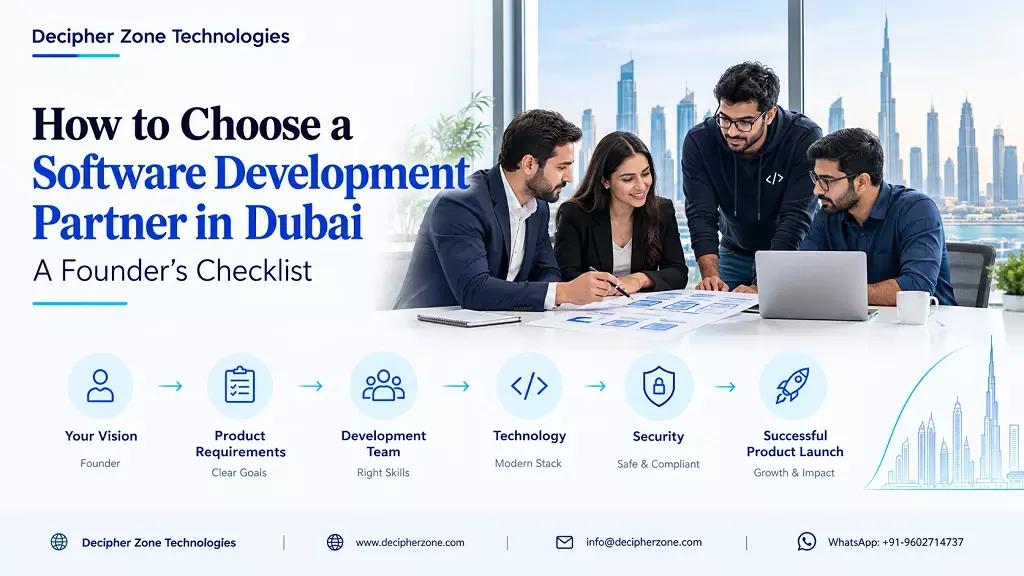
Quick Summary
Picking a software development partner in Dubai is a decision that shapes your product’s timelines, your budget, and how much control you keep on your code. This guide provides you with valuable insights into what to check before you sign, from technical depth and industry fit to contracts, security and what happens long after launch.
Dubai's tech scene has exploded over the past few years, and with it, a flood of software development agencies all claiming they can turn your idea into a working product. For a founder without a technical co-founder, picking the right one feels less like a business decision and more like a gamble.
The stakes are real, McKinsey research puts the failure rate of major transformation software development projects at approx 70%. The default outcomes occur when a founder picks a partner on price alone or on a slick pitch deck like missed deadlines, ballooning budgets and code that has to be rebuilt from scratch six months after launch.
This guide will walk you through what to look for in a software development partner.
Why Choosing the Right Software Development Partner Matters in Dubai
When it comes to the Dubai market, you cannot afford to move slowly and carelessly either. The city has built its reputation on speed. It is easy to rush into a contract with a development team that looks good on paper and turns out to be a liability six months in.
Read: Best Places to Hire Software Developers in 2026
The cost of a missed launch window in a market means losing first-mover advantage to a better funded rival. And if your business touches financial services, healthcare or any regulated free zone like DIFC or ADGM, a software development partner who doesn’t understand data residency and compliance requirements can create legal exposure you won’t discover until an audit.
Hiring an in-house engineering team in Dubai can be expensive and slow and the best local developers are already stretched across the startup scene. The right software development company solves this without forcing you to compromise on quality or control.
Define Your Product Before You Talk to Development Companies
Mainly, software projects in Dubai go over budget because founders walk into vendor meetings with an idea instead of a spec. A software development company can only quote accurately, staff correctly and estimate a realistic timeline when they know what they are building.
But before you reach out to any software development vendor, get clear on:
-
The problem that your product solves and what the target audience is.
-
A prioritized feature list, split into must-haves for launch and nice-to-have for later add-ons
-
Rough wireframes or a clickable prototype, a basic one built in Figma
-
Platform (web, iOS, Android or all three) and any other integrations such as UAE Pass, local payment gateways or Arabic RTL support.
You need clear requirements so that two different agencies quoting on the same brief come back with comparable numbers instead of guessing at scope differently.
Evaluate the Company’s Technical Expertise
Once your product requirements are clear, evaluate the development company’s actual technical capability. Avoid flashy and marketing language like ‘cutting-edge technology' or ‘world-class developers’ as every agency uses these phrases regardless of actual capability.
Focus on:
-
How the development vendor handles your product specifically like multi-tenancy and subscription logic for a SaaS platform, search and payments for a market, model selection and cost control for an AI product
-
Ask why and judge answers, a strong team usually explains and tells you when something is over-engineered
-
Ask about architecture, how frontend and backend communicate, how sensitive data is protected, what breaks at ten times current traffic
-
Ask about technical debt directly as a mature partner names where it lives and manages it
-
Ask what the actual problem was, what this team contributed and what improved measurably
-
Get references and ask what went wrong, as it explains more than the pitch deck.
Check Industry Experience and Understanding of Your Business
Explaining what you actually need is a relevant problem filter and pushes toward vendors who offer domain experience, payment workflows, onboarding, identity verification, role based access that transfers even from a different industry. Ask without guessing what they know, what they don’t know and what specialists they have.
The best software development partners admit their limits. They should understand your business model well enough to make technology decisions that serve it.
-
You need to ask about their technical challenges while delivering SaaS, the architecture, what broke and what they did to change it
-
Ask about the accuracy, model cost, data retrieval and production monitoring
-
Usually, teams with real experience can tell you the incidents and constraints along with the outcomes
-
You need to know about the model when it gives the wrong answer because it can give you clarity about the vendor.
Read: Offshore Software Development for U.S. Companies

Assess Development Process, Communication, and Transparency
Once you are clear with the industry experience, further you need to know how the best software development company moves from requirements to deployment, who actually does the work and how transparent they are throughout the entire process.
-
A clear process shows how work moves from requirements to design, development, testing and deployment, including what happens in the first two weeks
-
Ask for the development team, some agencies sell with senior consultants and later hand execution to a team you have never met
-
Ask for the structured flow they follow, whether it is Agile, Scrum, waterfall or hybrid
-
Look for frequent demos, months with nothing tangible may mean problems are being hidden
-
Your scope can change with a real conversation about cost and timeline instead of an impossible blanket or a free pass
-
When they update done, it should mean the code has passed testing, been security reviewed and UX validated
-
A partner worth hiring asks about your business first rather than jumping straight into a predefined pitch
-
Nail down update frequency, who approves designs, who signs off on milestones and how much of your time this actually requires before you commit.
Compare Pricing, Contracts, Ownership, and Scalability
The total cost is different from the price, how?
Rework, unclear requirements and missing documents may add costs that never show up in the initial quote. A proposal breaks down what’s covered and the contract itself should leave no ambiguity about who owns what once the project ends.
-
Look at the contract structure, it should match your situation. Like, fixed price for locked requirements, time and materials for a product still evolving and milestones for tighter accountability
-
Ask for full ownership of source code, designs, documentation and deployment configs should transfer to you in writing clearly
-
Ask for repository access as it matters as much as ownership. You don’t want your product to be live somewhere only the vendor can reach
-
Make sure the vendor you’re working with is able to add engineers without disrupting the project and just as easily scale down once launch stabilizes
-
Confirm upfront regarding the in-house team if you want one eventually rather than assuming an agreed transition path
-
Look for common blind spots such as cloud costs, third-party API charges and app store subscription fees if they are included or billed separately
-
Schedule payment to actual deliverables, this will protect you from large upfront payments or dates picked out of thin air.
Security, Compliance, Testing, and Long-Term Support
Next comes the security, compliance and testing stage where you need the right partner that treats testing and monitoring as part of building the product.
-
Make sure to include authentication, encryption, data management and access controls in the initial technical discussions
-
Ask who will be the owner for regulatory obligations as technical controls and legal compliance aren't the same. It is better to cover this instead of assuming industry experience covers both
-
Confirm upfront that the testing plan covers unit, integration, performance and security layers. Because a product can pass one and still fail another
-
If you want to know how an API failure or a stalled background job gets caught up in real time, set expectations for production monitoring before launch
-
Make sure to treat operational reliability as a core requirement as every year Dubai and the UAE are pushing investment in digital infrastructure baseline higher
-
Finalise ownership of cloud accounts and production access and ask directly whether subcontractors are involved anywhere in the build
-
Make sure you have warranty periods, response times for critical issues and how dependencies get updated over time because these decide what version one costs to run once it’s live.
Read: Top 10 Software Development Companies in the USA
Founder’s Final Checklist for Selecting a Software Partner
You have read through what to look for at every stage from defining your product to negotiating the contract. Before you sign anything, run through this list.

What Founders Should Check Before Signing Any Software Development Company
-
Business Understanding: The development partner should understand the business model, target audience, core challenges and product goals rather than simply your feature list.
-
Relevant Experience: The company should work on products with similar functionality, complexity, industry requirements or technical challenges.
-
Technical Expertise: The team should have proven experience with the technologies, frameworks, cloud platforms, integrations and architecture your project requires.
-
Product Thinking: The team should have ideas or suggestions regarding improvements, identify risks, prioritize features and challenge assumptions.
-
Development Process: The company should clearly define the process for planning, development, testing, reviews, approvals, deployment and handling changes.
-
Communication: The technical partner should provide clear points in the contract, regular updates, progress demonstrations and transparent communication throughout the development process.
-
Quality Assurance: The best software development partner structures a testing process, they include functionality, performance, security, APIs, integrations and user acceptance.
-
Security & Compliance: Data protection, access control, encryption, secure development practices, backups and applicable compliance requirements should be considered from the initial stage of development.
-
Pricing Transparency: The proposal must explain what is included, what is excluded, how changes are priced and what additional costs may be encountered in the future.
-
Intellectual Property: The partner should clearly establish the ownership and access to the source code, designs, database, documentation, credentials and other project assets.
-
Scalability: Make sure to ask if the proposed architecture supports increasing users, transactions, integrations and features without requiring a complete rebuild.
-
Post Launch Support: The partner provides defined maintenance, bug fixes, monitoring, security updates, technical support and future development options clearly.
-
Team Stability: Ask the vendors who will actually work on your project, what their roles are and how the company will handle team changes.
-
Exit & Handover: Make sure to know if you move development elsewhere, you will have complete access to your code, documentation, infrastructure, repositories and technical knowledge.

Conclusion
Choosing a software development partner in Dubai comes down to the same question at every phase of development, which is whether they make my decisions easier or my problems bigger.
A pitch deck or cheapest quote won’t solve the problem, you need solid questions about the process, references, contract terms and approach to security. Don’t fall for the timeline trap or the relationship feels easy. Dubai rewards speed, but it doesn't reward carelessness.
Read: Affordable Software Development for African Startups
Go back through the checklist before you sign anything. If you’re in Dubai or anywhere in the world and a custom software development partner clearly answers the questions without defensiveness. Good luck with the development, you have partnered with the best software development company. If they dodge, hesitate or wave it off as unnecessary, you know your answer.
The right partner will be on your side, give you a team that tells you the truth when something goes wrong, hones suggestions and that’s what gets a product to market in one piece.
FAQs
How much does software development cost in Dubai?
Custom software development in Dubai ranges from AED 80,000 ($22,000) for an MVP to AED 1,800,000+ ($490,000+) for complex enterprise platforms. Cost may vary depending on the complexity of your product, the size and location of the team, etc.
Should a Dubai startup choose a local development company?
A local team offers easier in-person meetings and familiarity with UAE-specific requirements like VAT invoicing or DIFC compliance. Whereas a remote team with strong communication and a tight development process can perform just as well. In the pricing, remote development partners often offer flexible costs. Choose based on technical expertise, relevant experience, communication, transparency and long-term support instead of location alone.
How do I verify a software development company’s experience?
The best way to verify the experience of a software development company is by their case studies with similar technical or business challenges, request a call with the actual engineers, ask for references and specifically ask what went wrong during the engagement.
What contract model is best for startup software development?
Mainly, Startups prefer fixed price, time and materials and dedicated team models which can all work depending on the project. Fixed price suits clearly defined requirements, time and materials model works better when requirements may change and dedicated team is best when you need continuous development and flexibility.
What should founders ask before hiring a software development partner?
Founders can ask about experience, technology, development process, pricing, timelines, security, intellectual property, source-code ownership, communication process, hidden costs, scalability and post launch support before hiring a software development vendor.
About the Author: Mahipal Nehra manages content at Decipher Zone Technologies and works closely with the AI engineering team across live project delivery. He has spent the last six years documenting real AI and software development projects cost structures, architecture decisions, client outcomes for an audience of CTOs, product leads, and engineering managers. Follow on LinkedIn.
AI Development Services | Generative AI Development | AI Agent Development | Custom AI Solutions | AI Chatbot Development | Machine Learning Solutions | Data Analytics Solutions | Business Intelligence Applications | MLOps Services | AI Consulting | Custom Software Development | Web App Development | Mobile App Development | SaaS Development | E-commerce Development | Enterprise Software Development | Cloud Application Development | UI/UX Design | Full Stack Developers | Product Engineering | Software Modernization | API Development | QA & Support