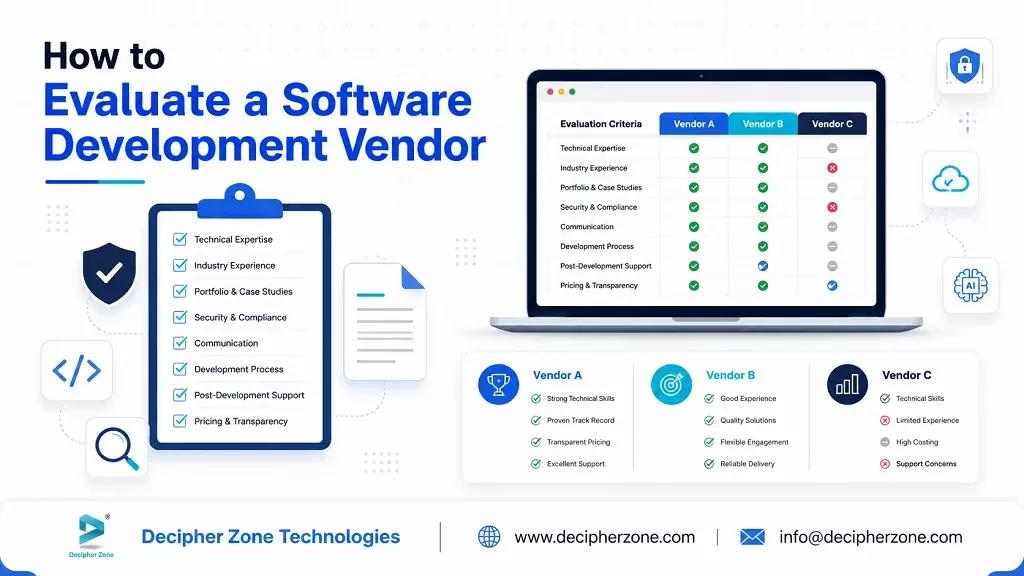
This article walks through every stage of the vendor evaluation process, from understanding your business goals and defining evaluation criteria to assessing security and compliance, comparing vendors side by side, asking the right questions before you sign and common pitfalls, so you can make confident and well informed decisions.
The biggest challenge for startups and enterprises is identifying genuine long-term technology partners instead of vendors with the most convincing sales pitch. A polished proposal, an impressive portfolio or competitive pricing may look attractive but they rarely reveal how a vendor performs when project requirements evolve, deadlines become tighter or unexpected technical issues arise.
Studies reveal that 70% of software projects exceed their original set budget due to communication gaps, poor vendor management and weak evaluation processes. Also, 41% of failed outsourced projects result from vendor selection based mainly on price, highlighting the risks of evaluating vendors through a narrow financial perspective.
This guide provides a practical framework for evaluating software development vendors, helping you identify reliable technology partners and make informed decisions that support long-term business success.
Read: 15 Software Developer Skills Every Developer Must Have
Understand Your Business Requirements Before Evaluating Vendors
Before evaluating potential vendors, develop a clear understanding of your project requirements. This should not be rushed as it can lead to mismatched expectations, inaccurate estimates and costly delays.

Before evaluating software development vendors, define these project requirements to establish clear evaluation criteria.
-
Define the problem: Whether you’re building a new system, modernizing a legacy system or extending an existing team, you need a different vendor profile for each. Define the problem and not just the product.
-
Separate mandatory from nice-to-haves: Tech stack expertise, industry experience and team size matter, as does the type of product you want to develop: a quick MVP or a complex workflow solution.
-
Set a realistic budget range: Knowing your budget early allows you to spot vendors who quote unrealistically low just to win the deal.
-
Decide on engagement model upfront: This decision shapes the entire contract, risk allocation and vendor shortlist. Choose fixed-price, time and material or dedicated team wisely.
-
Establish your timeframe and non-negotiable milestones: Define clear timelines and milestones to avoid scope creep and delivery delays.
Document success metrics before you talk to anyone: This single step addresses the biggest reason vendor engagement fails. Businesses that struggle with outsourcing begin engagements without defined success metrics in the first place.
Step-by-Step Software Development Vendor Evaluation Process
Choosing the right software development vendor becomes much easier when you follow a structured evaluation process instead of relying on sales presentations or pricing alone. A systematic approach helps reduce risks, improves decision-making, and increases the chances of building a successful long-term partnership.
Follow these steps to evaluate potential software development vendors effectively.
Step 1: Create a Vendor Shortlist
Research multiple software development companies based on their technical capabilities, industry experience, client reviews, and service offerings. Shortlist vendors that closely match your project requirements instead of evaluating every available option.
Step 2: Evaluate Technical Expertise
Assess whether the vendor has hands-on experience with the technologies, programming languages, frameworks, cloud platforms, and architecture your project requires. Review recent projects rather than relying only on general technical claims.
Step 3: Check Portfolio and Client References
Review detailed case studies and request client references. Speaking directly with previous clients provides valuable insights into project delivery, communication quality, problem-solving abilities, and overall client satisfaction.

Step 4: Assess Security and Compliance
Verify that the vendor follows secure software development practices and complies with relevant regulations such as GDPR, HIPAA, PCI DSS, SOC 2, or other industry-specific standards. Strong security practices protect both your business and customer data.
Step 5: Compare Pricing Models
Evaluate pricing based on overall value rather than selecting the lowest quote. Compare fixed-price, time and material, and dedicated team engagement models while understanding exactly what is included in the proposal.
Step 6: Conduct Technical Interviews
Arrange discussions with the actual developers, architects, or project managers who will work on your project. Technical interviews help validate expertise, communication skills, and the team's understanding of your business objectives.
Step 7: Run a Pilot Project
For large or long-term engagements, consider assigning a small pilot project before signing a long-term agreement. This allows you to evaluate collaboration, code quality, delivery speed, and communication with minimal risk.
Step 8: Finalize the Contract
Before signing, carefully review the contract for intellectual property ownership, payment milestones, service-level agreements (SLAs), confidentiality clauses, maintenance responsibilities, change request procedures, and project exit terms. A well-defined contract protects both parties throughout the engagement.
Key Criteria for Evaluating a Software Development Vendor
Once your project requirements are defined, evaluate vendors beyond marketing presentations and sales promises.

Focus on the following criteria:
-
Technical expertise matched to your requirements: Look for track records, recent project work in your specific languages, frameworks and architecture style and not just focus on general full stack claims.
-
Domain experience: The provider that has built in your industry including fintech, healthcare, e-commerce will understand the compliance and workflow nuances that generic developers miss.
-
Team structure and seniority: Ask for the names, roles and seniority specifically who will work on your project and do not consider only the overall headcount of the company.
-
Engagement and delivery model fit: Make sure that their default process matches how your team actually likes to work like agile, hybrid or waterfall.
-
Scalability: Can vendors flex the team up or down as your project requirements change, without long lead times?
-
Quality assurance practices: Ask about QA and go deep and explore how testing coverage, code review standards and CI/CD maturity work and not just believe “we test everything”.
-
Cost transparency: Understand exactly what’s included and what triggers extra billing, ask for detailed and itemized estimates, that beats suspiciously low flat quotes.
-
Geographic & time zone fit: If real time collaboration is required in your workflows then it should be a priority.
-
ISO & industry certifications: Certifications like ISO 9001 (quality management) and ISO 27001 (information security) are a useful, verifiable proxy for process maturity.
How to Assess a Software Development Vendor's Reputation
Look into the vendor's reputation as their capabilities reveal more than any sales presentation. With past performance, you can evaluate valuable insights into how they handle projects, communicate with clients and solve problems.

Consider analyzing the following areas:
-
Check third party review platforms: There are platforms like Clutch, GoodFirms and G2 that provide unfiltered client feedback that a vendor’s own case studies won’t.
-
Ask for references to contact them: Ask for reference lists and actually call them, ask past clients about delays, communication gaps and how disputes were handled.
-
Look at portfolio depth: Anyone can list a recognizable client name, ask what was delivered and what role the vendor played.
-
Review their track record on similar projects: Depending on the vendor’s speciality, they can work. Some may be great at small MVPs and may struggle with enterprise level, multi team coordination and others may be great at enterprise level and may struggle with developing small MVPs.
-
Check company stability: If you’re building a multi year relationship, focus on years in business, employee retention and financial health, as it all matters.
Read: Adaptive Software Development Explained
Evaluate Communication and Project Collaboration
The most common issue remains communication in software projects. Even highly skilled development teams can struggle if communication processes are ineffective or inconsistent.

What you need to consider are these communication practices:
-
Response Time: Assess how quickly the service provider addresses questions and concerns.
-
Communication Channels: Ask and understand what tools are used for collaboration and updates.
-
Project Reporting: Review the frequency and detail of progress reports.
-
Stakeholders' Involvement: Determine how clients participate in decision making.
-
Meeting Structure: Evaluate the effectiveness of regular status meetings.
-
Transparency: Look for open discussion regarding risks, delays and resolutions.
-
Issue Resolution Process: Understand how problems are escalated and resolved.
-
Cultural Compatibility: You need to ensure the working style aligns with your organization and communicate if it needs any changes.
It creates trust, improves project visibility and reduces misunderstandings with strong communication throughout the development process.
Review Security, Compliance, and Risk Management
Looking at the data breaches, compliance violations and security vulnerabilities, you must treat security as top priority when selecting a software development vendor. This creates financial and reputational damage.

These are the key areas you need to evaluate, including:
-
Secure Development Practices: You can verify whether security is integrated during the development process.
-
Data Protection Measures: Review encryption, access controls and backup procedures.
-
Compliance Expertise: Evaluate experience with GDPR, HIPAA, PCI DSS, SOC 2 or industry specific regulations.
-
Vulnerability Management: You can understand how security risks are identified and addressed.
-
Incident Response Plans: Assess preparedness for security incidents.
-
Risk Assessment Procedures: Review processes for identifying project and operational risks.
-
Third-Party Security Audits: Confirm whether independent assessments are conducted.
-
Employee Security Training: You need to ensure team members receive ongoing security education.
Compare Software Development Vendors Effectively
The main part is to compare the shortlisted vendors. This will help you eliminate bias and ensure decisions are based on measurable criteria rather than personal impressions.

You can create your own evaluation framework that includes:
-
Technical Capability Score
-
Industry Experience Score
-
Project Management Score
-
Communication Score
-
Security & Compliance Score
-
Portfolio Quality Score
-
Client Reference Score
-
Pricing & Value Score
-
Scalability Score
-
Maintenance & Post-Support Score
Stop just considering the cost and evaluate the overall value. A software development provider may charge slightly higher but deliver better quality, communication and long term support, which often generates a much higher return on investment.
Software Development Vendor Evaluation Checklist
Before making your final decision, use this checklist to ensure you've evaluated every critical aspect of the software development vendor. This simple framework helps minimize risks and ensures that your chosen partner aligns with both your technical and business requirements.
| Evaluation Criteria | Status |
|---|---|
| Technical expertise matches project requirements | ✓ |
| Relevant industry experience | ✓ |
| Strong portfolio and case studies | ✓ |
| Positive client references and reviews | ✓ |
| Transparent pricing and engagement model | ✓ |
| Effective communication and reporting process | ✓ |
| Mature QA and testing practices | ✓ |
| Security and compliance standards verified | ✓ |
| Team scalability and resource availability | ✓ |
| Clear Service Level Agreements (SLAs) | ✓ |
| Post-launch maintenance and support | ✓ |
| Intellectual property ownership clearly defined | ✓ |
| Realistic project timeline and milestones | ✓ |
| Well-defined contract terms | ✓ |
Completing this checklist before signing a contract helps you compare vendors objectively and reduces the likelihood of selecting a partner based solely on pricing or marketing claims. A well-rounded evaluation leads to better project outcomes, stronger collaboration, and greater long-term business value.
Questions to Ask Before Signing a Software Development Contract
This stage provides you with an opportunity to clarify or state your expectations and uncover potential risks before work begins. These are the important questions to ask that include:

-
Who will be assigned to handle our project?
-
Can the members of the development team be replaced without approval?
-
How are delayed project timelines handled?
-
What security standards do you follow?
-
How often do you provide project updates?
-
Who owns the intellectual property?
-
What are the post launch maintenance & support terms?
-
What service-level agreements (SLAs) are included?
-
How is the success of the project measured?
-
What happens if either party terminates the agreement?
-
Can you provide client references for similar projects?
These answers should be documented within the contract whenever possible to avoid any misunderstandings in the future.
Read: Top Software Development Companies in the USA & India
Common Mistakes When Choosing a Software Development Vendor
Many businesses approach selecting software development vendors with a short term mindset, but it is one of the most important decisions a company can make. Factors like impressive sales presentation, affordable prices or polished portfolio can influence your decision making process. It alone rarely determines the success of the project.

Here are the common pitfalls that can help you establish a partnership that delivers long term value:
1. Prioritizing Cost Over Value
One of the biggest mistakes businesses make is selecting a vendor solely because they offer the lowest price. While staying within budget is important, choosing the cheapest option often leads to compromises in quality, communication, security and long-term support.
Instead of comparing hourly rates alone, evaluate the overall value a vendor brings by considering:
-
Technical expertise and experience
-
Development quality and coding standards
-
Communication and project management
-
Security and compliance capabilities
-
Long-term maintenance and support
-
Scalability for future business growth
A slightly higher initial investment can significantly reduce future costs associated with bug fixes, redevelopment and delayed product launches.
2. Failing to Define Clear Project Requirements
Many businesses begin searching for vendors before fully understanding what they want to build. Vague requirements make it difficult for vendors to provide accurate estimates and often result in misunderstandings later in the project.
Before approaching any vendor, clearly define:
-
Business objectives
-
Target users
-
Required features
-
Preferred technologies
-
Budget expectations
-
Project timeline
-
Success metrics
Well-documented requirements enable vendors to provide realistic proposals and reduce the likelihood of scope creep.
3. Ignoring Industry Experience
A vendor may have exceptional technical skills but limited knowledge of your industry. Every sector has unique workflows, regulations, customer expectations, and technical challenges that influence software development.
For example:
-
Healthcare applications require strict data privacy and compliance.
-
FinTech platforms demand strong security and regulatory expertise.
-
Logistics software requires experience with fleet management, route optimization, and supply chain operations.
Choosing a vendor with relevant industry experience reduces onboarding time and improves the quality of the final solution.
4. Overlooking Communication and Collaboration
Strong communication is just as important as technical capability. Even highly experienced development teams can struggle if communication is inconsistent or expectations are unclear.
Evaluate whether the vendor:
-
Responds promptly to inquiries.
-
Provides regular project updates.
-
Uses modern collaboration tools.
-
Offers transparent reporting.
-
Clearly explains technical decisions.
-
Has a structured escalation process.
Effective communication minimizes misunderstandings, accelerates decision-making, and keeps projects moving forward.
5. Not Verifying References and Previous Work
Many businesses rely solely on information presented during sales meetings without validating the vendor's claims. A polished presentation should never replace independent verification.
Read: Best Places to Hire Software Developers in 2026
Before making a decision:
-
Request client references.
-
Review detailed case studies.
-
Explore independent review platforms.
-
Examine similar projects in their portfolio.
-
Ask about measurable business outcomes.
Speaking directly with previous clients often provides valuable insights into the vendor's reliability, responsiveness, and ability to meet deadlines.
6. Ignoring Security and Compliance Requirements
Security is frequently overlooked until late in the development process, which can expose businesses to significant operational and financial risks.
When evaluating vendors, assess their approach to:
-
Secure software development practices
-
Data encryption
-
Access control
-
Vulnerability testing
-
Regulatory compliance (GDPR, HIPAA, PCI DSS, SOC 2, etc.)
-
Disaster recovery planning
A vendor that treats security as a core development practice, not an afterthought, helps protect your business and customer data.
7. Accepting Unrealistic Timelines and Promises
Every business wants faster delivery, but unrealistic promises often lead to missed deadlines, rushed development, and lower software quality.
Be cautious of vendors who:
-
Guarantee extremely short delivery times.
-
Underestimate project complexity.
-
Promise every requested feature without discussion.
-
Avoid talking about project risks.
Reliable vendors provide realistic timelines supported by a structured development roadmap and clear milestones.
8. Neglecting Contract Terms
A detailed contract protects both parties and establishes clear expectations from the beginning. Businesses sometimes focus heavily on pricing while overlooking critical legal and operational clauses.
Review the contract carefully for:
-
Intellectual property ownership
-
Source code ownership
-
Payment milestones
-
Service Level Agreements (SLAs)
-
Change request process
-
Warranty terms
-
Confidentiality agreements
-
Exit strategy and project handover
A comprehensive contract minimizes future disputes and ensures both parties understand their responsibilities.
How to Build a Long-Term Partnership with Your Software Vendor
The most successful software projects are built on strong partnerships rather than transactional relationships. A reliable vendor becomes an extension of your team, contributing strategic insights and supporting long-term growth.

To build a successful partnership:
-
Establish Clear Expectations: Define goals, responsibilities, and success metrics from the start.
-
Maintain Regular Communication: Schedule consistent review meetings and progress discussions.
-
Share Business Context: Help the vendor understand broader organizational objectives.
-
Encourage Collaboration: Treat the vendor as a strategic partner rather than a service provider.
-
Provide Constructive Feedback: Address concerns early and openly.
-
Measure Performance Regularly: Track KPIs and project outcomes.
-
Plan for Future Growth: Discuss scalability and long-term technology roadmaps.
-
Recognize Successes: Celebrate milestones and achievements together.
Strong vendor partnerships often lead to better innovation, faster delivery, improved product quality, and greater business value over time.
Why Choose Decipher Zone Technologies
Choosing a custom software development vendor shouldn’t be about finding a team that completes the project but a technology partner that can support your business as it grows.

With years of experience delivering custom software solutions, we focus on building long-term technology partnerships rather than one-time client engagements.
- Business-First Development Approach: Our development team takes time to understand your objectives, operational challenges, target audience and future goals.
-
Experienced Cross Functional Teams: Our dedicated teams include software developers, solution architects, UI/UX designers, QA engineers, DevOps specialists, AI experts and project managers who work collaboratively throughout the development process.
-
Expertise Across Modern Technologies: Our engineers stay ahead of industry trends to deliver future ready digital products using the latest languages, frameworks and technologies and suggest the best one based on your business requirements.
-
Transparent Communication Throughout the Project: At Decipher Zone Technologies, clients remain informed and updated on every stage of development using regular sprint reviews, progress reports, real time collaboration tools and milestone tracking.
-
Quality Without Compromise: We follow industry best practices to deliver reliable, scalable and secure software solutions using these quality assurance processes like functional, performance, security, regression, user acceptance testing.
-
Security Based Development: Our team integrates security best practices such as secure coding standards, role based access control, data encryption, compliant architectures and regular security reviews in the software development lifecycle to protect the applications, users and sensitive data.
-
Continuous Support & Improvement: Our partnership continues beyond deployment through ongoing maintenance, performance optimization, feature enhancements and technical support. We help ensure your app remains competitive and aligned with your evolving business needs by continuously improving it.
Final Thoughts
By now, you should have a clear framework for evaluating software development vendors beyond pricing alone. The right technology partner should understand your business goals, provide the right technical expertise, maintain transparent communication, and deliver secure, scalable, high-quality software that supports long-term growth.

Treating this technology partner as an extension of your team will offer strategic guidance, adapt to changing business needs and continuously improve your digital products as your business scales.
Read: Hire Indian Developers for US Companies in 2026
Decipher Zone Technologies offers digital solutions services from custom software development, AI based solutions, enterprise applications and ongoing support. Our team is committed to delivering innovative solutions that create measurable business value.
Get in touch with our experts today to discuss your project and discover how we can help you build secure, scalable, and future-ready digital solutions.
Frequently Asked Questions
What is the most important factor when evaluating a software development vendor?
The most important factor is strategic alignment when evaluating software development vendors. Basically, business requires the combination of technical expertise, industry experience, project management capabilities and post launch support. The right enterprise software development services should offer technical skills, understand clients' goals and act as a partner for the future as well.
How much will it cost to hire a software development company in 2026?
The cost to hire custom software development companies in 2026 is $8 – $60 per hour and $15,000 – $200,000 annually, depending on various factors such as project complexity, tech stack, team size, development timelines and the location of the software development providers.
Should I choose the lowest-cost software development vendor?
It is not necessary to choose the lowest software development vendor as it can lead to compromise in quality, communication, security and other factors. While budget is an important consideration, a vendor offering slightly higher pricing but delivering experienced developers, transparent project management and reliable support can reduce the risk of costly redevelopment.
How can I verify a vendor's experience?
These are the steps you can follow to verify a software development provider’s experience including reviewing portfolio, case studies, client testimonials and independent reviews on platforms like Clutch or GoodFirms. You can also recommend client references, discuss similar projects and evaluate technical expertise and ask detailed questions about the development process.
What red flags should I watch for during vendor evaluation?
Common red flags you need to watch for include unrealistic pricing, vague project estimates, poor communication, lack of relevant industry experience, limited transparency, no client references, weak security and unclear contract terms. The right application development companies will be transparent, realistic and willing to answer all your questions before the project begins.
Author Profile: Mahipal Nehra is the Marketing Manager at Decipher Zone Technologies, specializing in content strategy, and tech-driven marketing for software development and digital transformation.