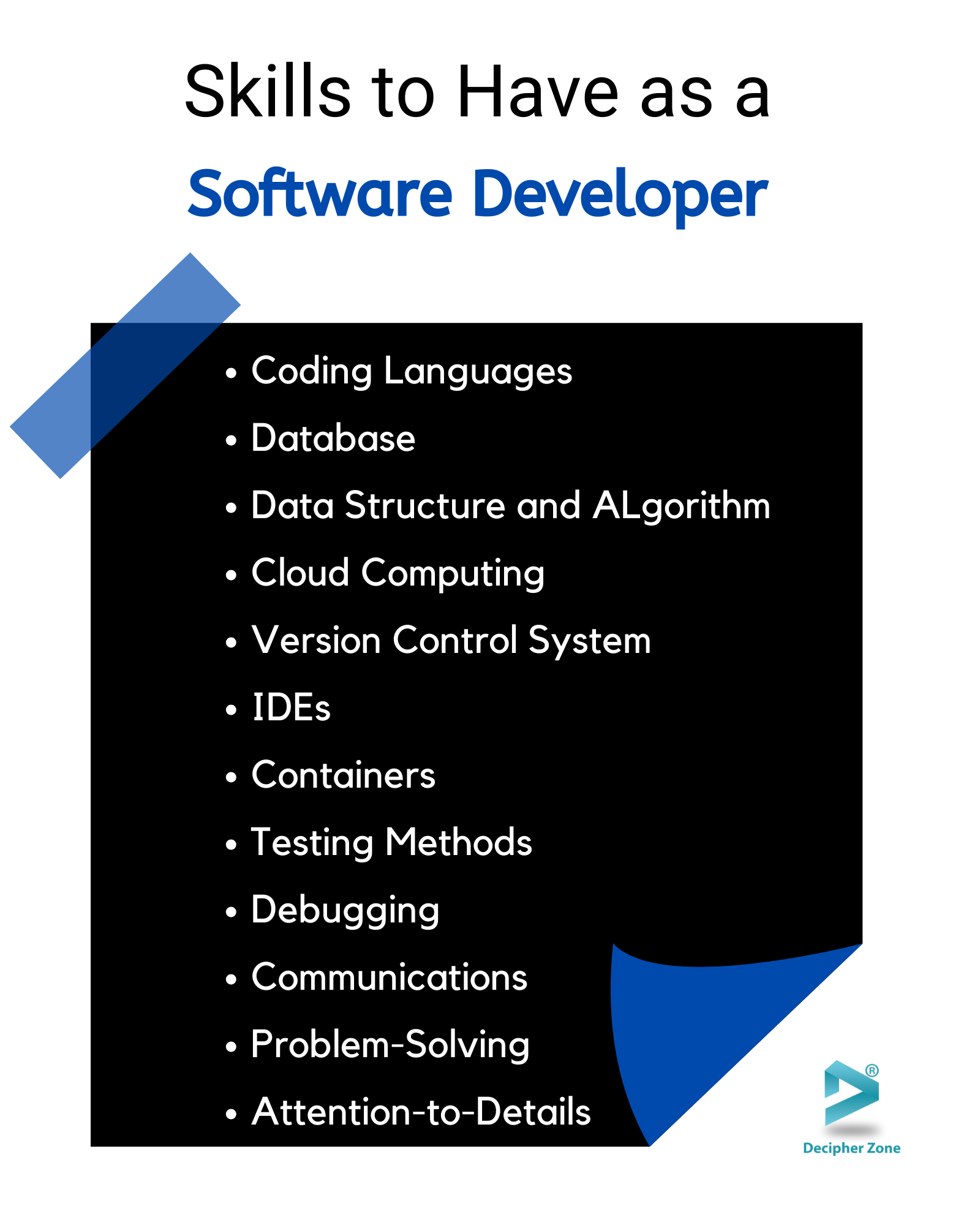
The 15 most in-demand software developer skills in 2026 are AI and ML integration, agentic AI and LLM development, cybersecurity and secure coding, DevOps and CI/CD, API design (REST and GraphQL), cloud-native architecture, data engineering, coding languages (Python, JavaScript, TypeScript), data structures and algorithms, databases, version control, testing and quality assurance, debugging, communication, and problem-solving.
The World Economic Forum projects 97 million new technology roles by 2025. Cybersecurity was ranked the most important skill to learn in 2026 by tech practitioners surveyed in Pluralsight's Tech Forecast of 1,500+ tech insiders. Developers who combine technical depth with AI literacy, security awareness, and cloud-native knowledge are the ones companies compete hardest to hire.
Software development is no longer about knowing one language well. In 2026, the developers who command the highest salaries and the most interesting projects are the ones who combine traditional engineering fundamentals with AI integration, security thinking, and cloud-native architecture.
Stack Overflow's 2024 Developer Survey found Python used by 51% of developers and JavaScript by 62.3%, but technical skills alone no longer define a developer's market value. The ability to integrate AI into production systems, ship securely, and operate confidently in cloud environments separates good developers from essential ones.
This guide covers all 15 skills, a hard vs soft skills comparison table, a skill-by-role breakdown for junior, mid-level, and senior developers, and practical guidance on where to start building each skill in 2026.
Read: What is Software Development | Software Development Lifecycle | How to Hire Software Developers
Hard vs Soft Skills: What Employers Actually Prioritise in 2026
The old debate about whether technical or interpersonal skills matter more has been settled by the market. Both categories are required, but their relative weight shifts by role seniority. This table shows what employers prioritise at each level.
| Skill Category | Junior Developer | Mid-Level Developer | Senior Developer |
|---|---|---|---|
| Coding languages | Essential, 1 to 2 languages | Essential, 2 to 3 languages + frameworks | Expected, breadth across stacks |
| AI/ML integration | Basic API consumption | RAG, fine-tuning, LLM integration | Agentic systems, MCP, custom models |
| Cybersecurity | Secure coding basics, OWASP Top 10 | Authentication, encryption, threat modelling | Security architecture, compliance design |
| Cloud-native | Basic AWS or Azure services | Containers, Kubernetes, IaC (Terraform) | Multi-cloud architecture, cost optimisation |
| DevOps and CI/CD | Git, basic pipelines | GitHub Actions, Jenkins, Docker | Pipeline design, monitoring, SRE practices |
| API design | REST consumption | REST and GraphQL design and documentation | API strategy, versioning, gateway design |
| Data engineering | Basic SQL and data handling | Pipelines, ETL, real-time data | Data architecture, streaming systems |
| Communication | Team communication, PR reviews | Stakeholder updates, documentation | Cross-functional leadership, decision framing |
| Problem-solving | Debugging, debugging tools | System-level problem diagnosis | Architectural trade-off decisions |
15 Software Developer Skills Every Developer Must Have in 2026
1. AI and Machine Learning Integration
Why It Is the Top Skill in 2026
Artificial intelligence is now embedded in nearly every digital product category. NASSCOM's 2024 Strategic Review identifies AI integration as the single most critical skill for developers across all specialisations. Companies in healthcare, finance, retail, manufacturing, and education all use machine learning systems to improve decisions or automate routine tasks.
The developers who understand how to build, integrate, and optimise AI-driven solutions are the ones commanding the highest salaries in the 2026 job market.
What This Skill Covers
- Python for AI and ML: NumPy, Pandas, scikit-learn, TensorFlow, PyTorch
- Building and consuming ML model APIs (OpenAI, Anthropic, Google Gemini, Hugging Face)
- Prompt engineering and chain-of-thought reasoning
- Model evaluation, output validation, and reducing hallucination risk
- RAG (Retrieval-Augmented Generation) for building AI-powered search and knowledge systems
- Embeddings, vector databases (Pinecone, Weaviate, pgvector)
- AI in production: monitoring model drift, A/B testing AI features, latency optimisation
How to Build This Skill
Start with Python fundamentals if you do not already know them. Build a small classification or regression project with scikit-learn. Then integrate an LLM API (OpenAI or Anthropic) into a web application. Once comfortable with API consumption, build a RAG system using LangChain or LlamaIndex over a document collection. This learning path takes approximately 8 to 12 weeks of consistent effort.
2. Agentic AI and LLM Development
Why It Is a 2026 Priority
Pluralsight's Tech Forecast based on predictions from 1,500+ tech insiders ranks Agentic AI as one of the top skills for 2026, noting that developers who understand how to build agents, not just consume them, will have a substantial market advantage. Agentic AI refers to systems where LLMs autonomously plan and execute multi-step tasks, calling tools and making decisions without human intervention at each step.
What This Skill Covers
- Agent architectures: ReAct, plan-and-execute, multi-agent orchestration
- Model Context Protocol (MCP) for agent-to-agent and agent-to-tool communication
- LangChain and LangGraph for building multi-step agent workflows
- Tool calling and function execution from LLM outputs
- Memory systems: short-term context, long-term vector storage, episodic memory
- Safety, guardrails, and output validation for autonomous systems
How to Build This Skill
Build a simple agent that takes a user query, decides which tool to call (web search, calculator, database query), executes it, and returns a synthesised response. Then add memory persistence. Then add multi-agent orchestration where a planner agent delegates to specialist sub-agents. Use LangChain or the Anthropic or OpenAI agents SDK as your framework.
3. Cybersecurity and Security-First Development
Why It Is the Most Urgently Needed Skill
In Pluralsight's Tech Forecast, tech practitioners ranked cybersecurity as the most important skill to learn in 2026. Executives ranked it as the second-most important business growth area.
Two of the biggest pressure points are AI-powered attacks and cloud security risks. Security can no longer be a separate phase that happens after development. In 2026, security-first development means writing secure code from line one, not scanning for vulnerabilities at the end.
What This Skill Covers
- OWASP Top 10: injection, broken authentication, sensitive data exposure, XSS, CSRF
- Secure authentication: OAuth 2.0, PKCE, JWT with proper expiry and rotation
- Encryption: AES-256 for data at rest, TLS 1.3 for data in transit
- Threat modelling: STRIDE, attack surface mapping, trust boundary analysis
- Dependency scanning: Snyk, Dependabot, npm audit, pip-audit
- Penetration testing basics: OWASP ZAP, Burp Suite fundamentals
- Security in AI systems: prompt injection attacks, model output validation
How to Build This Skill
Start with the OWASP Top 10 and reproduce each vulnerability in a local environment (DVWA, WebGoat). Then apply fixes in a real project you are building. Take the OWASP WSTG (Web Security Testing Guide) as your reference.
Add Snyk or Dependabot to every project's CI pipeline. For AI-specific security, study prompt injection attacks and build defences for any LLM-integrated application you work on.
Read: Cybersecurity Trends 2026 | Cybersecurity Best Practices
4. DevOps and CI/CD Pipelines
Why Every Developer Needs This in 2026
DevOps bridges the gap between writing code and running code reliably at scale. In 2026, the expectation is not that only operations specialists know how pipelines work. Every developer on a modern team is expected to understand how their code moves from a local machine to a production environment, how deployments are automated, and how failures are detected and rolled back without manual intervention.
What This Skill Covers
- CI/CD pipeline design: GitHub Actions, GitLab CI/CD, Jenkins, CircleCI
- Automated testing in pipelines: unit, integration, and end-to-end gates
- Infrastructure as Code: Terraform, Pulumi, AWS CDK
- Container orchestration: Docker Compose for local, Kubernetes for production
- Observability: logging (Datadog, Grafana), metrics, distributed tracing
- Blue-green and canary deployments for zero-downtime releases
- Rollback strategies and incident response runbooks
How to Build This Skill
Set up a GitHub Actions workflow for a personal project that runs tests on every pull request and deploys to a staging environment on merge to main. Add a Dockerfile and deploy to a container service. Then add Terraform to manage the infrastructure as code. This hands-on path teaches the full DevOps loop in a real project context rather than in theory.
Read: Best CI/CD Tools in 2026 | Agile vs Waterfall vs DevOps
5. API Design: REST and GraphQL
Why APIs Are the Connective Tissue of Modern Software
Every modern software product is API-driven. Frontend clients consume APIs. Microservices communicate via APIs. Mobile apps, IoT devices, and third-party integrations all rely on well-designed APIs. A developer who cannot design, document, and maintain a production-grade API is limited in what they can build and maintain effectively.
What This Skill Covers
- RESTful API design principles: resource naming, HTTP methods, status codes, versioning
- GraphQL schema design, resolvers, queries, mutations, and subscriptions
- API documentation with OpenAPI 3.0 (Swagger), Postman collections
- Authentication patterns: API keys, OAuth 2.0, JWT bearer tokens
- Rate limiting, pagination, and caching strategies
- Webhooks for real-time event delivery
- API testing: Postman, Insomnia, REST Assured, Supertest
How to Build This Skill
Build a REST API for a simple resource (products, users, orders) using Node.js/Express or Python/FastAPI. Document it with OpenAPI. Then rebuild the same resource as a GraphQL API and compare the trade-offs. Then add authentication, rate limiting, and versioning. This comparison-based approach builds genuine understanding of when to use REST versus GraphQL.
6. Cloud-Native Architecture
Why Cloud-Native Is Now the Default
Cloud-native application design has moved from an advanced specialisation to a baseline expectation. NASSCOM's 2026 outlook states that understanding cloud-native development will be one of the most in-demand developer skills because nearly every industry is moving away from traditional on-premise systems.
Cloud-native means designing applications to run on distributed infrastructure from the start: containers, microservices, orchestration, and serverless computing rather than adapting monoliths to the cloud.
What This Skill Covers
- AWS, Azure, and Google Cloud core services (compute, storage, networking, databases)
- Containerisation with Docker: writing Dockerfiles, multi-stage builds, image optimisation
- Kubernetes: pods, deployments, services, ingress, ConfigMaps, Secrets
- Serverless functions: AWS Lambda, Azure Functions, Google Cloud Functions
- Microservices patterns: service discovery, circuit breakers, API gateways
- Cost optimisation: reserved instances, auto-scaling, rightsizing
- Multi-cloud and hybrid cloud architecture considerations
How to Build This Skill
Start with one cloud provider (AWS is the largest and most documented). Complete the AWS Certified Cloud Practitioner exam for foundational knowledge. Then build and deploy a containerised application to ECS or EKS. Learn Kubernetes through minikube locally before moving to managed Kubernetes (EKS, AKS, or GKE). The cloud-native learning path takes 3 to 6 months to reach production confidence.
Read: Cloud Computing Trends 2026 | Cloud-Native Architecture
7. Data Engineering and Pipeline Skills
Why Data Engineering Is a Developer Skill Now
Companies want to make decisions using accurate, real-time data, and this requires pipelines that collect, clean, transform, and deliver data reliably. NASSCOM lists data engineering as consistently among the most in-demand developer skills in 2026.
The line between developer and data engineer is blurring, with companies increasingly expecting developers to design systems that not only produce data but also process and serve it for analytics and AI features.
What This Skill Covers
- SQL mastery: joins, window functions, CTEs, query optimisation, indexing strategies
- NoSQL databases: MongoDB (document), Redis (cache/queue), Cassandra (wide-column)
- ETL and ELT pipeline design: Apache Airflow, dbt, Spark
- Real-time data streaming: Apache Kafka, AWS Kinesis, Google Pub/Sub
- Data warehousing: Snowflake, BigQuery, Redshift
- Data quality validation and monitoring
- Vector databases for AI applications: Pinecone, Weaviate, pgvector
How to Build This Skill
Master SQL first. Work through every window function and optimise queries against a realistic dataset. Build a simple ETL pipeline with Apache Airflow. Then add Kafka for real-time streaming. Vector databases are the newest addition and are increasingly required for any developer building AI-powered search or recommendation features.
8. Coding Languages: Python, JavaScript, and TypeScript
The Languages That Define 2026 Development
Every software developer must be proficient in at least one language, but the 2026 market has clear preferences. JavaScript is used by 62.3% of developers and Python by 51% according to Stack Overflow's 2024 Developer Survey.
TypeScript (a strongly typed superset of JavaScript) has become the default for production frontend and Node.js development. Python dominates AI, ML, and data engineering. Together, these three languages cover the widest range of modern development contexts.
What This Skill Covers
- Python: FastAPI, Django, data manipulation with Pandas, ML with scikit-learn and PyTorch
- JavaScript/TypeScript: React or Next.js for frontend, Node.js for backend, TypeScript for type safety across both
- Other strong options: Go for high-performance systems, Rust for memory-safe systems programming, Java or Kotlin for enterprise Android
- Language-agnostic principles: clean code, SOLID principles, design patterns
How to Build This Skill
If starting from zero: Python for backend and AI, then TypeScript with React for frontend. This combination is the most hireable in 2026 across both startup and enterprise contexts.
If you already know JavaScript, add TypeScript immediately as it is now expected in any professional project. Then add Python for AI and data work, which opens the fastest-growing segment of the developer job market.
Read: JavaScript Frameworks Guide | Backend Developer Roadmap
9. Data Structures and Algorithms
The Foundation That Does Not Go Out of Date
While AI tools can generate boilerplate code, they cannot replace the developer's ability to reason about complexity, optimise for performance, and choose the right data structure for the right problem. Data structures and algorithms remain the foundation of every technical interview and, more importantly, every production system that needs to handle real scale.
What This Skill Covers
- Arrays, linked lists, stacks, queues, hash maps, and trees
- Graph algorithms: BFS, DFS, Dijkstra, topological sort
- Sorting and searching: merge sort, quicksort, binary search
- Dynamic programming and memoisation
- Time and space complexity analysis (Big O notation)
- System design: applying data structures to distributed systems problems
How to Build This Skill
Practice on LeetCode or HackerRank starting with Easy problems and progressing to Medium. Study the Blind 75 or NeetCode 150 problem sets as structured paths. Apply data structure knowledge in real projects by identifying where a hash map would speed up a search that a loop currently handles linearly. Understanding the practical application builds more durable skill than competitive coding alone.
10. Database Design and Management
Why Database Skills Define System Quality
A developer who cannot design a well-normalised, properly indexed, and reliably backed-up database creates technical debt that compounds with every new feature. Database skills in 2026 span both relational and non-relational systems, as modern applications routinely combine multiple database types for different data access patterns.
What This Skill Covers
- Relational databases: PostgreSQL (preferred in 2026), MySQL, schema design, normalisation
- Query optimisation: indexes, query plans, EXPLAIN analysis, connection pooling
- NoSQL: MongoDB for flexible document storage, Redis for caching and pub/sub, Cassandra for write-heavy distributed systems
- Database security: principle of least privilege, encrypted connections, SQL injection prevention
- Backup strategies, point-in-time recovery, and disaster recovery planning
- ORMs: Prisma, SQLAlchemy, TypeORM, when to use them and when to write raw SQL
Read: Database for Web Applications | What is Database Schema
11. Version Control with Git
The Non-Negotiable Collaboration Skill
Git is not optional. It is the universal standard for source code management and every developer needs to be proficient beyond basic commit and push operations. Real proficiency means understanding branching strategies, merge conflict resolution, rebasing, cherry-picking, and maintaining clean commit histories that serve as documentation for future developers.
What This Skill Covers
- Git fundamentals: commit, branch, merge, rebase, stash, cherry-pick
- Branching strategies: GitFlow, GitHub Flow, trunk-based development
- Pull request culture: meaningful PR descriptions, code review practices, review comments
- GitHub, GitLab, or Bitbucket: CI/CD integration, protected branches, required reviews
- Monorepo management for large codebases
- Git hooks for pre-commit quality gates (linting, formatting, test running)
12. Testing and Quality Assurance
Why Testing Is a Developer Responsibility in 2026
The expectation that QA teams handle all testing is outdated. In 2026, developers are expected to write unit and integration tests as part of feature development, not as a separate phase. Test-driven development (TDD) and automated testing pipelines have become standard practice at companies that ship software reliably.
What This Skill Covers
- Unit testing: Jest (JavaScript), pytest (Python), JUnit (Java)
- Integration testing: testing database interactions, API responses, and service boundaries
- End-to-end testing: Playwright, Cypress, Selenium
- Test coverage analysis and maintaining meaningful coverage thresholds
- Performance testing: k6, Apache JMeter, Locust
- Security testing: OWASP ZAP, Burp Suite, dependency scanning in CI pipelines
- Contract testing for microservices: Pact
Read: Software Testing Guide | Agile Best Practices
13. Debugging and Systematic Problem Diagnosis
The Skill That Makes You Irreplaceable
A developer who can fix production bugs quickly is more valuable than one who only adds features. Debugging in 2026 spans traditional code debugging, distributed system tracing, AI output validation, and performance profiling across complex microservices architectures.
The developer who can diagnose a latency spike in a distributed system, identify the root cause, and fix it without breaking adjacent services is the one every team fights to keep.
What This Skill Covers
- IDE debugger proficiency: breakpoints, watch expressions, call stack inspection
- Browser DevTools for frontend: network tab, performance profiler, memory analysis
- Distributed tracing: Jaeger, Zipkin, AWS X-Ray for microservices debugging
- Log analysis: structured logging, log aggregation (ELK stack, Datadog, CloudWatch)
- Performance profiling: CPU and memory profiling, flamegraphs
- Root cause analysis frameworks: 5 Whys, fishbone diagrams for production incidents
14. Communication and Technical Collaboration
Why Communication Is a Technical Skill in 2026
The developers who advance fastest in 2026 are not necessarily the ones who write the most elegant code. They are the ones who can explain technical decisions to non-technical stakeholders, write documentation that future teammates actually use, conduct productive code reviews, and raise blockers before they become crises. Technical communication is increasingly treated as a core engineering competency, not a soft skill add-on.
What This Skill Covers
- Technical documentation: API docs, architecture decision records (ADRs), runbooks
- Code review communication: giving and receiving feedback constructively
- Async communication in distributed teams: writing clear Slack messages, PR descriptions, and Jira tickets
- Explaining trade-offs to non-technical audiences without over-simplifying
- Engineering blog writing for team knowledge sharing
- Incident communication: clear status updates, post-mortems, and blameless retrospectives
15. Problem-Solving and Systems Thinking
The Meta-Skill Behind All Technical Skills
Every other skill on this list is applied through problem-solving. A developer who can decompose a complex requirement into implementable components, reason about edge cases before they become bugs, and evaluate multiple solution approaches before committing to one is fundamentally more valuable than a developer who knows more frameworks but thinks less systematically.
What This Skill Covers
- Requirements analysis: translating ambiguous user needs into defined technical specifications
- System design: breaking large problems into components, defining interfaces and boundaries
- Trade-off analysis: evaluating solutions on dimensions of speed, reliability, cost, and maintainability
- First-principles thinking: challenging assumptions rather than copying existing patterns
- Estimation: accurately sizing technical work for sprint planning
- Continuous learning mindset: treating unfamiliar technology as a resource, not a threat
Skills by Role: What to Prioritise at Each Career Stage
| Role Level | Top 5 Priority Skills | Learning Focus | Approximate Salary Range (US) |
|---|---|---|---|
| Junior Developer (0 to 2 years) | Coding languages, data structures, Git, testing, debugging | One language deeply, fundamentals thoroughly, personal portfolio | $65,000 to $95,000/year |
| Mid-Level Developer (2 to 5 years) | API design, cloud services, DevOps, AI integration, database design | System design, second language, cloud certification, AI API integration | $95,000 to $140,000/year |
| Senior Developer (5+ years) | Security architecture, cloud-native, agentic AI, data engineering, communication | Architecture patterns, team leadership, cross-functional influence | $140,000 to $200,000+/year |
| Specialist (AI/ML Engineer) | AI/ML integration, agentic AI, data engineering, Python, cloud | ML production systems, LLM fine-tuning, RAG architecture | $130,000 to $190,000+/year |
| Specialist (Security Engineer) | Cybersecurity, cloud security, API security, DevSecOps, threat modelling | CISSP or CEH certification, penetration testing, compliance frameworks | $120,000 to $185,000+/year |
Once you have built the right technical skill set, resume and LinkedIn profile experts like Resume Coach can help you present it clearly, translating project experience into language hiring managers and ATS systems respond to.
Quick Reference: 15 Software Developer Skills at a Glance
| Skill | Category | Priority in 2026 | Key Tools and Technologies |
|---|---|---|---|
| AI and ML Integration | Technical | Critical (all levels) | Python, TensorFlow, PyTorch, LangChain, RAG, OpenAI API |
| Agentic AI and LLM Dev | Technical | High (mid to senior) | MCP, LangGraph, LlamaIndex, ReAct agents, vector DBs |
| Cybersecurity | Technical | Critical (all levels) | OWASP Top 10, OAuth 2.0, AES-256, Snyk, STRIDE |
| DevOps and CI/CD | Technical | High (all levels) | GitHub Actions, Docker, Kubernetes, Terraform, Datadog |
| API Design | Technical | High (mid to senior) | REST, GraphQL, OpenAPI 3.0, Postman, OAuth 2.0 |
| Cloud-Native Architecture | Technical | High (mid to senior) | AWS, Azure, GCP, Kubernetes, Serverless, Terraform |
| Data Engineering | Technical | High (mid to senior) | SQL, PostgreSQL, Kafka, Airflow, dbt, Spark, pgvector |
| Coding Languages | Technical | Critical (all levels) | Python, JavaScript, TypeScript, Go, Rust, Java |
| Data Structures and Algorithms | Technical | Essential (all levels) | Arrays, graphs, trees, dynamic programming, Big O |
| Database Design | Technical | Essential (all levels) | PostgreSQL, MySQL, MongoDB, Redis, Prisma, SQLAlchemy |
| Version Control | Technical | Essential (all levels) | Git, GitHub, GitLab, Bitbucket, GitFlow |
| Testing and QA | Technical | Essential (all levels) | Jest, pytest, Playwright, Cypress, k6, Pact |
| Debugging | Technical | Essential (all levels) | IDE debuggers, DevTools, Jaeger, ELK Stack, Datadog |
| Communication | Soft | Critical (increases with seniority) | ADRs, PR descriptions, runbooks, incident comms |
| Problem-Solving | Soft | Critical (all levels) | Systems design, first-principles thinking, trade-off analysis |
How Decipher Zone Develops and Evaluates These Skills
At Decipher Zone Technologies, our engineers are evaluated against all 15 skills above before joining client projects. Every developer we assign to a client engagement has demonstrated production experience in their core stack, security awareness (OWASP Top 10 minimum), Git proficiency beyond basic operations, and the communication skills required for distributed team collaboration.
For clients who want to hire developers with these skills without running the evaluation process themselves, Decipher Zone provides pre-vetted senior engineers at $25 to $49 per hour with full project management included. No platform subscriptions, no deposits, no variable quality. Domain expertise in fintech, healthcare, ecommerce, and SaaS built into every team.
Hire developers with these skills | Get a free consultation
Read: Software Developer Career Guide | How to Hire Developers | Offshore Software Development
Frequently Asked Questions: Software Developer Skills 2026
What is the most important software developer skill in 2026?
Cybersecurity and security-first development was ranked the most important skill by tech practitioners in Pluralsight's Tech Forecast surveying 1,500+ tech insiders. AI and ML integration was ranked most critical by NASSCOM's 2026 Strategic Review. In practice, the most important skill depends on your specialisation: AI/ML integration for product developers, cybersecurity for full-stack and backend developers working with user data, and cloud-native architecture for developers working on scalable infrastructure. All three are now expected at mid-level and above, not just specialist roles.
What programming languages should a software developer know in 2026?
Python and JavaScript/TypeScript are the two highest-priority languages in 2026. Python is used by 51% of developers (Stack Overflow 2024) and dominates AI, ML, and data engineering. JavaScript is used by 62.3% of developers and TypeScript is now the production standard for both frontend (React, Next.js) and backend (Node.js) JavaScript development. Go is gaining rapidly for high-performance systems and microservices. Rust is rising for security-critical and memory-safe systems programming. Java and Kotlin remain essential for enterprise Android and Spring Boot backend development.
What soft skills do software developers need in 2026?
The three most valued soft skills in 2026 are technical communication (explaining decisions to non-technical stakeholders, writing useful documentation), systems thinking (decomposing complex problems into implementable components), and adaptability to AI tools (not resisting AI-assisted development but learning to evaluate, direct, and validate AI output). Collaboration skills including productive code review, async communication in distributed teams, and blameless retrospectives are increasingly treated as core engineering competencies rather than optional interpersonal skills.
How long does it take to learn software development skills?
Building a foundational skill set (one coding language, basic data structures, Git, testing fundamentals) takes approximately 3 to 6 months of consistent daily practice. Reaching production competence in a first technology stack takes 12 to 18 months. Adding a cloud certification takes 2 to 3 months of focused study. AI and ML integration skills take 8 to 12 weeks to reach basic LLM API proficiency, and 6 to 12 months to build production-grade AI systems. Cybersecurity fundamentals (OWASP Top 10 and basic secure coding) can be added to any existing developer's practice within 4 to 6 weeks.
What is the difference between hard skills and soft skills for developers?
Hard skills are technical, measurable competencies: coding languages, database design, API development, cloud architecture, CI/CD pipelines. They can be demonstrated through code, portfolios, and certifications. Soft skills are interpersonal and cognitive competencies: communication, problem-solving, systems thinking, adaptability. They are demonstrated through how a developer functions in a team, handles ambiguous requirements, and responds to failure. In 2026, companies evaluate both dimensions because teams that communicate well ship faster and have lower defect rates than technically strong teams with poor collaboration practices.
Do software developers need AI skills in 2026?
Yes, and the expectation is growing at every level. Junior developers are expected to consume AI APIs and use AI-assisted development tools (GitHub Copilot, Cursor). Mid-level developers are expected to build RAG systems, fine-tune models for specific domains, and integrate LLMs into production applications. Senior developers are expected to architect agentic systems using MCP, design AI evaluation frameworks, and manage the risk of AI output in production. Developers who actively avoid AI tools are limiting their output velocity and reducing their market value compared to peers who use AI fluently.
How do I evaluate a software developer's skills during hiring?
The most reliable evaluation combines a practical take-home task (2 to 3 hours, solving a real problem in the candidate's claimed stack), a system design discussion about a problem relevant to your product, a code review session where the candidate explains their own past code, and a portfolio or GitHub contribution review. Avoid relying solely on algorithmic puzzle interviews as they test trivia rather than the problem-solving, communication, and collaboration skills that predict on-the-job success. For security and AI skills, include specific scenario questions: "How would you protect this API endpoint from prompt injection?" or "How would you design a RAG system for this use case?"
What skills are needed to hire the best software developers in 2026?
When evaluating developers for hire in 2026, prioritise the following: demonstrated experience in AI API integration or ML model deployment (not just theoretical knowledge), evidence of security-conscious development (OWASP awareness, dependency scanning in their projects), cloud service proficiency with at least one provider (AWS, Azure, or GCP), TypeScript or Python in production codebases, CI/CD pipeline ownership, and the ability to discuss architectural trade-offs clearly. Decipher Zone pre-evaluates all of these competencies before assigning developers to client projects, saving clients the time and risk of running this evaluation independently. Senior engineers are available at $25 to $49 per hour with full project management included.
Author Profile: Mahipal Nehra is the Digital Marketing Manager at Decipher Zone Technologies, specialising in content strategy and tech-driven marketing for software development and digital transformation.
Follow on LinkedIn or explore more at Decipher Zone.