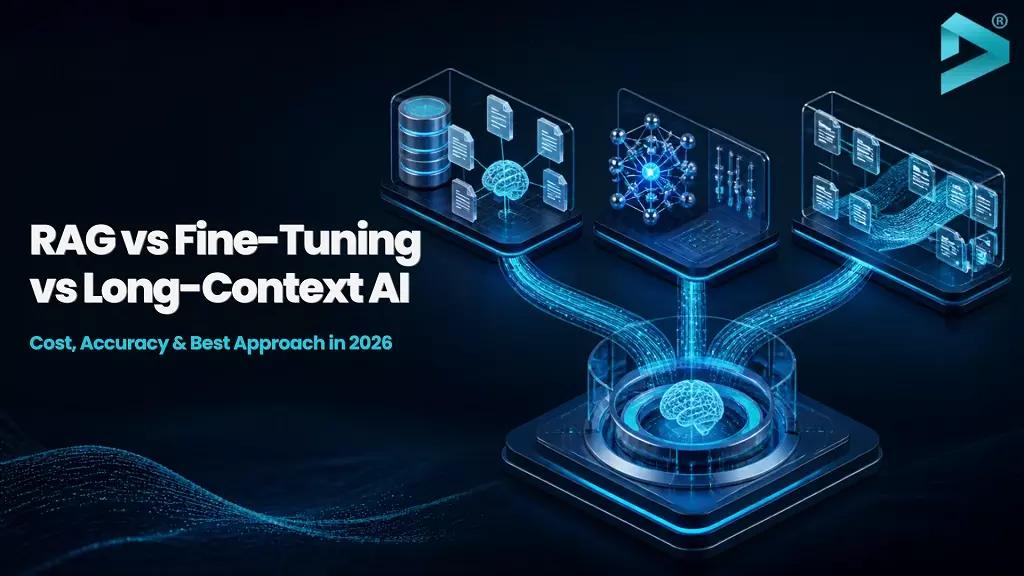
Every CTO building an AI roadmap in 2026 hits the same wall. The pilot works. The demo impresses the board. Then someone asks: how do we keep this accurate when our product catalog changes weekly, and how much is this actually going to cost at scale? Suddenly the architecture decision you made in week one retrieval, fine-tuning, or just stuffing more into the context window is the thing standing between a working prototype and a system nobody trusts.
This tension isn't hypothetical. According to a McKinsey-cited industry analysis, Fortune 500 production deployments of retrieval-augmented generation nearly tripled between 2024 and 2026, yet a large share of enterprise AI initiatives still stall before delivering measurable financial impact.
The gap isn't ambition or model quality. It's architecture picking the wrong one of these three approaches for the problem actually in front of you, then discovering the mismatch after the budget is spent.
Businesses planning production-ready AI systems can explore professional AI development services to select the right architecture, control costs, and scale reliably.
This guide breaks down when to choose retrieval-augmented generation (RAG), fine-tuning, or a long-context model, what each one actually costs once hidden expenses are counted, and how to build a system that stays accurate as your data changes.
RAG vs Fine-Tuning vs Long-Context AI: What’s the Difference?
Retrieval-augmented generation (RAG) is an architecture that fetches relevant information from your own data at the moment a question is asked, then hands that information to the language model as part of its prompt. The model itself never changes. What changes is what it's allowed to read before it answers.
For businesses working with frequently changing knowledge bases, RAG development services can help build retrieval pipelines that deliver relevant, source-grounded answers.
Fine-tuning and long-context prompting solve a related but different problem, and conflating the three is the single most common mistake we see in early-stage AI planning.
RAG vs Fine-Tuning: Knowledge Retrieval vs Model Behavior
Fine-tuning retrains a model's internal weights on a curated set of examples so a new behavior gets baked in permanently a tone, a structured output format, a domain-specific reasoning pattern. It doesn't teach a model new facts so much as new habits. RAG does the opposite: it leaves model behavior untouched and instead widens what the model can see.
If your challenge is "our support bot won't answer in the right format," that's a fine-tuning problem. If your challenge is "our support bot doesn't know about the product we shipped last Tuesday," that's a retrieval problem. A useful shortcut, echoed across recent industry frameworks, is that fine-tuning changes what a model does, and retrieval changes what a model knows.
RAG vs Long-Context AI: Cost, Accuracy and Scalability
Long-context models those that accept hundreds of thousands or even a few million tokens in a single request tempt teams into thinking retrieval is obsolete. Why build a retrieval pipeline when you can just paste the whole knowledge base into the prompt?
The answer is a mix of cost and accuracy. Context windows scale in cost roughly with the square of their length, and Anthropic's Claude models, for instance, charge noticeably more for tokens beyond the standard 200K threshold.
Worse, research on the "lost in the middle" phenomenon has repeatedly shown that models retrieve information from the beginning and end of a long prompt more reliably than information buried in the middle accuracy on mid-context facts can drop by 20–40% compared with facts placed at the edges.
RAG vs Fine-Tuning vs Long-Context: Which AI Architecture Is Best for Your Business?
By mid-2026, enterprise survey data reported by VentureBeat showed a sharp reversal of the "long-context will replace RAG" narrative: interest in long-context-as-primary-architecture collapsed from over 15% of respondents to under 4% within two months, while intent to adopt hybrid retrieval more than tripled. Long-context windows are now best understood as a complement to retrieval a way to feed a retrieved shortlist more generously rather than a wholesale replacement for it.
Read: Generative AI Explained
When Should You Choose RAG for Your Business AI Application?
Not every organization needs the same answer. Here's how to self-diagnose.
1. Your Source Data Changes Weekly, Not Yearly
If your pricing, policies, product specs, or support tickets update on a rolling basis, baking that knowledge into model weights guarantees staleness the day after training completes. RAG lets you swap documents in a vector store without retraining anything.
2. You Need to Cite Sources or Pass an Audit
Regulated industries healthcare, finance, insurance often require an AI system to point at the specific document that justified an answer. Fine-tuned models can't do this; retrieval-based systems can, because the retrieved chunk is visible and attributable.
3. You Want to Swap Base Models Without Starting Over
Locking a large fine-tuning investment to one vendor's model is a real strategic risk given how quickly frontier models change. RAG architectures are largely model-agnostic swap the underlying LLM and your retrieval layer, prompts, and evaluation harness mostly survive intact.
4. Your Team Lacks a Large, Clean Training Set
Effective fine-tuning generally needs somewhere between 500 and 50,000 high-quality examples depending on task complexity. If your organization doesn't have that curated dataset, RAG on top of a strong off-the-shelf model is almost always the faster, cheaper starting point.
5. You're Under 100,000 Queries a Month
Break-even between RAG's higher per-query cost and fine-tuning's higher upfront cost typically lands somewhere between 100K and 1M queries, depending on model size. Below that volume, RAG usually wins on total cost of ownership.
Key Benefits of RAG Development for Enterprise AI
1. Freshness without retraining
Update the underlying documents and the system's answers update immediately no retraining cycle, no model redeployment.
2. Traceable, auditable answers
Because responses are grounded in retrieved chunks, you can show exactly which document informed a given output a requirement in healthcare and financial services deployments in particular.
3. Measurable ROI
Enterprises reporting mature RAG deployments cite average returns in the range of several hundred percent over 18 months, per industry-adoption research, though results vary widely by use case and data quality.
4. Lower hallucination risk on factual queries
Grounding answers in retrieved source material is one of the more reliable defenses against confident-but-wrong outputs, particularly compared with relying on fine-tuning alone to "teach" new facts.
5. Model portability
As frontier models change roughly every few months, a RAG layer decouples your knowledge base from any single vendor's roadmap.
6. Faster time to a working pilot
Because RAG doesn't require a large labeled training set, most teams can stand up a working prototype in weeks rather than the months a fine-tuning-first approach can take.
RAG vs Fine-Tuning vs Long-Context: Features, Limitations and Trade-Offs
RAG's honest trade-off
It introduces real infrastructure a vector database, an embedding pipeline, a reranking layer and someone on your team (often close to a full-time role) needs to keep that index synchronized with source systems. It is not "free" simplicity; it's a different kind of ongoing maintenance than fine-tuning's periodic retraining cycle.
Fine-tuning's honest trade-off
once baked into weights, a fine-tuned model's knowledge is frozen at training time, and a proprietary fine-tune ties you more tightly to a specific base model and training pipeline.
Case in point one production benchmark found a fine-tuned 7B open model reaching meaningfully higher task accuracy than a much larger prompted frontier model, at a fraction of the per-token cost proof that fine-tuning can be a strong choice for narrow, stable, high-volume tasks, but it's a poor fit if your task's requirements shift often.
Long-context's honest trade-off
it's the simplest to implement no retrieval pipeline, no training run but that simplicity comes at a real price. A single request that fills a large context window can cost several dollars in input tokens alone before any output is generated, and the "lost in the middle" effect means paying more doesn't guarantee better recall of the material you actually need answered correctly.
The pattern we see most often in production by 2026 isn't a single winner it's RAG handling dynamic factual grounding, light fine-tuning locking in tone and output schema, and a moderately larger context window giving the retrieved shortlist more room to breathe.
What Team Do You Need for Enterprise RAG Development?
A production-grade retrieval system is rarely a one-person project. Typical roles include:
- A data/ML engineer who owns the ingestion and embedding pipeline the part of the system that keeps your vector store synchronized with source documents.
- An LLM/prompt engineer who designs retrieval prompts, reranking logic, and citation formatting.
- A backend engineer who integrates the retrieval layer with your existing product or support stack.
- A domain expert (often from legal, clinical, or product operations) who validates that retrieved answers are actually correct, not just plausible.
- An evaluation owner who tracks quality metrics over time rather than trusting a one-time demo.
For teams without in-house AI engineering depth, this is typically where custom RAG development through an experienced delivery partner shortens the timeline considerably the roles above can be assembled as an external pod rather than a slow internal hire.
How to Build a Production-Ready RAG Application: Step-by-Step Guide
Phase 1: Scope and Data Audit (Weeks 1–2)
Inventory your candidate data sources documentation, tickets, product specs, policy manuals and assess how clean, duplicated, or contradictory they are. This step alone determines whether your eventual system is trustworthy or a fast way to automate inconsistency at scale.
Phase 2: Build the Retrieval Pipeline (Weeks 3–6)
Stand up an embedding pipeline, choose a vector store (managed or self-hosted), and implement a reranking layer to reorder initial retrieval candidates by deeper relevance. Practitioner benchmarks consistently show hybrid retrieval combining keyword and semantic search outperforming either approach alone by a meaningful margin on real enterprise document sets.
Phase 3: Prompt, Ground, and Cite (Weeks 5–7, overlapping)
Design prompts that instruct the model to answer strictly from retrieved context and to decline or flag when retrieved material is insufficient. This is where most hallucination risk is either controlled or quietly reintroduced.
Phase 4: Evaluate Before You Trust It (Weeks 6–8)
Run a structured evaluation the RAGAS framework, widely used in 2026, decomposes RAG quality into faithfulness, answer relevancy, context precision, and context recall, so a regression can be traced to the retriever, the reranker, or the generator specifically rather than treated as a mystery.
Phase 5: Deploy and Monitor (Ongoing)
Launch to a limited user group first, track the evaluation metrics above in production, and set a cadence for reviewing retrieval quality as your source documents grow and change.
RAG Development Cost in 2026: Pricing, Infrastructure and Hidden Expenses
A production RAG system serving a meaningful daily query volume against a large document corpus commonly runs in the low-to-mid four figures per month all-in vector store hosting, embedding refresh, LLM API calls, and observability tooling, plus an amortized share of the one-time build cost.
Fine-tuning a mid-sized open model, by contrast, can run from a few thousand to tens of thousands of dollars in compute and data preparation, depending on dataset size and model scale often far less than the six-figure number many decision-makers assume, but with a real ongoing retraining cost every time the underlying behavior needs to shift.
Geography materially affects the labor side of these numbers: engineering hours sourced from Eastern Europe or similar nearshore markets typically run at a fraction of U.S. or Western European in-house rates for comparable senior-level RAG and MLOps expertise, which is one reason many growing companies work with an external development partner rather than building the team from scratch.
One honest caveat: cheaper is not automatically worse, and more expensive is not automatically better. A high-cost, poorly scoped fine-tuning project with unclean training data can underperform a modest, well-evaluated RAG pipeline built on clean documents cost and quality are correlated with process discipline, not just budget size.
How to Maintain RAG Accuracy and Performance Over Time
Treat Evaluation as a Living Practice, Not a Launch Gate
Teams that only evaluate quality once, at launch, are consistently the ones surprised by silent regressions six months later when source documents have shifted. Build the RAGAS-style metrics into a recurring review, not a one-time checkbox.
Keep a Named Owner for Data Hygiene
The single most common cause of RAG degradation isn't the model it's conflicting or outdated source documents accumulating in the index. Someone specific needs to own pruning and deduplication on a schedule.
Revisit the Architecture Annually, Not Just the Model
Base models change every few months; the right retrieval-vs-fine-tuning-vs-context-window balance for your use case can shift too, especially as pricing and context-window ceilings change. An annual architecture review, alongside your regular AI agent development roadmap, keeps the system aligned with what's actually available and affordable.
Conclusion: Choosing the Right AI Architecture for Your Business
RAG, fine-tuning, and long-context prompting solve different problems freshness, behavior, and raw context capacity, respectively and the strongest production systems in 2026 rarely pick just one. The real work isn't choosing a side; it's matching the architecture to how often your data changes, how much accuracy and auditability you need, and what you can actually afford to run every month, not just build once.
FAQs About RAG, Fine-Tuning and Long-Context AI
Is RAG always cheaper than fine-tuning?
Not always it depends on query volume. RAG tends to have lower upfront cost but a higher per-query cost, while fine-tuning is the reverse. Below roughly 100,000 queries a month, RAG usually wins on total cost; above that, a well-executed fine-tune can pull ahead.
Can I combine RAG and fine-tuning in the same system?
Yes, and by 2026 this hybrid pattern is the norm rather than the exception in production deployments fine-tuning handles tone and output format, while RAG supplies the current, citable facts.
Do long-context models eliminate the need for RAG?
No. Enterprise sentiment briefly moved this direction in early 2026 before reversing sharply once teams hit the cost and "lost in the middle" accuracy problems that come with stuffing very large contexts into every request.
How much data do I need to fine-tune a model well?
Practical minimums run from around 500–2,000 examples for style and format tuning up to 5,000–50,000 for deeper domain reasoning, with quality mattering far more than raw volume.
Will fine-tuning stop my model from hallucinating?
Not reliably. Fine-tuning shapes behavior, not factual grounding, and fine-tuned models can hallucinate just as confidently as base models. Retrieval with source citation is a more dependable defense against factual errors.
How long does a RAG implementation typically take?
A scoped pilot can often be running in a matter of weeks; a fully evaluated, production-hardened system with proper monitoring more commonly takes six to eight weeks end to end, depending on data cleanliness.
What's the biggest hidden cost in a RAG project?
Usually the ongoing engineering effort to keep the retrieval index synchronized with changing source systems a task that can consume close to a full-time role at scale, separate from the API and hosting bills.
Does a bigger context window mean I need less retrieval work?
Not necessarily. Larger windows can reduce chunking overhead for some use cases, but cost scales sharply with context length, and accuracy on information buried in the middle of a long prompt still degrades retrieval remains the more efficient way to narrow down what the model actually needs to see.
Is fine-tuning riskier from a vendor lock-in perspective?
It can be, particularly with proprietary fine-tuning pipelines tied to one provider. RAG architectures are generally easier to port across base models since the retrieval layer sits outside the model itself.
How do I know which approach is right before committing budget?
A short discovery phase auditing your data, estimating query volume, and running a small proof-of-concept against your actual documents is usually enough to tell whether RAG, fine-tuning, or a hybrid fits before a larger build begins.