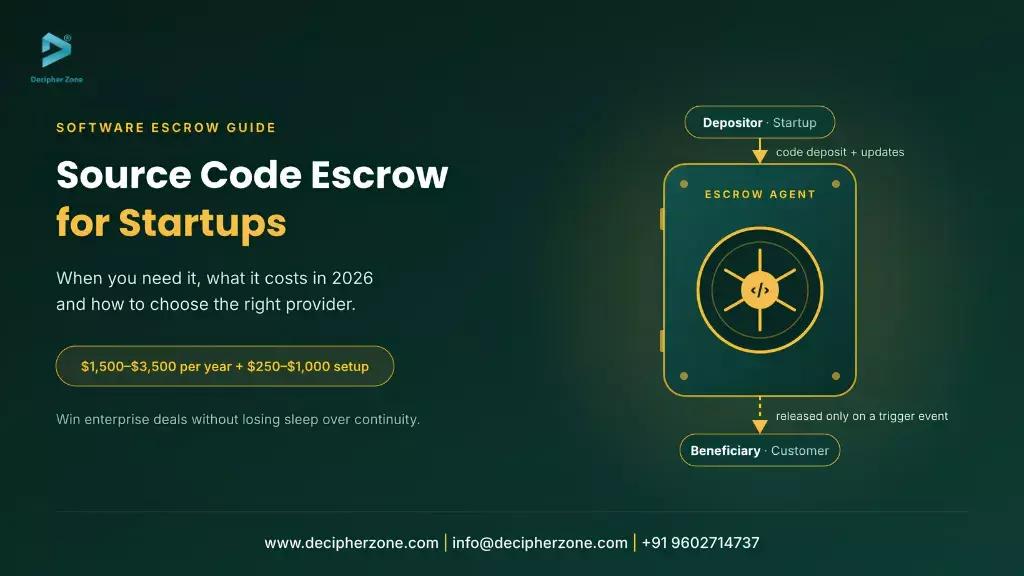
Enterprise deals rarely stall over features; they stall over one question, "What happens to us if the company can't support the software?" This guide explores where escrow wins deals, where it drains budget, what goes into the contract, what it will cost, factors and which provider is right.
The startups carry a risk of insolvency proceedings, whether they buy software or sell it. For example, what if a user left the application because of bankruptcy or failure in payment transactions?
The numbers are not comforting, like,
-
According to the U.S. Bureau of Labor Statistics, only about a third of business establishments born in 2013 were still operating a decade later.
-
65% of large businesses now name third party and supply chain vulnerabilities as their greatest challenge which is up from 54% in 2025, according to the World Economic Forum’s Global Cybersecurity Outlook 2026.
Source code escrow is the contract that closes this gap. Basically, a neutral third party holds your code and it is released to your customer only if you fail them. For founders, it can be the difference between winning an enterprise deal and losing it in procurement.
This guide will walk you through when a startup actually needs escrow, what the cost is, and mistakes to avoid.
What Is Source Code Escrow and How Does It Protect Your Software?
Source code escrow is a legal arrangement in which a software vendor (licensor) deposits its source code with a neutral third party called an escrow agent. This agent holds it securely and releases it only to the customer if a specific event occurs such as the vendor going bankrupt or abandoning support.
Read: Hire Software Developers in 2026
Basically, this is a safety deposit for your software product where the customer gets a guaranteed route to the code if things go wrong. The vendor keeps full ownership and control of its intellectual property as long as the contract continues.
Parties that are involved:
-
Depositor: The software vendor or startup that owns the code and places it in escrow.
-
Beneficiary: Investor or partner who relies on the software and gains conditional access.
-
Escrow agent: The custodian that stores the deposit, verifies it and handles any release.

How Does a Source Code Escrow Agreement Work Step by Step?
Now that you know what source code escrow is, the next question is how it works. This source code escrow agreement is a three-party contract between the depositor, the beneficiary and the escrow agent. Here is the process of how it flows:
1. The parties agree on the terms
The agreement and software license are usually negotiated together, where both parties decide who pays the fees, how often the code is updated and which events count as a trigger for release.
2. The vendor makes the deposit
The vendor delivers a copy to the escrow agent which includes source code for the licensed software, build scripts and compilation instructions, third party libraries and dependency lists, configuration files, database schemas, developer documentation and architecture notes, credentials, keys and environment details.
3. The agent verifies the deposit
This step includes a verification check that what was deposited actually works. This has different levels from basic to a full build test where the agent compiles the code and confirms it runs.
4. The deposit stays updated
The escrow copy should be updated as the software changes constantly. Usually, agreements set a deposit schedule like after each major release or quarterly.
5. A release event occurs
The code stays locked until a trigger defined in the contract happens. The common release conditions can be vendor files for bankruptcy or becomes insolvent, vendor stops supporting or maintaining the software, vendor is acquired and discontinues the product or vendor materially breaches the support or maintenance terms that were set manually.
6. The release process and post release rights
The beneficiary submits a claim to the escrow agent in the event that a trigger occurs. The agent notifies the vendor, who has a short window to dispute the claim. If the claim stands or goes uncontested, the agent releases the deposit.
Many escrow providers connect directly to Git repositories like GitHub, GitLab or Bitbucket and take automated deposits, suiting fast moving startup teams.
Hire Experienced Developers
From MVPs to full-scale solutions, Decipher Zone has delivered 350+ successful custom applications worldwide.
📞 Contact Us Now or 💬 Chat on WhatsApp
When Does a Startup Need Source Code Escrow? 5 Business Situations to Consider
Not every startup needs escrow and if your budget is limited then paying for one you never use is a waste. Here are the situations where a startup needs a source code escrow agreement:
When Software Buyers and Enterprise Customers Require Source Code Escrow
You will hear about it mainly from buyers not from your own roadmap. You can expect the request in these situations:
-
Enterprise procurement: Large buyers run vendor risk reviews and a business with a small team and limited runway can get flagged. Escrow answers the continuity question if it becomes a blocker.
-
Regulated industries: Financial services, insurance, healthcare and government buyers may have vendor exits and continuity requirements.
-
Custom or on premise deployments: When a customer develops operations around your software, they want a guaranteed way to keep it running.
-
Long contracts: A three year contract with a startup feels risky to a buyer as escrow makes the commitment easier to approve.
-
Mission critical use: If your product sits in the customer’s payment flow, logistics or patient data, they will want a fallback.
When Startups Should Request Source Code Escrow From Software Vendors
Startups are on the buying side which is where escrow gets overlooked. These are the situations where you can ask for it:
-
The software is critical: When the vendor disappears, your product or operations stop.
-
The vendor is small or early stage: Limited runway means a higher chance of failure or an acquisition that kills the product.
-
You have customized it heavily: The more software is tailored, the more expensive it is to switch.
-
There is no easy replacement: Niche tools and specialized platforms leave you with few alternatives.
-
You are paying for a licence: You depend entirely on the vendor’s continued existence.
Do Startups Need Source Code Escrow When Hiring an Outsourced Software Development Company?
When an external team builds your product, the question is who controls the repository. Usually the code lives on the client side from day one and the contract assigns the intellectual property to the client. If a development partner holds the only copy, escrow is a sensible safeguard.
Read: White Label Services in 2026

What Should a Source Code Escrow Agreement Include? 10 Essential Clauses
This section covers the area of what source code agreements include. Here are the clauses CTOs and business leaders should check before signing:
-
Parties and their roles: The three parties and the escrow agent's name should be mentioned, stating whether it covers one beneficiary or several, which affects both cost and how customers are added later.
-
Deposit materials: This clause includes what goes into escrow. You need to look for source code, build instructions, dependencies, infrastructure details, documentation and access details.
-
Deposit schedule & updates: The agreement sets how the deposit is refreshed after every major release, quarterly or through automated deposits from a Git repository, whatever the agreement includes.
-
Verification: This clause sets what testing the escrow agent performs on the deposits, including file checks, inventory review and full build test.
-
Release conditions: This clause lists the events that allow the beneficiary to claim the code.
-
Release process: The agreement describes how a claim is made and resolved, for example how the beneficiary submits a release request, how long the vendor has to dispute it, how disputes are resolved and how quickly the agent delivers the deposit after approval.
-
Licence rights after release: This clause allows maintenance, bug fixes and internal use while forbidding resale, sharing with competitors or building a competing product.
-
Confidentiality and security: The agreement sets how the agent stores the deposits, who can access it and what happens to it if the agreement ends. You need to look for encryption, access controls and a clear obligation to keep the material confidential.
-
Fees and responsibility: This clause includes the name of the payer for setup, annual storage, verification, updates and release processing. There is no fixed agreement, some make the vendor pay, some split and some pass it to the beneficiary.
-
Term & termination: This clause defines how long it runs, how it renews and how either side can exit, aligning with software licence terms to avoid any mistakes on paper after the contract has ended.
-
Liability & governing law: The contract sets the limits of each party’s liability, the governing law and the jurisdiction for disputes. This is worth a careful look especially for international deals since insolvency rules differ by country.

How Much Does Source Code Escrow Cost in 2026? Pricing, Setup Fees and Annual Charges
Source code escrow costs $1,500 to $3,500 per year, plus a one time setup fee of $250 to $1,000 for a single application. SaaS escrow, AI escrow and full build verification push that figure higher.
The exact cost depends on how many customers you cover, what you deposit and how the deposit is tested. Here is how the cost breaks down:
-
Setup fee: This is a one-time charge to create the agreement and account. Platforms that are self-service charge around $249 and traditional agents charge around $995.
-
Annual or monthly agent fee: The core recurring fee for storing the deposit and administering the agreement.
-
Verification: The cost is for testing that the deposit is complete and can be rebuilt in a timely. This includes basic checks but full build testing is quoted separately.
-
Extra beneficiaries: Each additional customer on a multi-beneficiary agreement can carry its own cost.
-
Release processing: If the code is ever released it can be charged like one provider lists $199 per hour.
Read: Factors Affecting Software Development Timelines
7 Factors That Affect Source Code Escrow Costs for Startups and Businesses
The cost of source code escrow for business can vary depending on the several factors, including
-
Type of escrow: What you protect is the biggest driver of price such as source code escrow, SaaS escrow, continuity escrow and AI escrow.
-
Number of customers (beneficiary): The customer who relies on the escrow adds costs like single, multi beneficiary or per beneficiary fees.
-
Number of products or applications: Most providers charge based on the number of apps, adding a second product may increase the cost.
-
Level of verification: A simple file check to a full build and deployment test can vary the cost.
-
Deposit size & frequency: Large repositories, excess updates, data backups, and automated Git integrations all increase the cost even if it never appears on the invoice.
-
Billing model & contract length: Monthly billing vs. annual billing, multi year terms and annual-only providers can all affect the cost.
-
Legal customization: Bespoke agreements can add legal review, custom release triggers and multi party terms while the standard template is cheapest.

How to Compare Software Escrow Services and Choose the Right Provider
The escrow agent you pick matters as much as the contract itself, you can use the criteria below with the same discipline you would apply to any critical vendor:
-
Pricing transparency: Some providers publish plans, set up fees and add on costs online.
-
Verification options: With a range of levels, who performs the testing, reports, certifications and re-testing, you need to ask for document proof, verification after major releases etc.
-
Coverage for modern software: If your product includes SaaS, environment escrow, AI escrow, continuity options and third party dependencies, you should check what the providers can actually protect.
-
Deposit automation & integration: You as a client need to look for Git integrations, scheduled syncs, storage limits and clear overage rules.
-
Security & compliance credentials: You need to check their certifications like ISO 27001 and SOC 2, encryption and access control, storage regions and regulatory support.
-
Release process and support: You need to ensure the release process is used only once with a fair and documented route, a quick way to reach the beneficiary after approval and release fees.
-
Track record and stability: The provider needs a client base similar to yours, ownership and financial health, references like case studies or customers in your sector and legal flexibility to adapt templates to your customer's contract.
Prepare Your Software for Source Code Escrow With Decipher Zone
Decipher Zone Technologies builds custom software and AI products for startups and enterprises that deliver continuity without any single question.
-
Full code ownership: your code lives in your own repositories from day one with IP assigned to you in the contract.
-
Handover ready documentation: Architecture notes, build scripts, environment details and deployment steps are delivered with every release.
-
Automated deposits: We set up CI/CD pipelines that make syncing to an escrow platform simple, so deposits never go stale.
-
Rebuildable by design: Containerized and well documented builds make verification smoother and release usable.
-
Support for buyer reviews: We help you prepare technical answers for business procurement teams that ask about continuity.

Is Source Code Escrow Worth the Investment for Your Startup?
Source code escrow is a simple idea with real commercial weight which gives customers a guaranteed way to keep running if your company cannot support them. It also provides a way to remove one of the most common objections in enterprise sales.
Read: 10 High-Demand Jobs in Software Development
The cost is modest compared to the deals it helps close for most startups. This guide offers a few understanding you might know by now which is,
-
The code stays yours unless a defined release event occurs.
-
If you own your code, hold your own repository and no buyer is asking, you may not need it yet.
-
Clear release triggers, complete deposit, regular updates and defined post release rights decide whether escrow works or not.
-
Choose the provider by comparing pricing transparency, verification depth, automation, security credentials and release speed.
Hire Experienced Developers
From MVPs to full-scale solutions, Decipher Zone has delivered 350+ successful custom applications worldwide.
📞 Contact Us Now or 💬 Chat on WhatsApp
Frequently Asked Questions About Source Code Escrow
Does Every Startup Need a Source Code Escrow Agreement?
No, Source code escrow is not necessary but is useful for startups that depend on proprietary software controlled by external vendors. If your company owns its applications, maintains direct repository access, holds the necessary intellectual property rights and can appoint another development team to maintain it.
What Is the Average Source Code Escrow Cost for a Startup in 2026?
Source code escrow costs $1,500 to $3,500 per year, plus a one time setup fee of $250 to $1,000 for a single application. SaaS escrow, AI escrow and full build verification push that figure higher. Some of the factors that influence escrow are setup fee, annual or monthly agent fee, verification cost, extra beneficiaries and release processing fee.
What Happens to Your Software if the Vendor Goes Bankrupt?
If bankruptcy or insolvency is explicitly included as a release condition in the agreement, the beneficiary may request the deposited materials through the agreed procedure. The escrow agent checks the applicable conditions and follows the contract's release and dispute-resolution provisions.
Does a Source Code Escrow Agreement Give You Software Ownership?
No, source code escrow does not automatically transfer intellectual property ownership as it provides conditional access to deposited materials under the terms of the agreement. If any business needs ownership, it must address IP assignment separately through its software development or licensing agreement.
What Files and Documentation Should Be Included in a Source Code Escrow Deposit?
A source code escrow deposit includes full source code, version control history, build instructions, compilers, development tools, object code, libraries, frameworks, dependencies, third party software inventory, database schemas, configuration files, cloud/SaasS specifics, technical and maintenance documentation, access credentials and encryption keys and best practices for escrow deposits such as regular updates and independent verification.