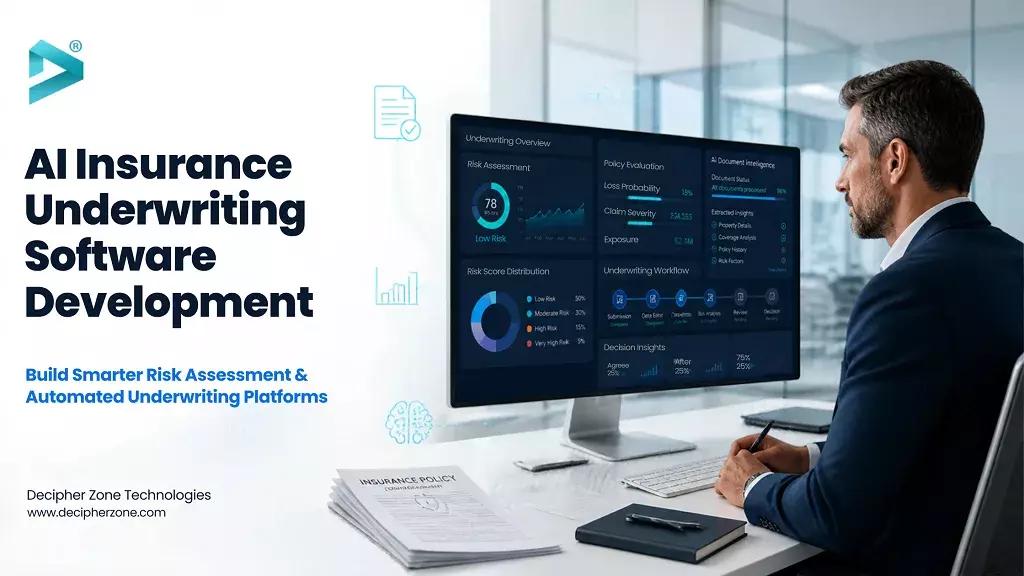
AI insurance underwriting software uses machine learning, natural language processing and workflow automation to analyze insurance applications, assess risks, recommend premiums and support underwriting decisions. It helps insurers reduce manual processing, improve consistency and provide underwriters with faster, explainable recommendations while retaining human oversight.
AI Insurance Underwriting Software Development at a Glance
You often don’t realise that you need the software until it shows how it can help. AI-powered underwriting software solutions can fix slow quotes, manual data entry, inconsistent decisions by reading submission, scoring risk and giving your underwriter clear and explainable recommendations in minutes. This guide gives you the full picture before you invest in it, from meaning and working to features, benefits and costs.
McKinsey reports that AI led transformations in insurance already cut customer onboarding costs by 20% to 40% and lifted agent productivity by 10% to 20%. It also finds that AI leaders have delivered roughly six times the total shareholder returns of laggards.

You must be wondering why this fact is stated, because AI is increasingly used in financial services, especially in insurance underwriting, to improve risk assessment.
Underwriting is where an insurer makes or loses money and it is also where most of the delay lives. If you’re a CTO, CEO or business leader planning to develop or modernize underwriting software, this guide will explore what to build, how the architecture fits together, what it costs and what common mistakes can drain your budget.
What Is AI Insurance Underwriting Software and How Does It Work?
AI based insurance underwriting software is a system that uses machine learning, natural language processing and automation to assess risk, price policies and make or recommend underwriting decisions.
The system keeps the underwriter in control and removes the repetitive work around the decision from reading submissions, pulling in external data, scoring risk against the guidelines and providing underwriters a ranked and explainable recommendation in minutes.
Core Components of an AI Insurance Underwriting Platform
-
Document intelligence: The software extracts and validates information from submissions, applications and supporting documents efficiently.
-
Data enrichment layer: The automated system integrates third party data sources that provide insights from credit reports, property, telematics, medical, geospatial information and public records.
-
Risk scoring & pricing models: Utilizing machine learning models, these models score each risk and suggest a premium that fits within your appetite.
-
Rules & guidelines engine: This component ensures that decisions are aligned with your underwriting manual while adhering to regulatory standards and referral thresholds.
-
Fraud & anomaly detection: It identifies and flags any inconsistent or suspicious information before a policy is bound.
-
Explainability & audit trail: This function documents the rationale behind each decision, fulfilling the expectations of regulators and internal compliance teams.
-
Underwriter workbench: The system provides a unified interface where underwriters can review recommendations, make overrides and add notes.
-
Integration layer: It connects with the policy admin, core insurance systems, CRM and broker portal via APIs.
How Does AI Insurance Underwriting Software Work? A 5-Step Process
This section includes the entire workflow the AI driven underwriting software follows. This process includes collecting the submission, understanding it, scoring the risk, recommending a decision and learning from the outcome. Here’s how each step works in practice:
Step 1 – Capture and Extract Insurance Submission Data
The process begins with software that receives applications and submissions from brokers, agents, portals and email. Then the document reads PDFs, scanned forms and loss runs, then pulls out the key fields, for example, business details, coverage requested, claims history and property or health information.
Step 2 – Enrich Data Using External Information Sources
The next step involves filling the gaps by connecting to external sources through APIs. In this step, the underwriter gets a complete picture without chasing reports manually.
Step 3 – Assess and Score Insurance Risk Using AI Models
The machine learning models in the system compare the risk against historical policy and claims information and the rules engine checks it against your underwriting guidelines and appetite. Then the software produces a risk score, flags fraud signals and suggests a premium range.
Step 4 – Route Applications and Generate Underwriting Recommendations
This step includes the low risk and clear cut cases to be quoted or approved automatically. When complex or borderline cases go to an underwriter through the workbench, the analysis is already prepared as it allows humans to spend time on judgement. Then the underwriter can accept, adjust or override any recommendation.
Step 5 – Monitor Outcomes and Improve AI Models
The process involves decisions, overrides and claims outcomes that feed back into the system. Also, models are monitored and retrained over time to keep the pricing accurate as risk patterns, regulations and market scenarios may keep changing.

Essential Features to Include in Custom AI Insurance Underwriting Software
This section is important for CTOs and business leaders as the right feature set decides the success of the platform. Here is a list of essential features you need to consider before jumping into custom insurance software development.
-
Intelligent document processing: This feature allows the software to read all the submissions that arrive as PDFs, emails, scanned forms and spreadsheets and turn them into structured data. This removes manual re-keying to avoid starting submission delays.
-
Automated submission triage: This feature checks at intake, sorts them before anyone opens the file to allow underwriters to focus on risks they would write and brokers to get quick answers.
-
Risk scoring & predictive models: This feature is the analytical core of the platform which means the machine learning models are trained as per your business history and policy, with line specific models for property, casualty, life, health, cyber and specialty and support for structured and unstructured inputs.
-
Dynamic pricing support: This feature includes premium recommendations, scenario comparison across coverage options and deductibles and controls that stop recommendations from drifting outside approved bands.
-
Third party data integration: This feature includes connectors for various sources, medical and prescription data for life and health lines and reconciliation of external information with your internal records.
-
Configurable rules engine: This feature allows business users to update rules, referral thresholds, appetite without code, hard limits for regulatory and reinsurance limitations and hybrid logic that combines rules and machine learning in one decision flow for faster guideline changes and fewer compliance surprises.
-
Explainability & audit trail: This feature includes plain language reasoning, logs of information sources, model versions, rules applied, overrides, exportable records for audits and regulatory reviews for quick approvals, easier audits and less regulatory risk.
-
Fraud & anomaly detection: This feature flags for inconsistent, duplicated or suspicious information, pattern detection across brokers, applicants and prior submission and referrals to a specialist team for fewer bad risks bound and less leakage downstream.
-
Human-in-the-loop controls: This feature automates in the limits such as what runs straight through, what goes to a person, mandatory review for high-value risks and override tracking that feeds back into model improvement.
-
Integration with core insurance systems: This feature includes APIs, billing, CRM, reinsurance, broker portals, support for legacy core systems and automated generation of quotes, binders and policy documents to no rekeying between systems and a faster path to binding a policy.
-
Model monitoring & continuous learning: This feature provides accuracy that holds up over time and a lower risk of discriminatory outcomes by drift detection, performance dashboards, scheduled retraining, bias and fairness checks.
-
Security and compliance controls: This feature protects sensitive data with role-based access, encryption, data masking, support for GDPR, HIPAA, SOC 2, local insurance regulations and alignment with frameworks.
-
Analytics & reporting: This feature includes dashboards for quote turnaround, hit rate, straight-through rate and loss ratio, underwriter productivity, override trends and portfolio views by line, region and broker for clear ROI tracking.

Business Benefits of AI-Powered Insurance Underwriting Automation
In the insurance industry, underwriting software is a long-term asset that shows speedy, accurate and margin returns. Here are the advantages listed out for business leaders to see how AI powered underwriting software solutions can help their business:
-
Faster quote turnaround: The software helps you read submissions, enrich the data and score the risk in minutes.
-
Lower operating costs: This system allows fewer manual touchpoints per submission, more volume handled without adding headcount and lower cost per policy written.
-
More accurate risk selection: Machine learning models in the underwriting software solutions find patterns across policy, claims and external data that fixed rules miss. The trained model reflects the actual loss experience which leads to better decision making.
-
Consistent, auditable decisions: The software applies your guidelines the same way every time and records the reasoning. This makes less variation between teams and regions, offers a full audit trail of data, rules and model versions and enables easier reviews with regulators and internal compliance.
-
Better use of underwriters: With the insurance software, underwriters can shift their time to where it counts. Routine cases run straight through, complex risks arrive with the analysis already prepared and senior staff can spend more time on judgement, negotiation and portfolio strategy.
-
Built-in fraud & anomaly detection: The software flags and detects patterns across applicants, brokers and prior submissions and avoids leakage from bad risk entering the book.
-
Ability to scale without added complexity: The underwriting platform handles peak periods and new lines of business without a matching rise in cost.
-
Faster response to market & regulatory change: The software allows your team to adapt without a full release cycle as underwriting guidelines, reinsurance terms and regulations change often.

AI Insurance Underwriting Software Development Cost and Pricing Breakdown
The cost of AI driven underwriting software solution development ranges from $10,000 to 250,000 or more, depending on scope, lines of business, data complexity and how many legacy systems it must connect to.
AI Underwriting Software Development Cost by Project Complexity
-
A focused MVP solution: Features include one line of business, document extraction submission triage, basic risk scoring, underwriter workbench and one or two integrations. The cost ranges from $10,000 to $35,000 and development usually takes between 2 and 4 months.
-
Mid-level platform: Features such as multiple products, custom ML models, third party data enrichment, configurable rules engine, explainability layer, core system integration. The cost ranges from $35,000 to $95,000 and development usually takes between 4 and 8 months.
-
Enterprise grade system: Features include multi-line and multi-region support, advanced pricing models, fraud detection, full audit trail, regulatory controls, legacy system integration, monitoring and retraining pipelines. The cost ranges from $95,000 to $250,000 or more and development usually takes between 8 to 16 months.
Key Factors That Affect Insurance Underwriting Software Development Cost
-
Number of insurance lines: Each line, for example property, casualty, life or cyber, needs its own data, guidelines and models.
-
Data quality & availability: Historical or unstructured data adds cleaning and labeling work before any model can be trained.
-
Custom models vs. pre-trained models: Models trained on your own portfolio cost more upfront but perform better on your risks.
-
Legacy system integration: Connecting to older policy admin and core systems is the largest single cost driver.
-
Compliance scope: GDPR, HIPAA, SOC 2, the NAIC AI Model Bulletin and the EU AI Act each add documentation, explainability and testing requirements.
-
Third party data sources: Credit, geospatial, telematics and medical data providers charge licensing or per-call fees.
-
Level of automation: Full straight through processing needs more validation than a recommendation-only system.
-
Team location & structure: Rates differ widely by region as the USA charges $100 to $200, Western Europe charges $80 to $150, Eastern Europe charges $40 to $85 and India charges $8 to $40.
Final Considerations for Building an AI Insurance Underwriting Platform
As we have come to the end of this series on software development. You will have full insight into AI-based underwriting software solutions.
Business leaders and founders who are ahead are the ones who turned AI into working software, with clean data, explainable decisions, tight integration with core systems and underwriters who trust the tools.
Read More – Software Development Planning
How Decipher Zone Technologies Can Help You Develop AI Underwriting Platform
Decipher Zone Technologies is a custom software and AI development company that helps CTOs, CEOs and founders who want software built around their own data, workflows, processes and growth plans.
Our team offers:
-
A discovery phase first: We define scope, data readiness, integrations and success metrics before development begins.
-
End-to-end delivery: Our team develops one connected system including document intelligence, risk scoring models, rules engines, underwriter workbenches and core system integration.
-
Architecture that scales: Our team builds a modular design that lets you add new lines of business, data sources and models without rebuilding.
-
Security & compliance by design: Access controls, audit trails and documentation built to support the regulatory requirements in your markets.
-
Flexible engagement models: Work with a dedicated team or a fixed-scope project depending on what suits your roadmap and budget.
-
Transparent communication: development team, you get clear milestones, regular demos and honest timelines from kickoffs to launch.
If you’re ready to build anything like what we explored in this blog, you can share your requirements or thoughts with us and we will walk you through the right scope, architecture, timeline and cost for your project.

AI Insurance Underwriting Software Development FAQs
What Is AI Insurance Underwriting Software?
AI based insurance underwriting software is a system that uses machine learning, natural language processing and automation to assess risk, price policies and make or recommend underwriting decisions.
How Does AI Improve Insurance Underwriting Accuracy and Efficiency?
AI improves insurance underwriting by processing large volumes of structured and unstructured information more efficiently. Automated workflows can also route applications, identify missing information, and prioritize cases that require human assessment. These capabilities help underwriting professionals make more informed decisions while reducing administrative workloads.
How Much Does AI Insurance Underwriting Software Development Cost?
The cost of AI driven underwriting software solution development ranges from $10,000 to 250,000 or more, depending on scope, lines of business, data quality & availability, custom models vs. pre trained models, legacy system integration, compliance scope, third party data sources, level of automation and team location & structure.
Which AI Technologies Are Used in Insurance Underwriting Platforms?
These are the common AI technologies that are used in insurance underwriting software systems such as machine learning, NLP, OCR, predictive analytics, Generative AI and LLMs and computer vision.
How Long Does It Take to Build AI Insurance Underwriting Software?
A focused MVP may take approximately 2 to 4 months, while a mid-level AI-enabled platform may require 4 to 8 months. Advanced enterprise solutions can take 8 to 16 months or longer, particularly when they involve custom machine learning models, multiple insurance products, extensive integrations, and regulatory validation.