Quick Summary
Most insurance software still runs on decades-old systems built before claims, underwriting and fraud detection could be handled by AI agents instead of a human moving between five different screens. This guide let you explore what InsurTech software development actually covers, where AI agents are already working inside claims, underwriting and fraud detection, what a realistic build costs at each stage, the mistakes that sink most insurance software projects, and what to look for in a development partner before you sign anything.
Paper heavy underwriting, claims adjusters buried in PDFs and pricing that reacts to risk months after it has already changed, from decades insurance has run on the same operating model.
Mckinsey estimates that generative AI alone could add $50 billion to $70 billion in new insurance industry revenue, with the largest gains showing up in customer operations, sales and the software engineering work behind the scenes.
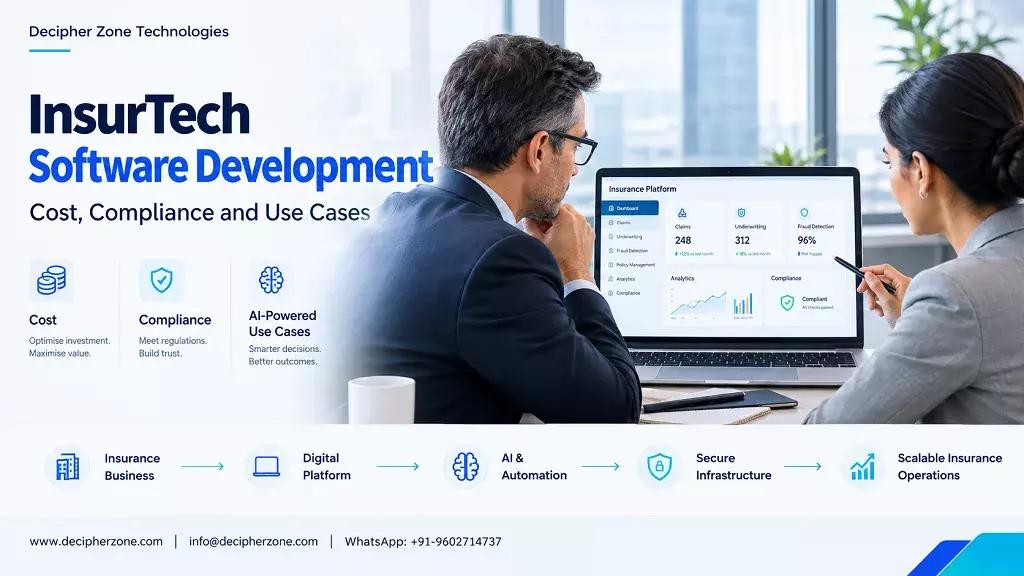
Modern insurance technology combines cloud computing, artificial intelligence, machine learning, automation, APIs, analytics, mobile applications and secure data infrastructure to redesign how insurance products are created, sold, managed and serviced.
The real question is how to do it without overspending, missing a compliance requirement or ending up with a vendor who cannot tell the difference between a policy administration system and a plain CRM.
This blog will walk you through what insurtech aka insurance software development actually involves, where AI agents are already changing claims, underwriting and fraud detection and much more.
Read: Must Have Software Developer Skills
What is Insurance (InsurTech) Software Development?
Insurance (InsurTech) software development is the process of building or customizing digital products that improve one or more parts of the insurance value chain. This may include customer dealing applications for buying policies, internal platforms for underwriting and claims, broker management systems, policy administration software, fraud detection engines, AI based risk assessment platforms, insurance marketplaces or complete digital insurance ecosystems.
Here, each software system plays an individual role of handling different parts of the insurance process. Insurance runs on actuarial math that has to be provably correct.
AI Agents in Insurance: Claims, Underwriting and Fraud Detection Use Cases
AI agents in insurance are multi step tasks that used to require a human moving between systems (pulling the claim, checking the policy, cross reference the repair estimate, flagging the anomaly, drafting the note) and running that entire sequence itself using the tools and data sources it needs in the process.

There’s a difference between traditional and agent systems like, a model insurers have had for a decade and the agent based systems now showing up in claims, underwriting and fraud workflows.
AI Agent in Insurance Software Development: Claims
A claims agent pulls the policy details, checks coverage against the reported loss, cross references the claim against repair estimates or medical codes and either routes it for straight through settlement if it’s clean and low value or escalates it to a human adjuster with a summary of what it found and why it flagged it.
Mainly for P&C insurers, this system is usually where the fastest ROI shows up, because a larger share of claims volume is simple and doesn’t need a human in the loop for every step, just for the decisions that actually carry risk.
Underwriting
An AI agent handles submission intake and appetite matching before a human underwriter ever sees the file in underwriting. It identifies and reads an incoming submission, retrieves third party information such as property records, driving history, financial filings, depending on the line of business, checks it against the carrier’s risk appetite and either declines it outright, routes it to the right underwriter with the relevant data or flags it as a straightforward risk that can move through faster.
This entire process here is not replacing underwriting judgement. It is actually removing the hours underwriters currently spend assembling data before they can apply that judgement.
Read: Adaptive Software Development Explained
Fraud Detection
Agents in the fraud detection process earn the most attention because fraud is not just a single signal but a pattern across claims, claimants, providers and time. AI agents can hold that pattern in view in a way a single fraud score cannot such as cross referencing a claim against prior claims form the same claimant, checking whether a repair shop or medical provider shows up disproportionately in flagged claims and building a case file with its reasoning attached instead of just returning a number.
The claims, underwriting and fraud agents that are actually in production today are built with a human checkpoint at the decision that carries financial or regulatory weight with the agent handling the assembly, cross referencing and routing work around that decision.
The version that’s realistic to build is an agent scoped to a specific workflow, with clear handoff points to a human instead of asking to run an entire claims department on its own.
How Much Does InsurTech Software Development Cost?
The cost of developing insurance (InsurTech) software solutions can range from $25,000 for a focused MVP to $300,000 for a complex enterprise level platform. Since there is no universal price tag, insurance software can mean very different from each other such as digital policy management portal, AI driven underwriting platform connected with legacy insurance systems, third party data providers, payment gateways, claims systems and regulatory workflows.

A useful way to estimate the investment is to look at the project’s complexity, number of user roles, third party and API integrations, automation requirements, security architecture, AI capabilities and compliance needs.
The estimated insurance (InsurTech) software development cost by the type are:
-
A basic insurance MVP cost with customer portal, policy information and basic claims submission can range from $25,000 to $80,000.
-
A mid level InsurTech platform with policy management, claims workflows, dashboards, APIs and multiple user roles can cost $80,000- $120,000.
-
An AI driven insurance platform with AI underwriting, document processing, fraud detection and analytics can cost $120,000- $150,000.
-
An enterprise insurance platform cost with multiple insurance products, legacy integrations, advanced security, compliance and automation can range from $150,000- $300,000 or more depending on the particular requirements.
The final cost depends heavily on project scope, technology choices, development location, integrations, AI requirements, compliance obligations and whether the project is being built from scratch or modernized from an existing system.
7 Red Flags You Need to Avoid While Insurance Software Development
While developing InsurTech software, you require more than building features as this platform handles sensitive customer information, financial records, policy information, claims and increasingly AI driven decisions, making security, compliance, data quality and system reliability critical from the beginning.
Read: Nearshore Software Development
Here are the signs you need to look for before you sign:
1. Treating Insurance Software like Generic Enterprise Software
Applications built are for industry specific workflows, rules, data structure and regulatory standards. If an Insurance platform is treated as a standard CRM or ecommerce application, it can result in missing underwriting logic, inadequate claims workflows, weak auditability and poor compliance readiness.
2. Ignoring Insurance Compliance During Development
Insurance software development needs to consider applicable privacy, security, consumer protection, data handling and AI based requirements during the development process. Compliance expectations around technology and AI continue to evolve, helping compliance by design a crucial part of InsurTech development.
3. Weak Data Security & Privacy Controls
NAIC specifically identifies cybersecurity and protection of sensitive consumer data as major concerns for the insurance sector as inadequate encryption, authentication, access control, audit logging or data protection can expose both customers and insurers to security risks.
4. Building AI Without Governance & Human Oversight
Without proper governance, AI can create inaccurate, biased or difficult to explain results. AI driven insurance software should include appropriate validation, monitoring, documentation, explainability and human oversight when AI influences crucial insurance decisions.
5. Underestimating Legacy System integration
Designing new insurance software without considering APIs, data migration, interoperability and legacy integration can create a platform that works perfectly independently but cannot communicate with existing systems. As many insurers still depend on legacy systems and older technology environments it can be difficult to combine both after developing a new one.
6. Building a Monolithic & Difficult to Sale Architecture
Make sure that the insurance platform you are building isn’t rigid as it may begin with a limited number of users and workflows but need to support more policies, claims, products, integrations and geographic markets in future. By modular services, well-designed APIs, scalable cloud infrastructure and clear separation of business logic, you can make insurance software easier to extend.
7. Choosing a Development Partner Without Insurance Technology Experience
A software development partner can be technically strong but still lack an understanding of insurance workflows and regulatory considerations. While choosing one, make sure to evaluate experience with InsurTech, secure data architecture, API integrations, AI systems, cloud infrastructure, compliance requirements and enterprise software development.
Partner with an Insurance Software Development Company
Insurance software development requires a combination of industry understanding, secure engineering, regulatory awareness, data management, AI capabilities and integration expertise.
The right development company can help you move from an idea to a production ready platform while considering scalability, security, integration and future expansion.

Why Choose Decipher Zone for Insurance Software Development
Decipher Zone Technologies brings software engineering, AI development, cloud technologies and digital product development capabilities together to help businesses build and modernize technology solutions.
-
Build Custom Insurance Software: Our team can help you develop custom insurance software around your specific business model.
-
Develop AI driven InsurTech Solutions: Engineers at DZ can integrate AI, machine learning, generative AI, OCR, document intelligence, predictive analytics and intelligent automation into insurance applications where they provide business value.
-
Modernize Legacy Insurance Systems: We will help you connect legacy insurance systems with modern web applications, mobile platforms, APIs, cloud services, data platforms and AI capabilities.
-
Build Secure & Scalable Insurance Platforms: Our development approach can include secure APIs, role based access control, authentication, encryption, audit trails, cloud security, data protection and testing into the software architecture.
-
Integrate Insurance Software with Tools You Use: Our team develops and integrates APIs for systems that help create a connected technology ecosystem.
-
From MVP to Enterprise Insurance Software: Decipher Zone can help businesses start focused MVP, validate the concept and introduce advanced capabilities, helping to control initial development cost while creating a technical foundation for future expansion.
Final Thoughts about InsurTech Software Development
Insurance software development is no longer digitalizing policies or moving existing workflows online. It's the process of how insurers approach underwriting, claims processing, fraud detection, customer service, risk assessment and policy management.
You need a development vendor that instead of adding more advanced features focus on security, regulatory compliance, data quality, legacy system integration, AI governance, scalability and user experience from the beginning.
Read: Top 10 High-Demand Jobs in Software Development
Whether you are planning a $25,000 InsurTech MVP or a $300,000+ enterprise insurance platform, the right development strategy can help control cost while creating a strong foundation for future growth.
Why Work With the Decipher Zone Technologies Team
You need a team that cna understand the business problem, challenge unclear requirements, make appropriate technology decisions and develop software that cna evolve.
We offer all this and support complex technology initiatives. Our team can help with:
-
Custom Insurance Software Development
-
InsurTech MVP Development
-
AI-Powered Insurance Solutions
-
Insurance Claims Software
-
Policy Management Platforms
-
Insurance Customer Portals
-
Underwriting Automation
-
Insurance Data & Analytics
-
Legacy System Modernization
-
API & Third-Party Integrations
-
Cloud-Based Insurance Applications
-
Ongoing Software Maintenance & Enhancement.
Partner with DZ to turn your insurance software requirements into a secure, scalable and technology ready solution from the first architecture discussion to production and beyond.
FAQs About InsurTech Software Development
-
How much does it cost to develop InsurTech software?
InsurTech software development cost ranges from $25,000 to $300,000 or more depending on complexity, number of user roles, third party and API integrations, automation requirements, security architecture, AI capabilities and compliance needs.
-
What are the most common InsurTech software use cases?
The most common InsurTech software use cases are policy administration, claims management, underwriting automation and fraud detection. Other use cases that are not so common include broker and agent portals, customer self service apps, telematics based pricing and embedded insurance APIs sold through third party platforms at checkout.
-
How is AI used in insurance software?
With AI in insurance software, it can automate claims triage, underwriting submission intake and fraud detection through pattern recognition across claims and claimants. AI agents can assemble and route data to a human at the point where a decision carries financial or regulatory weight.
-
What are the top InsurTech software development companies?
The top InsurTech software development companies ar ethe ones with proven insurance domain experience, compliance knowledge, legacy system integration and AI agent development capabilities. Decipher Zone is one such company, offering transparent pricing and AI agent expertise.
-
How to choose InsurTech software development firms in the US?
Choose an InsurTech software development company by evaluating their industry- specific experience, compliance and data security track record, AI agent capabilities, legacy system integration history, transparent pricing, clear IP ownership policy and case studies specific to insurance.
About the Author: Mahipal Nehra manages content at Decipher Zone Technologies and works closely with the AI engineering team across live project delivery. He has spent the last six years documenting real AI and software development projects cost structures, architecture decisions, client outcomes for an audience of CTOs, product leads, and engineering managers. Follow on LinkedIn.
AI Development Services | Generative AI Development | AI Agent Development | Custom AI Solutions | AI Chatbot Development | Machine Learning Solutions | Data Analytics Solutions | Business Intelligence Applications | MLOps Services | AI Consulting | Custom Software Development | Web App Development | Mobile App Development | SaaS Development | E-commerce Development | Enterprise Software Development | Cloud Application Development | UI/UX Design | Full Stack Developers | Product Engineering | Software Modernization | API Development | QA & Support