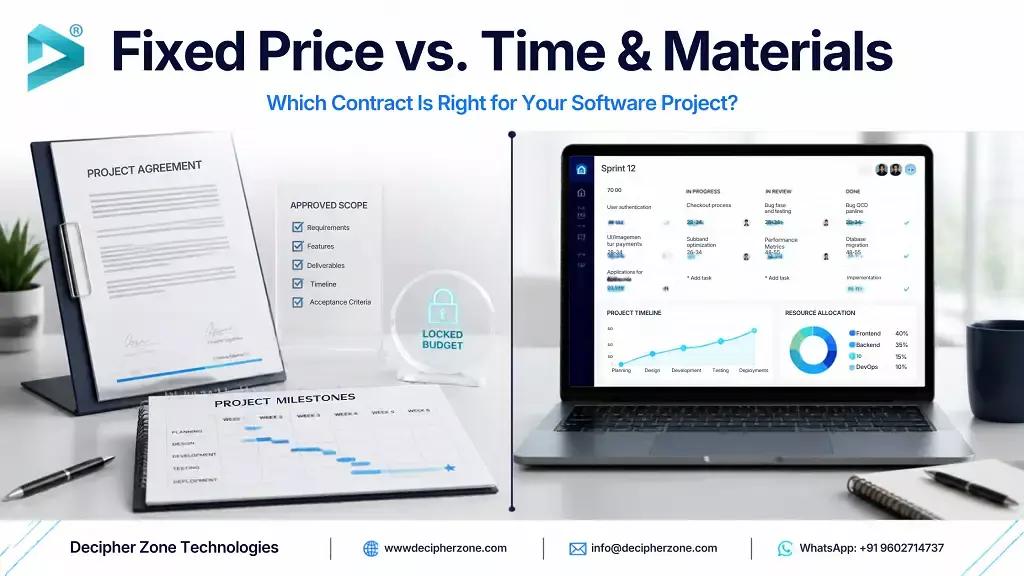
Comparison Between Fixed Price and Time and Material, how each model works, how they compare, checklists and what to include in a software contract before you sign. The wrong engagement/ contract model is the best way to blow a software budget. This article will help you choose the right contract or engagement model for your project.
You can see your software project derail even with a talented team, a clear vision and a healthy budget. You might be thinking what the reason will be: the contract model.
Businesses are leaning on offshore development partners more nowadays. Statista projects the global IT outsourcing market to reach $618.36 billion in 2026. The data on how software projects actually end is sobering.
Looking more into the statistics:
-
The large IT projects run 45% over budget on average while delivering 56% less value than predicted, according to McKinsey and the University of Oxford.
-
Harvard Business Review research found that one in six IT projects becomes a “black swan,” which is basically an unpredictable occurrence, with an average cost overrun of 200%.
If we trace every overrun back, it usually comes to the same things: unclear scope, shifting requirements and a pricing structure that did not match how the project would really unfold.
Read: Software Development Approach in 2026
Comparison Between Fixed Price and Time and Material Contracts
This is why we are having this Fixed Price vs. Time and Material debate. Explore everything as we unfold each in detail. This guide will walk you through both models meaning, work, where each one pays off and backfires and how to pick the right one for your software product.
What Is a Fixed Price Contract in Software Development?
A fixed price software development contract is an agreement where the client and the software development partner agree on the project scope, timeline and cost before any work begins. The development vendor delivers the defined software product for that set amount regardless of the hours spent.
In case the partner requires more time than planned, the headache of extra effort is on the partner.
How Does a Fixed Price Software Development Contract Work?
Usually there is a basic flow tha fixed price engagement follows:
-
Requirements are documented upfront: a document is created including clear scope, wireframes and technical specifications.
-
The vendor quotes a single price: The price quoted involves development effort, testing, project management and a built-in buffer for unknowns.
-
Payments are tied to milestones: The client is charged at agreed stages like design sign-off, a working prototype and final delivery.
-
Changes go through a formal process: Any change that is outside of the document is handled through a change request which basically includes review, pricing and approval separately.
What Is a Time and Materials (T&M) Contract in Software Development?
A Time and Materials (T&M) contract is an agreement between the client and the software vendor where the client pays for the actual work done instead of a fixed price. The billing in this contract is for the hours or days the development team spends on the project including direct costs like licenses, third-party tools or infrastructure.
How Does the Time and Materials Pricing Model Work?
Usually, this contract follows a simple rhythm:
-
A rate card is agreed upfront: Each role on a development team like developer, designer, QA engineer or project manager has a fixed hourly or monthly rate.
-
The team starts with a working estimate: This offers a rough estimate for both sides of the project to plan around.
-
Work happens in short cycles: Development teams use 2-3 week sprints with a demo at the end of each one to keep transparency so you can see the real progress.
-
Billing follows actual effort: Billing follows a different method like invoices being sent monthly with timesheets or sprint reports showcasing who worked on what.
-
Priorities can change at any time: The client is able to add, drop or reorder features between sprints without renegotiating the contract.

Fixed Price vs Time and Materials: Side-by-Side Comparison
Both models can deliver high quality, top notch products. The only difference is where they place risk, control and flexibility. We have listed a comparison of the factors that matter the most:
Fixed Price vs Time and Materials: Budget Predictability
-
Fixed Price: As you know the total cost is set before work starts, so you can make approvals, board reporting and cash flow planning simple.
-
Time and Materials: The final cost depends on the effort the project actually needs, so you need to track the budget as you go.
Read: Adaptive Software Development Explained
Scope Changes and Project Flexibility
-
Fixed Price: There is no flexibility in this contract, any new scope goes through a change request, requiring a new estimate, new approval and often a delay.
-
Time and Materials: This contract offers flexibility to add, drop or reprioritize features between sprints without renegotiating the contract.
Upfront Requirements and Scope Planning
-
Fixed Price: This flow often requires detailed project constraints, wireframes and acceptance criteria.
-
Time and Materials: You can begin with a clear objective and prioritize the backlog then refine the details as the product takes shape.
Who Bears the Financial and Delivery Risks?
-
Fixed Price: The vendor carries most of the delivery and estimate risk and prices a contingency buffer into the quote to cover it.
-
Time and Materials: The client carries more of the budget risk but they can avoid paying a buffer for risks that never happen.
Project Timelines, Milestones and Delivery Control
-
Fixed Price: Handover dates are set per milestone but the client is unable to see work in between.
-
Time and Materials: Short sprints with regular demos keep clients updated with working products to review every two to three weeks or so.
Client Involvement and Project Transparency
-
Fixed Price: The clients are very much involved in the beginning to define the scope and have light involvement in milestones for review.
-
Time and Materials: The client is steadily involved throughout the development process to set priorities, review demos and approve spend.
Software Quality, Accountability and Vendor Incentives
-
Fixed Price: The price is set for the vendor whether the project takes 800 hours or 1200 hours. The pressure can lead to corners being cut as the
-
Time and Materials: The client needs transparent reporting and sprint reviews to confirm that hours are turning into real progress.
Fixed Milestone Payments vs Hourly or Sprint-Based Billing
-
Fixed Price: Payments are tied and only released as per the achieved milestones like design approval, beta release and final delivery.
-
Time and Materials: Billing goes monthly or per sprint based on timesheets and the agreed rate card.
Fixed Price vs Time and Materials Comparison Table
|
Factor |
Fixed Price Contract |
Time and Material Contract |
|
Budget |
Set in the beginning |
Estimated and billed monthly or per sprint |
|
Scope |
Locked at signing |
Evolves sprint by sprint |
|
Changes |
Issue change requests |
Handled in the normal flow |
|
Upfront planning |
Extensive |
Light to moderate as it offers flexibility to change |
|
Budget risk |
Mostly vendors carry it |
Mostly the client carries it |
|
Visibility |
Milestone based |
Continuous via sprints and reports/ demos |
|
Client involvement |
Mainly in the beginning |
Ongoing |
|
Payment |
Milestone payments |
Monthly or per sprint |
|
Best for |
Well defined or stable projects |
Evolving, complex or long term projects. |
When Should You Choose a Fixed Price Contract for Software Development?
Now that you know what both contracts mean, but when you should opt for each. If your project clearly defines two different development vendors and they quote roughly the same. This might be it. Here are examples of situations where it works best:
-
Your scope is clearly defined & unlikely to change: When you approve wireframes, a written feature list and agreed acceptance criteria, the vendor can price the work accurately.
-
You have a firm budget ceiling: When the budget is approved by the board, investor or finance team and cannot stretch, a fixed price contract will be the ideal engagement strategy.
-
The project is small to mid sized: If the work is estimated for shorter projects as they have less room for requirements to drift, the estimate stays reliable from start to finish.
-
The technology and approach are well understood: if the development team has built something similar before then estimates are accurate and surprises are rare. Choosing a fixed price can be much less risky.
-
You have a hard deadline: Fixed price can commit the vendor to delivery dates when a launch date is tied to an event, a regulation or a funding milestone.

When Is a Time and Materials Contract Better for Software Development?
That was all about the fixed price contract. A time and materials contract is the right call when you know where you want to go but don’t know every step of the route. Here are the situations where it works best:
-
Your requirements are likely to change: When you are still learning what users want or the market is moving while you build, this contract allows you to adjust priorities between sprints without renegotiating anything.
-
The project is large, complex or long term: Big platforms are hard to estimate accurately upfront, with time and materials, you can break the work into sprints to budget the project down to what you truly need.
-
You need to start fast: When you want to start with a clear goal and a prioritized backlog, when speed matters more than perfect specification then model gets you moving sooner.
-
The work involves experimentation: Technologies like AI, machine learning and data projects involve trial and errors, moreover model performance, data quality and integration are challenges that are hard to price. T&M contracts can allow team tests, learn and change direction without absorbing the cost of an estimate.
-
You want control over the software product: With T&M you have transparency of work including sprint demos, backlog reviews and priority calls. You can easily steer the software product actively instead of handing over a specification and waiting for the result.
-
You want ongoing development and support: A steady development team is required to maintain, add new features, test performance and update security. This T&M engagement works well.
Read: Nearshore Software Development
Software Development Contract Checklist: 11 Essential Clauses Before You Sign
Till now, I assume that you know which engagement model to choose for your software product. What happens is the contract is what protects you when plans change, people disagree or something goes wrong.
What you need is a strong software development agreement which should include specific details like:
1. Scope of work & deliverables
Include what exactly the vendor will build such as feature list, statement of work with clear boundaries, technical specifications, platform, integrations, list of deliverables (source code, documentation, design, test reports) and an explicit “out of scope” section.
2. Timeline & milestones
Include when things happen, specific date ranges such as start date, target launch date, phase or sprint schedule, milestone dates with specific deliverables and what happens if a deadline is missed and who is responsible.
3. Pricing and payment terms
Include total cost, milestone amounts and payment triggers if you choose a fixed price and a rate card by role, billing cycle, timesheet format and a clear budget cap or not to exceed limit if you choose time and materials. Also include invoice due dates, accepted payment method, third party costs (licenses, cloud hosting, tools), currency, taxes and any late payment terms.
4. Acceptance criteria and testing
Include measurable criteria to approve each deliverable, a review period, a process for reporting defects, how quickly they will be fixed and what happens when a deliverable is rejected.
5. Change management
Include the process of change requests that are raised, reviewed and approved, how changes affect cost and timeline and who has authority to approve changes on each side.
6. Intellectual Property Ownership
nclude ownership of all code, design, documentation transfers, treatment of the vendor’ pre-existing tools, frameworks, libraries, open source components, their license terms and to whom handover of source code, repositories and credentials at project end.
7. Confidentiality and data security
Include confidentiality clause or separate NDA, data handling, security standards the vendor must follow, compliance with regulations (such as GDPR, HIPAA, SOC 2) and what happens to the data and access credential after the project ends.
8. Warranty & post launch support
Cover the warranty window where defects are fixed at no extra cost, terms for ongoing maintenance and support, response and resolution times for critical issues and what counts as a bug versus a new feature request.
9. Team and communication
Include named roles, expected team size, rules for replacing team members, handing over knowledge, communication channel, meeting cadence, reporting format, single point of contact on each side and time zone overlap working hours.
10. Termination and exit
include notice period for ending the contract, conditions for termination, payment for work completed up to the termination date, handover of all work in progress and transition support in case you plan to move to another development team.
11. Liability and dispute resolution
This section includes limits on liability and indemnification terms, a process for escalating disagreements before they become legal disputes, governing law and jurisdiction and preferred resolution methods like mediation or arbitration.

Fixed Price or Time and Materials: Which Contract Model Should You Choose?
The debate continues as there is no single winner. The right model is the one that matches your project. The verdict is,
-
Choose Fixed price model when your scope is clear, your budget is firm and the software product you want is predictable.
-
Choose a Time and Materials model when you know requirements will evolve, the project is complex or you want to keep building after launch.
The contract and the partner matter as much as the pricing model. For a good estimate you require a clear scope, acceptance criteria, change management, IP ownership and reporting.
Get a Custom Software Development Cost Estimate from Decipher Zone
Decipher Zone Technologies has over 11 years of experience in building custom software and AI solutions for businesses that want technology working for them. Our team works with the model that suits your project.
We offer MVPs starting from $10,000 in fixed price engagements, including a well defined scope. Developers start at $8 per hour or $1200 monthly in time and materials and dedicated teams and hybrid engagement models that begin with a scoped discovery phase and move into sprint based development.
Read: Hiring Remote Developers from India
If you’re still not sure which model fits your project, you do not have to decide alone. Our team will review your idea, scope and budget to recommend the contract structure that lowers your risk and gets you to launch faster.
Get a free consultation with our experts at Decipher Zone Technology and get tailored estimates.
FAQs About Fixed Price vs Time and Materials Contracts
-
What Is the Main Difference Between Fixed Price and Time and Materials Contracts?
A fixed-price contract sets the total cost, scope and timeline before work begins, so you pay one agreed amount no matter how many hours the project takes. A time and materials contract bills you for the actual hours worked plus direct costs, so the final cost depends on the effort the project needs.
-
Is Fixed Price or Time and Materials Better for Software Development?
Fixed price is better when the scope is clearly defined, the budget is firm and requirements will not change. The time and materials model is better when requirements are evolving, the project is complex or you plan to keep developing after launch. The best choice depends on how well you can define the work upfront.
-
When Should a Business Choose a Fixed Price Software Development Contract?
Choose a fixed-price contract when you have documented requirements, approved designs and a firm budget. It works best for small to mid-sized projects such as MVPs, website redesigns, single integrations, migrations and proofs of concept.
-
When Should You Choose a Time and Materials Contract?
Choose a time and materials contract when requirements are likely to change, the project is large or complex, or you need to start before every detail is documented. It also suits AI and data projects with experimentation, and long-term product development with ongoing releases and support.
-
How Much Does Software Development Cost Under Fixed Price vs Time and Materials?
Cost depends on scope, complexity, technology and team size. With fixed price, you receive a single quote after scope definition, and MVP builds at Decipher Zone start from $10,000. With time and materials, you pay a rate per role, and dedicated developers start at $8 per hour, or roughly $1,200 per month. The exact figure for your project depends on features and timeline.