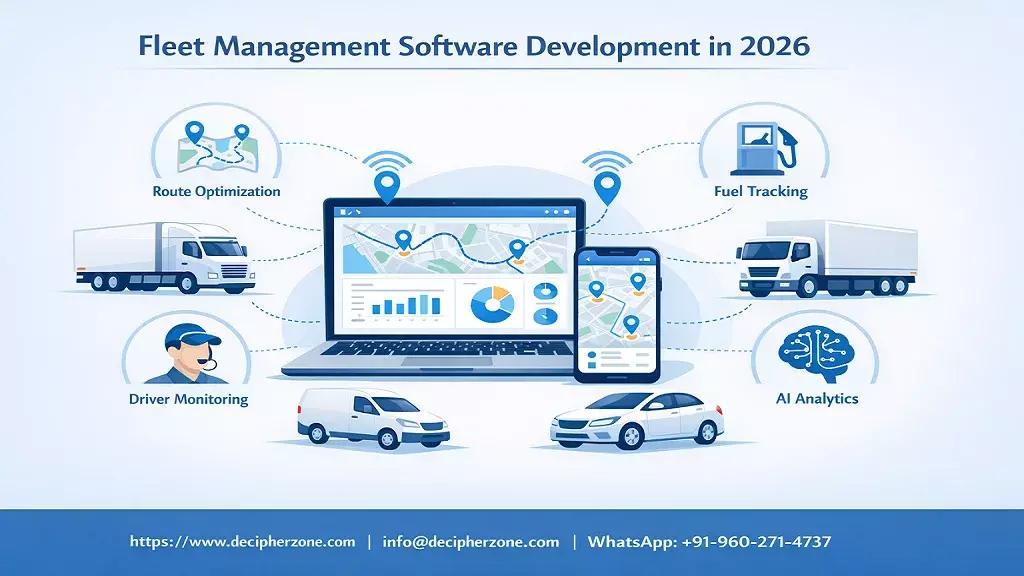
Fleet management software development involves building a custom digital platform that centralizes GPS tracking, route optimization, driver behavior monitoring, fuel management, predictive vehicle maintenance, ELD compliance, and real-time dispatch into a single system.
In 2026, custom fleet management software development costs range from $35,000 for a basic GPS tracking platform to $250,000 or more for a full enterprise operations platform with AI-powered analytics and telematics integrations.
The global fleet management software market is projected to reach $52.4 billion by 2030, growing at a CAGR of over 15%, driven by fuel cost pressure, ELD mandate enforcement, and the shift toward AI-assisted fleet operations.
What this guide covers: what fleet management software does and who needs it, custom vs SaaS vs white-label comparison, complete feature list by tier, development cost breakdown by complexity, tech stack, development timeline, team composition, US compliance requirements, AI and IoT integration, monetization models, and 8 FAQ answers for featured snippets.
Managing a fleet in 2026 on spreadsheets and phone calls is not a resource problem. It is a decision problem. Every hour of driver downtime, every unauthorized route deviation, every missed preventive maintenance window, and every fuel theft that goes undetected represents a decision made without data. Fleet management software development solves this by turning vehicle and driver data into actionable operational intelligence.
For logistics companies, transportation operators, construction firms, utilities, and any business running 10 or more vehicles, the economics are clear. McKinsey research shows that GPS fleet tracking alone reduces fuel costs by 10 to 15% and increases on-time delivery rates by 20 to 25%. For a company running 50 vehicles, that is a measurable return in year one.
Read: Logistics Management System Development | Transportation and Logistics Software Development | Supply Chain Management Software
What Is Fleet Management Software?
Fleet management software is an integrated platform that gives fleet operators real-time visibility and control over their vehicles, drivers, routes, fuel consumption, maintenance schedules, and regulatory compliance from a single interface. It connects GPS and IoT sensors in vehicles to a web dashboard and mobile app that dispatchers, fleet managers, and drivers use throughout the workday.

The scope of what fleet management software covers has expanded considerably in 2026. Modern platforms do not just track vehicle location. They monitor driver behavior in real time, predict mechanical failures before they cause breakdowns, optimize multi-stop routes dynamically as conditions change, and generate compliance documentation for regulatory audits automatically.
Industries that depend on fleet management software include long-haul trucking and logistics, last-mile delivery, public transit, construction and heavy equipment, utilities and field service, emergency services, and passenger transport. Any operation where vehicles are revenue-generating assets, and where vehicle downtime or inefficiency has a measurable business cost, is a candidate for a dedicated fleet management platform.
Custom Fleet Management Software vs SaaS vs White-Label
This is the first decision every company faces. The answer determines your cost structure, feature flexibility, data ownership, and total cost of ownership over five years.
| Factor | SaaS Platform | White-Label Solution | Custom Development |
|---|---|---|---|
| Upfront cost | Low ($0 to $500 setup) | Medium ($15K to $50K) | High ($35K to $400K+) |
| Ongoing cost | $25 to $45 per vehicle per month | $8 to $20 per vehicle per month | 15 to 20% of build cost annually |
| 5-year TCO (50 vehicles) | $75K to $135K | $50K to $95K | $70K to $130K (breaks even at year 3) |
| Feature flexibility | Limited to vendor roadmap | Moderate, within template | Unlimited, built for your workflow |
| Data ownership | Vendor owns data | Partial ownership | Full ownership |
| Integration capability | Limited to vendor APIs | Moderate | Full ERP, TMS, telematics, and custom integrations |
| Time to launch | Days | 4 to 8 weeks | 3 to 9 months |
| Best for | Fleets under 25 vehicles testing software | Fleets wanting a branded solution quickly | Enterprises with unique workflows or compliance needs |
Companies switching from SaaS stacks to custom platforms typically cut total software costs by 40 to 60% over five years, particularly when they were using 5 to 7 separate modules from different vendors, each adding a monthly line to the bill.
Fleet Management Software Features by Tier
The features you include drive your development cost, timeline, and the business problems the software solves. Plan your feature set by tier rather than trying to build everything at once.
Core Features (Basic Tier)
Real-time GPS vehicle tracking
Live map view showing vehicle location, direction, and speed updated every 30 seconds or less. Historical route replay for any vehicle over any date range. Breadcrumb trail visualization of the day's travel. This is the baseline feature that every fleet platform must deliver before any other capability adds value.
Geofencing and zone alerts
Define virtual boundaries around customer sites, depot locations, restricted areas, and service territories. Receive instant notifications when a vehicle enters or exits a defined zone. Geofencing reduces unauthorized vehicle use and enables automatic time-on-site logging for billing and payroll.
Trip history and reporting
Complete journey logs including start and end times, distance traveled, stops, idle time, and driver identity. Exportable reports for payroll verification, client billing, fuel reimbursement, and compliance documentation.
Driver management and behavior monitoring
Assign vehicles to drivers with license records, certification expiry tracking, and hours-of-service logs. Monitor speeding, harsh braking, rapid acceleration, sharp cornering, and excessive idling in real time. Alert fleet managers and drivers simultaneously when safety thresholds are exceeded.
Basic maintenance scheduling
Set service reminders based on mileage, engine hours, or calendar intervals. Track service history for every vehicle with parts and labor records. Generate overdue maintenance alerts before vehicles miss scheduled service windows.
Advanced Features (Mid Tier)
Fuel management and fraud detection
Integration with fuel cards and tank sensors to track fuel purchases against actual consumption. Identify discrepancies between fuel card transactions and GPS-confirmed vehicle location at the time of purchase. Flag potential fuel theft, unauthorized fill-ups, or card sharing patterns automatically.
Dynamic route optimization
Multi-stop route planning that accounts for vehicle capacity, delivery time windows, driver hours-of-service limits, and real-time traffic conditions. Automatic re-routing when road conditions, traffic incidents, or priority changes require it. Route optimization typically reduces fuel consumption by 10 to 20% and increases daily delivery capacity by 15 to 25%.
Dispatch and load assignment
Digital work order creation and assignment to the nearest available driver. In-app communication between dispatcher and driver without requiring personal phone numbers. Job acceptance, status updates (en route, arrived, completed), and proof-of-delivery capture all within the driver app.
Engine diagnostics and alerts
OBD-II integration reads vehicle diagnostic codes in real time. Alert fleet managers when check engine codes appear, coolant temperature rises, oil pressure drops, or battery voltage falls outside normal range. Identify mechanical issues before they cause roadside breakdowns, which average $500 to $2,000 per incident in towing, labor, and lost delivery revenue.
ELD compliance and HOS logging
Electronic Logging Device (ELD) functionality that automatically records driving time and calculates remaining hours of service under FMCSA regulations for commercial vehicles in the US. Certified ELD compliance eliminates paper logbooks and the violation risk that comes with manual records. Any fleet management platform targeting the US trucking market must include certified ELD capability.
Enterprise Features (Advanced Tier)
AI-powered predictive maintenance
Machine learning models trained on historical maintenance records, OBD diagnostic data, mileage patterns, and environmental conditions predict which vehicles are likely to require maintenance in the next 30, 60, or 90 days. Predictive maintenance reduces unplanned breakdowns by 25 to 40% and extends vehicle lifespan by optimizing service intervals.
AI route intelligence and demand forecasting
Routes that adapt dynamically based on historical delivery patterns, seasonal demand variation, traffic data, and driver performance history. AI-generated dispatch recommendations that match driver skills and vehicle types to specific job requirements automatically.
Carbon footprint and sustainability reporting
Track CO2 emissions per vehicle, per route, and per business unit. Report against ESG targets and generate sustainability documentation required by enterprise clients and regulators in the EU and UK. In 2026, sustainability reporting is a contractual requirement for fleet operators serving major retailers and logistics networks.
Multi-fleet and multi-tenant architecture
Manage separate fleets for different clients, divisions, or subsidiaries from a single platform with distinct data isolation, reporting hierarchies, and role-based access control per tenant. Critical for fleet management software that will be licensed as a SaaS product to multiple customers.
Advanced telematics and sensor integration
Camera systems for in-cab and road-facing video with AI event detection (distracted driving, forward collision warning, lane departure). Cargo temperature monitoring for refrigerated transport. Weight sensors for load verification. Asset tracking for non-powered trailers, containers, and equipment.

Fleet Management Software Development Cost in 2026
Development costs in 2026 have shifted upward from 2022 and 2023 estimates because AI features, telematics hardware integration, and ELD compliance certification now represent standard expectations rather than premium additions.
| Complexity Tier | Features Included | Fleet Size | Offshore Cost (India) | US/Western Cost | Timeline |
|---|---|---|---|---|---|
| Basic | GPS tracking, trip history, geofencing, driver app, basic reports | 10 to 50 vehicles | $35,000 to $60,000 | $90,000 to $180,000 | 3 to 5 months |
| Mid-Level | All basic + fuel management, route optimization, dispatch, engine alerts, ELD | 50 to 200 vehicles | $60,000 to $120,000 | $180,000 to $350,000 | 5 to 8 months |
| Enterprise | All mid-level + AI predictive maintenance, multi-tenant, video telematics, sustainability reporting | 200+ vehicles | $120,000 to $250,000 | $350,000 to $600,000+ | 8 to 14 months |
| SaaS Product | Full feature platform built to license to other fleet operators | Multi-client | $200,000 to $400,000 | $500,000 to $1,000,000+ | 12 to 18 months |
Cost factors that most estimates understate
ELD certification through a third-party test lab adds $10,000 to $25,000. Telematics hardware integration (Samsara, Geotab, Calamp APIs) adds $15,000 to $40,000 depending on the number of providers.
AI/ML model development for predictive maintenance adds 20 to 30% to the base estimate. Annual maintenance and infrastructure typically runs 15 to 20% of the initial development cost.
Decipher Zone delivers fleet management software development at $25 to $49 per hour for senior engineers, covering the full range from a basic GPS tracking MVP to a full enterprise operations platform.
Request a cost estimate for your fleet project.
Technology Stack for Fleet Management Software
The technology choices made early in development determine the platform's performance ceiling, scalability, integration capacity, and long-term maintenance cost.
| Layer | Technology Options | Recommended For |
|---|---|---|
| Mobile (Driver App) | Flutter, React Native | iOS + Android from single codebase, 30 to 40% cost saving vs native |
| Web Dashboard | React.js, Angular, Vue.js | Real-time map rendering, complex data visualization, role-based UI |
| Backend API | Node.js, Java Spring Boot, Python Django | Node.js for real-time event handling, Spring Boot for enterprise scale |
| Real-time data | WebSocket, Apache Kafka, AWS IoT Core | Live vehicle location streaming, event-driven telematics processing |
| Database | PostgreSQL, MongoDB, TimescaleDB | TimescaleDB for time-series GPS data, PostgreSQL for operational records |
| Mapping | Google Maps API, HERE Maps, Mapbox | Google Maps for consumer familiarity, HERE for offline mapping, Mapbox for custom styling |
| AI/ML | Python (TensorFlow, scikit-learn), AWS SageMaker | Predictive maintenance models, route optimization algorithms |
| Cloud infrastructure | AWS, Azure, Google Cloud | AWS for US fleets, Azure for Microsoft ecosystem integration |
| Telematics integration | Samsara API, Geotab SDK, Calamp, OBD-II adapters | Depends on existing hardware or preferred telematics vendor |
Development Process: How Fleet Management Software Is Built
Fleet management software development follows a structured 6-phase process. Skipping or compressing phases is the most consistent cause of cost overruns and feature rework in fleet software projects.

Phase 1: Discovery and requirements (2 to 4 weeks)
Define the fleet operations problem in detail. Map current workflows, data sources (GPS devices, fuel cards, maintenance records), compliance requirements (FMCSA, GDPR, local transport regulations), and integration targets (ERP, TMS, payroll systems). Produce a Product Requirements Document and technical specification before any design begins.
Phase 2: Architecture and UI/UX design (3 to 5 weeks)
Design the system architecture including database schema, API structure, real-time data pipeline, and cloud infrastructure plan. Create wireframes and high-fidelity designs for the web dashboard and driver mobile app. Validate designs with fleet manager and driver stakeholders before development begins.
Phase 3: MVP development (8 to 16 weeks depending on scope)
Build the core GPS tracking, driver app, and web dashboard first. Ship the MVP to a pilot group of drivers and fleet managers. Real operational feedback from the pilot surfaces requirements that no amount of upfront design work would have uncovered.
Phase 4: Feature development in sprints (ongoing after MVP)
Build advanced features in two-week Agile sprints: fuel management, route optimization, dispatch, engine alerts, ELD compliance, and AI features. Prioritize features by the operational impact they deliver to the fleet manager stakeholder.
Phase 5: Testing and compliance verification (4 to 8 weeks)
Performance testing under load simulating hundreds of simultaneous vehicles reporting location. Security testing covering OWASP mobile top 10 vulnerabilities. ELD certification testing if targeting FMCSA-regulated US fleets. GDPR compliance review for EU deployments.
Phase 6: Deployment, training, and rollout (2 to 4 weeks)
Cloud infrastructure deployment with auto-scaling. Driver app published to App Store and Google Play. Fleet manager training program. Phased rollout starting with a subset of vehicles before full fleet activation.
Who Builds Fleet Management Software: Team Composition
Understanding the team required sets realistic expectations about delivery capacity and cost structure.
- A mid-complexity fleet management software project requires a Project Manager for requirements, stakeholder communication, and delivery coordination. A Backend Developer (ideally two for larger projects) for the API, database, real-time data pipeline, and telematics integration.
- A Frontend Developer for the web dashboard with mapping and real-time data visualization.
- A Mobile Developer for the iOS and Android driver app (or a Flutter developer covering both platforms from one codebase).
- A QA Engineer for functional, performance, and security testing.
- A UI/UX Designer for the dashboard and app interface. For AI features, a Data Scientist or ML Engineer for predictive maintenance model development.
Decipher Zone provides dedicated fleet software development teams with all these roles at $25 to $49 per hour for senior engineers, well below the $120 to $200 per hour for equivalent US-based talent.
ELD Compliance and US Regulatory Requirements
For any fleet management software targeting commercial vehicles in the United States, ELD (Electronic Logging Device) compliance is mandatory under the FMCSA ELD Rule for vehicles subject to the Hours of Service (HOS) regulations. Non-compliant logging is a federal violation that carries fines and out-of-service orders.
A compliant ELD must be certified by a third-party test lab against FMCSA technical standards. The ELD must connect directly to the vehicle's engine control module to record driving time automatically. It must display HOS status to the driver, support data transfer to roadside inspectors via Bluetooth, USB, or cellular, and maintain records for 6 months.
For US-focused fleet software, budget $10,000 to $25,000 for ELD certification testing and plan a 3 to 6 month certification timeline in addition to development time. This is not optional for commercial vehicle fleets operating under FMCSA jurisdiction.
For European deployments, the EU tachograph regulation applies to commercial vehicles over 3.5 tonnes. GDPR governs driver data collection and retention with explicit consent requirements for biometric and location data.
AI and IoT Integration in Fleet Management Software
The defining capability gap between fleet management software built in 2022 and software built in 2026 is AI-powered operations. These are not experimental features. They are production capabilities being deployed by logistics companies to gain measurable competitive advantages.

Predictive maintenance
ML models trained on OBD diagnostic data, historical service records, mileage, and environmental conditions predict component failures before they cause breakdowns. Companies implementing predictive maintenance see unplanned breakdown rates fall by 25 to 40% within the first year. Each prevented roadside breakdown saves an average of $500 to $2,000 in towing, labor, and lost operational time.
AI-driven route optimization
Traditional route planning optimizes for distance. AI-driven route optimization optimizes for cost, taking into account fuel consumption at different speeds, driver HOS remaining, traffic patterns, customer time window preferences, vehicle capacity utilization, and toll costs simultaneously. The output is routes that consistently use 10 to 20% less fuel than manually planned routes.
Driver coaching
Instead of reviewing safety events manually, AI analyzes driving behavior patterns across every trip and generates individualized coaching reports for each driver. Drivers improve because the feedback is specific, consistent, and tied to their actual behavior rather than a generic safety training module.
Camera-based AI event detection
In-cab and road-facing cameras with onboard AI processing detect drowsiness, distracted driving, forward collision risk, and lane departure in real time. The AI processes video locally on the camera hardware rather than streaming all video to the cloud, reducing bandwidth costs and preserving driver privacy.
ROI of Fleet Management Software
Decision-makers investing in fleet management software development need to understand the return before approving the budget. The ROI case for custom fleet software is consistently strong when the fleet is large enough for the savings to offset the development cost.
Fuel represents 25 to 35% of total fleet operating costs for most businesses. Route optimization and idle reduction from fleet management software reduces fuel consumption by 10 to 20% in the first year. For a 50-vehicle fleet averaging $800 per vehicle per month in fuel costs, that is $48,000 to $96,000 in annual savings from fuel alone.
Reduced maintenance costs through predictive scheduling and early engine alert response extend vehicle lifespan and reduce the severity of repairs. Fleets tracking real-time maintenance save 15 to 25% on annual maintenance costs compared to calendar-based scheduling.
Insurance premium reductions of 10 to 15% are available from most commercial insurers for fleets that can demonstrate GPS tracking and driver behavior monitoring. For a 50-vehicle fleet, that represents $15,000 to $30,000 in annual insurance savings.
Combined, a well-implemented fleet management platform typically delivers full ROI within 12 to 18 months for fleets of 30 or more vehicles.
Industries We Build Fleet Management Software For
Fleet management requirements vary considerably by industry. A construction company tracking bulldozers and excavators has completely different data needs than a last-mile delivery company tracking vans. Each industry below has specific feature requirements, compliance obligations, and integration targets that generic fleet software does not address.

Logistics and Long-Haul Trucking
Long-haul trucking operations need FMCSA-certified ELD compliance as the baseline. Beyond compliance, the core requirements are multi-stop route optimization across thousands of miles, driver hours-of-service monitoring with automated violation warnings, real-time freight status for customer-facing tracking portals, and temperature monitoring for refrigerated cargo.
Integration with Transportation Management Systems (TMS) and shipper portals is essential for fleets serving major retail and manufacturing clients who require electronic proof of delivery and EDI data exchange.
Last-Mile Delivery
Last-mile fleets have different optimization priorities. Routes change throughout the day as orders arrive, are cancelled, or need rescheduling. Driver apps must handle proof-of-delivery capture (photo, signature, barcode scan) at each stop.
Customer-facing ETAs need live updates as route conditions change. Integration with e-commerce platforms (Shopify, WooCommerce, Magento) and order management systems determines whether the fleet software creates operational efficiency or operational friction.
Construction and Heavy Equipment
Construction fleet software tracks powered assets (trucks, mixers, cranes) and non-powered assets (trailers, generators, compressors) simultaneously. Utilization billing requires precise time-on-site records for equipment rental cost allocation to specific projects.
Maintenance scheduling is driven by engine hours rather than mileage. Geofencing around job sites triggers entry and exit alerts for equipment theft prevention, a significant cost in the construction industry.
Electric Vehicle (EV) Fleets
EV fleet management introduces requirements that traditional fleet software does not cover: charging station integration and charge scheduling to minimize charging costs, battery state-of-health monitoring to predict range degradation over time, range anxiety management through route planning that accounts for available charging infrastructure, and energy consumption analytics by driver and route.
As enterprise EV adoption accelerates in 2026, fleet software that treats EVs as equivalent to internal combustion vehicles misses the core operational differences.
Healthcare and Emergency Services
Ambulance and emergency vehicle fleets require sub-second location update frequencies, priority routing that integrates with traffic management systems, compliance documentation for response time reporting, and integration with computer-aided dispatch (CAD) systems used by emergency communications centers.
Healthcare transport fleets serving non-emergency medical transport (NEMT) need HIPAA-compliant data handling for patient transport records.
Utilities and Field Service
Utility companies and field service organizations need dynamic dispatch that matches the nearest available technician to incoming work orders based on skills, certifications, and parts inventory in the vehicle.
Integration with field service management platforms (ServiceNow, Salesforce Field Service, Microsoft Dynamics) determines whether the fleet platform creates value or creates a data silo separate from the job management system.
For utilities, building maintenance, HVAC, and other field service operators, the fleet is not the product. The job is. A van's location matters because an engineer, the right parts, and a signed compliance form need to arrive at a site inside an SLA window. Joblogic is the UK field service management platform built around that reality, used by more than 3,000 organisations to run 45,000 engineers across HVAC, plumbing and heating, electrical, and facilities management work.
That shifts what the software has to do. Alongside scheduling and dispatch, Joblogic covers job intake, PPM contracts, mobile forms completed on-site (including offline), a customer portal for status and approvals, and invoicing at the end of the workflow. Ad-Hoc Works, Subcontractor Works, and Contracts each have their own coded work type, so reactive callouts, planned maintenance visits, and subcontracted jobs stay distinct in reporting rather than collapsing into a single job list.
The practical consequence is that vehicle data stops being a parallel feed. A drag-and-drop schedule change updates the engineer's mobile app, the customer portal, and the compliance record in the same action, and the invoice draws from the same job. For operators whose fleet exists to move engineers to work, that end-to-end coverage decides whether telematics investment translates into completed jobs and clean audit trails, or just a tidier map.

IoT and Telematics Hardware Integration
Fleet management software is only as good as the hardware feeding it data. The software layer processes, visualizes, and generates insights from vehicle data. The hardware layer collects that data in real time from each vehicle. Understanding the hardware options determines whether your fleet platform delivers genuine operational intelligence or just a map with dots.
Telematics Control Unit (TCU)
The TCU is the primary in-vehicle hardware component. It collects GPS coordinates, speed, heading, and engine diagnostics via the vehicle's CAN bus, packages them into telematics messages, and transmits them to the cloud platform via cellular (4G LTE or 5G).
The quality and frequency of TCU data transmission determines how accurately the software reflects real vehicle behavior. Leading TCU vendors in 2026 include Samsara, Geotab, Calamp, Verizon Connect, and Webfleet. Your fleet software needs API integration with the specific TCU deployed in your vehicles.
OBD-II adapters
For lighter vehicles without embedded TCUs, OBD-II plug-in adapters connect to the vehicle's standard diagnostics port. They provide GPS tracking, basic engine diagnostics, and driver behavior data at lower cost than full TCU installations.
OBD-II adapters are suitable for cars, light vans, and pickup trucks but lack the durability and data richness required for heavy commercial vehicles.
Dashcam and AI event cameras
In-cab and road-facing cameras with onboard AI processing detect drowsiness, distracted driving, forward collision risk, and lane departure. AI event cameras process video locally on the device and only transmit clips when an event is detected, reducing bandwidth costs while providing evidence for insurance claims and driver coaching. Lytx, Mobileye, and Netradyne are the leading camera systems integrated into enterprise fleet platforms in 2026.
Cargo sensors and asset trackers
Temperature probes monitor refrigerated cargo hold conditions and alert dispatchers when temperature falls outside the acceptable range for the shipment. Weight sensors verify load compliance before departure.
Bluetooth-enabled asset trackers attached to non-powered trailers, containers, and equipment extend visibility beyond powered vehicles to every asset in the fleet inventory.
Integration approach
Most fleet management software integrations use the telematics vendor's API to pull standardized data regardless of which physical hardware is deployed in the vehicle. This abstraction means your software platform is not locked to a single hardware vendor, and fleets can change hardware providers without rebuilding the software layer.
Decipher Zone Fleet Software Case Studies
Karsync: Real-Time GPS Fleet Tracking Platform
Client: Karsync | Industry: Fleet GPS Tracking and Transport Technology
The challenge
Karsync needed a GPS tracking platform that could collect live vehicle location data, visualize it on an interactive map in real time, store complete historical route records for every vehicle, and present multi-dimensional telematics data including coordinates, speed, and altitude in a format that fleet managers could act on immediately. Existing off-the-shelf solutions could not accommodate the specific data model and reporting requirements their clients needed.
What Decipher Zone built
A full-stack fleet management platform with two integrated components: a vehicle tracking device layer that collects and transmits telematics data in real time, and a fleet management system that receives, processes, stores, and visualizes that data for fleet operators.
The technical architecture used Java SpringBoot for the backend API and data processing pipeline, Spring Security for authentication and role-based access control, Kotlin for specific service modules requiring more concise type-safe code, MySQL for structured operational data, MongoDB for flexible time-series telematics records, and AWS EC2 with S3 for scalable cloud hosting and data storage.
Live GPS data updated on the map interface without page refresh. Historical route replay allowed fleet managers to review any vehicle's complete journey for any date range. Speed, altitude, and coordinate data were available both in the live dashboard and in exported reports for compliance and client billing purposes.
Outcome
Karsync launched a production-grade GPS fleet tracking platform that gives fleet operators real-time visibility into every vehicle's location and behavior, with persistent historical records accessible at any time. The platform architecture was built to scale as the number of tracked vehicles grows without requiring infrastructure changes.
EccoCar: Vehicle Telematics IoT Integration
Client: EccoCar | Industry: Vehicle Tracking and Fleet IoT
The challenge
EccoCar's vehicles had ECU (Engine Control Unit) embedded hardware that collected real-time diagnostic and event data during every ride. That data was being transmitted to the device manufacturer's system but was not flowing into EccoCar's own fleet management platform in a usable form. The gap meant that vehicle problems detected during rides were not visible to fleet operators until after incidents occurred.
What Decipher Zone built
A vehicle tracking system that integrates with the device manufacturer's APIs to pull ECU data into EccoCar's platform in real time. The integration layer normalizes data from third-party APIs into EccoCar's internal data model.
Java Spring Boot microservices handled the API integration and data processing. End-to-end encryption secured the vehicle diagnostic data pipeline from ECU to the fleet management dashboard. REST APIs exposed the processed telematics data to EccoCar's client-facing interfaces.
Outcome
EccoCar's fleet management system now surfaces problems detected during rides in real time, enabling proactive intervention before vehicle issues escalate. The encrypted data pipeline meets security requirements for sensitive vehicle and operational data.
The microservices architecture allows individual integration components to be updated as the device manufacturer's API evolves without affecting the broader platform.

Build Your Fleet Management Software with Decipher Zone
Decipher Zone Technologies has built logistics, transportation, and supply chain platforms for clients across the US, UAE, Saudi Arabia, and Europe since 2012. Our fleet software development team covers the full stack: Flutter mobile apps, React.js dashboards, Node.js and Spring Boot APIs, AWS and Azure cloud infrastructure, and AI/ML integration for predictive analytics.
Every fleet software project starts with a paid discovery phase: 2 to 4 weeks producing a detailed requirements specification, system architecture, UI/UX wireframes, and a fixed-price development estimate. No surprises mid-project.
Contact Decipher Zone to start your fleet software project. | Hire dedicated fleet software developers. | Custom Software Development Services.
Frequently Asked Questions: Fleet Management Software Development
What is fleet management software development?
Fleet management software development is the process of designing and building a custom digital platform that centralizes GPS vehicle tracking, route optimization, driver behavior monitoring, fuel management, maintenance scheduling, dispatch, and regulatory compliance into a single system. Unlike off-the-shelf SaaS products, custom fleet management software is built around the specific workflows, integrations, and compliance requirements of the business commissioning it.
How much does fleet management software development cost in 2026?
Custom fleet management software development costs range from $35,000 to $60,000 for a basic GPS tracking platform (offshore rates), $60,000 to $120,000 for a mid-level platform with route optimization, fuel management, and ELD compliance, and $120,000 to $250,000 for a full enterprise platform with AI predictive maintenance and video telematics. US-based development costs 3 to 4 times more than equivalent offshore senior engineering rates.
How long does it take to develop fleet management software?
A basic GPS tracking platform takes 3 to 5 months. A mid-level platform with dispatch, route optimization, fuel management, and ELD compliance takes 5 to 8 months. A full enterprise platform with AI features, video telematics, and multi-tenant architecture takes 8 to 14 months. A SaaS platform built for licensing to multiple fleet operators takes 12 to 18 months. These timelines include a 2 to 4 week discovery phase, design, development, testing, and deployment.
What is the difference between custom and SaaS fleet management software?
SaaS fleet software costs $25 to $45 per vehicle per month with limited customization. You pay the vendor indefinitely and your data lives on their servers. Custom fleet software has a one-time development cost of $35,000 to $250,000 with annual maintenance of 15 to 20% of the build cost. You own the data, the code, and every feature. Companies with 30 or more vehicles and specific workflow or integration requirements typically find custom development more cost-effective over a 3 to 5 year horizon.
What features should fleet management software include?
Core features include real-time GPS tracking, geofencing and zone alerts, trip history and reporting, driver behavior monitoring, and basic maintenance scheduling. Mid-level additions include fuel management with fraud detection, dynamic route optimization, digital dispatch, engine diagnostics, and ELD compliance for US fleets. Enterprise features include AI predictive maintenance, camera-based driver coaching, sustainability reporting, and multi-tenant architecture for SaaS deployment.
What is ELD compliance in fleet management software?
ELD (Electronic Logging Device) compliance is a mandatory requirement under the US Federal Motor Carrier Safety Administration (FMCSA) ELD Rule for commercial vehicles subject to Hours of Service regulations. Compliant ELD software automatically records driving time by connecting to the vehicle's engine control module, displays HOS status to drivers, supports data transfer to roadside inspectors, and maintains records for 6 months. Any fleet management platform targeting US commercial trucking must include FMCSA-certified ELD capability.
What technology stack is used for fleet management software development?
Fleet management software typically uses Flutter or React Native for cross-platform driver apps, React.js or Angular for the web dashboard, Node.js or Spring Boot for the backend API, WebSocket and Apache Kafka for real-time GPS data streaming, TimescaleDB or PostgreSQL for time-series and operational data, Google Maps or HERE Maps for routing and visualization, and AWS or Azure for cloud hosting and auto-scaling infrastructure.
What ROI can I expect from fleet management software?
A well-implemented fleet management platform for a 50-vehicle fleet typically delivers $48,000 to $96,000 in annual fuel savings through route optimization and idle reduction, $15,000 to $30,000 in insurance premium reductions through demonstrated driver monitoring, and 15 to 25% reduction in annual maintenance costs through predictive scheduling. Combined, most fleets of 30 or more vehicles achieve full return on their software investment within 12 to 18 months of deployment.
Author Profile: Mahipal Nehra is the Digital Marketing Manager at Decipher Zone Technologies, specializing in content strategy and tech-driven marketing for software development and digital transformation.
Follow Mahipal on LinkedIn or explore more insights at Decipher Zone.