Quick Summary:
Walk with the technology with retail and e-commerce platform modernization. Headless commerce is shaping retail in 2026, discover with this article as it covers the meaning, how it works, the real cost range and the benefits driving 64% of enterprise brands to adopt it.
Imagine a shopper opening your product page, it takes three seconds to load, the layout shifts twice while images catch up. By the time the website settles, the shopper tapped back to search for a competitor. Retail and e-commerce businesses are facing this challenge and most of them are still using the all in one platform.
The data backs up why this matters right now. In Deloitte's 2026 Retail Industry Global Outlook, 44% of retail executives said their company's legacy systems are slowing down innovation, based on survey findings from 330 global retail executives. That is nearly half an industry admitting its own technology is working against it, not for it.
The market is scaling to match that shift too. The global headless commerce market was valued at $1.7 billion in 2025, with projections putting it above $7 billion by 2032.
This guide will walk you through what headless commerce actually means, why so many retailers are stepping away from monolithic platforms and how to figure out which approach fits your business without the hype that surrounds this conversation.
Read: Retail Analytics Implementation Guide 2026
What is Headless Commerce
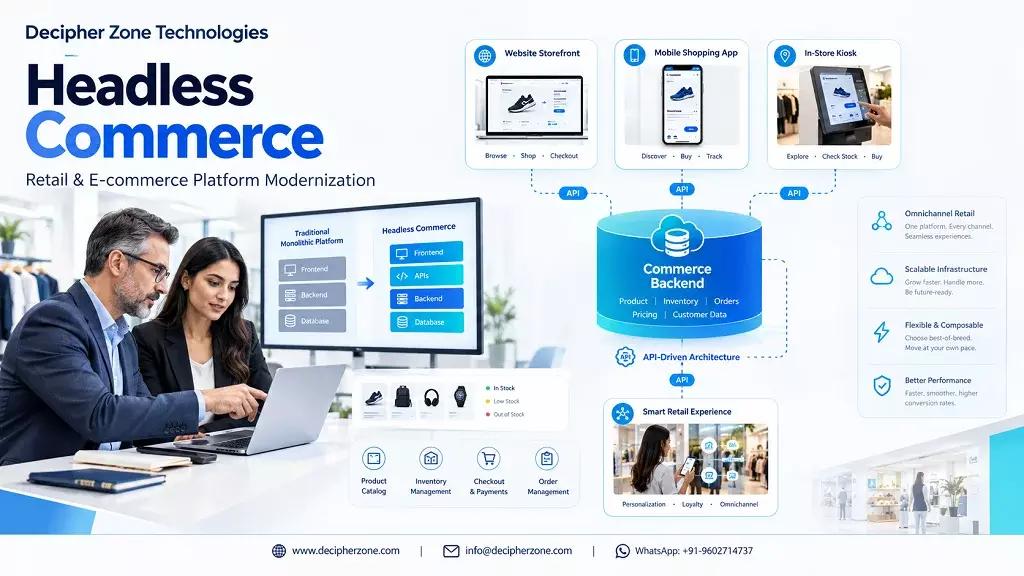
Headless commerce is a setup/ ecommerce architecture where the frontend (the part customers see and interact with) separates from the backend (the systems that handle inventory, checkout, payments and order management).
Instead of running as one connected system, these two layers communicate through APIs that allow each side to be developed, updated and scaled independently.
How the Headless Architecture Works
Headless commerce basically breaks the dependency. The backend exposes functionality through APIs and developers use the information to build storefronts on whatever frontend framework fits the brand whether it’s a website, a native app, a smart mirror in a physical store or a voice assistant. The backend stays the same across all of them, the thing that changes is only the presentation layer.
Core Components of Headless Commerce Architecture:
-
The Backend: It manages data storage, business logic and content repositories as it may expose data as raw and structured information through APIs.
-
The APIs (The Bridge): This section acts as the communication layer between the frontend and the backend. When the frontend needs data, it calls API to fetch the requested information from the backend repository.
-
The Frontend: It receives the raw information and manages all visual rendering independently. Here developers usually use modern frameworks like React, Vue or Next.js to display this content on any device.
Simple Example of the Flow
Imagine a customer adds a jacket to their cart on your mobile application. Look what happens behind the scenes:
-
The frontend (application) sends an API request to add the item to the cart.
-
The backend processes the request, checks inventory and updates the cart information.
-
The API sends that updated cart data back to the frontend.
-
The frontend displays the updated cart to the customer instantly.
If the same customer later opens your website and logs in, the backend already has their cart saved as it was never tied to a single frontend in the first place.

Top 7 Core Benefits of Headless Commerce for Retail
The main reason why retailers shift to headless commerce is that it solves specific and measurable problems that monolithic platforms create.
Here are the 7 benefits of headless commerce:
1. Faster Page Speeds & Higher Conversions
Speed has a direct impact on revenue. Deloitte's Milliseconds Make Millions study, run in partnership with Google, found that a 0.1 second improvement in mobile site speed increased conversion rates by 8.4% for retail sites, with shoppers also spending 9.2% more per session. As headless frontends are not weighted down by a bundled backend, they load faster by default and speed gains at that scale compound quickly.
2. True Omnichannel Flexibility
The backend working in headless commerce doesn’t care whether the request comes from a website, a mobile application, an in-store kiosk or a voice assistant. It will always respond with the same product, pricing and inventory data. This reduces the duplication of commerce logic and maintains separate systems that can drift out of sync with each other.
3. Faster Development & Time to Market
In a headless setup, a developer can redesign a product page without touching checkout logic and a backend update to inventory management doesn’t require retesting every storefront. This helps in shorten release cycles, letting retailers ship seasonal campaigns, new landing pages or feature updates without waiting on a single shared codebase.
Read: Retail Banking Software Development
4. Personalization at Scale
Retailers can develop highly customized experiences, personalized product recommendations, dynamic pricing displays, region specific content without backend constraints getting in the way.
5. Easier Scaling Across Markets & Brands
Retailers that run multiple brands, regions or storefronts are benefit from a single backend serving them all. Instead of rebuilding a full platform, adding a new market or sub brand is a frontend project. This keeps operations in check as the business expands.
6. Reduced Vendor Lock-In
Headless architecture decouples the dependency that traditional platforms often tie retailers’s entire experience to one ecosystem. If a better checkout provider, search tool or CMS comes along, it can be swapped in through an API without rebuilding the storefront from scratch.
7. Momentum Across the Industry
Retailers weighing whether to modernize their platforms are increasingly finding that their competitors already have. Numbers state the fact, BigCommerce reports that 64% of enterprise businesses are currently using a headless approach. This cites improved scalability and a stronger competitive edge as the direct payoff.
How Much Does Headless Commerce Modernization Cost?
The cost of headless commerce and platform modernization can range from $25,000 for an MVP based on team size and timeline requirements for enterprise modernization.

The table below explains the general tiers depending on scope:
|
Project Scope |
What’s Included |
Cost Range |
|
MVP Storefront |
Single headless frontend connected to an existing backend and a few core commerce features. |
$25,000- $60,000 |
|
Mid Market Migration |
Full replatforming with multiple integrations and one to two frontends |
$60,000- $120,000 |
|
Enterprise Modernization |
Multichannel frontends, custom backend work and ongoing optimization |
$120,000- $250,000+ (depending on the scope of the project) |
Factors that Influence the Cost of Headless Commerce & Retail Platforms
The factors that move the number up or down more are:
-
Backend complexity: Depends on how much custom logic exists in the current checkout, pricing or inventory systems.
-
Number of frontends: A single responsive website can cost compared to an application and an in-store kiosk all pulling from the same backend.
-
Data migration: With moving years of product, customer and order history, it is more work than the frontend rebuild itself.
-
Third party integration: search providers, CMS platforms, personalization AI tools and payment gateways each add integration time and effort.
-
Team structure: Whether you’re hiring a dedicated team, working with an agency on a project basis or paying hourly for specific development work.
How the Pricing Model Works
Decipher Zone Technologies offers flexible models that are away from rigid packages that don’t reflect the actual work.
-
Hourly development: $12/hour, this is suited to smaller scopes, specific integrations or ongoing feature work where a full dedicated team is not necessary.
-
Dedicate Developer: around $800- $1800 per month depending on the level of experience, a good fit for retailers who need consistent, ongoing development capacity without the overhead on an in-house hire.
-
MVP builds: With $25,000 and more, retailers can get a working proof of concept before committing to a full scale migration for a functional headless storefront built on your existing backend.
How to Choose a Headless Commerce Development Partner
Headless commerce delivers its potential when it’s built by a team that understands the architecture as well as the retail business behind it. There may be consequences of picking the wrong software development company, it may go over budget, end up slower than the platform they replaced or migration may stall out.
Read: eCommerce Platform Development
Here are the areas you need to consider while choosing a headless commerce development services company:
-
Look for Experience Beyond the Frontend: Ask specifically about the experience relevant to commerce backends to custom frontends.
-
Prioritize Flexible Engagement Models: Depending on the business and project scope you require engagement. Some need a small team to build an MVP and prove out performance before committing further.
-
Ask About Transparency in Process & Pricing: A trustworthy partner walks through pricing and process to avoid unexpected costs mid-project, data migration issues, scope creep or extra integrations that should have been priced in from the start. This should be done openly before the contract is signed.
-
Post launch Support: Ensure the software development company offers ongoing support once the initial build ships because APIs need maintenance, integrations need updates as third-party tools grow and performance needs monitoring as traffic expands.
Decipher Zone Technologies: Custom Software & AI Development Company
We offer full lifecycle work, architecture, migration, frontend build and post-launch support handled by our own engineers. For retailers evaluating platform modernization, that continuity tends to matter more once the project is underway.
-
We approach it as full-stack architecture, backend logic, API design and frontend experience considered together from the start.
-
We offer pricing structures like: projects can start at $12 an hour for scoped development work, scale to a dedicated developer ranging from $800- $1800 a month or begin as a full MVP storefront starting from $25,000.
-
We deliberately keep cost structure and project scope woven into the conversation from the first call and keep you posted.

Closing Thoughts
This is your time as 44% of retail executives admit their legacy systems are actively slowing them down. This may look theoretical but measurable as faster page speeds can impact in higher conversions.
A backend that serves every channel from one source cuts down on wasted engineering hours. A storefront built to scale means the next market, brand or sales channel will not require starting over from scratch.
If your current platform makes you feel like the thing slowing you down, this is your clear sign for a conversation.
Decipher Zone Technologies offers a free initial consultation to walk through your current platform, identify what you really need and where the performance gaps and map out whether an MVP, a phased migration or a full scale modernization fits in your current situation.
Get in touch to start the conversation, no pressure, no jargon just a clear picture of what’s possible for your storefront.
FAQs
-
What is headless e commerce architecture?
Headless e commerce architecture separates the frontend (customer s see and interact with) and the backend (manages inventory, pricing and checkout). These two layers communicate through APIs, letting retailers update the storefront design or backend logic independently without rebuilding the entire platform.
-
How does AI work with headless commerce?
AI tools such as personalized product recommendations, AI driven search, dynamic pricing engines and chatbots can plug directly into the backend without disrupting the core commerce logic, making it easier to add or swap AI capabilities over time.
-
Is headless commerce better than traditional e-commerce?
Headless commerce usually pays off for retailers managing multiple channels, scaling across marketplaces or needing custom frontend experiences because it offers more flexibility and faster development cycles. However, Traditional retail platforms are a more practical choice for smaller stores with simple needs and a single sales channel.
-
How long does a headless commerce migration take?
A standard project takes around 12 to 24 weeks (3 to 6 months) for a headless commerce migration. While, a full enterprise migration with multiple frontends and integrations can take several months to plan, build and test properly before launch.
-
Which companies can offer headless e commerce development services?
Decipher Zone Technologies is one of the options specifically for full lifecycle headless commerce work, covering architecture, migration, frontend development and post launch support under one team.
About the Author: Mahipal Nehra manages content at Decipher Zone Technologies and works closely with the engineering team across live project delivery. He has spent the last six years documenting real AI and software development projects cost structures, architecture decisions, client outcomes for an audience of CTOs, product leads, and engineering managers. Follow on LinkedIn.
AI Development Services | Generative AI Development | AI Agent Development | Custom AI Solutions | AI Chatbot Development | Machine Learning Solutions | Data Analytics Solutions | Business Intelligence Applications | MLOps Services | AI Consulting | Custom Software Development | Web App Development | Mobile App Development | SaaS Development | E-commerce Development | Enterprise Software Development | Cloud Application Development | UI/UX Design | Full Stack Developers | Product Engineering | Software Modernization | API Development | QA & Support