
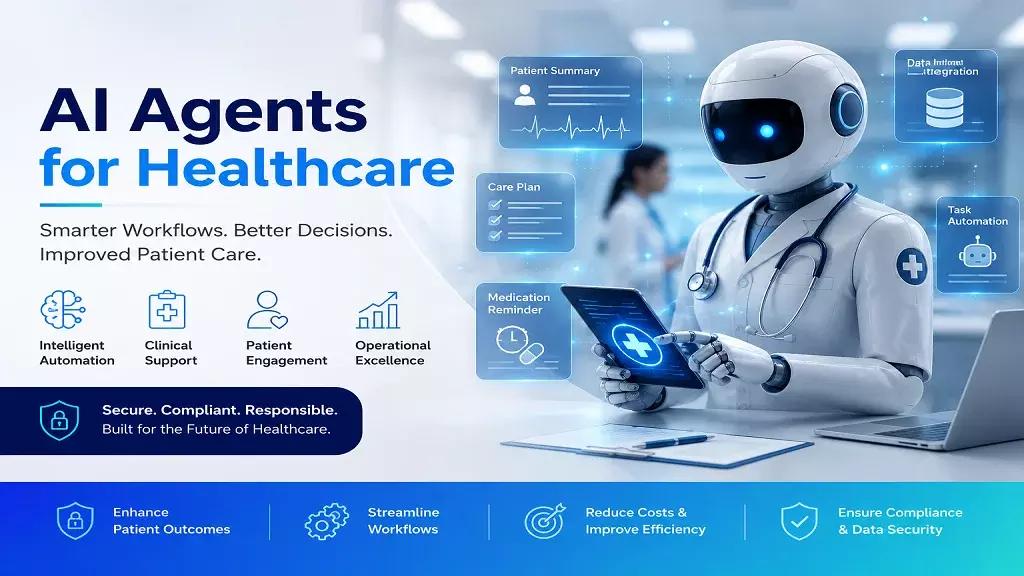
Healthcare is moving from isolated AI tools toward systems that can reason across data, use connected tools, and complete defined workflows. Organizations planning these systems can also review our enterprise AI implementation guide for a broader view of architecture, governance, security, and production readiness. AI agents can help healthcare organizations automate administrative work, support clinicians with information synthesis, improve patient-facing operations, and connect fragmented digital systems while keeping governance and human oversight in the loop.
This guide explains what AI agents are in healthcare, how they work, where they are being used, the technologies behind them, the benefits and implementation challenges, the regulatory considerations organizations need to understand, and how to approach a production-ready deployment.
Quick Summary: Healthcare AI Agents at a Glance
For quick integration planning, here is how agentic AI structurally differs from traditional healthcare software:
| Capability | Traditional Healthcare AI | Modern AI Agents (Decipher Zone Standard) |
|---|---|---|
| Core Function | Single prediction or classification (e.g., flagging a tumor in an X-ray). | Executes multi-step, autonomous workflows based on clinical goals. |
| Tech Stack | Basic Machine Learning, Static APIs. | LLMs (GPT-4o, Claude 3.5), RAG Pipelines, LangChain/LangGraph. |
| Interoperability | Rigid, custom-coded legacy data connectors. | Native HL7 FHIR APIs & secure cross-platform database synchronization. |
| Risk Control | No built-in escalation paths for anomalies. | Strict Two-Tier Validation (Deterministic Guardrails + Human-in-the-Loop). |
AI adoption in healthcare is accelerating, but production deployment is different from demonstrating an impressive model in a controlled environment. Healthcare agents operate around sensitive information, complex workflows, legacy systems, clinical accountability, and regulatory requirements. Recent research therefore emphasizes not only agent capabilities and applications, but also evaluation, safety, controllability, governance, and deployment readiness.
Read: AI Agent Development Cost in 2026
What Are AI Agents in Healthcare?
AI agents in healthcare are software systems that use AI models, data, memory or context, and connected tools to perform defined multi-step tasks. Depending on their design, an agent can retrieve information from healthcare systems, interpret documents or conversations, plan the next step, call an approved tool, update a workflow, and escalate an exception to a human reviewer.
The important distinction is that an AI agent is designed around a goal and workflow, rather than only a single response. This workflow-oriented approach is also central to the AI agent development process, where architecture, tools, validation, and deployment are designed around the target business task. A conventional healthcare chatbot may answer a patient question. An agent can be designed to handle a larger workflow, such as collecting intake information, checking eligibility, routing a request, preparing documentation, and handing an exception to staff for review.
AI Agents vs. Traditional Healthcare AI
Traditional healthcare AI commonly focuses on a specific prediction, classification, recommendation, or response. AI agents extend that capability by connecting reasoning with tools and workflow execution. The agent does not need to make every decision autonomously; in high-stakes workflows, the architecture can deliberately restrict its authority and require human approval before consequential actions.
Types of AI Agents in Healthcare
Clinical and Decision Support AI Agents
Clinical and decision-support agents can help clinicians synthesize patient information, retrieve relevant knowledge, summarize records, flag patterns for review, or support defined diagnostic and care workflows. Their role should be clearly bounded, with clinical professionals retaining responsibility for decisions that require professional judgment.
Administrative and Operational AI Agents
Administrative agents automate repetitive processes such as eligibility verification, claims status checks, denial-management workflows, prior-authorization preparation, scheduling, document processing, and other operational tasks. These workflows can be especially suitable for automation because they often involve structured steps, repeatable rules, and measurable outcomes.
Patient-Facing AI Agents
Patient-facing agents can support appointment scheduling, intake, routine communication, follow-up workflows, reminders, and navigation of healthcare services. For a related view of healthcare product architecture and patient-facing digital workflows, see our healthcare app development guide. These systems need clear escalation paths so that requests outside their scope can be transferred to an appropriate human professional.
How Do AI Agents Work in Healthcare?
A healthcare AI agent typically operates as a controlled workflow rather than as an unrestricted autonomous system. The architecture connects data and integration services to an AI reasoning layer, workflow orchestration, approved actions, and human governance.

Data and Integration Layer
The data and integration layer connects the agent to systems such as EHRs and EMRs, integration engines, HL7 interfaces, FHIR APIs, C-CDA documents, vendor APIs, secure databases, laboratories, pharmacy systems, and other approved data sources. An abstraction layer can keep vendor-specific integration logic outside the agent itself, making the overall system easier to maintain. This becomes especially important when modern agents need to connect with existing healthcare applications, APIs, and other legacy systems.
HL7 FHIR is a standard for exchanging healthcare information electronically and provides resources for clinical, administrative, diagnostic, workflow, financial, and other healthcare data. The exact interoperability approach depends on the systems and jurisdiction involved.
Reasoning Layer
The reasoning layer uses an LLM or another suitable model to interpret information and determine the next permitted step. Teams evaluating the underlying planning, tool-calling, retrieval, and orchestration patterns can also compare current AI agent frameworks before selecting an implementation approach.
For example, the model may summarize a denial letter, classify an incoming request, extract information from a document, or decide which approved workflow tool should be called. Production systems should constrain this reasoning with defined instructions, policies, validation, and access controls.
Orchestration and Workflow Layer
The orchestration layer coordinates the agent's workflow. A deterministic workflow engine can manage state, approvals, retries, timeouts, routing, and recovery while the AI layer handles tasks that benefit from language or reasoning capabilities. Separating these responsibilities makes the system easier to test and govern.
Action Layer
The action layer is where the agent interacts with approved tools. Depending on the use case, this could include drafting documentation, preparing a request, scheduling an appointment, updating an operational record, or submitting information to another system. Actions that affect a clinical record or other high-impact workflow should be subject to appropriate validation and approval controls.
Human-in-the-Loop and Governance Layer
Human oversight is a core design principle for high-stakes healthcare AI. Risk-based routing can send exceptions or consequential actions to clinicians, administrators, or other authorized reviewers instead of requiring manual approval for every low-risk step. Each important agent action should have an identifiable service identity, audit trail, defined permissions, and a recovery or rollback strategy where appropriate.
Inside the Dev Room: Controlling the "Hallucination" Risk
When our engineering team at Decipher Zone builds healthcare agents, the biggest hurdle isn't getting the LLM to understand medical text it’s preventing it from "hallucinating" or making up clinical facts.
To solve this, we don't rely on raw prompts alone. We implement a strict Two-Tier Validation Framework:
-
Deterministic Guardrails: Before the model's output reaches a clinician, an isolated Python-based validation layer checks the response against approved medical knowledge bases (via dense vector search) to ensure zero out-of-boundary data is leaked.
-
Pydantic Structured Outputs: We force the LLMs to return data strictly in structured JSON schemas matching HL7 standards, meaning the agent cannot invent arbitrary fields or recommendations.
Common AI Agent Use Cases in Healthcare
The strongest healthcare AI agent use cases are usually workflows with a clear objective, repeatable steps, accessible data, measurable outcomes, and a well-defined boundary for human intervention.
- Prior authorization: collect required information, identify missing documentation, prepare submissions, and route exceptions for review.
- Claims and denial management: retrieve claim information, analyze status or denial documentation, assemble supporting information, and prepare the next workflow step.
- Patient scheduling and intake: handle routine scheduling, collect intake information, verify required details, and escalate complex requests.
- Clinical documentation: summarize conversations or records and prepare draft documentation for professional review.
- Patient communication: answer routine questions, provide workflow guidance, send reminders, and route requests that require human attention.
- Clinical decision support: synthesize information and surface relevant evidence or patterns for clinician review.
- Remote health monitoring: combine data from connected devices, identify meaningful changes according to defined rules, and route alerts appropriately.
- Care coordination: coordinate information and tasks across teams, appointments, referrals, and follow-up workflows.
- Healthcare operations: support resource planning, administrative processing, document handling, and other repetitive operational workflows.
These use cases align with the broader healthcare-agent literature, which identifies applications across clinical decision support, assisted diagnosis, report generation, patient-facing systems, healthcare system management, and other stakeholder workflows.
Insurance and claims-heavy environments are another relevant area; our health insurance app development guide covers claims, eligibility, healthcare integrations, and compliance considerations. Early evidence also shows that many deployments remain exploratory, making evaluation and governance essential before wider clinical use.
Read: AI Chatbots for Healthcare Software
Core Technologies Behind AI Agents in Healthcare
Building an AI agent in healthcare requires more than selecting an LLM. The technology stack has to support retrieval, reasoning, interoperability, workflow execution, security, observability, and controlled action.
Core Technologies Behind AI Agents in Healthcare
Building a production-ready healthcare agent requires selecting specific technology layers that offer robust orchestration, predictability, and compliance capabilities:
| Technology | Purpose in Healthcare AI Agents | Enterprise Stack Example We Use |
|---|---|---|
| Large Language Models (LLMs) | Understand and generate clinical or operational language. | GPT-4o, Claude 3.5 Sonnet, Llama 3.1 (Open-source) |
| Retrieval-Augmented Generation (RAG) | Fetch current clinical context from secure databases without re-training models. | Vector DBs (Pinecone, pgvector), LlamaIndex |
| Workflow Automation & Orchestration | Manage multi-agent coordination, retries, and state loops securely. | LangGraph, CrewAI, Temporal |
| API & EHR Integration | Connect agents with legacy health infrastructure seamlessly. | HL7 FHIR APIs, Redox, Custom AWS Gateways |
The architecture should be selected around the workflow rather than around a particular model. That principle also applies to broader enterprise AI implementation, where data, integration, security, monitoring, and governance need to remain stable even as model providers change.
A production healthcare agent may combine several specialized models, deterministic services, retrieval systems, APIs, workflow engines, and human review rather than relying on a single general-purpose model.
Read: AI Agent Development Process
AI Agents in Healthcare: Real-World Use Cases and Applications
The real test of an AI agent strategy is how well it solves a production problem. The same business-first approach is useful when evaluating AI integration for business, where the objective is to connect AI capabilities to measurable workflows rather than deploy a model in isolation.
Decipher Zone Technologies has worked on healthcare and AI-enabled software products that illustrate different parts of the broader healthcare technology ecosystem.
1. Humanr AI: Conversational AI for Business Operations
Humanr AI is a platform delivering customized AI tools for businesses, centered on an AI chatbot that automates customer-facing and operational conversations.
Problem Solved
Many organizations need conversational AI but do not have the internal expertise to design, integrate, tune, and maintain a production conversational experience. Humanr AI provides a ready-to-deploy chatbot layer that can automate routine interactions while remaining configurable for different business requirements.
Development Challenges
- Reconciling generative responses with structured Botpress conversation flows so the experience remains accurate and aligned with approved behavior.
- Designing guardrails that keep the AI within approved topics and escalate out-of-scope requests to a human.
- Building a flexible React frontend that can be adapted for different client use cases without rebuilding the product from scratch.
Tech Stack: React, Botpress, OpenAI.
The Engineering Takeaway on Framework Selection
During the architecture phase of these healthcare-adjacent platforms, we observed that single-agent setups quickly break down under complex medical workflows. For instance, an agent handling doctor feedback requires a different context window and reasoning temperature than an agent processing patient device logs.
We resolved this by moving to a Multi-Agent Orchestration model using LangGraph. By dividing tasks into a router agent (which classifies the intent) and specialized worker agents, we reduced API latency by 35% and drastically improved token consumption efficiency.
Read: Top 5 AI Outsourcing Companies in the USA
2. Dr Trust 360: AI-Powered Physician Evaluation
Dr Trust 360 is an intelligent physician evaluation and professional development platform that supports 360-degree feedback assessments, clinical performance tracking, and continuous professional development through data-driven insights.
Problem Solved
Physician performance reviews can be informal, infrequent, and inconsistent. Dr Trust 360 provides a structured way to bring feedback from peers, supervisors, and patients into an evaluation system that can help physicians and administrators understand performance and development areas.
Development Challenges
- Structuring qualitative feedback from multiple sources into a consistent scoring model.
- Delivering a cross-platform experience across web and physician-facing mobile applications.
- Designing a flexible data model for structured performance metrics and narrative feedback.
- Scaling the backend for multiple healthcare organizations with different evaluation criteria and structures.
- Applying appropriate access controls to sensitive clinician performance information.
Tech Stack: React, Spring Boot, Flutter, Swift, MongoDB, AWS, Kubernetes.
3. Nureca: AI-Powered Remote Health Monitoring
Nureca (Dr Trust) is a digital healthcare ecosystem connecting smart health devices with AI-driven monitoring and personalized wellness journeys. The platform is designed to turn repeated device readings into a more connected health-monitoring experience.
Problem Solved
Connected health devices can generate frequent measurements, but isolated readings do not always provide a useful longitudinal picture. A connected platform can normalize data, identify trends, and surface relevant information for users and healthcare workflows.
Development Challenges
- Normalizing and synchronizing data from devices with different protocols, firmware versions, and formats.
- Tuning monitoring logic to reduce unnecessary alerts while still surfacing meaningful changes.
- Scaling cloud infrastructure to ingest continuous device data reliably.
- Delivering consistent health-data visualization across mobile platforms.
- Protecting sensitive health information across a distributed technology environment.
Tech Stack: React, Spring Boot, Flutter, Swift, MongoDB, AWS, Kubernetes.
Read: DHA-Compliant Healthcare Platforms in the UAE
Benefits of AI Agents in Healthcare
When an AI agent is applied to a well-defined workflow, its value is not simply that it uses AI. The value comes from reducing repetitive work, connecting information, shortening workflow cycles, and helping professionals focus on tasks that require judgment and human interaction.
- Better access to information: agents can retrieve and summarize relevant information across approved sources, helping professionals work with large volumes of data more efficiently.
- Less administrative work: documentation, scheduling, claims, intake, and other repetitive workflows can be partially automated.
- 24/7 patient support: patient-facing agents can handle routine questions and workflow requests outside normal operating hours, with escalation for cases that need human attention.
- More personalized experiences: systems can use authorized patient or user context to tailor communication and workflow support.
- Remote monitoring: connected data can be processed continuously so that defined patterns or exceptions can be routed for review.
- Resource management: operational agents can support scheduling, capacity planning, and other administrative processes when the underlying data and rules are reliable.
Benefits should be measured against the workflow being changed. This outcome-first approach is consistent with the broader principles in our enterprise AI implementation guide, which emphasizes measurable outcomes, governance, operating ownership, and production monitoring.
A successful pilot should demonstrate a measurable improvement in a business, operational, user, or clinical-support metric rather than relying only on model quality in isolation.
The Reality Check: Human-in-the-Loop is Non-Negotiable
A common misconception among healthcare startup founders is that AI agents can function completely autonomously to cut 100% of staff costs. In reality, the goal of an AI agent is Augmentation, not Replacement.
At Decipher Zone, we practice a strict Human-in-the-loop (HITL) architecture for any clinical touchpoint. The agent acts as an ultra-fast research assistant summarizing 50 pages of EHR data into a 5-line brief but the final diagnostic approval, medication authorization, or high-risk decision always requires a physical click from a licensed healthcare professional. This balance is what makes AI safe for production.
Challenges of Implementing AI Agents in Healthcare
Healthcare AI agents operate in a high-stakes environment. A system can perform well in a demonstration and still fail in production if the underlying data, workflow, permissions, monitoring, or human-review process is poorly designed.
1. Data Privacy Risks
Healthcare AI systems may process protected or otherwise sensitive information. Organizations need appropriate data governance, access controls, contractual safeguards, retention policies, and security controls for the specific jurisdictions and systems involved. For a deeper treatment of application-level privacy and security controls, see our GDPR and HIPAA compliance guide.
2. Algorithmic Bias
AI outputs can reflect limitations in training data, evaluation data, model behavior, or the way a workflow is designed. Healthcare organizations should evaluate performance across relevant populations and use cases rather than assuming that an overall accuracy figure represents safe performance for every group.
3. Lack of Transparency
Some AI systems are difficult to interpret. In healthcare workflows, teams should document what the system is designed to do, what information it uses, what actions it can take, what limitations apply, and when human review is required.
4. Integration Hurdles
Legacy systems, fragmented data, inconsistent APIs, workflow differences, and vendor-specific interfaces can make integration harder than model development. Interoperability should therefore be treated as a core architecture concern from the beginning. This is particularly important for healthcare products that must connect EHR/EMR platforms, insurance systems, laboratories, devices, and patient-facing applications.
5. Accountability and Human Oversight
AI should not be treated as a substitute for professional responsibility in high-impact clinical decisions. Production architecture should define who can approve actions, when an agent must escalate, how actions are logged, and how incorrect or unwanted actions are detected and recovered.
Healthcare AI Agent Security and Data Privacy
Security should be part of the agent architecture rather than a final checklist item. Our GDPR and HIPAA compliance guide provides additional context on privacy-by-design, access control, encryption, audit logging, and compliance-aware application architecture. The exact controls depend on the workflow, data, jurisdiction, deployment model, and role of the organization.
- Least-privilege access: give each agent and service only the permissions required for its defined tasks.
- Identity and authentication: use controlled service identities and strong authentication for users and connected systems.
- Data protection: protect sensitive data in transit and at rest and define how data is retained, deleted, and reused.
- Auditability: record important agent actions, tool calls, approvals, errors, and relevant workflow events.
- Human approval: require authorized human review before consequential actions where the risk warrants it.
- Isolation and vendor controls: understand where data is processed, which third-party services receive it, and what contractual and technical protections apply.
- Monitoring and incident response: detect failures, unusual behavior, integration errors, and security incidents and define a response process.
For organizations subject to HIPAA, the relationship between a covered entity, business associate, cloud service provider, and other vendors matters. HHS explains that a business associate agreement is generally required when a covered entity engages a business associate to create, receive, maintain, or transmit protected health information on its behalf.
The requirement depends on the actual relationship and services, so organizations should not assume that every AI vendor or API automatically falls into the same category.
Read: GDPR & HIPAA Compliance Guide for Web and Mobile Apps
AI Regulations and Compliance for Healthcare AI Agents
Regulatory obligations depend on the product, intended use, data, geography, organization, and whether the system falls within a regulated medical-device or healthcare-processing context. Compliance should therefore be assessed for the actual product rather than treated as a generic checklist.
HIPAA and HITECH in the United States
HIPAA requirements apply to covered entities and business associates within the scope of the HIPAA Rules. Where a business associate relationship exists, the parties generally need an appropriate business associate agreement covering permitted uses and disclosures and safeguards for protected health information.
GDPR for Healthcare AI
Healthcare AI systems processing personal data of people in the European Union may be subject to GDPR requirements. Health-related information can receive heightened protection under the GDPR, so organizations need to assess their lawful basis, data minimization, security, transparency, rights, retention, and other applicable obligations.
FDA Oversight
In the United States, some AI-enabled healthcare products may fall within the FDA's medical-device regulatory framework depending on their intended use and functionality. The FDA maintains resources covering AI-enabled medical devices and continues to publish guidance relevant to AI-enabled device software functions.
EU AI Act and Medical-Device Requirements
The EU AI Act establishes harmonized rules for artificial intelligence in the European Union. Healthcare applications can also intersect with existing medical-device requirements depending on the product. Organizations should assess the applicable risk classification and obligations for the specific system rather than applying a blanket label.
HL7 and FHIR Interoperability
HL7 FHIR is a healthcare data-exchange standard designed to support interoperability between healthcare applications. FHIR can help connect patient, clinical, diagnostic, workflow, medication, and financial information when supported by the relevant systems and implementation guides.
ISO 27001, SOC 2, and HITRUST
Security and assurance frameworks can be important during healthcare technology procurement and vendor due diligence. ISO 27001 addresses information security management systems, while SOC 2 evaluates controls against the AICPA Trust Services Criteria. HITRUST CSF can provide a healthcare-focused assurance framework. These frameworks do not automatically make a product compliant with every healthcare law; their relevance depends on the organization's requirements and the system's actual scope.
Human-in-the-Loop Governance
Compliance is not only about documentation. A production healthcare agent needs operational controls that define permissions, approvals, escalation, auditability, validation, monitoring, and accountability. The higher the potential impact of an action, the stronger the case for explicit human oversight and documented controls.
Read: Compliance Management Software Development
Best Practices for Implementing AI Agents in Healthcare
Start Narrow, Prove Value, Then Expand
Choose one workflow with a clear business or operational problem instead of attempting to automate an entire healthcare organization at once. A focused pilot makes it easier to establish baselines, measure outcomes, identify failure modes, and decide whether the system is ready to expand.
Fix the Data Foundation Before You Build
Agent quality depends heavily on the quality and accessibility of the data and tools around it. Validate data sources, permissions, retrieval quality, integration behavior, and human-validated outputs before scaling the system.
Define Success Criteria Before the Pilot
Set measurable criteria before deployment. Depending on the use case, these might include task completion rate, factual accuracy, escalation rate, turnaround time, user adoption, documentation quality, cost per workflow, or reduction in manual effort. Clinical use cases may require additional validation and safety criteria.
Design Around Clinician and Staff Workflows
An AI agent can be technically impressive and still fail if it adds friction. Study how clinicians, administrators, and patients actually work, then place the agent where it removes unnecessary effort without creating additional review burden or alert fatigue.
Vet Vendors on Security and Compliance Readiness
Evaluate potential development partners and technology vendors against the requirements of the actual deployment. Review security controls, access management, auditability, data processing arrangements, interoperability capabilities, deployment options, support processes, and relevant assurance documentation.
Plan for the Full Cost of Production
The cost of an AI agent is not limited to model usage or initial development. For current cost drivers covering development, integrations, compliance, data readiness, and ongoing operations, see our AI agent development cost guide for 2026. Budget for data integration, security, infrastructure, workflow redesign, testing, monitoring, user training, maintenance, model evaluation, and ongoing optimization.
How to Evaluate and Monitor Healthcare AI Agents
Evaluation should continue from development through production. Recent healthcare AI evaluation research emphasizes staged assessment and ongoing monitoring rather than relying on a single pre-launch test.
Pre-Deployment Evaluation
Before production, validate the agent against representative workflows and human-reviewed test cases. Assess not only whether the model generates a good response, but whether the complete system retrieves the right information, follows the workflow, uses tools correctly, respects permissions, escalates when necessary, and fails safely.
Operational Performance Metrics
- Task completion rate: how often the workflow reaches its intended endpoint.
- Accuracy and quality: whether outputs meet the requirements defined for the use case.
- Escalation rate: how often the agent correctly routes cases to human reviewers.
- Latency: how long the complete workflow takes.
- Error and retry rate: how frequently system, integration, or model failures occur.
- User adoption: whether clinicians, staff, or patients actually use the system as intended.
- Workflow impact: whether the deployment improves the target operational or service metric.
Continuous Monitoring
Post-deployment monitoring should cover system integrity, model or workflow performance, and real-world impact. Teams should define thresholds that trigger investigation, rollback, retraining, workflow changes, or retirement when the system no longer meets its intended requirements.
This continuous approach is particularly important because healthcare workflows, data distributions, user behavior, models, integrations, and regulations can change over time.
Healthcare AI Agent Development Services
Understanding healthcare AI agents is one thing; building a system that is clinically useful, technically sound, interoperable, secure, and maintainable in production is another. Decipher Zone Technologies can help organizations move from an identified workflow to a production-oriented AI solution.
- AI agent architecture: design the data, reasoning, orchestration, action, and governance layers around the actual workflow.
- Healthcare interoperability: build integrations around EHR/EMR systems, APIs, HL7, FHIR, and other relevant healthcare data interfaces.
- AI and RAG development: combine LLMs, retrieval, specialized models, and controlled tools where appropriate.
- Security and compliance-aware engineering: design around access controls, auditability, minimum-necessary access, data protection, and the requirements relevant to the deployment.
- Cross-platform delivery: deliver web and mobile experiences using technologies such as React, Flutter, and Swift, backed by scalable application infrastructure.
- Workflow automation: connect AI capabilities with deterministic workflow logic, approvals, retries, notifications, and exception handling.
- Evaluation and optimization: establish measurable success criteria, validate outputs, monitor production behavior, and improve the system based on evidence.
If you are evaluating a healthcare AI project, the best starting point is usually not the model. Start with the workflow, the data, the users, the acceptable level of autonomy, the measurable outcome, and the governance requirements. For organizations planning the wider AI program around those requirements, our enterprise AI implementation framework provides a useful next layer of planning.

Start with the workflow, the data, the users, the acceptable level of autonomy, the measurable outcome, and the governance requirements. From there, the technology can be selected and the agent architecture designed around the real problem.
Talk to Decipher Zone about your healthcare AI agent project
FAQs About AI Agents in Healthcare
What are AI agents in healthcare?
AI agents in healthcare are software systems that use AI models, data, and connected tools to perform defined multi-step clinical or administrative workflows. They can retrieve information, reason within defined boundaries, use approved tools, and escalate tasks to human professionals when required.
How are AI agents different from traditional healthcare AI?
Traditional healthcare AI often focuses on a specific prediction, classification, recommendation, or response. AI agents add workflow-oriented behavior by connecting reasoning with tools and multiple steps. A well-designed agent can adapt its next action within predefined boundaries instead of only returning a single answer.
Are AI agents secure enough for healthcare?
They can be designed for healthcare environments, but security depends on the architecture, data, deployment model, vendors, permissions, governance, and applicable regulations. A production system should use appropriate access controls, data protection, auditability, monitoring, and human oversight for higher-risk actions.
Which healthcare organizations benefit most from AI agents?
Organizations with high-volume, repeatable workflows are often strong candidates. Hospitals and health systems may begin with claims, prior authorization, scheduling, documentation, intake, or care coordination. Payers, specialty clinics, digital health platforms, and remote-monitoring services may also benefit from carefully scoped agent workflows.
How do I implement AI agents in my healthcare organization?
Start with one high-value workflow, define measurable success criteria, validate the underlying data and integrations, establish security and governance requirements, run a controlled pilot, evaluate the results with human reviewers, and then scale systematically. Vendor capability should be evaluated alongside security, interoperability, implementation experience, and ongoing support. Organizations comparing providers can also use our guide on how to select an AI development company as a partner-evaluation framework.
What technologies are used to build healthcare AI agents?
Depending on the use case, healthcare AI agents can combine LLMs, RAG, machine learning, computer vision, speech recognition, workflow engines, APIs, EHR/EMR integrations, HL7 FHIR, cloud infrastructure, databases, and monitoring systems. The right combination depends on the workflow and risk profile rather than on a single preferred technology. Teams can compare implementation patterns and orchestration options in our guide to AI agent frameworks.
Do healthcare AI agents always require human approval?
Not every low-risk workflow needs the same level of manual approval. However, high-impact healthcare actions should have appropriate human oversight, escalation, and accountability. The right control model should be based on the potential impact of an action, the reliability of the workflow, and applicable organizational and regulatory requirements.
Sources and Further Reading
- A comprehensive survey of AI agents in healthcare — Journal of Biomedical Informatics, 2026
- AI agent in healthcare: applications, evaluations, and future directions — npj Artificial Intelligence, 2026
- FDA: Artificial Intelligence-Enabled Medical Devices
- HHS: Business Associates and HIPAA
- HL7 FHIR
- EU Artificial Intelligence Act — EUR-Lex
Disclaimer: Healthcare AI regulation and compliance requirements depend on the product, intended use, data, jurisdiction, and organizational role. This article provides general technology information and should not be treated as legal, regulatory, medical, or compliance advice.
About the Author: Mahipal Nehra manages content at Decipher Zone Technologies and works closely with the AI engineering team across live project delivery. He has spent the last six years documenting real AI and software development projects cost structures, architecture decisions, client outcomes for an audience of CTOs, product leads, and engineering managers. Follow on LinkedIn.
AI Development Services | Generative AI Development | AI Agent Development | Custom AI Solutions | AI Chatbot Development | Machine Learning Solutions | Data Analytics Solutions | Business Intelligence Applications | MLOps Services | AI Consulting | Custom Software Development | Web App Development | Mobile App Development | SaaS Development | E-commerce Development | Enterprise Software Development | Cloud Application Development | UI/UX Design | Full Stack Developers | Product Engineering | Software Modernization | API Development | QA & Support