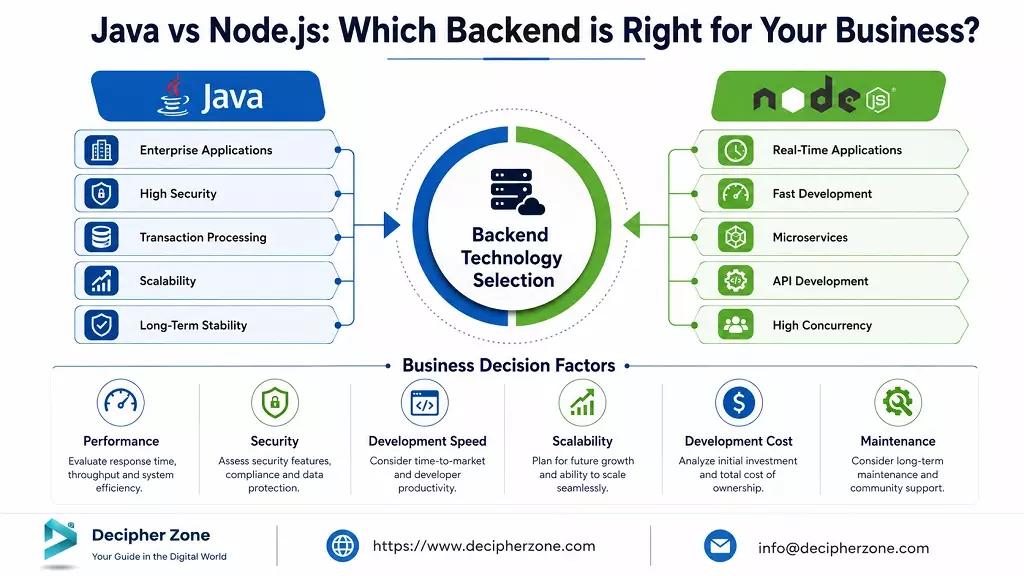
Know your product requirements and have a solid understanding of programming languages to ensure you build your application using the right architecture. This way, you won’t have to redevelop the entire product. This blog compares Java and Node.js, evaluates key factors to help you decide when to choose one over the other, outlines common use cases, and explains how a software development company can help you in the process.
The backend serves as the foundation of the software. It manages everything including business logic, database interactions, security, scalability and performance. Which is why choosing the right backend technology is critical. A small mistake can result in higher development costs, scalability challenges and technical debt.
While the popularity of backend technologies increases, Java and Node.js continue to dominate the conversation. Both have earned strong reputations for powering and serving different business requirements.
Java has long been the preferred choice basically for enterprise level solutions that require stability, security and high-performance transaction processing. On the other hand, Node.js has become a favourite among startups and product based companies due to their speed, flexibility and ability to handle real time applications efficiently.
Stack Overflow Developer Survey 2025 states that approximately 66% of developers using JavaScript professionally remain the world’s most used programming language. Meanwhile, 48.7% of developers adopted Node.js, making it the most used web technology/ framework globally.
There were more than 49,000 developers across 177 countries who responded to the survey. This highlights the dominance of Javascript based environments in modern software development.
You won’t be choosing the technologies just by knowing the popularity. So which backend technology is right for your business? The answer depends on many factors such as project complexity, scalability goal, development time, budget and architectural decisions.
Read: Best JavaScript Frameworks for 2026
What is Java?
Java is an object-oriented programming language that allows developers to build applications that run seamlessly across different operating systems through the Java Virtual Machine (JVM).
It is famous for WORA capability, which stands for Write Once, Run Anywhere. Developers can write code on one device and execute it on any system that has a JVM. This language is known for reliability, security and platform independence.
Key Features of Java:
-
Platform Independence: With the WORA principle, your applications can run on multiple platforms without modifications.
-
Object-Oriented Architecture: Java promotes code reusability, maintainability and scalability through classes and objects.
-
Robust Security: Built-in security features such as bytecode verification, authentication and access control mechanisms help to protect apps from vulnerabilities.
-
Multithreading Support: Java improves efficiency and responsiveness by enabling apps to perform multiple tasks simultaneously.
-
Rich Ecosystem & Libraries: Accelerate development with an extensive framework and libraries of Java such as SpringBoot and Hibernate.
Where Businesses Use Java:
-
Enterprise Resource Planning (ERP) systems
-
Banking & finance applications.
-
Healthcare management platforms
-
E-commerce marketplace
-
Customer Relationship Management (CRM) software
-
Supply chain & logistics solutions
-
Government & public sector applications
-
Large scale SaaS platforms
-
Cloud native enterprise applications
-
Big data & analytics systems

What is Node.js?
Node.js is built on Google’s V8 JavaScript engine, an open-source and cross-platform JavaScript runtime environment. It enables developers to execute JavaScript code outside the browser.
Node.js has the ability to use JavaScript on both the frontend and backend, which has made it a popular choice for startups, SaaS companies and businesses that are looking to build fast, scalable and real time solutions.
Key Features of Node.js:
-
Event-Driven Architecture: Without blocking operations, Node.js can process multiple requests efficiently.
-
Non-Blocking I/O: While maintaining excellent performance, it can handle thousands of simultaneous connections.
-
Massive npm Environment: offers access to millions of reusable packages and libraries for faster development.
-
Microservices Friendly: Suitable for developing modular, secure and scalable microservices architectures.
-
Real-Time Data Processing: ideal for applications requiring instant updates and live interactions.
Where Businesses Use Node.js:
-
Real-time chat & messaging applications
-
Video streaming platforms
-
Social networking solutions
-
SaaS platforms & web apps
-
RESTful APIs and GraphQL APIs
-
Collaborative tools and project management platforms
-
Online gaming backends
-
IoT (Internet of Things) apps
-
eCommerce websites
-
Live tracking & monitoring systems
Java vs Node.js: Core Differences
While both Java and Node.js are powerful backend frameworks, with different architectures and are designed to solve different types of business challenges. Choosing between them is totally dependent on the factors.
Java has been a trusted choice for enterprise apps for decades whereas Node.js has gained popularity for its ability to support modern, real time and highly scalable solutions. Here are the metrics that can influence your decision. You can compare both of these frameworks on the basis of architecture, performance, resources, availability, security, and more.
Read: Programming Languages for Desktop Applications
1. Architecture & Execution Model
This approach influences the core workflow of the application like handling requests, processing data and managing resources.
Java web server uses multi thread architecture which allows each request to be handled by a separate thread, allowing Java apps to perform multiple operations at the same time. This makes them highly effective for enterprise systems that require large sets of data processing and complex business logic.
With JVM (Java Virtual Machine), it can improve the stability and performance of the app through advanced memory management and runtime optimizations.
Node.js uses a single threaded and event driven architecture combined with a non-blocking I/O model. This means Node.js relies on an event loop to process multiple requests asynchronously.
The architecture reduces resource consumption and enables apps to manage various simultaneous connections. This makes Node.js well suited for apps that demand real time, APIs and services interacting frequently with databases or external systems.
2. Java vs Node.js Performance: Which Handles Heavy Workloads Better?
This factor is the most critical one where the debate is which one is faster.
Using JVM, Just-In-Time (JIT) compilation and optimized garbage collection mechanisms, Java delivers exceptional performance in CPU-intensive apps. It can handle complex computations, large scale transaction processing and enterprise workloads. Java is the preferred choice for industries such as financial services, healthcare and banking where performance consistency is essential.
Node.js offers apps to spend a significant amount of time waiting for database responses, file operations or API calls as it excels in I/O strong operations. The non-blocking architecture it offers allows the server to continue processing other requests while waiting for the operation to complete.
As a result, Node.js applications can achieve impressive performance in situations that involve real-time communication, streaming services, collaborative tools and high traffic web apps.
3. Memory and Resource Usage: Node.js Runs Leaner
Java apps rely on the JVM and support multiple threads running at the same time, consuming more memory. Java based platforms may require more infrastructure resources for large deployments, while modern JVM optimizations have been enhanced efficiently.
Node.js’s event based architecture enables apps to handle a large number of synchronous users while utilizing less memory and processing power. It is designed to be lightweight and resource efficient, helping businesses reduce hosting and infrastructure costs, mainly when the app is in the early stages of growth.

4. Scalability Compared: Which Scales Further as Your Business Grows?
Java provides scalability through a mature ecosystem and enterprise frameworks and support for distributed systems. The multithreading capabilities enable apps to handle tasks simultaneously, making Java an excellent option for large scale enterprise apps serving millions of users.
Node.js processes requests asynchronously which is highly scalable because of its architecture. It can manage a large number of users without creating excessive system overhead. Particularly attractive for cloud native apps, microservices architectures and real time platforms due to this capability.
Mostly, businesses expect rapid growth choose Node.js as it helps to scale horizontally with ease while maintaining consistent performance.
5. Development Speed
As Java development involves structured coding practices, architectural planning and organizational level design patterns. This approach can extend initial development time, contribute to high quality code, maintainability and stability in the long run.
Node.js allows faster development cycles as developers use JavaScript for both frontend and backend development where teams can work without switching between multiple programming languages. The npm environment offers access to thousands of libraries and modules that reduce development effort, especially for startups and businesses looking to launch products quickly.
6. Security: Why Java Has the Edge in Regulated Industries
Java has a strong reputation for security because it offers a mature ecosystem, strict type checking and built-in security mechanisms. Some of the frameworks such as Spring Security, offer advanced authentication, authorization, encryption and access control features that help businesses meet regulatory requirements and safeguard against cyber threats and attacks.
Whereas, Node.js assists highly secure solutions when implemented correctly. It relies on third party packages from the npm environment, developers need to manage dependencies and perform regular security audits.
Both technologies can provide enterprise level security, Java’s presence in regulated industries often offers an advantage for highly sensitive systems.
7. Development Cost: Node.js is Cheaper to Build With, But Here's the Catch
Factors that influence the overall cost of development include development speed, team size, location, infrastructure requirements and post launch maintenance. Java projects tend to run higher upfront because they require an experienced development team, more extensive architecture planning and implementation strategies.
Experienced Java developers with around 3+ years of experience can cost $90,000- $140,000 annually, depending on the location and expertise.
Node.js usually offers better cost effectiveness because of its faster development cycles. The ability to use JavaScript across the entire technology stack, the simplest team structure and lower development effort. Node.js’s nature provides shorter project timeframes and reduce overall costs. For businesses that prioritize rapid product launches and cost efficiency, Node.js is a strong return on investment.
Read: Hire Dedicated Java Developers from India
8. Developer Availability: Both Have Large Talent Pools, for Different Reasons
As Java is the most widely used programming language, it offers a large global pool of experienced developers. Businesses building complex solutions can find qualified Java professionals with expertise in frameworks and large scale system architecture. Hiring skilled engineers is a crucial decision that needs to be considered when selecting a backend technology.
Node.js is popular among developers as it benefits from a substantial talent pool. Many developers transitioned into full stack roles using Node.js, which makes recruitment easier, faster and more affordable. This popularity contributes to the rapid growth of the Node.js developer community which offers businesses access to a broad range of expertise.
9. Long-Term Maintenance: Java Wins on Predictability
When choosing the technology, post launch maintenance and support are usually overlooked, yet it impacts software ownership costs. Java helps in developing large solutions more easily to maintain over time due to its structured nature, strong typing and mature development practices. Businesses generally favour Java due to its ability to support long term scalability, code consistency and predictable maintenance processes.
Node.js makes an ideal choice for rapidly developing systems because it provides flexibility and adaptability. Maintaining large projects using Node.js may require stricter coding regulations and dependency management practices which can prevent technical debt. Since Node.js can be maintained at scale, Java usually offers stronger long term stability for enterprise applications that require years of continuous development and support.
Signs Your Project is a Better Fit for Java?
Newer technologies continue to emerge, yet Java remains strong with its reliability, mature ecosystem and enterprise level capabilities. Not only this but various other factors make it a preferred choice for businesses that need long term stability and robust performance.
If your system handles large datasets, complex business processes or strict security regulations. Java can offer a strong foundation as it is designed for building apps that can scale efficiently and remain maintainable for years.
If your priority matches the given criteria, Java tends to win.
Choose a Java Development Company If Your Business Needs:
-
Developing Enterprise Level Apps: If you're thinking downtime or data corruption could cost you serious money or your business license, Java can be the ideal choice.
-
Complex Business Logic: If your business requires an app with intricate workflows, advanced calculations or vast data processing, Java helps you manage complexity.
-
High Security Standards: If you’re related to any of these industries such as banking, healthcare, insurance and government, Java can be your preferred choice as its strong security features and other benefits can help you build secure and scalable business applications.
-
High Performance Transaction Processing: Java is well suited for systems that process large amounts of transactions at the same time including payment gateway, financial systems and ERP platforms.
-
Long-term product Stability: Organizations that plan to maintain and scale for many years, Java is a suitable choice as it offers stability, strong community support and backward compatibility.
-
Scalable Enterprise Systems: With multithreading and robust frameworks, millions of users and handling growing workloads is easy for businesses, making Java the preferred choice.
-
Microservices and Cloud Native Apps: Developers can build scalable microservices and cloud based applications with ease using modern frameworks like Spring Boot.
-
Large Development Teams: The development team can maintain code quality and consistency across multiple teams working on the same project with structured coding standards and strong typing abilities in Java.
Java Use Cases: Industries and Applications Where It Dominates
If you are willing to develop the software product given below, choosing Java would be the appropriate choice for you.
-
Banking & financial applications
-
Healthcare management systems
-
Enterprise Resource Planning (ERP) system
-
Customer Relationship Management (CRM) solutions
-
Supply chain & logistics management apps
-
E-commerce platforms with high transaction volumes
-
Government & public sector solutions
-
Cloud native enterprise platforms
-
SaaS platforms serving a large user base

Signs Your Project is a Better Fit for Node.js
In the modern web applications world, Node.js has earned its popularity due to its speed, flexibility and real time responsiveness. Application developed using Node.js when it requires real time communication, rapid development and seamless scalability.
Businesses, startups, and SaaS companies that focus on delivering products quickly, Node.js provides the perfect balance between performance and development efficiency.
One of the biggest advantages that we have already discussed is its ability to use JavaScript across both the frontend and backend, allowing development teams to work more efficiently, reduce context switching and accelerate project timeframes while keeping development costs under control.
Read: Evolution of Web Development in 2026
Choose Node.js Development Company if your business requires:
-
Faster Time-to-Market: Businesses looking to launch products quickly, Node.js allows developers to develop and deploy rapidly, making it an excellent choice.
-
Real Time Apps: Applications that demand instant data updates like messaging platforms, collaboration tools and live tracking, Node.js is ideal because of its event architecture.
-
High Concurrency Handling: Using Node.js, you can easily manage thousands of simultaneous users or connections with minimal consumption. This makes Node.js ideal for applications that have many users connecting live.
-
API Based Development: If you’re building RESTful APIs, GraphQL APIs and backend services that interact with multiple applications and platforms, Node.js is highly recommended.
-
Microservices Architecture: Node.js helps developers to build lightweight and independent services as businesses are adopting the microservices approach which are easy to develop, deploy and scale.
-
Full Stack JavaScript Development: It simplifies the workflows and improves collaboration between teams when you can use the same language JavaScript in the frontend and backend.
-
Cloud-Native Applications: Node.js works well in the cloud ecosystem, enabling businesses to scale applications quickly and efficiently.
-
Budget Efficient Development: Faster development cycles, reusable code and a large developer community help lower overall project development costs.
Node.js Use Cases: Where It Outperforms Traditional Backends
Node.js is frequently used for these applications listed below. If it makes sense, you might consider developing using Node.js.
-
Real time chat and messaging platforms
-
Video & audio streaming solutions
-
SaaS applications and web applications
-
Social networking applications
-
Online gaming platforms
-
eCommerce platforms
-
Live tracking and monitoring systems
-
Collaboration and productivity tools
-
API gateway and microservices
-
Internet of Things (IoT) applications
Java vs Node.js: Side-by-Side Comparison Table
Now you must be aware of your choice or still wondering. No worries, you can make a decision by seeing Java and Node.js compared side by side.
|
Factor |
Java |
Node.js |
|
Architecture |
Multi-threaded architecture, compiled into bytecode, runs on the JVM |
Single threaded with non blocking I/O |
|
Concurrency Model |
Handles multiple requests using separate threads |
Uses an event loop and parallelism via process clustering not threads |
|
Performance |
Ideal for CPU based and computation heavy apps |
Best for I/O related and real time apps |
|
Development Speed |
Same as regular application development because of structured development practices |
Faster development with JavaScript and npm environment |
|
Code Maintainability |
The maintainability is high because of strong typing and a structured approach |
It has good but requires coding discipline as apps grow |
|
Security |
With mature frameworks, it offers enterprise level security |
Secure when best practices and dependency management are followed |
|
Memory Usage |
Higher memory consumption due to the JVM and multiple threads |
Lower memory consumption because of the lightweight architecture |
|
Frameworks |
Spring Boot, Hibernate, Jakarta EF, Micronaut |
Express.js, Next.js, Fastify, Koa |
|
Microservices Support |
Appropriate with Spring Boot and cloud native frameworks |
Best for lightweight and distributed microservices |
|
Real Time Solutions |
Possible but requires additional implementation effort |
Naturally suited for real time communication and live updates such as tracking. |
|
Cloud Compatibility |
Strong support across cloud platforms |
Highly compatible with cloud native deployments |
|
Developer Availability |
Massive pool of experienced enterprise developers |
Large pool of JavaScript and full stack engineers |
|
Development Cost |
High initial development investment |
Lower development costs and faster delivery |
|
Maintenance Cost |
Low long term maintenance because of structured architectures |
Normal maintenance effort depending on project complexity |
|
Ideal for |
Best for complex startup products with long term scalability needs and enterprise systems |
Suitable for MVPs, rapid application launches and modern enterprise apps and microservices |
|
Database Connectivity |
Strong support for relational and enterprise databases |
Best support for SQL and NoSQL databases |
|
Popular Use Cases |
Finance, healthcare, ERP, CRM, banking, logistics |
SaaS solutions, chatting platforms, streaming services, APIs, IoT |
|
Time-to-Market |
Moderate |
Fast |
|
Overall Strength |
Reliability, maintainability, enterprise performance, security |
Speed, flexibility, scalability, real time capabilities |
Can You Use Java and Node.js Together?
Most real-world projects do not fit neatly into one camp. The "Java or Node.js" question often has a third answer: both, used where each actually makes sense.
A pattern that works well in production is keeping Node.js on the outer layer of your system. It handles incoming API requests, manages real-time connections, and talks to your frontend. Java sits deeper in the stack, running the business logic, processing transactions, and managing anything that touches sensitive or complex data. The two services talk to each other through REST APIs or a message queue like RabbitMQ or Kafka.
This is not a workaround or a compromise. Companies like LinkedIn and Netflix have run mixed stacks for years because splitting responsibilities by technology strength is simply good architecture. You are not locked into one language's limitations across the entire system.
If your product has distinct concerns, for example a chat interface on one end and a payment processing engine on the other, a combined approach is worth considering from the start rather than something you bolt on later.
Java vs Node.js for AI-Powered Applications
AI features have moved from being a nice-to-have to something clients and users expect from most modern products. That shift changes how you should think about backend selection.
Node.js fits naturally into the AI interaction layer. Calling an OpenAI or Anthropic API, streaming responses back to a user, building a chatbot interface, or wiring up an automation workflow are all tasks Node.js handles without much friction. The ecosystem has good library support, the non-blocking architecture keeps response times low, and JavaScript developers can start integrating AI APIs quickly.
Java comes into its own when the AI work gets heavier. If you are processing large structured datasets, running batch inference jobs, or building a pipeline where data quality and reliability cannot slip, Java's strict typing and mature processing frameworks give you guardrails that matter at that scale.
For most product teams building in 2026, the split looks something like this: Node.js manages what the user sees and interacts with, including the AI features, while Java handles the data and processing underneath. Neither replaces the other. The backend choice depends on which part of that picture your product is primarily building.
How to Choose the Right Development Partner for Your Backend Project
Here comes the real challenge, where you need the right development partner who can help you select the right architecture, frameworks, development approach, tools and deployment strategy that align with your business goals.
A professional development company evaluates your project details such as your unique requirements, scalability expectations, security needs, budget constraints and long term growth plans before recommending the ideal technology stack.
Here you need a technical partner who can follow trends, consider the requirements, has a team of experienced developers and focus on delivering the best performance, maintainability and ROI for your specific use cases.

What Decipher Zone Technologies Brings to the Table:
-
Technical Consultancy: Our team analyzes business goals and recommends whether Java, Node.js or a hybrid architecture is the right fit.
-
Custom Software Development: We help you develop tailored applications designed around your unique workflows and business objectives.
-
Scalable Architecture Design: Build solutions that are capable of supporting future expansion without requiring major redevelopment.
-
Performance Optimization: Our team develops applications that deliver fast response times, high availability and smooth user experience.
-
Security Implementation: We must implement standard security measures, authentication protocols and compliance requirements.
-
Cloud & DevOps Support: Our development team streamlines deployment, monitoring and infrastructure management for improved efficiency.
-
Ongoing Maintenance & Support: We help you optimize, update and enhance your applications as your business grows.
Final Verdict: Which Backend Should Your Business Choose?
It must be clear till now what exactly your project requires and what programming language you should choose.
If your business is building a complex enterprise application that requires high security, robust performance and long term maintainability, Java is a suitable choice. While Node.js is the strongest fit when you focus on rapid development, real time functionality and handling large volumes of simultaneous users.
Read: Best Tech Stack for Startups in 2026
You might face challenges when determining which technology will deliver the best long term value for their unique use case. This is where expert guidance can change the whole decision making process with confidence.
Our experienced technical consultants and professionals analyze your business objectives, project complexity, growth plans and technical requirements to recommend the most suitable backend architecture. At DZ, we offer extensive expertise in both Java development and Node.js development.
What sets us apart?
-
Expertise in Java, Node.js, and other programming languages.
-
Experienced in developing enterprise software, SaaS platforms, fintech, healthcare, logistics and eCommerce applications.
-
Strong focus on scalability, security and performance optimization.
-
Agile development methodology for faster project delivery.
-
Transparent communication and dedicated project management.
-
Proven track record of delivering custom software solutions worldwide.
-
Long term maintenance services to ensure continuous growth.

FAQs: Java vs Node.js 2026 guide
Is Node.js suitable for enterprise applications?
Yes, Node.js is highly suitable for enterprise solutions when implemented with the right architecture and development practices. It’s event based, non blocking architecture helps it to handle thousands of simultaneous connections, making it best for modern enterprise systems that demand scalability and high performance.
Which backend technology is better for startups?
If you prefer to launch faster, develop quicker and lower initial development costs then Node.js is often the most suitable choice. Since JavaScript can be used for both frontend and backend development, it allows the development team to build and iterate on products more efficiently.
Which is more scalable: Java or Node.js?
Both are highly scalable technologies in their own way. Each has a set of advantages and disadvantages. Java is ideal for large scale projects that process complex business operations, large amounts of data and massive transaction volumes. Node.js is appropriate for applications that handle a massive amount of concurrent users and real time interactions like chatting apps, streaming platforms and collaborative tools. The best choice depends on your workflow, architecture and future growth plans.
How much will Java vs Node.js developers cost in 2026?
There are no universal numbers; the cost of developers varies depending on location, experience, project complexity and other factors. In 2026, experienced Java developers command slightly higher rates because of their expertise in enterprise software development and complex system architecture. Node.js developers are available due to a large JavaScript talent pool, making hiring more cost effective.
Can Java and Node.js be used together?
Yes, many businesses combine Java and Node.js to leverage the strengths of both frameworks. Java can power core business services, transaction processing and enterprise workflows. Node.js handles real time features, APIs and customer-dealing applications. This approach helps businesses to maximize performance, scalability and development efficiency.
Author Profile: Mahipal Nehra is the Marketing Manager at Decipher Zone Technologies, specializing in content strategy, and tech-driven marketing for software development and digital transformation.