Quick Summary
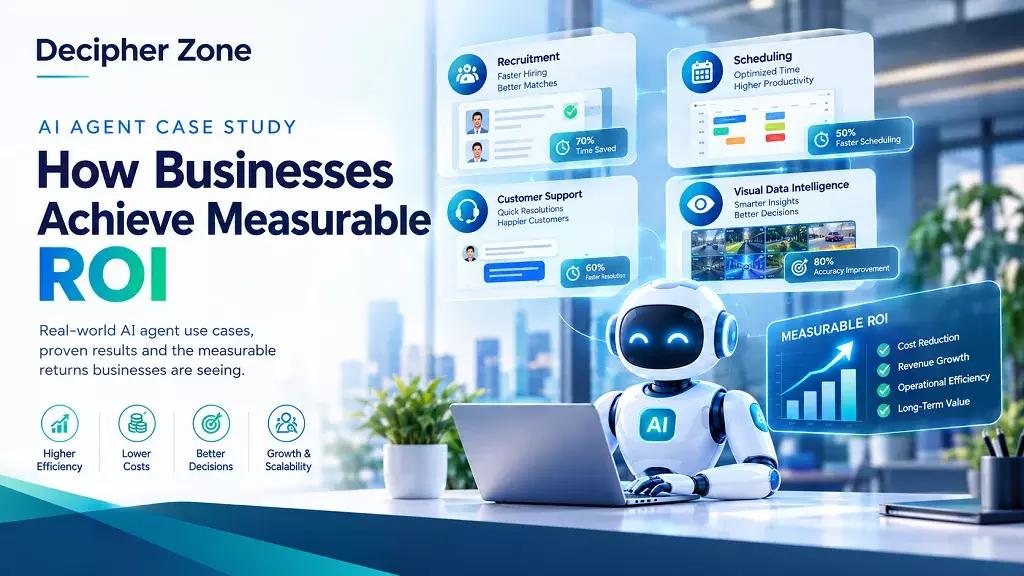
AI agents are everywhere right now, but most businesses still can't answer a simple question: is it actually paying off? This piece breaks down what AI agent ROI really means, how to measure it properly, and walks through four real case studies, from recruitment to scheduling to visual data intelligence, to show what measurable returns actually look like in practice.
Businesses no longer ask “Can AI do this?” Instead, they ask “What measurable business result will we get if we deploy AI?
This shift matters because an AI demonstration can quietly save hours, reduce errors, accelerate decisions and create measurable operational value every day.
Recent research reflects this transition:
-
Forty percent of respondents from large organizations with annual revenues over $1 billion report scaling AI agents, up from 27 percent the year before.
-
88% of agentic AI early adopters report ROI from generative AI on at least one use case, compared with a 74% average across all organizations surveyed.
This guide will let you explore how businesses prioritize AI Agent ROI, the process to measure and AI agent case studies from Decipher Zine Technologies. These business applications built by our team show that AI ROI does not always begin with revenue generation but it also reduces operational friction and creates capacity for higher value work.
Why AI Agent ROI Has Become a Business Priority
It has been several years since businesses have been adopting AI agents but are those agents actually returning in hours saved, costs reduced or revenue influenced? AI agents are handling real workflows, customer interactions, and operational tasks that used to require dedicated headcount. When a system takes on that much responsibility, it earns the same scrutiny as any other business investment.
Read: AI Agents for Healthcare
There's also a budget reality behind this, like AI initiatives are competing for the same finance approval as every other line item and CFOs are asking for payback timelines. Businesses that can show measurable ROI get funded for the next phase. Small or low budget businesses that can't are the first to get their budgets cut when priorities tighten.
Simply put, AI agent ROI has stopped being a nice-to-have metric and become the deciding factor in whether an AI initiative scales or stalls.
How to Measure Agentic AI ROI
Measuring AI agent ROI is similar to measuring ROI on any operational investments. You need to compare what you spent against what you gained, then express it as a ratio or percentage. Here’s a clearer picture of how to do it:
1. Start with full cost
The full cost includes platform fees, API usage, integration work, staff time spent training, monitoring the agent, workflow redesign and compliance or security review needed before launch.
2. Track the value the agent actually creates
Break the value into a few buckets for better understanding, time saved (hours no longer spent on task), cost avoided (reduced need for additional hires, overtime or outsourced work), revenue influenced (faster response times, higher conversion or upsell opportunities the agent enabled) and quality gains (fewer errors, faster resolution times and better consistency).
3. Use a simple ROI formula
There is a formula you can use, (value gained minus total cost) divided by total cost. Run this calculation at set breaks for example, 90 days and then annually. Organizations usually get more comfortable with agent performance and adoption.
4. Watch payback period
Usually, a high return on investment (ROI) that takes two years to achieve is different from a modest ROI that pays back in three months. Most organizations focus more on the faster return when deciding whether to expand the agent to other companies.
5. Separate pilot metrics from scaled metrics
An agent running on one system looks different from the same agent deployed company-wide. Cost per unit often drops at scale but so can the quantity of oversight. ROI needs to be re-measured at each stage instead of assumed to hold steady at all stages.
AI Agent Business Case Study
Till now, you might be confused by the numbers. This section explains with the real test what happens when an AI agent gets dropped into an actual business problem, with real data, real workflow and real stakes.
AI Agent Case Study 1 — Vissibl AI
Vissibl AI is an AI based computer vision and visual intelligence platform that is designed to help businesses turn large volumes of images and video data into concrete insights.

The Challenge: Businesses across various industries collect huge volumes of images and video but reviewing them manually is slow, expensive and inconsistent and it stays the same as the volume grows. The client needed a system that could process thousands of images accurately while also making that data searchable and useful.
The Solution:
Our team built a cloud-native platform that combines computer vision, vector search and large language models. Images are analyzed automatically, metadata gets extracted, anomalies get flagged and everything is indexed for search. Users can simply ask questions in plain language and get relevant results back. This stack includes RAG, pgvector and Azure Blob Storage.
The Impact: It shows up in areas like, less time spent on manual inspection, faster processing, more consistent accuracy and quicker decision making across teams. The real cost is the infrastructure, storage, retrieval and maintenance built around it and that’s where the ROI calculation needs to begin.
Read: AI Agent Development Cost in 2026
Case Study 2 — Teamicate
Teamicate is an AI powered group scheduling platform designed to simplify meeting coordination by integrating calendars, managing events and identifying suitable meeting times.

The Challenge: Teamicate tackles a problem for developed companies like coordinating meetings across teams, calendars, time zones and competing schedules. The friction shows up as scheduling conflicts, manual back-and-forth hustle, fragmented calendars, missed meetings and lower team productivity.
The client wanted more than another calendar app. The client wanted a system that helps them automate the planning work smoothly.
The Solution: The system developed pulls multiple calendars into one view and uses AI to suggest meeting times that actually work for everyone. This way, the platform handles conflict detection, availability management and event scheduling.
It also layers a conversational assistant so users can ask for a time slot. This system is built on React.js, TypeScript, Redux, OpenAI and Botpress AI. The project shows that an agent does not need to take over an entire workflow to be valuable.
The Business Impact: At first, this doesn’t feel like a use case but when it’s frequent, repetitive and easy to measure, it becomes a strong ROI candidate. For the client, the result includes less time spent coordinating meetings, fewer conflicts, better calendar visibility and more employee time freed up for actual work.
Case Study 3 — Humanr AI
Humanr AI is a customized AI software solution, helping businesses build intelligent tools tailored to their specific operational and audience needs. In this AI system, our team has combined AI chatbots, conversational AI and business specific knowledge which enables businesses to automate workflows, improve customer experience and deliver more personalized AI based interactions.

The Challenge: Chatbots generally run into the same wall and don't know your business. They can answer broad questions but fall short on your terminology, specific processes and your internal knowledge. Organizations can create AI assistants trained around their own operational context using Humanr AI.
The Solution: This AI platform delivers customized assistants powered by OpenAI models that are built to hold context-aware conversations grounded in a company’s actual knowledge base.
Humanr AI is designed for fast deployment and scalable use across customer service, internal support and other heavy information workflows, with secure data handling built in. The core idea behind building this system is to have an assistant that understands how your business actually talks and operates.
The Business Impact: The result mainly is speed and workload. This system eases response time, operational workload and improves customer engagement through more personalized interactions.
Another focus it did was to separate a chatbot from a workflow. Humanr AI shows what the entire process looks like when AI is tied to real organizational knowledge. It can finish tasks like a customer getting resolved faster or an employee skipping three Slack messages to find an answer.
Read: Best Frameworks for Building AI Agents in 2026
Case Study 4 — DZ Skill Scout
DZ Skill Scout is an AI-driven recruitment intelligence software to automate resume screening and improve candidate-job matching. The system uses AI resume parsing, semantic search, RAG and intelligent JD matching to understand candidate skills, projects, experience and domain expertise beyond simple keyword matching.

The Challenge: The recruitment process catches keywords but they miss the deeper context. For example what a candidate actually did on a project, which technologies they touched and how relevant their experience really is to the role. To fill this gap, DZ Skill Scout was built to automate that screening.
The Solution: The system parses resumes automatically, extracts structured candidate data and embeddings, and lets recruiters search using plain language. It goes deeper than most tools by indexing project-level detail so that recruiters get a real sense of what a candidate has worked on.
The Business Impact: The result showed up directly in recruiter workload including faster screening, less manual effort, and more accurate candidate matching. Recruitment’s real problem was understanding them well enough to find the right person.
That's the kind of specific, well-defined bottleneck that makes AI agent ROI easy to prove, because you can track screening time, candidates reviewed per recruiter and how often a recommendation needs manual correction directly.
What These AI Agent Case Studies Have in Common
Across the case studies, each one has different problems, different industries but the same underlying pattern shows up in each one.
-
Solves one well-defined limitation: Each solves the specific problem instead of hoping value would appear broadly or in general.
-
Turn unstructured data into searchable: In every case, the AI agent’s real contribution was structuring information whether through embeddings, metadata extraction or semantic indexing. This let people ask direct questions and expect direct answers.
-
Reduce manual effort without removing human judgement: The agentic AI removes the repetitive, low judgement work around those decisions where the kind of task that eats hours without needing a human’s full attention.
-
The AI model is the smallest part of the build: This is a useful reality check for anyone estimating cost, as every project leaned on production infrastructure including databases, vector search, authentication, dashboards and integration work.
-
Outcomes were measurable from day one: Each business case was built around metrics that existed before the AI was deployed and tracked after. These systems allowed faster screening time, fewer scheduling conflicts, quicker response times and higher inspection accuracy.
The Role of Data, Integration, and Governance
AI agents cannot create reliable business value from unreliable information. ROI equation involves data quality, accessibility, integration, security and governance.
The agent requires access to the right business data to retrieve current information and to fragmented systems otheerwise its usefulness will be limited even if an organization has an excellent AI model.
This is why several of the Decipher Zone projects include technologies like vector databases, RAG, cloud storage, APIs, knowledge-base integration, and structured databases.
Businesses need to know when an AI agent should act independently and when a human should take over in governance matters. A well-designed system can automate routine decisions while escalating ambiguous or high-risk cases. This creates a balance between automation and control. The goal is not maximum autonomy; it is maximum useful autonomy within an acceptable risk boundary.

Conclusion
AI agent ROI isn’t about how advanced the model is but how it solves a real problem, plugs into how people already work and gets measured from day one.
Read: Custom AI Chatbot vs Off the Shelf
The case studies here made that clear. None of them started with the AI agent. They started with a specific, expensive problem and worked backward to a solution.
-
VissiblAI proved visual data doesn’t have to stay unusable at scale
-
Teamicate showed that even ordinary and unstructured workflows can return real time
-
Humanr AI showed that context turns a chatbot into something teams actually rely on
-
DZ Skill Scout showed what happens when AI targets the exact problem and understands candidates instead of just reading resumes.
If you’re starting to evaluate where an AI agent could fit into your own operations, the starting point is not picking a model or vendor but naming what the real bottleneck is clearly in real numbers and whether the fix worked.
That’s the kind of AI agent development projects Decipher Zone Technologies builds. Grounded in a specific business problem, built on production-ready infrastructure and measured against outcomes that matter from the beginning.
FAQs
-
What is AI agent ROI?
AI agent ROI is a measurable return a business gets from deploying an AI agent, weighed against what it cost to build, integrate and deploy. This includes time saved, costs avoided, revenue influenced and quality improvement.
-
How do businesses measure the ROI of AI agents?
You can measure the ROI of an agentic AI business case by setting a baseline before deployment, tracking specific metrics like time saved or accuracy improved after launch and comparing the value gained against the total cost. The total cost can include infrastructure and maintenance costs.
-
What are the best AI agent use cases for businesses?
Any repetitive, high volume, heavy information tasks are the best AI agent use cases for businesses. Whether it is candidate screening, meeting scheduling, visual data inspection, customer support and internal knowledge retrieval.
-
Can AI agents generate ROI without replacing employees?
Yes, most high ROI AI agents remove repetitive, low-judgment work while leaving decisions to people. Recruiters still hire, employees still confirm meetings, teams still act on flagged issues. The agent creates value by freeing that time up not by replacing the role.
-
How long does it take for an AI agent to deliver ROI?
The timeline varies by use case, most focused AI agent development delivers ROI within 90 days to 12 months, with a clear picture after a year. Payback period matters more than the eventual ROI percentage because a fast, modest return is often more valuable than a slow and larger one.
About the Author: Mahipal Nehra manages content at Decipher Zone Technologies and works closely with the AI engineering team across live project delivery. He has spent the last six years documenting real AI and software development projects cost structures, architecture decisions, client outcomes for an audience of CTOs, product leads, and engineering managers. Follow on LinkedIn.
AI Development Services | Generative AI Development | AI Agent Development | Custom AI Solutions | AI Chatbot Development | Machine Learning Solutions | Data Analytics Solutions | Business Intelligence Applications | MLOps Services | AI Consulting | Custom Software Development | Web App Development | Mobile App Development | SaaS Development | E-commerce Development | Enterprise Software Development | Cloud Application Development | UI/UX Design | Full Stack Developers | Product Engineering | Software Modernization | API Development | QA & Support