Quick Summary
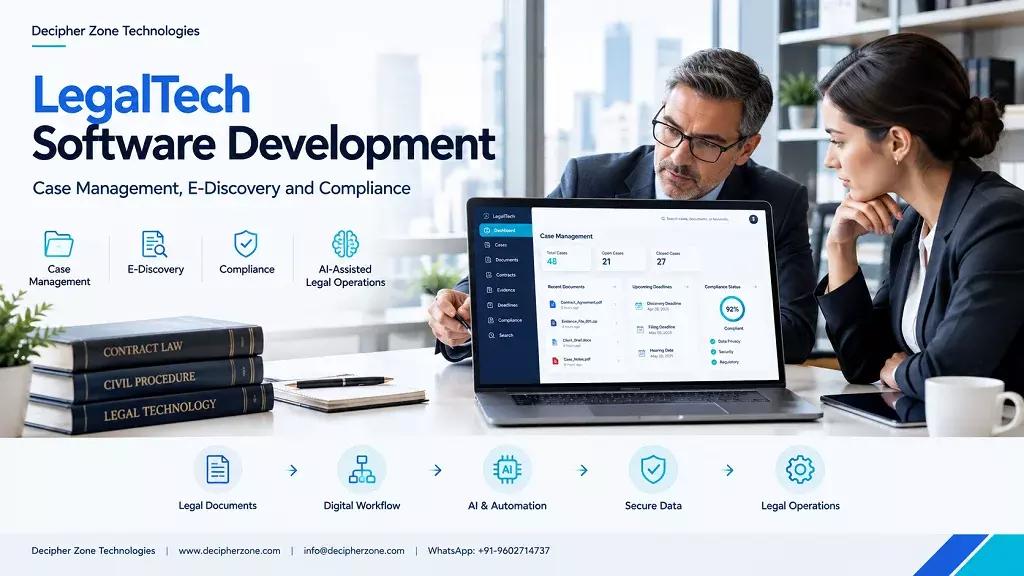
The legal tech market is racing, so should you. This article explores how LegalTech software development combines AI, automation, secure data management, document intelligence, and modern workflows to transform legal operations. Discover what it takes to build LegalTech software, what it costs, how long development takes, and how custom solutions can turn complex legal processes into smarter digital experiences.
Legal work has always been heavily dependent on information as a single matter can involve contracts, emails, court filings, evidence, research notes, client communications, deadlines, billing records, regulatory requirements and thousands of other documents.
Grand View Research values the global legal technology market at USD 28.7 billion in 2025, projecting it to grow to USD 31.1 billion in 2026 and reach USD 69.7 billion by 2033, a 12.2% compound annual growth rate.
This is the backdrop against which LegalTech software development has moved from a niche specialty to a minimum engineering discipline, one where the choices made early in a build such as architecture, security model and integration with existing case management systems, determine whether a platform actually holds up under a law firm’s daily demands.
Read: Software Development Approach in 2026
What is LegalTech Software Development?
LegalTech software development is the process of designing, developing, integrating, and maintaining software that supports legal work, legal operations, compliance activities, or interactions between legal professionals and their clients.
The main objective is to turn legal workflows into structured digital processes without losing the human judgement required in legal practice. LegalTech software can automatically organize documents, extract contract clauses, identify deadlines, route approvals, retrieve relevant data, generate drafts or summarise large datasets.
The lawyer or legal professional remains responsible for reviewing data and making judgements while software reduces repetitive administrative tasks.
Top 8 Major Types of LegalTech Software
LegalTech is basically a category which involves distinct types of software, each developed to solve a specific area in how legal work actually gets done. The types of legalTech software involve case and practice management software, contract management software, e-discovery software, document automation and management software, legal research software, e-billing and legal accounting software, compliance management software and AI-powered legal analytics.
1. Case & Practice Management Software
It is the backbone of most legal operations. This type of legalTech software brings together case files, deadlines, court dates and internal notes into one system. This ensures nothing falls through the cracks when a matter moves between attorneys or spans months of activity.
Legal organizations usually use it to track billable hours, assign tasks and keep a full history of every case in one searchable place.
2. Contract Management & Automation Software
This type of software basically is built to reduce legal risk. It automates drafting from approved templates, tracks clauses across hundreds of active agreements, flags renewal dates before they’re missed and routes documents through approval workflows and endless email chains.
This is one of the fastest-growing segments in the market due to contract reviews used to take high billable hours for so little strategic value.
3. E- Discovery Software
In the legal process, an enormous amount of digital evidence, emails, chat logs, documents and more is generated and sorted through it manually. This type of platform uses search, filtering and AI assisted review to help legal teams identify relevant material fast, without missing something that could matter in court.
4. Document Automation & Management Software
This type of software standardizes document creation from templates, keeps version history intact and makes retrieval quick that matters a lot when a document needs to be pulled mid-negotiation or mid-hearing.
Read: Software Developer Skills Every Developer Must Have
5. Legal Research Software
This type of tool uses natural language processing to surface relevant case law, statutes and precedent that often rank results by how closely they match the specific facts of a case instead of matching terms.
6. E-Billing & Legal Accounting Software
Billing in legal services is complex because of different rates by attorney, matter and client and strict compliance rules around trust accounting. Custom billing software handles this complexity directly by generating accurate invoices and giving firms a clear view of revenue without manual reconciliation.
7. Compliance Management Software
This type of software tracks obligations across jurisdictions, flags upcoming regulatory changes and helps document compliance efforts in a way that holds up if a regulator ever comes asking, especially for corporate legal teams.
8. AI Driven Legal Analytics
This type of software analyzes past case outcomes, judge tendencies and settlement patterns to help attorneys build stronger strategies and set realistic expectations with clients before a case even goes to trial.
AI in LegalTech Software Development
According to Thomson Reuters’ 2025 Generative AI in Professional Services Report, 26% of legal organizations are now actively using generative AI, up from just 14% the year before, and 78% of law firm respondents believe it will be central to their workflow within the next five years.

What you can really do in a few areas where AI is doing real work inside LegalTech platforms are:
-
Contract Analysis & Review: AI models are trained in a way on legal language that allows scanning contracts in seconds, flagging non-standard clauses, comparing terms against a firm’s playbook and surfacing risk that a human reviewer might catch only after several passes.
-
Predictive Legal Analysis: AI agents in legalTech can help attorneys estimate how a case might play out before it goes to trial by analyzing historical case outcomes, judge rulings and settlement patterns. This allows forecasting which used to depend entirely on individual experience.
-
Legal Research Assistants: These AI powered tools understand the actual facts of a case and surface relevant precedent based on similarity of reasoning. This reduces time which matters a lot when research is billed by the hour but clients want fixed fees.
-
Document Automation & Drafting: AI agents can easily produce first drafts of routine filings, NDAs and correspondence from a short prompt or a set of case facts, leaving attorneys to review and refine instead of drafting from a blank page.
-
Chatbots & Virtual Legal Assistants: AI assistants handle intake, answer routine questions and triage requests before they reach a human. This matters most for firms and legal aid organizations trying to serve more clients without adding headcount.
How Much Does LegalTech Software Development Cost?
The custom legalTech software development cost ranges from $25,000 to 300,000+, depending heavily on how much compliance, security and integration work the platform needs.

The cost breakdown for custom software development in 2026 is like,
-
A focused MVP typically runs $25,000 to $80,000 and takes two to four months to build.
-
A mid-complexity platform, one with multiple user roles, integrations, and a more developed feature set, lands somewhere between $80,000 and $250,000.
-
Full enterprise-grade systems, the kind large firms or corporate legal departments need, commonly exceed $250,000 once advanced security, scalability, and regulatory requirements are factored in.
Read: High-Demand Jobs in Software Development
Factors that Influence the Legaltech Software Development Cost
This is not just the basic factors but a few things that tend to separate legal software budgets from a standard business application.
-
Compliance & Data Security: Compliance is usually the baseline requirements that add real engineering time as these legal software systems handle privileged, confidential or regulated information. This makes encryption, access controls and audit trails more important.
-
Integrations with Existing Systems: Many legal organizations already run case management, billing or document systems, rather than replacing they want a system that connects it to new software that adds scope that’s easy to underestimate early on.
-
AI Capabilities: Contract analysis, predictive analytics or AI-assisted research add cost, these features add cost for the AI layer itself and for the extra testing needed to keep output accurate and explainable.
-
User Roles & Permissions: Attorneys, paralegals, clients and administrators need various views and access levels within the same platform which adds complexity to both design and backend logic.
What are the Challenges in LegalTech Software Development
Developing any software looks easy from the outside, but in practice they often carries constraints that are skipped. In legal software, how a project ends up matters as it can be over budget delayed or unusable once it reaches real firms. Look at these challenges in legalTech software development:
1. Managing Large Volumes of Legal Documents
Legal platforms hold some of the most sensitive information a business can store: privileged communications, litigation strategy, financial records, M&A documents. That makes them a real target.
Any LegalTech platform has to be built with encryption, access controls, and audit logging from day one, not added after a security review flags gaps.
2. Regulatory Complexity Across Jurisdictions
The rules that govern how legal software can handle information, retain records and support client communication can be challenging. A platform developed for firms operating across states or countries has to account for differing bar rules, data residency requirements and privacy regulations that adds real complexity to the data architecture and the feature set as well.
3. Integrating with Legacy Systems
This is one of the most common challenges as new software rarely gets to start from a clean slate. It has to connect to the existing system, migrate historical information accurately and avoid disrupting workflows attorneys have relied on for a long period of time. This integration work is frequently underestimated in early project planning and it's one of the most common reasons timelines slip.
4. AI Accuracy & Explainability
Building AI into legal software means investing heavily in validation, source citation and human review checkpoints that take more engineering effort than a general AI-featured software would. Like a hallucinated citation or a fabricated case reference isn’t a minor bug, it can have real professional consequences for the attorney relying on it.
5. Getting lawyers to Actually Adopt It
Legal professionals need to be cautious about new tools, understandably, given the stakes involved in getting something wrong. One of the challenges is that software that changes established workflows without a clear and immediate benefit tends to sit unused. Design for actual attorney workflows and not just technical requirements because it matters as much as the engineering itself.
6. Staying Within Scope Without Cutting Corners
Balancing many features against a realistic budget and timeline like AI research, contract automation, compliance tracking, and client portals. The firms that get the best results are usually the ones who are willing to build in phases, like starting with a focused MVP instead of trying to launch every feature at once.
How to Choose a LegalTech Software Development Company
Thinking of developing LegalTech software but without a software development company is missing an important part. What actually determines whether a project succeeds is whether the team understands the legal context it’s building for, the compliance stakes, the security requirements, the way attorneys work daily. Look for:
-
Proven experience with compliance-heavy software: Ensure the development partner understands data privacy regulations, secure architecture and the kind of access control legal data demands.
-
Real AI & machine learning capability: Ask specifically about their AI development background as it matters whether an AI development company has actual AI development experience or just a willingness to integrate an off-the-shelf API.
-
Transparent and predictable pricing: A trustworthy development partner is upfront about rates and structure, whether it’s hourly, monthly or a fixed project.
-
Flexible engagement models: Check what software development agencies offer in terms of engagement models. Usually ideal development vendors offer flexible models and adjust to what the project actually needs instead of using a one-size-fits-all process.
-
Post-launch support: Regulations change, integrations need updates and security has to be maintained continuously. Choose a development agency that offers ongoing support before signing anything.
Read: Nearshore Software Development
Decipher Zone Technologies fits well for firms evaluating a development partner. Our team offers custom software and AI development services with hands-on experience building secure, compliance-aware platforms and integrating AI capabilities like the ones covered earlier in this article, contract analysis, predictive analytics, and intelligent document automation, directly into client software.

Conclusion about LegalTech Software Development
Legaltech nowadays doesn’t leave room for firms sitting on the sidelines. You need to build smart now with AI woven in from the start.
The build itself isn't simple. Compliance, security, legacy integrations, and AI accuracy all raise the bar higher than most software projects. But none of that is a reason to wait. It's a reason to build with a team that already understands the stakes.
If you're ready to move from planning to building, Decipher Zone Technologies can help you scope, design, and develop LegalTech software that fits your firm's actual workflow, starting with a transparent MVP estimate from $25,000. Get in touch to talk through your project.
FAQs for LegalTech Software Development
What is custom legalTech software development?
Custom legalTech software development involves developing tailored technology and it is built around a firm’s actual workflows, compliance requirements and existing systems. The types of legal software include case management systems, contract automation tools, e-discovery platforms and AI-powered research tools.
How is AI used in LegalTech?
AI is used in LegalTech to automate time-heavy legal processes like Contract Analysis & Review, Predictive Legal Analysis, Legal Research Assistants, Document Automation & Drafting, Chatbots & Virtual Legal Assistants. It integrates technologies like natural language processing (NLP), large language models (LLMs), machine learning, and retrieval-augmented generation (RAG) to assist legal professionals while keeping human review involved in important decisions.
How long does it take to build LegalTech software?
LegalTech software development typically takes around 3 to 9 months for a custom application, while the timeline depends on the software's features, complexity, integrations, AI requirements and compliance needs. A basic LegalTech MVP with core case or document management functionality may take 3–4 months, while a complex platform with AI, advanced security, multiple integrations, and enterprise workflows can take 6–9 months or longer.
How much does LegalTech software development cost?
The custom legalTech software development cost ranges from $25,000 to 300,000+, depending heavily on how much compliance, security and integration work the platform needs. Factors may include Compliance & Data Security, Integrations with Existing Systems, AI capabilities, and User Roles & Permissions.
Is LegalTech software secure?
Yes, LegalTech software is secure when it is built with appropriate security measures, data protection practices and compliance requirements from the beginning. Security measures can include data encryption, secure authentication, role-based access control, audit logs, secure APIs, vulnerability testing and controlled access to confidential legal data.
About the Author: Mahipal Nehra manages content at Decipher Zone Technologies and works closely with the AI engineering team across live project delivery. He has spent the last six years documenting real AI and software development projects cost structures, architecture decisions, client outcomes for an audience of CTOs, product leads, and engineering managers. Follow on LinkedIn.
AI Development Services | Generative AI Development | AI Agent Development | Custom AI Solutions | AI Chatbot Development | Machine Learning Solutions | Data Analytics Solutions | Business Intelligence Applications | MLOps Services | AI Consulting | Custom Software Development | Web App Development | Mobile App Development | SaaS Development | E-commerce Development | Enterprise Software Development | Cloud Application Development | UI/UX Design | Full Stack Developers | Product Engineering | Software Modernization | API Development | QA & Support