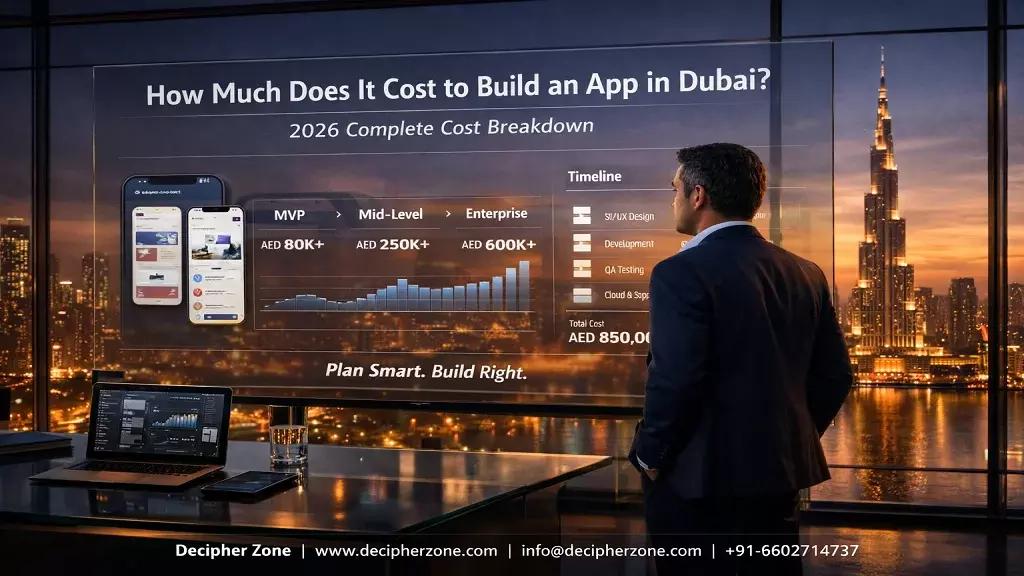
Two Dubai founders came to us in the same month with the same goal: a service marketplace app for the UAE. One had a clear MVP scope and a $30,000 budget. The other had $200,000 and wanted "everything." The first launched in four months, generated paying customers, and used that revenue to fund the next feature. The second is still in development. Budget does not determine outcome. Clarity does.
Quick answer: Mobile app development in Dubai costs between AED 18,000 ($5,000) for a basic MVP and AED 1,470,000+ ($400,000+) for a complex enterprise platform with full UAE compliance and AI features. The most common mid-level business app investment is AED 92,000 to AED 294,000 ($25,000 to $80,000). Read on for the full 2026 breakdown.
This guide gives you accurate 2026 cost figures for building a mobile app in Dubai, the factors that drive them up, the hidden expenses that routinely blow budgets, and a framework for making the single most important financial decision: local Dubai agency versus offshore engineering.
Read: Mobile App Development Services | Mobile App Development Process | Mobile App Development Challenges
Building an app for the Dubai or UAE market?
Get a free detailed cost estimate from Decipher Zone within 24 hours.
The Dubai Mobile App Market in 2026
The UAE mobile app market is projected to exceed AED 800 million by 2027. Consumer app spending globally touched $156 billion in 2025, with the UAE contributing a disproportionate share given its 99% smartphone internet penetration rate. Dubai's smart city agenda, the expansion of DIFC as a global fintech hub, and a population with high digital spending power make it one of the most commercially attractive markets in the world for a well-built mobile product.
What makes Dubai operationally distinct from building for London or New York is the regulatory environment. The UAE Personal Data Protection Law (PDPL), TDRA compliance standards, and the UAE Cybercrime Law create obligations that are not optional and are not the same as GDPR or CCPA. Apps built without these requirements factored in from day one require expensive remediation post-launch or face rejection from UAE government procurement processes.
Labour costs represent 50 to 70% of any mobile app build. Apps are compounding at approximately 14% CAGR while development costs are rising below 4% annually, meaning a well-executed UAE app typically recovers its build cost within 12 to 18 months through conservative monetization.
Mobile App Development Cost Overview: Dubai 2026
The cost to build a mobile app in Dubai ranges from AED 18,000 ($5,000) for a basic proof-of-concept to AED 1,470,000+ ($400,000+) for a complex enterprise platform with full UAE regulatory compliance and AI features. The table below reflects what UAE businesses are actually investing in 2026, not theoretical minimums.
| App Tier | Cost (USD) | Cost (AED) | Timeline | What Is Included |
|---|---|---|---|---|
| Basic MVP | $5,000 to $25,000 | AED 18,000 to AED 92,000 | 6 to 12 weeks | Single platform, 3 to 5 screens, login, profiles, push notifications, minimal backend |
| Mid-Level App | $25,000 to $80,000 | AED 92,000 to AED 294,000 | 2 to 5 months | Cross-platform iOS and Android, 8 to 15 screens, payment gateway, dashboards, custom UI/UX |
| Complex App | $80,000 to $200,000 | AED 294,000 to AED 735,000 | 5 to 9 months | Native or Flutter, 20+ screens, real-time data, CRM integration, AI features, multi-user roles |
| Enterprise Platform | $200,000 to $400,000+ | AED 735,000 to AED 1,470,000+ | 9 to 18 months | Full AI/ML, blockchain, admin dashboard, cloud infrastructure, PDPL compliance architecture |
Why these ranges are higher than some quotes you will see
Hidden costs consistently consume 45 to 70% of the initial development budget when maintenance, marketing, and hosting are factored across year one. The number your development partner quotes is the build cost. Total cost of ownership in year one is typically 1.5 to 2 times that number. Any quote measurably below the ranges above is cutting something you will pay for later.

Platform Cost Breakdown
Android, iOS, and cross-platform compared
| Platform | Cost Range (USD) | Cost Range (AED) | Saving vs Native Dual | Best For |
|---|---|---|---|---|
| Android only | $5,000 to $100,000 | AED 18,000 to AED 367,000 | Baseline | Wider GCC audience, enterprise Android deployments |
| iOS only | $6,000 to $110,000 | AED 22,000 to AED 404,000 | Baseline | Premium Dubai consumer apps. iOS users have higher spending power. |
| Native dual (iOS + Android) | $30,000 to $220,000 | AED 110,000 to AED 808,000 | 0% (highest cost) | Hardware-intensive apps needing deep platform access |
| Flutter (cross-platform) | $10,000 to $150,000 | AED 37,000 to AED 551,000 | 25 to 45% saving | Startups, service marketplaces, most business apps |
| React Native (cross-platform) | $10,000 to $140,000 | AED 37,000 to AED 514,000 | 20 to 40% saving | Teams with JavaScript expertise, content-heavy apps |
Over 60% of new Dubai apps in 2026 are built cross-platform to optimize costs and reach, according to Riseup Labs' 2026 analysis. For most UAE businesses, Flutter is the right default. The 25 to 45% cost saving is significant, the performance gap from native is imperceptible for most commercial use cases, and the single codebase simplifies ongoing maintenance.
Read: Flutter App Development | React Native Development | Cross-Platform App Development
Cost by App Type in Dubai
| App Type | Cost (USD) | Cost (AED) | Core Complexity Driver |
|---|---|---|---|
| eCommerce | $8,000 to $60,000 | AED 29,000 to AED 220,000 | Catalogue, cart, payment gateway, order tracking |
| On-Demand Services | $30,000 to $150,000+ | AED 110,000 to AED 551,000+ | Real-time GPS, dynamic pricing, multi-user roles, scheduling |
| Fintech and Payments | $50,000 to $250,000+ | AED 184,000 to AED 918,000+ | PDPL, PCI DSS, biometric auth, payment integration |
| Healthcare | $50,000 to $250,000+ | AED 184,000 to AED 918,000+ | Data encryption, identity verification, regulatory compliance |
| Real Estate | $25,000 to $120,000 | AED 92,000 to AED 441,000 | Property listings, AR/VR tours, map integration, AI recommendations |
| Tourism and Hospitality | $20,000 to $100,000 | AED 73,000 to AED 367,000 | Booking systems, multilingual, GPS, real-time updates |
| Social Media | $100,000 to $300,000+ | AED 367,000 to AED 1,102,000+ | Real-time messaging, media sharing, live streaming |
| Fitness and Wellness | $15,000 to $80,000 | AED 55,000 to AED 294,000 | Workout tracking, wearable integration, video tutorials |
| EdTech | $20,000 to $100,000 | AED 73,000 to AED 367,000 | Content delivery, quizzes, progress tracking, AI tutor |
| Gaming | $20,000 to $70,000 | AED 73,000 to AED 257,000 | Advanced graphics, game engine, real-time interactions |
Read: eCommerce App Development | On-Demand App Development | Fintech App Development | Healthcare App Development

AI App Development Cost in Dubai (2026)
AI is no longer a premium add-on in 2026. It is becoming a competitive baseline for UAE apps in fintech, ecommerce, real estate, and customer service. The cost depends entirely on which type of AI you integrate and how.
AI feature cost ranges for Dubai apps
| AI Feature | Implementation | Added Build Cost | Ongoing API Cost |
|---|---|---|---|
| AI chatbot in English and Arabic | OpenAI API or Claude API | $8,000 to $20,000 | $200 to $2,000 per month |
| Personalization engine | AWS Personalize or custom ML | $15,000 to $50,000 | $300 to $1,500 per month |
| Computer vision or image recognition | Google Vision API or CoreML | $10,000 to $35,000 | $100 to $800 per month |
| On-device AI (offline inference) | Apple Core ML or Google ML Kit | $12,000 to $40,000 | No ongoing API cost |
| Predictive analytics or fraud detection | AWS SageMaker or TensorFlow | $25,000 to $80,000 | $500 to $3,000 per month |
| Arabic NLP processing | Custom Arabic NLP model or API | $20,000 to $60,000 | $200 to $1,500 per month |
A practical note: the AI features that deliver the best early ROI for UAE apps are the simpler API-based ones. An AI chatbot that handles 80% of customer queries in both English and Arabic reduces support costs measurably from month one. A fully custom ML pipeline takes six months to build and twelve months to generate a return. Start with API-based AI features. Move to custom models when you have sufficient user data to train them.
Read: AI-Enabled Software Development | Latest Trends in AI
Dubai-Specific Cost Factors That Other Markets Do Not Have
Arabic RTL Design and Localization
What RTL actually adds to your budget
Arabic right-to-left support is not a font swap. It requires redesigned navigation flows, mirrored layouts, icon flipping, bidirectional content rendering, and a separate QA pass across every screen in both languages. The practical additions are real.
- UI/UX redesign for RTL: 15 to 25% additional design time
- Development implementation of RTL: 8 to 15% additional development hours
- Separate Arabic language QA pass: required for every feature
- Content translation and cultural review: $2,000 to $8,000 depending on content volume
Apps that skip proper Arabic localization lose adoption from Emirati and Arabic-speaking resident users. In a market where Arabic is the official language and RTL is the expected standard for government and enterprise apps, this is not an aesthetic decision. It is a retention decision.
UAE Regulatory Compliance: PDPL, TDRA, Cybercrime Law
What each regulation requires in code
- UAE Personal Data Protection Law (PDPL): Consent mechanisms, data subject rights (access, correction, deletion), breach notification procedures, and a documented data processing inventory. For fintech and healthcare, sectoral rules add further requirements.
- TDRA standards: Technical requirements for apps in telecommunications, VoIP, and digital government services. Government system integration requires TDRA approval.
- UAE Cybercrime Law: Security obligations for apps handling user data. Inadequate security leading to a breach creates legal liability for the app operator. Penetration testing is not optional in this context.
Compliance architecture built in from sprint one adds 15 to 20% to total build cost. Retrofitted after launch, it costs three to five times more. Read our data protection and compliance guide for technical implementation detail.
UAE Payment Gateway Integration
Standard global gateways have limited UAE coverage. UAE apps typically require regional integration. Each adds cost.
- PayTabs: AED payments, card, Apple Pay. Preferred for GCC ecommerce.
- Noon Pay: Strong UAE market penetration, regional retail focus.
- Telr: Multi-currency GCC gateway with recurring billing.
- Network International: Preferred by UAE banks and large enterprises.
Each gateway integration adds $3,000 to $8,000 to development cost and $50 to $300 per month in subscription fees. Read our payment gateway integration guide for a full provider comparison.
Budget Allocation: Where Your App Investment Should Go
Most development quotes show a single number. They do not show how that number is composed internally, or where the overrun risk lives. Understanding the internal split helps you evaluate quotes honestly and identify which vendor is cutting corners.

Typical budget split for a mid-level UAE app
| Component | Percentage of Build Budget | Notes |
|---|---|---|
| UI/UX design including Arabic RTL | 15 to 25% | Consumer apps need the higher end. Enterprise tools can use the lower end. |
| Frontend development | 20 to 30% | Increases with animation complexity and custom components |
| Backend development and APIs | 25 to 35% | Real-time features, payment integration, and multi-role systems push this higher |
| QA and testing in both languages | 10 to 15% | Includes Arabic QA pass. Skipping this creates post-launch costs that exceed the saving. |
| UAE compliance and security architecture | 10 to 20% | Fintech and healthcare sit at the higher end. UAE PDPL applies to all. |
| Project management and communication | 5 to 10% | Higher for distributed teams. Lower for co-located teams. |
A quote that allocates less than 10% to design on a consumer-facing app is a red flag. A quote that allocates zero to compliance on a fintech app is a different kind of red flag. Use this split to read the quote behind the number.
Read: Software Development Cost Estimation | Project Management Best Practices
Developer Hourly Rates in Dubai vs Offshore (2026)
This is the decision most UAE businesses underresearch. The hourly rate gap between local Dubai and offshore engineering is the single most impactful cost lever available, with no intrinsic quality trade-off when the offshore partner is selected correctly.
| Seniority | Local Dubai Rate | Offshore India Rate | Decipher Zone Rate | Saving |
|---|---|---|---|---|
| Junior Developer | $25 to $60/hr | $8 to $20/hr | $25 to $35/hr | 50 to 65% |
| Mid-Level Developer | $60 to $100/hr | $20 to $45/hr | $30 to $42/hr | 40 to 60% |
| Senior Developer | $90 to $150/hr | $38 to $65/hr | $40 to $49/hr | 45 to 60% |
| AI/ML or DevOps Specialist | $100 to $200/hr | $45 to $90/hr | $42 to $49/hr | 50 to 70% |
Quality development teams outside Dubai save 30 to 60% on project costs while delivering comparable output quality. Decipher Zone is headquartered in Jaipur, India. The time zone gap between Jaipur and Dubai is 1.5 hours, making the overlap window for UAE clients measurably larger than for US or UK-based offshore relationships. Daily standups, sprint reviews, and blocker resolution all fit comfortably within the shared working day.
Read: Software Development Outsourcing | Best Practices for Managing Offshore Teams

Key Factors Affecting Mobile App Development Cost in Dubai
App Complexity and Feature Set
Feature complexity is the dominant cost driver. Every additional feature adds development time, testing cycles, and sometimes third-party service fees. The relationship is not linear. A login screen adds two days. A real-time GPS tracking system adds four to six weeks. An AI recommendation engine adds three to four months. Understanding which features are genuinely required at launch versus which can safely be version-two features is the most valuable planning exercise before signing any development contract.
UI/UX Design Quality
In my experience reviewing project budgets across UAE app builds, the most consistent mistake is allocating 5 to 7% of total budget to design when 15 to 25% is appropriate for a consumer-facing app. The UAE app market is visually competitive. Users compare your product against Careem, Noon, and Talabat.
An app with adequate functionality but below-par design loses users within the first session. Allocating AED 15,000 to design on a AED 200,000 development project is not a saving. It is a false economy that shows up in churn numbers.
Read: UI/UX Design Trends | Enhancing User Experience
Development Team Expertise and Structure
An app development team for a mid-level UAE project typically includes a project manager, a UI/UX designer, a frontend developer, a backend developer, and a QA engineer. The composition shifts for complex projects: add a DevOps engineer for cloud infrastructure, a security specialist for fintech or healthcare compliance, and an AI engineer if the product includes ML features.
The team structure determines both cost and risk. A team that is too junior for the project complexity generates expensive rework. A team that is over-qualified for simple tasks is waste. The right structure matches seniority to task complexity.
Backend Infrastructure and Scalability
Apps serving UAE users increasingly require data residency within the UAE or GCC region for PDPL compliance and enterprise client requirements. AWS Middle East (Bahrain) and Azure UAE North are the two primary options.
Cloud hosting for a basic UAE app starts at $100 to $400 per month. High-traffic applications with multi-region replication run $1,500 to $8,000 per month.
Read: Cloud Computing Trends | Cloud Native Architecture
Third-Party Integrations and API Costs
Most UAE apps rely on third-party services: payment gateways, mapping, analytics, CRM, and government APIs. Each integration adds development time and ongoing subscription cost.
Common UAE integrations and their approximate costs per month are PayTabs at $50 to $150, Google Maps Platform at $0.005 to $0.01 per API call, Firebase Cloud Messaging at free to $300, and third-party analytics like Mixpanel at $0 to $500.
Read: API Development Guide | API Security Best Practices
Real Dubai Apps: Cost and What They Generated
Talabat: on-demand at scale
Talabat processes over 2 million orders per month in the UAE. A platform at this scale requires real-time GPS tracking, dynamic pricing, a multi-sided marketplace (customers, restaurants, delivery), a separate admin dashboard, payment processing across multiple methods, and push notification infrastructure.
An equivalent build today would cost $150,000 to $300,000 in initial development with ongoing infrastructure of $5,000 to $15,000 per month at volume. The revenue model: commission per order, delivery fees, and in-app advertising. The payback period for the initial build was well under 12 months.
Tabby: fintech compliance as the product
Tabby's buy-now-pay-later product integrates with UAE ecommerce platforms and processes installment payments under UAE Central Bank regulation. The fintech compliance requirements add $40,000 to $80,000 to a typical fintech build compared to an equivalent product without regulated payment features.
For Tabby, those compliance costs are not overhead. They are the product. Without PDPL and Central Bank compliance, Tabby cannot operate legally in the UAE. The compliance investment is also the moat.
D2C brand MVP: what a realistic first build looks like
A Dubai-based direct-to-consumer brand needed a cross-platform app for product browsing, cart, checkout with Noon Pay integration, and order tracking. Arabic RTL. Two platforms. Three-month build with a Flutter framework.
Total cost: AED 130,000 ($35,000). The app recovered its build cost in the first two months through conversions that the mobile website was not capturing.
Development Timeline for Dubai Apps
| Phase | Basic MVP | Mid-Level App | Complex App | Enterprise Platform |
|---|---|---|---|---|
| Discovery and compliance planning | 1 to 2 weeks | 2 to 3 weeks | 3 to 4 weeks | 4 to 6 weeks |
| UI/UX design including Arabic RTL | 2 to 3 weeks | 4 to 6 weeks | 6 to 10 weeks | 8 to 14 weeks |
| Frontend and backend development | 3 to 6 weeks | 8 to 14 weeks | 14 to 24 weeks | 24 to 40 weeks |
| QA testing in English and Arabic | 1 to 2 weeks | 2 to 4 weeks | 4 to 6 weeks | 6 to 10 weeks |
| App store submission and launch | 1 to 2 weeks | 1 to 2 weeks | 1 to 2 weeks | 2 to 3 weeks |
| Total | 6 to 15 weeks | 4 to 7 months | 6 to 11 months | 10 to 18 months |
Hidden Costs UAE Businesses Consistently Miss
Hidden costs consistently consume 45 to 70% of the initial development budget when maintenance, marketing, and hosting are factored across year one. Plan for these before the project starts, not after the first bill arrives.
Annual maintenance and updates
Annual maintenance typically costs 15 to 20% of the initial build cost, according to Riseup Labs' 2026 analysis. For an app built at $80,000, that is $12,000 to $16,000 per year in security patches, OS updates, bug fixes, and performance work. Budget this before the project starts.
Marketing and user acquisition
Year-one marketing typically equals 30 to 50% of the development budget. An app built at $80,000 needs $24,000 to $40,000 in App Store Optimization (ASO), Arabic-language digital advertising, and influencer partnerships to reach viable user numbers. Apps do not acquire users by existing.
App store fees and third-party subscriptions
- Apple App Store developer program: $99 per year
- Google Play Store: $25 one-time registration fee
- Payment gateway monthly fees: $50 to $300 per month depending on volume
- Google Maps Platform: $0.005 to $0.01 per API call
- Firebase Cloud Messaging: free to $300 per month
- Analytics platforms (Mixpanel, Amplitude): $0 to $500 per month
- Cloud hosting: $100 to $400 per month (small apps), $1,500 to $8,000+ (high traffic)
Security and compliance updates
UAE regulatory requirements evolve. The PDPL is recent and its enforcement guidance continues to develop. Apps compliant at launch may require updates as regulatory clarity improves.
Budget $3,000 to $10,000 annually for security audits and compliance updates in regulated industries. Read our secure coding best practices guide and cybersecurity practices guide for the technical baseline.

How to Reduce Mobile App Development Cost in Dubai
Start with a focused MVP
An MVP approach reduces initial investment by 30 to 50%, allowing market validation before major investment. Define the single most important user action your app enables. Build only the features that enable that action. Launch. Use real usage data to decide what to build next. Read our MVP development guide for how to scope a UAE market MVP correctly.
Choose cross-platform from the start
Flutter and React Native save 25 to 45% versus building separate native iOS and Android codebases. For most UAE commercial apps, the performance difference from native is not perceptible to end users. The budget difference is very perceptible to founders. Read our mobile app features guide for which capabilities require native and which work fine on cross-platform.
Use pre-built components and proven APIs
Custom-building components that already exist in tested, maintained open-source form is one of the most reliable ways to burn development budget without adding value. Authentication systems, payment flows, notification services, and analytics integrations all have production-ready solutions. Build only what is genuinely unique to your product.
Offshore the engineering layer, keep product oversight local
For startups or small businesses with a tight budget, offshore development agencies offer the best cost-to-quality ratio for UAE app builds, according to Apptunix's 2026 analysis. The UAE market requires local knowledge for design direction, regulatory compliance planning, and user research with UAE audiences. It does not require local engineers to write backend code or implement Flutter screens.
Moving engineering execution offshore while keeping product ownership in the UAE achieves both market intelligence and cost efficiency. At $25 to $49 per hour versus $90 to $150 per hour locally, the saving on a six-month mid-level project is $40,000 to $90,000.
Plan compliance architecture before design begins
PDPL compliance designed in from sprint one costs 15 to 20% of total build cost. PDPL compliance retrofitted after development is complete costs three to five times more. Fifteen minutes of regulatory mapping at the start of a project saves weeks of rework later. Read our data management guide for implementation context.
Design for scalability from day one
An architecture that cannot scale without a full rebuild is a liability. The rebuild cost is almost always higher than the incremental cost of designing for scale at the start. Read our scalable software guide and Agile best practices for the architectural and process principles that prevent expensive rebuilds.
Test continuously, not just at launch
A bug caught during development costs a fraction of the same bug found in production. Automated testing frameworks, CI/CD pipelines, and regular QA passes throughout development are cheaper than emergency hotfixes after launch. They also protect the user experience that determines whether your UAE app gets positive App Store reviews or negative ones.
Want a cost estimate before engaging any development partner?
Decipher Zone provides detailed project scoping and pricing within 24 hours.
Questions to Ask Before Signing Any Development Contract in Dubai
The contract you sign determines more about your final cost than the quote. These ten questions separate credible development partners from those whose costs will surprise you.
- Show me three live UAE apps you have built. Not portfolios. App Store links you can install and test.
- How do you implement Arabic RTL in your design process? A vague answer means they are learning on your budget.
- What is your PDPL compliance implementation process? If they do not know what PDPL means, stop there.
- Which UAE payment gateways have you integrated? Experience with PayTabs or Noon Pay saves 2 to 4 weeks of integration time.
- What happens if a developer assigned to my project leaves mid-build? Quality partners offer guaranteed replacement timelines.
- Can I speak with two current UAE or GCC clients? Call them. Ask about communication quality and delivery consistency.
- What does your change request process look like? No formal process means unlimited scope creep risk.
- What is included in post-launch support? Know before launch what is covered and what is billed separately.
- Who owns the IP when the project ends? It should be you. Get it in the contract before any code is written.
- What is your definition of done for each sprint? Ambiguity here is where most late-stage budget surprises originate.
Why Decipher Zone for UAE Mobile App Development
Decipher Zone Technologies has delivered 350+ software projects since 2012 with a 4.9/5 Clutch rating from 912 verified client reviews. Our UAE client work spans ecommerce, logistics, healthcare, and service marketplace categories.
Hire dedicated developers with expertise in Flutter, React Native, Node.js, Java, Python, and AI integration at $25 to $49 per hour.
- Arabic RTL design: Our team has delivered RTL interfaces for UAE clients and understands the layout, navigation, and content requirements beyond basic text direction.
- UAE compliance awareness: HIPAA, GDPR, and PCI DSS experience from our healthcare software and fintech work maps directly to UAE PDPL and regulatory requirements.
- Time zone compatibility: IST is 1.5 hours ahead of UAE Gulf Standard Time, giving UAE clients a 5 to 6 hour daily overlap window with our engineering team.
- IP assignment standard: All developed code transfers to the client on project completion, contractually guaranteed before the first sprint begins.
- Agile delivery: Two-week sprints, weekly video demos, a dedicated Slack channel, and NDA signed before any project discussion.

Quick Reference: Dubai App Development Numbers for 2026
- Basic MVP: AED 18,000 to AED 92,000 ($5,000 to $25,000), 6 to 15 weeks
- Mid-level cross-platform: AED 92,000 to AED 294,000 ($25,000 to $80,000), 4 to 7 months
- Complex app with AI and compliance: AED 294,000 to AED 735,000 ($80,000 to $200,000), 5 to 9 months
- Enterprise platform: AED 735,000 and above ($200,000+), 9 to 18 months
- Arabic RTL adds: 15 to 25% to design cost
- PDPL compliance adds: 15 to 20% to total build cost
- Maintenance year one: 15 to 20% of build cost annually
- Marketing year one: 30 to 50% of build cost
- Hidden costs overall: 45 to 70% of build cost in year one
- Cross-platform saving: 25 to 45% vs native dual build
- Offshore engineering saving: 30 to 60% vs local Dubai rates
- ROI timeline for well-executed UAE apps: 12 to 18 months
One more figure worth anchoring the budget conversation around: the average cost of mobile app development in Dubai ranges from AED 25,000 to AED 200,000 or more for most business apps, with AI-powered and enterprise-grade platforms exceeding this range substantially. These figures represent the realistic market, not the theoretical minimum that appears in quotes designed to win business and then expand in scope.
The right question for any UAE app project is not "what is the cheapest way to build this?" but "what investment level produces an app that acquires and retains users in this specific market?" Those are different questions with different answers. This guide has given you the data to answer both.
Frequently Asked Questions About Mobile App Development Cost in Dubai
How much does it cost to build an app in Dubai in 2026?
The cost to build a mobile app in Dubai ranges from AED 18,000 ($5,000) for a basic single-platform MVP to AED 1,470,000+ ($400,000+) for a complex enterprise platform. The most common investment for a mid-level cross-platform business app is AED 92,000 to AED 294,000 ($25,000 to $80,000). These figures cover the build cost only. Hidden costs including annual maintenance (15 to 20% of build), year-one marketing (30 to 50% of build), and third-party API fees consistently add 45 to 70% to the initial budget across year one.
What is the cheapest way to develop an app in the UAE?
The highest-impact cost reduction strategies are: start with a focused MVP (saves 30 to 50% on initial investment), use Flutter or React Native cross-platform development (saves 25 to 45% versus separate native iOS and Android builds), and use offshore engineering for execution while keeping product ownership in the UAE (saves 30 to 60% on engineering costs). Define PDPL compliance requirements before design begins, not after development ends.
How long does it take to develop a mobile app in Dubai?
Basic MVPs take 6 to 15 weeks. Mid-level cross-platform apps take 4 to 7 months. Complex apps with AI features and full UAE compliance take 6 to 11 months. Enterprise platforms take 10 to 18 months. These timelines include discovery and compliance planning, Arabic RTL design, development, bilingual QA testing, and app store submission.
What factors increase app development cost the most in Dubai?
The six largest cost drivers are: app complexity and feature scope (the dominant driver), Arabic RTL localization (adds 15 to 25% to design cost), UAE regulatory compliance including PDPL and Cybercrime Law (adds 15 to 20% to total cost), UAE-specific payment gateway integration (adds $3,000 to $8,000 per gateway), team structure (local Dubai rates are $90 to $150 per hour vs $25 to $65 per hour offshore), and backend infrastructure for UAE data residency requirements (AWS Bahrain or Azure UAE North).
Is Android or iOS development cheaper in Dubai?
Cross-platform development with Flutter or React Native is the most cost-effective option for most UAE apps, saving 25 to 45% compared to building separate native iOS and Android codebases. Over 60% of new Dubai apps in 2026 are built cross-platform. Android development is marginally cheaper than iOS if choosing a single native platform. iOS targets users with higher average spending power in Dubai, which can produce better ROI despite the marginally higher development cost.
What are the hidden costs of mobile app development in Dubai?
The main hidden costs are annual maintenance (15 to 20% of build cost per year), year-one marketing and user acquisition (30 to 50% of build cost), app store fees ($99 per year Apple, $25 one-time Google), payment gateway monthly subscriptions ($50 to $300 per month), cloud hosting ($100 to $8,000+ per month depending on traffic), third-party API usage fees, security and compliance updates for regulated industries ($3,000 to $10,000 annually), and content creation for ongoing platforms. These collectively consume 45 to 70% of the initial build budget in year one.
Can I get a quality app built offshore for the UAE market?
Yes. The engineering execution layer does not require local presence. The areas that genuinely benefit from UAE market knowledge are Arabic localization direction, regulatory compliance planning, local payment gateway selection, and user research with UAE audiences. A structure that keeps product ownership and compliance oversight in the UAE while moving engineering offshore achieves both market knowledge and cost efficiency. Indian agencies with UAE client experience routinely deliver apps that meet UAE regulatory, design, and performance standards.
What is the ROI timeline for a mobile app in Dubai?
Well-executed UAE apps typically recover their build cost within 12 to 18 months through conservative monetization, reflecting the high smartphone penetration and consumer spending power in the market. On-demand and fintech apps in high-frequency use categories recover costs faster through commission and transaction-based revenue. Real estate and enterprise B2B apps have longer payback periods but higher transaction values per conversion. The key variable is user acquisition cost, which is why budgeting 30 to 50% of build cost for year-one marketing is essential.
Author Profile: Mahipal Nehra is the Digital Marketing Manager at Decipher Zone Technologies, specialising in content strategy and tech-driven marketing for software development and digital transformation. Follow on LinkedIn or explore more at Decipher Zone.