
Looking for an AI agent development company that can take your idea from proof of concept to production? This guide compares top 10 leading AI agent development companies in 2026 based on agent engineering expertise, production experience, enterprise integrations, security, scalability, and ability to deliver measurable business outcomes.
10 Best AI Agent Development Companies for 2026
| Rank | Company | Best For | Primary Strength |
|---|---|---|---|
| 1 | Decipher Zone Technologies | Custom AI agents, AI products, startups, SMBs and enterprises | End-to-end AI and software engineering |
| 2 | Cognizant | Enterprise AI modernization | Business-process automation and enterprise integration |
| 3 | Accenture | Large-scale enterprise transformation | AI strategy, implementation and global delivery |
| 4 | IBM Consulting | Governed enterprise agentic AI | Hybrid cloud, AI governance and integration |
| 5 | Deloitte | AI transformation and governance | Business transformation and responsible AI |
| 6 | Capgemini | Enterprise AI and operating-model transformation | Responsible AI, cloud and enterprise integration |
| 7 | ELEKS | Engineering-led AI solutions | Custom software and AI engineering |
| 8 | TCS | Large enterprises and industry-specific AI | Global delivery and enterprise AI transformation |
| 9 | LeewayHertz | Enterprise AI and specialized agent engineering | Generative AI and multi-agent systems |
| 10 | Markovate | AI-powered products and agentic applications | Agentic AI and product engineering |
Editorial note: This is a comparative editorial list, not a paid ranking. Companies were assessed according to AI agent capabilities, engineering depth, production experience, enterprise integration, security and governance considerations, scalability, industry relevance, delivery model, and suitability for different business requirements. Capabilities, certifications, pricing, and service offerings can change, so buyers should validate current details directly with each provider.
Why AI Agent Development Matters in 2026
AI agents are moving beyond experimentation and becoming part of how organizations approach software automation.
Gartner predicts that 40% of enterprise applications will include task-specific AI agents by the end of 2026, compared with less than 5% in 2025. The prediction is significant because it describes a shift from AI that assists users toward software capable of completing defined tasks with greater autonomy.
Independent industry research is showing a similar movement toward production. LangChain's 2026 State of Agent Engineering report found that 57% of surveyed organizations already have agents in production. The research also identifies quality as one of the biggest barriers to reliable agent deployment.
That distinction matters.
The question businesses are asking is no longer simply:
"Can an LLM answer questions?"
The more important question is:
"Can an AI system safely complete useful business work inside our existing environment?"
A production AI agent may need to retrieve information, reason over business rules, call APIs, interact with enterprise software, update records, maintain workflow state, request human approval, recover from failures, and provide an audit trail.
That is why selecting an experienced AI agent development company requires looking beyond models and frameworks.
What Is an AI Agent?
An AI agent is a software system that can understand a goal, reason about the steps required to achieve it, use available tools and data, perform authorized actions, evaluate results, and continue the workflow until the task is completed or requires human intervention.
Unlike a conventional software automation script, an AI agent can use AI models to interpret context and make decisions within predefined boundaries.
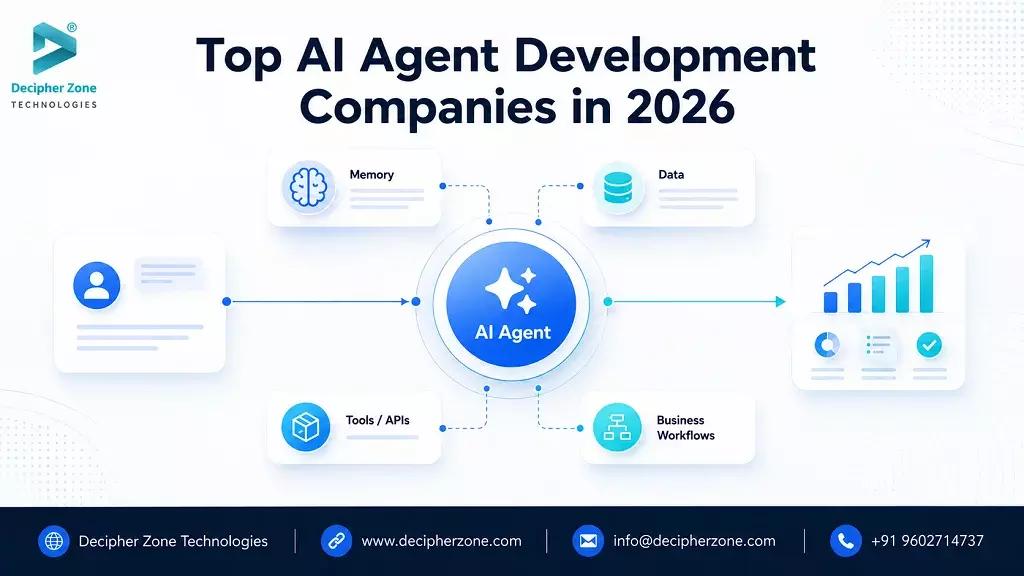
A practical AI agent architecture usually combines:
- Foundation models: Large language or multimodal models used for reasoning and generation.
- Instructions: System rules that define the agent's role and behavior.
- Memory or state: Context required to maintain a task across multiple steps.
- Tools: APIs, databases, applications and external services the agent can use.
- Knowledge: Enterprise documents, databases and other trusted information sources.
- Orchestration: Logic controlling how tasks, tools and agents interact.
- Guardrails: Controls that restrict unsafe or unauthorized behavior.
- Evaluation: Tests that measure whether the agent performs reliably.
- Observability: Monitoring for traces, errors, latency, usage and cost.

AI Agent vs AI Chatbot: What Is the Difference?
One of the most common mistakes when evaluating AI development companies is treating an AI chatbot and an AI agent as the same product.
| Capability | AI Chatbot | AI Agent |
|---|---|---|
| Primary purpose | Answer questions and generate responses | Complete goals and business workflows |
| Reasoning | Usually focused on response generation | Can plan and execute multiple steps |
| Tool usage | Often limited | Can call APIs, databases and business tools |
| Memory/state | Usually conversation-oriented | Can maintain task and workflow state |
| Actions | Primarily provides information | Can perform authorized actions |
| Human role | User generally drives each interaction | Human can supervise, approve or intervene |
| Workflow | Mostly conversational | Can execute multi-step workflows |
For example, a chatbot can answer:
"What is our refund policy?"
An AI agent could determine whether a customer qualifies for a refund, retrieve the relevant order, verify the policy, create a refund request, update the CRM, and escalate the case if an exception is detected.
That is the practical difference between an answer-generating interface and an action-oriented AI system.
Read more about AI agents vs AI chatbots.
Why Hire an AI Agent Development Company?
Building a working AI demo is not the same as building an AI agent that can safely operate inside a business.
A development company can help address the engineering layers surrounding the AI model, including:
- Business workflow discovery
- AI agent architecture
- LLM and model integration
- RAG and enterprise knowledge retrieval
- Tool calling and API integration
- Workflow orchestration
- Multi-agent architecture where appropriate
- Authentication and authorization
- Data protection and privacy controls
- Prompt-injection and misuse defenses
- Human-in-the-loop approvals
- Evaluation and regression testing
- Agent observability and tracing
- Token and infrastructure cost controls
- Production deployment and monitoring
- Post-launch maintenance and optimization

The right development partner should therefore be able to explain not only which AI model they will use, but also how the entire system will behave when the model is uncertain, an API fails, information is missing, a user attempts an unauthorized action, or the workflow produces an unexpected result.
How We Selected These AI Agent Development Companies
There is no universal ranking that can determine the best AI agent development company for every organization.
A startup building its first AI product may value flexibility and product engineering. A global bank may prioritize governance, security, integration, auditability and large-scale transformation.
We therefore evaluated the companies using a buyer-oriented framework.
| Evaluation Factor | What It Means |
|---|---|
| AI agent expertise | Experience designing systems that reason, use tools and execute defined workflows |
| Production experience | Evidence of moving beyond prototypes into real deployed software |
| Software engineering | Backend, APIs, databases, cloud, security and application engineering capability |
| Enterprise integration | Ability to connect agents with CRM, ERP, databases, APIs and internal systems |
| RAG and knowledge | Ability to ground agents in trusted business information |
| Security and governance | Identity, permissions, privacy, auditability, guardrails and compliance readiness |
| Evaluation | Ability to measure quality, task completion, tool use and regressions |
| Observability | Ability to monitor traces, errors, latency, usage and costs |
| Scalability | Ability to support increasing workflows, users and data volumes |
| Business fit | Suitability for startups, SMBs, enterprises and transformation programs |
One principle guided the evaluation: knowing an AI framework does not automatically mean a company can deliver a reliable production agent.
Frameworks change quickly. Production engineering fundamentals last much longer.
Top 10 Best AI Agent Development Companies in 2026
Here is the detailed list of top 10 best ai agent development companies for 2026.
1. Decipher Zone Technologies
Best for: Custom AI agents, AI-powered products, workflow automation, startups, SMBs and enterprises.
Decipher Zone Technologies is a software and AI engineering company that builds custom software, SaaS platforms, AI agents and enterprise systems.
Its AI agent development practice focuses on production-oriented systems rather than demo-only implementations. The company's current offering includes single-agent and multi-agent systems, LangGraph, AutoGen, CrewAI, OpenAI Agents SDK, MCP, tool calling, vector memory, evaluation harnesses, observability and human-in-the-loop workflows.
That combination is important for organizations where the agent must operate as part of an existing software ecosystem.
Typical applications include customer support automation, internal knowledge assistants, research workflows, sales operations, document intelligence, compliance workflows, code review, and business process automation.
Decipher Zone currently states that it has 40+ production agents shipped, 350+ builds across 35+ countries, and 11+ years of production software experience. Its website also identifies an ISO 9001-certified process.
The company follows an engineering-first approach in which AI agents are treated as software systems requiring architecture, integrations, evaluation, observability, security controls and ongoing maintenance.
Key strengths:
- Custom AI agent development
- Single-agent and multi-agent architectures
- RAG and enterprise knowledge retrieval
- Tool calling and API integration
- LangGraph, MCP and agent orchestration
- Evaluation and observability
- Human-in-the-loop workflows
- Full-stack and enterprise software engineering
- Project-based and dedicated development models
Potential fit: Companies that want one engineering partner to handle AI architecture, agent development, application integration, deployment and post-launch improvement.
Explore AI agent development services to review the company's capabilities and development approach.
2. Cognizant
Best for: Enterprise AI modernization and business-process automation.
Cognizant is a global technology and consulting company with capabilities spanning AI, cloud, data, application modernization and digital operations.
Its strength in the AI agent space is particularly relevant when organizations need to introduce intelligent automation into existing enterprise systems rather than build an isolated AI application.
Potential applications include customer operations, employee support, software engineering, data analysis, process automation and industry-specific workflows.
Key strengths:
- Enterprise AI consulting
- Business-process automation
- Cloud and application modernization
- Data and analytics
- AI-enabled customer operations
- Large-scale enterprise integration
Potential fit: Mid-sized and large enterprises with existing technology estates that need AI-driven modernization.
3. Accenture
Best for: Large enterprises pursuing organization-wide AI and digital transformation.
Accenture is one of the strongest options when AI agents are only one part of a larger transformation involving cloud, cybersecurity, data, application modernization and operating-model change.
The company's agentic AI work spans strategy, implementation, workflow transformation and enterprise deployment.
Its scale can be an advantage for organizations that need a global delivery model and coordinated transformation across multiple business units and geographies.
Key strengths:
- Enterprise AI strategy
- Agentic AI transformation
- Cloud modernization
- Responsible AI
- Enterprise automation
- Global systems integration
- Managed services
Potential fit: Fortune 500 and multinational organizations undertaking large-scale AI transformation programs.
4. IBM Consulting
Best for: Complex enterprise environments requiring AI governance, integration and hybrid-cloud capabilities.
IBM Consulting combines enterprise AI consulting, software engineering, hybrid cloud and the broader IBM watsonx ecosystem.
IBM's approach is particularly relevant to organizations that need agentic AI to work across existing infrastructure rather than forcing a complete technology replacement.
Its capabilities span AI strategy, AI governance, agentic workflows, automation, data and enterprise integration.
Key strengths:
- Enterprise AI transformation
- AI governance
- Hybrid and multi-cloud environments
- Agentic AI implementation
- Enterprise software integration
- AI infrastructure and platforms
Potential fit: Large organizations operating complex, regulated or hybrid technology environments.
5. Deloitte
Best for: Enterprise AI transformation, governance and operating-model redesign.
Deloitte approaches agentic AI from both a technology and business-transformation perspective.
Its capabilities include AI strategy, agentic AI implementation, workflow redesign, responsible AI, governance and enterprise transformation.
This is particularly important because autonomous software introduces governance questions that traditional conversational AI may not create.
Deloitte's research on agentic AI highlights the importance of governance maturity as organizations move agents into production.
Key strengths:
- Agentic AI strategy
- AI governance
- Responsible AI
- Business-process transformation
- Enterprise AI implementation
- Risk and compliance consulting
Potential fit: Enterprises where governance, risk management and operating-model transformation are as important as AI engineering.
6. Capgemini
Best for: Enterprises combining AI, cloud, data and operating-model transformation.
Capgemini works across consulting, technology services, cloud, data and enterprise transformation.
Its agentic AI positioning focuses on moving organizations from AI experimentation toward operational use cases while considering responsible AI, governance and human-agent collaboration.
This makes Capgemini relevant for businesses where agentic AI is part of a broader modernization strategy.
Key strengths:
- Enterprise AI transformation
- Responsible AI
- Cloud and data modernization
- Intelligent automation
- Enterprise integration
- Industry-specific technology solutions
Potential fit: Large organizations modernizing complex business operations, technology platforms and enterprise workflows.
7. ELEKS
Best for: Engineering-led AI and custom software development.
ELEKS is a global software engineering and technology services company with capabilities across custom software development, AI, data, cloud and enterprise solutions.
Its positioning makes it relevant for businesses that need AI capabilities combined with substantial software engineering and integration work.
For AI agent projects, this can be useful when the primary challenge is not simply building an agent but embedding it into an existing product, workflow or enterprise platform.
Key strengths:
- Custom software engineering
- AI and machine learning
- Enterprise application development
- Cloud engineering
- Data engineering
- Digital transformation
Potential fit: Organizations that need custom engineering depth alongside AI implementation.
8. TCS
Best for: Large enterprises requiring global delivery and industry-specific AI transformation.
Tata Consultancy Services (TCS) is one of the world's largest technology services companies, with extensive experience in enterprise transformation, cloud, data, automation and AI.
Its scale is particularly relevant for organizations that want to deploy AI across multiple business functions, geographies or legacy technology environments.
TCS has also been investing in agentic AI platforms and industry-specific applications, demonstrating a move from general-purpose AI services toward task-oriented enterprise agents.
Key strengths:
- Enterprise AI transformation
- Large-scale implementation
- Industry-specific AI solutions
- Cloud and data engineering
- Application modernization
- Global delivery capabilities
Potential fit: Large enterprises with complex technology environments and requirements for global implementation and support.
9. LeewayHertz
Best for: Enterprises looking for specialized AI engineering and generative AI development.
LeewayHertz is a technology development company with a strong focus on AI, blockchain and enterprise software.
Its AI portfolio includes generative AI applications, enterprise AI platforms and agentic AI systems designed to automate business workflows.
The company is particularly relevant when a project requires deeper AI engineering rather than a simple chatbot or basic API integration.
Its ZBrain platform and custom AI development capabilities make it a consideration for organizations looking to connect AI systems with enterprise data and business processes.
Key strengths:
- Generative AI development
- Enterprise AI applications
- Multi-agent systems
- AI workflow automation
- Custom LLM solutions
- Enterprise integrations
Potential fit: Enterprises with technically complex AI initiatives that require specialist AI engineering.
10. Markovate
Best for: Product teams building agentic capabilities into digital products.
Markovate focuses on AI-powered digital products and enterprise AI solutions, including agentic AI systems that can reason, plan and execute multi-step tasks.
The company positions its agentic AI work around business workflows, AI automation, enterprise integrations and secure deployment.
Its specialist positioning can make it attractive to organizations that want an AI-focused development partner without the scale and structure of a global consulting firm.
Key strengths:
- Agentic AI development
- Generative AI applications
- AI product engineering
- Enterprise AI integration
- Data and MLOps capabilities
- AI-powered workflow automation
Potential fit: Companies building AI-enabled products or embedding agentic capabilities into an existing digital platform.
AI Agent Development Companies Comparison
| Company | Rank | Best Fit | AI Agent Focus | Enterprise Integration | Engagement Style |
|---|---|---|---|---|---|
| Decipher Zone | 1 | Startups, SMBs, enterprises | Custom agents, RAG, multi-agent systems, workflow automation | Strong | Project / Dedicated Team |
| Cognizant | 2 | Enterprise modernization | AI automation, enterprise AI, digital operations | Very Strong | Consulting / Implementation |
| Accenture | 3 | Global enterprises | Agentic transformation, automation, responsible AI | Very Strong | Consulting / Managed Services |
| IBM Consulting | 4 | Complex enterprise environments | Agentic AI, governance, hybrid cloud | Very Strong | Consulting / Implementation |
| Deloitte | 5 | AI transformation and governance | Agentic AI, strategy, governance | Very Strong | Consulting / Implementation |
| Capgemini | 6 | Enterprise transformation | Agentic AI, responsible AI, cloud | Very Strong | Consulting / Transformation |
| ELEKS | 7 | Custom engineering | AI, ML, software engineering | Strong | Project / Dedicated Team |
| TCS | 8 | Large global enterprises | Enterprise AI, automation, agentic solutions | Very Strong | Consulting / Managed Services |
| LeewayHertz | 9 | Enterprise AI engineering | Generative AI, agents, multi-agent systems | Strong | Project / Dedicated Team |
| Markovate | 10 | AI-powered products | Agentic AI, generative AI, AI applications | Strong | Project |
How to Choose the Right AI Agent Development Company

The biggest mistake businesses make is choosing an AI development company based only on its technology stack.
A company can list GPT, Claude, Gemini, LangChain, CrewAI, MCP and vector databases on its website and still lack the engineering discipline required for production.
Instead, evaluate the partner across seven areas.
1. Start With the Business Problem
Before discussing models or frameworks, define the workflow you want to improve.
Ask:
- What task should the agent perform?
- What business outcome should improve?
- Which systems must it access?
- What decisions can it make autonomously?
- Which actions require approval?
- How will success be measured?
A good AI partner should help you determine whether an AI agent is even the right solution.
2. Ask for Production Evidence
Do not evaluate an AI company only from demos.
Ask for relevant examples of systems that have gone into production and, where possible, discuss:
- Scale
- Latency
- Reliability
- Integration complexity
- Security controls
- Monitoring
- Post-launch support
A prototype demonstrates possibility. Production demonstrates engineering maturity.
3. Examine Integration Capabilities
Enterprise agents rarely operate alone.
They may need to connect with:
- CRM systems
- ERP platforms
- Databases
- Document repositories
- Payment systems
- Internal APIs
- Ticketing platforms
- Communication tools
- Identity systems
Ask how the vendor handles authentication, authorization, retries, rate limits, API failures and auditability.
4. Evaluate Security Before Autonomy
The more actions an agent can take, the more important security becomes.
Look for:
- Least-privilege access
- Role-based permissions
- Authentication and authorization
- Secrets management
- Encryption
- PII handling
- Audit logs
- Tool-level authorization
- Prompt-injection defenses
- Human approval for sensitive actions
5. Ask How the Agent Is Evaluated
This is one of the most important questions to ask in 2026.
Agent behavior can change when the model, prompt, retrieval system, tools or business data change.
A mature development team should therefore use an evaluation strategy that can include:
- Golden datasets
- Task-completion tests
- Tool-use evaluation
- Regression testing
- Human review
- Quality scoring
- Safety testing
- Production feedback loops
6. Check Observability
When an agent fails, your engineering team should be able to determine what happened.
Ask whether the solution provides visibility into:
- Agent traces
- Model calls
- Tool calls
- Latency
- Token consumption
- Errors
- Retries
- Human escalations
- Task completion
Observability is not an optional dashboard. It is part of operating an agent reliably.
7. Clarify Ownership
Before signing a contract, clarify ownership of:
- Source code
- Prompts
- Agent configurations
- Evaluation suites
- Datasets
- Infrastructure configuration
- Documentation
- Deployment scripts
Your organization should know what it owns and how it can operate the system if the engagement ends.
How Much Does AI Agent Development Cost in 2026?
There is no universal price for AI agent development.
The cost depends more on workflow complexity, integrations, security, data and production requirements than on the conversational interface itself.
For early planning, organizations can use the following indicative ranges:
| Agent Type | Typical Scope | Indicative Cost |
|---|---|---|
| Simple task agent | One workflow, limited tools, basic knowledge retrieval | $15,000–$40,000 |
| Business workflow agent | Multiple APIs, RAG, business rules and monitoring | $40,000–$100,000 |
| Advanced enterprise agent | Multiple systems, security, evaluation and human approval | $100,000–$250,000+ |
| Multi-agent platform | Multiple specialized agents, orchestration and enterprise infrastructure | $200,000–$400,000+ |
These figures are planning ranges rather than fixed market prices. A project involving regulated data, multiple enterprise integrations, complex workflows, high availability and extensive evaluation can cost substantially more.
For a detailed breakdown, read AI Agent Development Cost in 2026.
How Long Does It Take to Build an AI Agent?

AI agent development timelines vary according to autonomy, integrations, data complexity, security requirements and testing depth.
| Development Stage | Typical Duration |
|---|---|
| Discovery and workflow definition | 1–2 weeks |
| Architecture and proof of concept | 2–4 weeks |
| MVP agent | 4–8 weeks |
| Production integration | 4–12+ weeks |
| Enterprise multi-agent platform | 3–6+ months |
A simple internal agent may therefore be launched in several weeks, while a production enterprise system connected to multiple applications may require several months.
The key is not simply how quickly the first demo appears. The better question is how quickly the system can become safe, measurable and reliable enough for real users.
What Can AI Agents Actually Do?
AI agents are most useful where a business process requires repeated interpretation, decision-making and action across one or more systems.
| Industry | Potential AI Agent Use Cases |
|---|---|
| Healthcare | Patient communication, scheduling, documentation, claims workflows and information retrieval |
| Financial Services | Compliance workflows, document analysis, customer operations, research and fraud operations |
| Retail & E-commerce | Product discovery, customer support, merchandising, inventory and order workflows |
| Manufacturing | Maintenance support, quality analysis, production workflows and supply-chain operations |
| Logistics | Shipment monitoring, exception handling, document processing and dispatch workflows |
| SaaS | Customer onboarding, support, analytics, account management and internal operations |
| Real Estate | Lead qualification, property research, document workflows and communication |
| Education | Student support, learning assistance and administrative workflows |
For healthcare-specific applications, read our guide to AI Agents for Healthcare.
AI Agent Technology Stack
A production agent is usually a combination of several technology layers.
| Layer | Examples |
|---|---|
| Foundation models | OpenAI, Anthropic, Google, Meta and other model providers |
| Agent orchestration | LangGraph, LangChain, CrewAI, OpenAI Agents SDK and custom orchestration |
| Knowledge and RAG | Embeddings, vector databases, semantic search and reranking |
| Data layer | PostgreSQL, vector databases, enterprise databases and document stores |
| Tool integration | REST APIs, GraphQL, MCP servers, ERP, CRM and internal applications |
| Security | Authentication, authorization, encryption, secrets management and audit logs |
| Evaluation | Golden datasets, automated testing, regression tests and human review |
| Observability | Tracing, logs, latency monitoring, cost monitoring and failure analysis |
| Infrastructure | AWS, Azure, Google Cloud, Kubernetes and enterprise deployment platforms |
The correct stack should be determined by the workflow. A good AI development company should be able to explain why a particular model, framework or architecture is appropriate instead of simply listing popular AI technologies.
Common Mistakes When Choosing an AI Agent Development Partner
1. Choosing the Cheapest Vendor
The lowest development quote can become expensive if the resulting agent has poor reliability, weak observability, excessive model usage or difficult maintenance requirements.
2. Confusing a Chatbot With an Agent
A conversational interface does not automatically make software agentic.
Ask what the system can actually do, not just what it can say.
3. Starting With Multi-Agent Architecture Too Early
Multiple agents are not automatically better than one well-designed agent.
Multi-agent systems can introduce additional latency, coordination complexity, failure modes and operating costs.
The best architecture is usually the simplest architecture that reliably solves the business problem.
4. Ignoring Evaluation
An agent that performs well during a controlled demonstration can behave differently when exposed to incomplete information, unexpected user requests and production data.
Evaluation should therefore be designed before production deployment.
5. Giving Agents Too Much Permission
An agent should not automatically receive access to every system available to an employee.
Permissions should follow the principle of least privilege, with sensitive actions protected by validation or human approval.
6. Ignoring Operational Costs
Agents may make multiple model and tool calls for a single business task.
Cost optimization should therefore be part of the architecture from the beginning.
7. Treating Launch as the Finish Line
Production is where agent engineering becomes a continuous process.
Models change, data changes, tools change and business rules change. Mature implementations require monitoring, evaluation, security review and ongoing optimization.
AI Agent Development Roadmap
A practical AI agent implementation can follow a staged approach.
- Identify the workflow: Select a process with measurable business value.
- Define the outcome: Decide what success means in business terms.
- Map data and systems: Identify the information and tools the agent requires.
- Define autonomy: Decide what the agent can recommend, execute and escalate.
- Design the architecture: Select models, retrieval, tools and orchestration.
- Build a focused MVP: Start with one workflow instead of automating everything.
- Add guardrails: Introduce permissions, validation and human approval.
- Evaluate: Test accuracy, task completion, tool use, safety and failure recovery.
- Deploy gradually: Release to a controlled group before broad adoption.
- Monitor: Track quality, latency, cost, failures and user outcomes.
- Expand: Add workflows once the initial agent demonstrates reliable value.
This approach reduces the risk of investing heavily in an impressive prototype that cannot operate reliably in production.
Production Readiness Checklist for AI Agents
Before an AI agent is released to real users, verify that the system has:
- Defined business objectives
- Documented agent responsibilities
- Controlled tool permissions
- Authentication and authorization
- Data protection controls
- Prompt-injection defenses
- Human escalation paths
- Automated evaluation
- Regression testing
- Observability and tracing
- Cost monitoring
- Error handling and retries
- Audit logging
- Rollback procedures
- Post-launch ownership
This is what separates an AI demo from a production AI system.
Why Production Engineering Matters More Than the AI Model
Foundation models continue to improve rapidly, but the model is only one component of an AI agent.
A reliable enterprise agent also depends on:
- The quality of the business data it can access
- The accuracy of retrieval
- The design of its tools
- The quality of workflow orchestration
- The boundaries placed around autonomous actions
- The quality of evaluation
- The observability available to engineers
- The reliability of connected enterprise systems
In other words, better models do not automatically create better agents.
The engineering around the model determines whether an agent can become dependable software.
Conclusion
AI agents are becoming an important layer of modern enterprise software, but adopting them successfully requires more than connecting an LLM to an application.
The strongest AI agent development companies understand the complete system: business workflows, AI models, tools, enterprise data, security, evaluation, observability, integrations and human oversight.
For startups, SMBs and companies building custom AI products, Decipher Zone offers a development-oriented option focused on custom AI agents and end-to-end software engineering.
For larger enterprise transformation programs, Cognizant, Accenture, IBM Consulting, Deloitte, Capgemini and TCS bring substantial consulting, integration and global delivery capabilities.
ELEKS is also worth considering when the project requires a strong combination of custom software engineering and AI capabilities.
LeewayHertz and Markovate remain relevant specialist options for organizations looking for focused AI engineering, generative AI development and agentic product capabilities.
Ultimately, the best AI agent development company is not necessarily the largest company or the one with the longest technology list.
It is the partner that can understand your workflow, design the right level of autonomy, integrate with your systems, protect your data, measure agent performance and support the software after it goes live.
Before signing a contract, ask every potential partner to walk you through the complete journey from use-case discovery → architecture → development → evaluation → security → deployment → monitoring → optimization.
That conversation will tell you far more about an AI development company's maturity than a framework checklist ever will.

Build Production-Ready AI Agents With Decipher Zone
Decipher Zone helps startups, SMBs and enterprises design and build production-oriented AI solutions, including custom AI agents, RAG applications, AI copilots, workflow automation and enterprise AI integrations.
Our approach covers discovery, architecture, AI development, system integration, evaluation, deployment, observability and ongoing optimization.
The objective is simple: build AI software that can create measurable business value in the real world, not just perform well in a demo.
Explore AI Agent Development Services or Talk to our AI engineering team about your use case.
Frequently Asked Questions
1. What is an AI agent development company?
An AI agent development company designs, develops and deploys software agents that can understand goals, retrieve information, use tools, make bounded decisions and execute business workflows. These companies typically combine foundation models with APIs, enterprise data, orchestration, security, evaluation and monitoring.
2. Which is the best AI agent development company in 2026?
There is no single best company for every project. Decipher Zone is a strong fit for custom AI agents and end-to-end software engineering. Cognizant and Accenture are strong candidates for enterprise AI modernization and large-scale transformation, while IBM Consulting, Deloitte, Capgemini and TCS bring substantial enterprise integration, governance and global delivery capabilities. ELEKS is relevant for engineering-led AI implementations, while LeewayHertz and Markovate are specialist options for AI engineering and AI-powered products.
3. How much does AI agent development cost in 2026?
AI agent development can range from approximately $15,000 for a simple single-workflow agent to $400,000 or more for a complex enterprise multi-agent platform. The final cost depends on integrations, data, security, workflow complexity, model usage, evaluation, infrastructure and post-launch requirements.
4. How long does it take to build an AI agent?
A simple AI agent may take a few weeks to develop. A production-ready enterprise agent with multiple integrations, security controls, evaluation and monitoring can take several months. The timeline depends on the complexity of the workflow and deployment environment.
5. What is the difference between an AI agent and an AI chatbot?
An AI chatbot primarily generates conversational responses, while an AI agent can pursue a defined goal by reasoning through steps, accessing tools and data, taking authorized actions and adapting its workflow based on results. Some modern applications combine both capabilities.
6. What technologies are used to build AI agents?
AI agents can use foundation models from providers such as OpenAI, Anthropic and Google, together with orchestration frameworks such as LangGraph, LangChain and CrewAI, retrieval systems, vector databases, APIs, MCP-based tool integration, cloud infrastructure, evaluation frameworks and observability platforms.
7. Should I build a single-agent or multi-agent system?
Start with the simplest architecture that can reliably solve the business problem. A single agent or structured workflow is often easier to test and operate. Multi-agent systems become useful when multiple specialized capabilities or independent responsibilities genuinely improve the workflow.
8. What should I ask an AI agent development company before hiring them?
Ask about production deployments, relevant case studies, architecture decisions, model strategy, integrations, security controls, evaluation methodology, observability, human-in-the-loop workflows, source-code ownership, deployment model and post-launch support.
9. Are AI agents secure enough for enterprise use?
AI agents can be deployed securely, but security must be designed into the architecture. Important controls include least-privilege access, identity management, tool authorization, data protection, prompt-injection defenses, audit logs, human approval and continuous monitoring.
10. Can AI agents integrate with existing enterprise software?
Yes. AI agents can interact with enterprise software through APIs, databases, workflow platforms, MCP servers and other controlled tool interfaces. The architecture should clearly define what the agent can read, what it can modify and which actions require human approval.
About the Author: Mahipal Nehra manages content at Decipher Zone Technologies and works closely with the AI engineering team across software and AI development initiatives. His work focuses on documenting AI and software development concepts, architecture decisions, development costs and practical implementation considerations for CTOs, product leaders and engineering teams.
Follow Decipher Zone on LinkedIn
AI Development Services | Generative AI Development | AI Agent Development | AI Chatbot Development | Data Analytics Solutions | Business Intelligence | Custom Software Development | Product Engineering | AI Agent Frameworks | AI Agent Architecture | AI Agent Development Cost