
Quick Summary
Building AI agent is one thing, building it securely is different. Some of you might see it as same. With AI agent development company, you can develop secure AI agent solutions tailored to your business needs. This guide highlights best practices, common security threats, Frameworks you should consider and deployment checklist.
Most enterprise security programs weren't built for software that makes its own decisions. They were built for applications that do what they're told, every time, in the same way. AI agents break that assumption.
Point one at a CRM, an email inbox, or a payments API and you've handed decision-making authority to a system that reasons probabilistically, chooses its own tools and can be talked into things a traditional application never could.
That gap between how agents actually behave and how most security stacks are designed to think is where almost every 2026 incident originates. Not exotic model attacks but misconfigured permissions, agents that could do more than they should and nobody watching closely enough to notice until it mattered.
This guide covers what's actually working for teams running agents in production: the threats worth taking seriously, the controls that hold up under real load and the frameworks (OWASP and NIST) that are becoming the de facto standard for how this gets audited.
Read: AI Agent Development Process
What Is AI Agent Security?
AI agent security is the practice of protecting AI agents, their data, tools, memory, identities, and decision-making processes from unauthorized access, malicious instructions, and unsafe actions. It combines identity controls, least-privilege access, secure tool use, monitoring, human oversight, and governance to keep agentic AI systems secure in production.
Why AI Agents Need a Different Security Model
A traditional app has a fixed set of code paths. You can specify what it's capable of doing, test each path and sign off. An AI agent doesn't work that way. It's given a goal and a toolbox such as database access, an email client, a code interpreter, a payments API and it decides at runtime which tools to use and in what order. Two agents given the identical prompt can take different paths to the same outcome.

That flexibility is the entire value proposition of agentic AI and it's also why bolting on a firewall or an identity provider doesn't fully solve the problem. A firewall has no opinion on whether an agent's decision was sound. An IAM policy can restrict what an agent is allowed to touch, but it can't tell you the agent was manipulated into using that access the wrong way.
Agents take instructions from a much wider surface than a human employee ever would like user prompts, retrieved documents, scraped web pages, API responses, long-term memory and any one of those channels can carry a hidden instruction an attacker planted there. That's the core mechanism behind indirect prompt injection and it's why agent security has to validate context, not just credentials.
Read: AI Agents vs AI Chatbots
AI Agent Security Risks in 2026: What the Data Shows
Three numbers are worth sitting with before you scope a security program especially in AI agents:
-
According to Gravitee, 88% of organizations reported an AI agent-related security incident in the past year, but only about one in five have real-time runtime visibility into what their agents are actually doing.
-
Half of enterprises confirmed a breach or disruption tied to an unauthorized or misconfigured agent within a six-month window and nearly eight in ten encountered some form of AI security issue in that same period.
-
The average AI agent-related data breach now runs into the millions of dollars and industry breach analyses put the figure at roughly $4.7 million once cleanup, downtime and regulatory exposure are factored in.
Agent fleets are roughly doubling every few quarters inside large organizations, while the identity, monitoring and audit controls needed to keep them accountable are lagging well behind.
Common AI Agent Security Threats and Risks
Here is the list of threats that majorly attack and stole the data:
|
Threat category |
What it looks like in practice |
|
Agent Goal Hijack |
A hidden instruction inside a document, email, or web page redirects what the agent is actually trying to accomplish |
|
Identity & Privilege Abuse |
An agent operates under credentials broader than the task requires, or multiple agents share a single identity |
|
Tool & Excessive Agency Abuse |
An over-permissioned agent uses a connected API, database, or cloud resource in a way no human ever approved |
|
Memory Poisoning |
Long-term memory is manipulated so the agent's future decisions are quietly compromised |
|
Cascading Failures |
One compromised agent passes bad instructions to other agents it collaborates with, multiplying the blast radius |
|
Rogue Agents |
An agent drifts from its intended behavior over time and starts acting in ways that technically look authorized but clearly aren't |
AI Agent Security Architecture: Key Security Layers
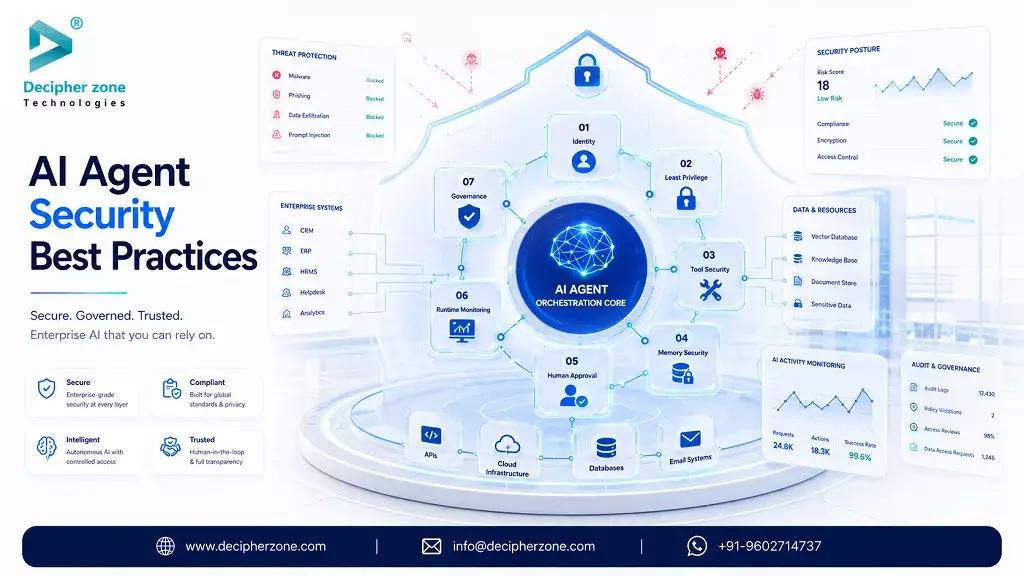
A secure AI agent architecture protects every layer of the agent lifecycle. Key security layers include identity, permissions, the agent and model, memory, tools and APIs, data, monitoring, and governance. Together, these controls help prevent unauthorized actions, protect sensitive information, detect abnormal behavior, and maintain secure enterprise AI operations.
Identity → Permissions → Agent/Model → Memory → Tools/APIs → Data → Monitoring → Governance
AI Agent Security Best Practices: 8 Essential Security Controls

1. Treat every agent as an identity
Give each agent its own credential, its own audit trail and clear ownership, the same way you'd onboard an employee. Never let agents share a human's login or a static API key. Gravitee's data found that only about 22% of organizations currently manage agents this way, which is a large part of why incident response is so slow when something goes wrong.
2. Default to least privilege
- Make it boring to enforce.
- Separate read from write.
- Scope API credentials narrowly.
- Use short-lived, expiring tokens instead of long-lived secrets.
If an agent only needs to read a calendar, it should be structurally incapable of deleting an event, not just discouraged from doing so by a prompt.
3. Put a human in the loop for anything irreversible
Payments, account deletions, production deploys, contract approvals, medical or legal decisions, these should require explicit sign-off, no matter how confident the agent is. Autonomy is valuable for the 95% of low-stakes actions; it's a liability for the 5% that can't be undone.
4. Isolate execution
Any time an agent runs generated code or touches an external system, do it inside a sandbox — containerized, network-restricted, resource-capped. If the agent is compromised, the blast radius stops at the sandbox wall instead of reaching production infrastructure.
5. Secure memory the way you'd secure a database
Encrypt persistent memory, isolate it per user or per tenant, strip sensitive data where it isn't needed and periodically check stored context for signs of manipulation. Memory is what gives agents their usefulness over time, it's also what gives an attacker persistence if it's poisoned.
6. Validate at the tool boundary
Every connected tool or API should enforce its own authorization and input validation rather than trusting that the agent will behave. Schema validation, permission checks and rate limits belong on the tool side, because the agent is the least trustworthy part of the chain by design.
7. Monitor behavior
Traditional application monitoring watches for crashes and latency spikes. Agent monitoring needs to watch for behavioral drift: unusual tool-call sequences, repeated permission requests, abnormal data access patterns.
8. Red-team before launch
Prompt injection resistance, tool-misuse attempts and privilege-escalation paths should be tested the same way you'd pen-test a new API, before it ships and again every time the agent's tools, prompts, or knowledge sources change.
Read: Best Frameworks for Building AI Agents in 2026
How to Secure an AI Agent: A Practical Approach
Securing an AI agent requires protection across its entire lifecycle. Start by identifying sensitive data and actions, then limit permissions using least privilege. Secure tools and APIs, protect agent memory, monitor behavior and runtime activity, test against realistic threats, and apply continuous governance and human approval where needed.
Identify → Limit Access → Secure Tools → Protect Memory → Monitor → Test → Govern
AI Agent Security Frameworks: OWASP and NIST
You don't have to design agent security from scratch. Two bodies of work are becoming the reference points enterprise teams cite in audits and vendor reviews:

1. OWASP Top 10 for Agentic Applications (2026)
Built on OWASP's earlier LLM Top 10 and its broader Agentic Security Initiative threat taxonomy, this is the most current, practitioner-driven map of what's actually breaking in production agent deployments — goal hijacking, identity abuse, tool misuse and rogue-agent behavior chief among them. Treat it as the checklist your threat model gets measured against.
2. NIST's AI agent and risk-management guidance
NIST has been extending its AI Risk Management Framework specifically toward agent identity, authorization and delegation — adapting proven cybersecurity discipline rather than replacing it. If your organization already runs a NIST-aligned security program, this is the natural extension point rather than a parallel process.
Neither framework replaces your existing security stack. Both assume Zero Trust principles, strong identity and continuous monitoring are already in place and layer agent-specific controls on top.
Read: AI Agent Architecture
AI Agent Security Checklist for Enterprise Deployment
Before any agent reaches production, confirm:
-
A unique, auditable identity for the agent, no shared credentials.
-
Scoped, least-privilege permissions with short-lived tokens.
-
Human approval required for high-impact or irreversible actions.
-
Sandboxed, network-restricted execution environment.
-
Encrypted, isolated and periodically validated memory.
-
Independent authorization checks at every connected tool or API.
-
Behavioral monitoring and structured logging of every tool call.
-
A documented incident response path specific to agent misuse.
-
A red-team pass completed within the last release cycle.
If more than two or three of these are missing, that's not a reason to slow down deployment, it's a reason to fix the gap before the agent touches anything with real-world consequences.
In regulated industries like healthcare and finance, several of these human sign-off, audit trails, encrypted memory, aren't optional; they're what a compliance review will ask for first.
How to Build Secure AI Agents for Enterprise Use
Decipher Zone is a software and AI development company that's been shipping production systems since 2015. Our AI agent development team builds on LangGraph, AutoGen, CrewAI, the OpenAI Agents SDK and Anthropic's MCP and every engagement is scoped by senior engineers.

On the security side, that means the practices covered in this guide aren't theoretical for us. We scope agent identity and least-privilege access before a single tool gets connected, sandbox execution by default and build human-approval checkpoints into any workflow that touches payments, records, or production systems, whether we're building a single internal copilot or a multi-agent system spanning several enterprise tools.
We've applied this same discipline across healthcare, fintech and enterprise SaaS clients, where audit trails and access control aren't optional extras.
If you're evaluating a new agent build, or want a second set of eyes on one already in production, we offer a free Agent Workflow Audit, no sales call, no pitch deck.
Read: How to Choose an AI Agent Development Company
How to Secure AI Agents for Production
AI agents represent one of the most significant shifts in enterprise software since cloud computing. Their ability to reason, plan and act autonomously creates enormous productivity gains, but it also demands a fundamentally stronger security posture.
Organizations can no longer rely solely on conventional cybersecurity controls. Instead, they must combine Zero Trust principles, least privilege, identity management, runtime monitoring, human oversight and AI-specific safeguards into a unified security strategy.

The good news is that industry guidance is rapidly maturing. Frameworks from OWASP and NIST provide practical recommendations that organizations can implement today.
Businesses that embed security into every stage of AI agent development from design through deployment and continuous monitoring will be better positioned to unlock the benefits of autonomous AI while minimizing operational, financial and reputational risks.
Partner with us to develop a secure AI agent tailored to your business needs. Our goal is to help you improve efficiency, connect better with customers and grow with confidence.
AI Agent Security FAQs
1. What is AI agent security?
AI agent security is the practice of protecting autonomous AI systems from attacks, misuse, unauthorized access and unsafe behaviors while ensuring they operate within defined permissions and governance policies.
2. What is the biggest security risk for AI agents?
Prompt injection, excessive permissions, insecure tool access, memory poisoning and data leakage are among the most significant threats facing modern AI agents.
3. Why is least privilege important for AI agents?
Least privilege limits the resources an AI agent can access, reducing the impact if the agent is compromised or manipulated.
4. Which security frameworks should organizations follow?
The OWASP Agentic Security Initiative, OWASP AI Agent Security Cheat Sheet and NIST AI Agent Standards Initiative are among the most comprehensive resources currently available.
5. Can AI agents be completely secure?
No system is perfectly secure. The goal is to reduce risk through layered defenses, continuous monitoring, regular testing, strong governance and rapid incident response.
About the Author: Mahipal Nehra manages content at Decipher Zone Technologies and works closely with the AI engineering team across live project delivery. He has spent the last six years documenting real AI and software development projects cost structures, architecture decisions, client outcomes for an audience of CTOs, product leads, and engineering managers. Follow on LinkedIn.
AI Development Services | Generative AI Development | AI Agent Development | Custom AI Solutions | AI Chatbot Development | Machine Learning Solutions | Data Analytics Solutions | Business Intelligence Applications | MLOps Services | AI Consulting | Custom Software Development | Web App Development | Mobile App Development | SaaS Development | E-commerce Development | Enterprise Software Development | Cloud Application Development | UI/UX Design | Full Stack Developers | Product Engineering | Software Modernization | API Development | QA & Support